SKILL 營運解題 · MK-038
Which Step Should Customers Take After Reading Your Page?
What a page should ask a customer to do next depends on the task they are currently trying to finish, the information they already have on hand, and what the company can actually fulfill. Once task branches align with fulfillment capacity, the change creates more profit against your current baseline only when it yields a positive actual net gain—meaning billable handling fees actually avoided plus the change in net contribution from completed orders (after cancellations and refunds), minus other new handling fees, exceed the cost of making the adjustment. Across any context, start by routing visitors by task and readiness, asking a single question when readiness is unclear so ready buyers can check out directly while others get the content needed to complete their immediate task. Before launch, test every destination page and internal handoff on a phone to confirm the page holds the promised answer, staff can fulfill the request, and tracking logs clicks, submissions, completed service, and net completed orders separately, then put handling invoices and order net contribution on the same sheet to evaluate results. It is known that only billable items disappearing from an invoice count as cash savings while fixed salaries or flat monthly plans save available time; actual fee reductions, order changes, and attribution remain unknown until verified against real invoices and comparable or control data.

Chia-ying, who runs marketing for a furniture store, spread this month’s callback statement from their partner customer-service team across her desk and checked it line by line. The partner team billed NT$100 for every completed delivery-assessment callback referred through the store’s booking form. Halfway through counting, she stopped. A-Zhe, the in-house customer-service rep who sorts the referral list, looked over and said, “In that batch, some people just want the measuring steps for now. Others are actually ready to place an order right away.”
What a page should ask a customer to do next depends on the task they are currently trying to finish, the information they already have on hand, and what the company can actually fulfill.[1] A customer with an informational need can read the guide on the page or print the measuring checklist to take back to the site. A customer comparing two models needs to see the specifications and carrying conditions side by side. A customer with a transactional need—whose sofa model, home dimensions, and delivery conditions are all confirmed—should go straight to the existing order entry. Someone who has already measured their space and needs a specialist to check the delivery route should send those dimensions to the staff who handle assessments. A navigational inquiry should land directly on the specific page requested. These are task branches: customers can enter whichever branch matches their current situation without being forced to walk through four sequential stages before they are allowed to buy. When a customer’s available information or readiness is still unclear, treat their intent as unresolved and ask one question that separates the possible next steps.
Once those task branches are arranged, compare the callback fees actually avoided against any change in net contribution from completed orders, then subtract the new cost of making the adjustment to decide whether the work is worth funding. The general formula is:
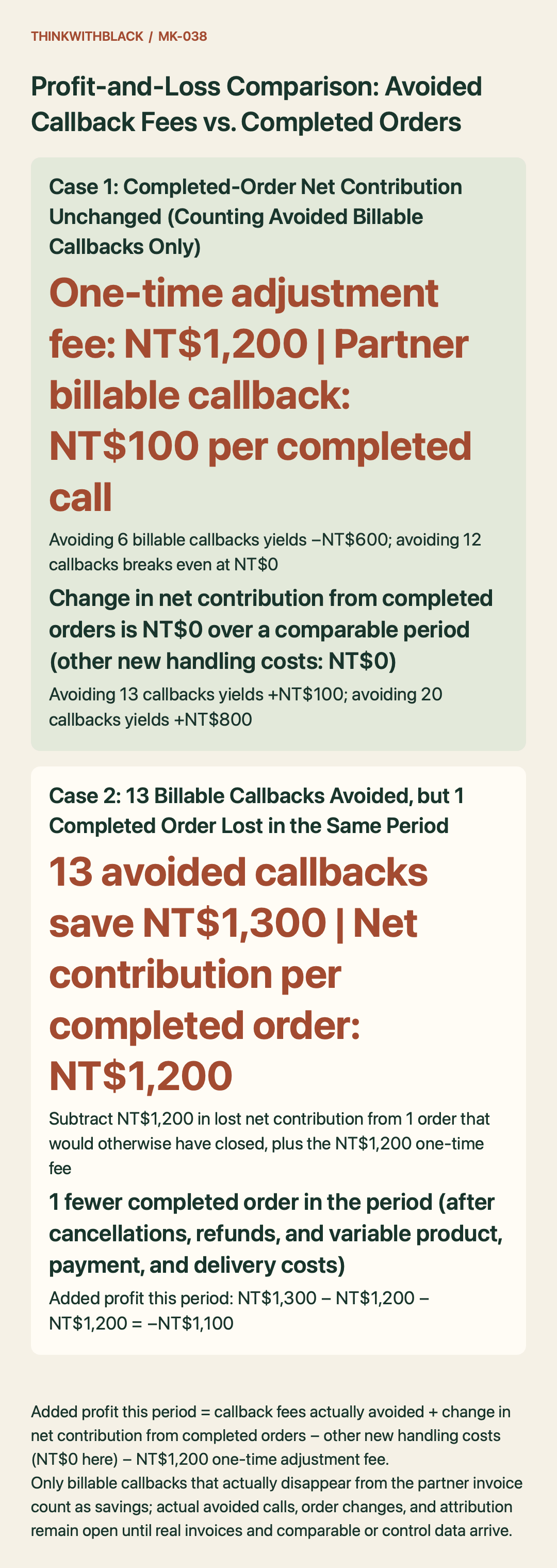
Added profit this period = callback fees actually avoided + change in net contribution from completed orders − other new handling costs − the one-time adjustment fee of NT$1,200
Using this round’s one-time adjustment fee of NT$1,200, a unit charge of NT$100 per completed and otherwise billable referral callback, and a net contribution of NT$1,200 per completed order (after cancellations, refunds, and per-order variable costs for product, payment processing, and delivery, but before this round’s one-time fee), the thresholds are straightforward. When other new handling costs are zero and net contribution from completed orders remains unchanged, avoiding 6 billable callbacks yields −NT$600, avoiding 12 breaks even at NT$0, avoiding 13 yields +NT$100, and avoiding 20 yields +NT$800. If you avoid 13 billable callbacks during the period but lose one completed order that would otherwise have closed, the net result becomes NT$1,300 − NT$1,200 − NT$1,200 = −NT$1,100.
Only billable callbacks that actually disappear from the partner customer-service invoice count as cost savings. If callbacks are handled by salaried staff or under a fixed monthly retainer, fewer calls free up staff time rather than reducing cash outlay, and the two must be accounted for separately. Shared expenses already spent in the previous two rounds form the existing baseline and are not deducted again here. The true number of avoided callbacks, any change in order volume, and whether those shifts can be attributed to this adjustment all remain open until actual invoices and reliable comparable or control data come in. The sections below follow Chia-ying’s statement and the customers’ own words to work through the branch design, fulfillment checks, and profit-and-loss calculation from start to finish.
One button carrying four different tasks
After filling in the delivery page’s measuring instructions and form and verifying that the submission flow worked internally, Chia-ying turned to the next round of call-to-action buttons and the partner customer-service bill. The earlier question of whether to spend NT$6,000 building a separate assessment page—along with the information gaps that remained unverified—still awaits evidence under the conditions set in the previous round. Her immediate task is narrower: decide what the live, working delivery page should ask readers to do once they finish reading a section.
After checking the invoice, Chia-ying opened the existing delivery page on her phone and walked through it herself. The measuring guide was there. The product dimensions were there. The form and receiving inbox both worked, and the delivery team confirmed they had received her test submission. Reaching the bottom of the page, she saw the bottleneck: regardless of which section a visitor had just read, every primary button on the page pointed to the same “Book a delivery assessment” form.
She had already tried tweaking that button. In an earlier pass, she rewrote the label to make it stand out and moved the entry point higher up the page. Even after those edits, A-Zhe still had to go through the referral list by hand, entry by entry, to figure out whether each person wanted measuring instructions, a comparison between two sofas, or a way to pay. Figuring out why visitors with completely different tasks all ended up submitting the same form required checking their verbatim messages alongside the paths they took; button click counts alone cannot tell you what a customer originally set out to finish. When a single button catches both the person who has not measured their stairwell yet and the person with a credit card ready, everyone gets funneled into the same paid callback queue.
A-Zhe pulled several recent customer records and had Chia-ying trace each task against the live page.
The first was Customer A, who wrote in the form notes: “I haven’t measured at home yet. I just want to know which part of the corner to measure.” The immediate task is explicit: Customer A needs a set of measuring steps to take home and use on site. With no dimensions in hand, this shopper is nowhere near needing a specialist to evaluate carrying clearances. Sending Customer A to the booking form forces them into required dimension fields they cannot fill out, and when the partner rep calls back, all they can do is explain how to use a tape measure over the phone. The reasonable next step is to let Customer A view or print the measuring instructions already on the delivery page.
The second was Customer B, who had picked a sofa model, measured the home clearances, and verified the delivery zone and floor rules. Customer B asked: “Can I order right now?” Every prerequisite for a transaction is met; the task is to buy. Routing Customer B into a delivery-assessment form forces a ready buyer to take a detour and wait in line for a phone call. The next step here should lead straight to the existing product order entry.
A third customer had two model numbers written down and wanted to see how the two sofas differed in overall width and carrying requirements. That shopper is comparing options and needs the existing product specifications and delivery notes placed side by side to decide which sofa fits. Asking them to submit an assessment booking form skips the comparison they are trying to complete.
A fourth case is the shopper who has already measured the stairwell width, corner depth, and elevator door, and needs the company to confirm whether a large sofa can make the turn upstairs. For this person, the existing “Book a delivery assessment” callback is an exact fit—provided the button clearly states that the form is for submitting measured dimensions for a route evaluation. Finally, when a customer leaves a message that is too brief to show what they have prepared, the next step is to ask one question that separates those paths and route them once they answer.
Looking at these cases side by side made the next move clear. Beyond button color or placement, the real adjustment is separating the task branches behind the buttons. A next step should continue the customer’s current search intent: informational visitors get help understanding the task, comparison visitors get a side-by-side breakdown, and transactional visitors go straight to purchasing or booking.[1] Auditing how a page connects to its actions also means checking two failure modes: asking the customer to jump too far ahead, or forcing a customer who is already prepared to keep circling.[1] Used this way, a marketing funnel is not a rigid four-stage track every buyer must march through in sequence, but a diagnostic tool for checking whether the company can actually catch customers at each level of readiness.[1]
Three steps to turn next-step design into a seven-column handoff table
With the bottleneck identified, Chia-ying and A-Zhe kept the existing measuring guide, product data, assessment form, and checkout entry intact, and reconnected the post-reading actions using the three steps of reasonable next-step design:[1][2]
- Continue the current search intent and task. Identify whether the reader is figuring out how to measure, comparing specific models, or ready to complete an order, and let the action button after each section carry that specific task forward.[1][2]
- Check whether the action jumps too far ahead or makes a ready buyer circle. Verify that the button does not demand form fields from someone who has no measurements yet, or force someone whose model and delivery conditions are confirmed to wait for an assessment call.[1][2]
- Confirm the company can actually fulfill the promise. Separate what the customer is willing to click from what the company can actually catch and deliver.[1] The destination page must contain the promised information, the receiving staff must have the capacity and criteria to handle the request, and the system must record evidence that the step was completed.[2]
Two interface and landing-page standards help keep those branches unambiguous in practice. First, the promise made in an ad, a page section, and its call-to-action button should match the destination page so visitors can actually finish the action they clicked for.[3] Second, button copy should state the specific action that happens next, while visual hierarchy distinguishes the primary action of a section from secondary paths.[4] For a retail page that serves multiple intents, the direct purchase entry stays consistently accessible for ready buyers, while visitors who still need to measure or compare models get clearly labeled branch buttons for those tasks.
Chia-ying combined the three design steps and the method’s eight required delivery elements—goal, target audience/task, solution and action, evidence versus assumption, prerequisites, existing resources, deliverables and acceptance criteria, and open questions—into a single seven-column handoff table she could share directly with A-Zhe and the person maintaining the website.[2] Built around the operational goal of cutting unnecessary billable callbacks while protecting the direct checkout path, the table keeps verbatim customer quotes (evidence) distinct from task classifications (assumptions):
| Customer’s own words | Current task / readiness | Primary next step and button text | Actual destination page / owner | What the company can deliver | Evidence the path was tested | Open questions |
|---|---|---|---|---|---|---|
| Customer A: “I haven’t measured at home yet. I just want to know which part of the corner to measure.” | Understand how to measure; no home dimensions on hand yet | View or print the measuring steps / “View or print corner measuring instructions” | Existing measuring section on the delivery page | Existing diagrams and dimension record sheet already explain corner measuring and can be read on screen or printed | On a phone, tapping opens the measuring section directly and the browser print view renders the full guide | Whether the customer measures on site after printing and returns to order |
| “I have two model numbers and want to see the difference in width and carrying conditions.” | Compare two sofas; model numbers chosen, checking which one fits through the entry | Compare product specs and delivery notes / “Compare width and carrying conditions for both models” | Existing product specification block and delivery conditions section | Overall width, assembled and disassembled dimensions, and stairwell turn limits for both sofas already exist and can be displayed side by side | On a phone screen, both sofas’ dimensions and carrying rules can be compared in one view by scrolling | Whether reading the side-by-side comparison is enough to pick a model without calling |
| Customer B: model selected, dimensions ready, delivery rules checked, asks “Can I order right now?” | Complete the purchase; model, dimensions, and delivery prerequisites all satisfied | Go straight to checkout / “Dimensions confirmed—go to order” | Existing product page order and checkout entry | Current shopping cart, payment gateway, and standard delivery scheduling can fulfill the order directly | Walked through model selection, delivery address entry, and payment screen on a phone | Number of orders actually paid and retained after cancellations and refunds |
| Has measured stairwell and corner clearances; needs confirmation that a large sofa can be carried upstairs | Request a specialist carrying assessment; on-site dimensions and target model ready | Submit dimensions for evaluation / “Send dimensions to schedule a carrying-assessment callback” | Existing delivery-assessment form; A-Zhe sorts submissions and refers them to partner customer service and the delivery crew | Partner customer service and the delivery team can evaluate clearances and carrying routes from the submitted numbers and call back | Test form submission reached the back end; referral list tag and callback completion log are intact | Change in completed, billable assessment callbacks during this period |
| Left a brief note such as “want to ask about sofa delivery”; available dimensions and readiness unclear | Intent unresolved; not enough information to assign a task branch | Ask one question to separate the next steps / “Tell customer service what info you have to get the right link” | Existing customer-service chat or message channel, handled by A-Zhe using a neutral confirmation question | Route the customer based on their reply to the measuring guide, the two-model comparison, the assessment form, or the order page | Support log records the customer’s verbatim reply and the specific branch URL sent | True distribution of tasks after replies and their downstream conversion rates |
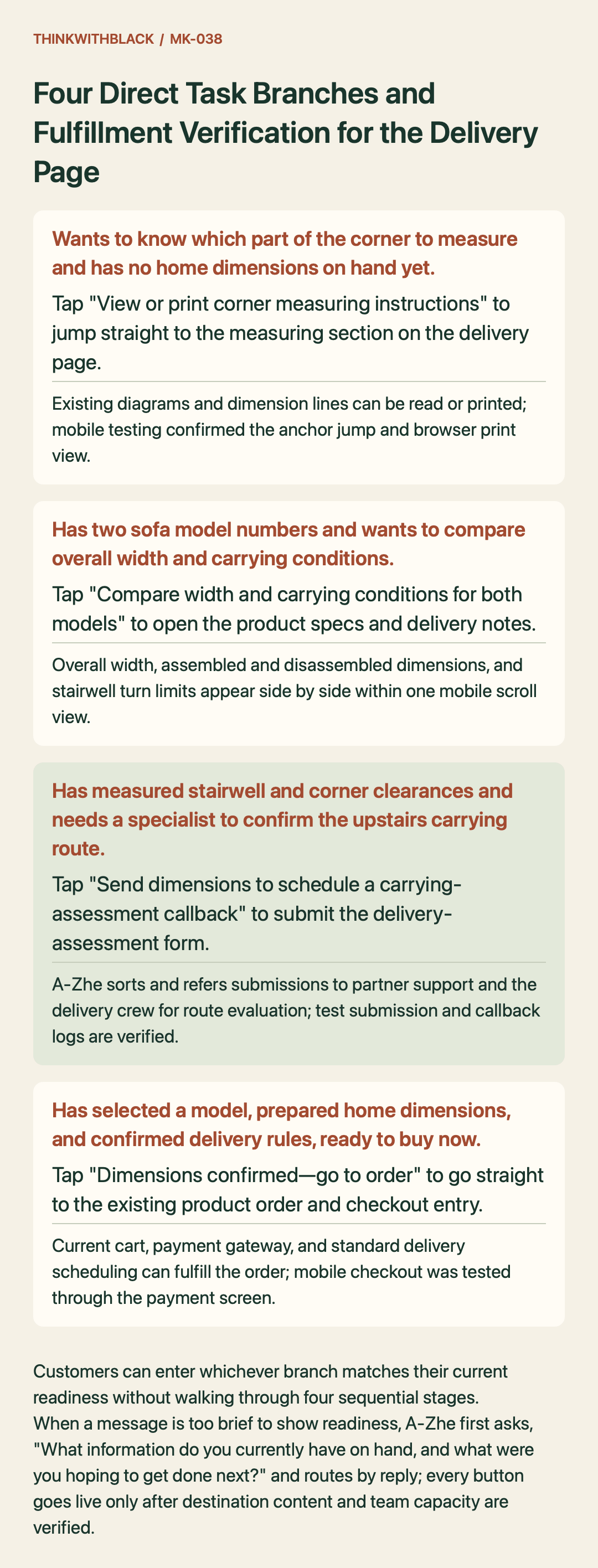
Putting the plan into one table aligns who each button serves, where the link goes, who catches the request internally, and what counts as a verified pass before anyone edits a line of page layout. The “Open questions” column on the far right marks the exact operational metrics to audit once the changes go live.
Verify that the team can catch the request before publishing the buttons
With the seven-column table drafted, Chia-ying picked up her phone and tested all five branches from start to finish.
She tapped “View or print corner measuring instructions” first, confirming that the anchor link jumped straight to the measuring section of the delivery page. The diagrams and blank measurement lines for stairwell corners, elevator door width, and entryway depth were legible on a mobile screen, and triggering the phone browser’s print function cleanly formatted the existing guide. Next, she tested the comparison path: placing the existing product specification block next to the delivery notes kept overall width, detached dimensions, and stairwell turn thresholds within a single mobile viewport so a reader could compare two model numbers by scrolling.
Then she walked Customer B’s direct checkout path. Tapping “Dimensions confirmed—go to order” on the delivery page took her straight to the existing product order entry, where she selected the sofa configuration, filled in a delivery address, and advanced to the payment confirmation screen. The high-intent buying path worked end to end without forcing the shopper into an assessment form. Finally, she submitted a test entry through “Send dimensions to schedule a carrying-assessment callback” and verified with A-Zhe and the delivery crew that the back end captured every dimension field and flagged the record as a ready-dimensions route evaluation.
Whenever a button leads to a destination page that still lacks the promised explanation—or when internal staff cannot actually perform the evaluation the button implies—the button label and destination page must be scaled back to what the company can currently supply so that the prompt and the fulfillment match.[1][3]
For brief messages where a customer’s readiness cannot be determined up front, Chia-ying and A-Zhe agreed that customer service will respond first with a single neutral, open confirmation question:
“What information do you currently have on hand, and what were you hoping to get done next?”
Once the customer replies in their own words, A-Zhe routes them according to the table:
- Has not measured yet and wants to know how: send the direct link to view or print the delivery page’s measuring section.
- Comparing two specific models on width and carrying clearances: send the side-by-side product specifications and delivery conditions view.
- Has measured the space and needs the stairwell or elevator route checked: send the delivery-assessment form.
- Has confirmed the sofa model, home dimensions, and delivery rules: send the direct product order entry.
They also separated their tracking indicators so one metric would not be mistaken for another. A button click only proves someone tapped an entry point. A successful form submission proves the customer’s data reached the company’s system, while a logged customer-service reply proves a staff member picked up and handled the inquiry, and a callback completion record proves the assessment service was carried out. An actual sale is counted only as a net completed order after payment finishes and cancellations and refunds are deducted. Tracking clicks, form submissions, staff replies, completed assessment callbacks, and net completed orders each by their own evidence shows which task branch actually helped customers finish what they came to do.
Before publishing the updated buttons, run through this three-step pre-launch checklist:
Does this round pay for itself? Check the callback bill and completed orders together
Once every branch passed mobile testing, Chia-ying returned to the partner customer-service invoice on her desk. Reorganizing the page’s action buttons serves two concrete operational goals: stop paying NT$100 referral callback fees for visitors who only want measuring guides or spec comparisons, and keep ready buyers like Customer B moving smoothly into the checkout entry.
Determining whether this round of changes pays off financially requires putting handling costs and order contributions into the same equation:
- One-time adjustment fee: NT$1,200 (covers button branch edits, checklist entry adjustments, and internal handoff setup; shared costs already spent in the previous two articles are part of the baseline and are not deducted again)
- Partner callback unit cost: NT$100 per call (counted only for completed delivery-assessment callbacks that were referred from the booking form and billed on the partner invoice)
- Net contribution per completed order: NT$1,200 (after deducting cancellations, refunds, and per-order variable costs for product, payment processing, and delivery, prior to deducting this round’s NT$1,200 one-time fee)
- General profit formula:
Added profit this period = callback fees actually avoided + change in net contribution from completed orders − other new handling costs − the one-time adjustment fee of NT$1,200
First, examine the cost-reduction baseline where other new handling costs are zero and net contribution from completed orders remains unchanged over a comparable period, counting only billable callbacks actually avoided:
- 6 billable callbacks avoided: NT$600 saved − NT$1,200 = −NT$600 (has not yet broken even)
- 12 billable callbacks avoided: NT$1,200 saved − NT$1,200 = NT$0 (exact break-even threshold)
- 13 billable callbacks avoided: NT$1,300 saved − NT$1,200 = +NT$100 (begins generating net gain)
- 20 billable callbacks avoided: NT$2,000 saved − NT$1,200 = +NT$800
Second, bring changes in completed orders into the same calculation. Suppose other new handling costs are zero and the partner customer-service invoice shows 13 fewer billable callbacks during the period, but the store also loses one completed order that would otherwise have closed under the same comparison baseline:
- 13 billable callbacks avoided, but 1 completed order lost: NT$1,300 saved − NT$1,200 lost order contribution − NT$1,200 one-time fee = −NT$1,100
Conversely, if other new handling costs are zero and keeping a clear direct-order entry allows ready buyers to complete just one additional order during the period, then even with only 6 avoided callbacks the added profit becomes NT$600 + NT$1,200 − NT$1,200 = +NT$600.
These thresholds establish three operating rules for reviewing the adjustment after launch:
- Count cost savings strictly from billable callbacks that disappear from the invoice. Compare against an equivalent period under the exact same billing definition—completed referrals from the booking form that would otherwise have been charged. A drop in button clicks alone, or shifting the same inquiry from the booking form to another paid support channel, does not reduce cash expenses. If your team handles callbacks in-house on fixed salaries or through a flat monthly software plan, reducing unnecessary calls frees up staff capacity; check your actual vendor contract to see whether cash payout changes, and book a cost reduction only when cash spend actually drops.
- Audit the callback bill and high-intent checkout orders on the same sheet. Losing a single completed order worth NT$1,200 in net contribution wipes out the savings from 12 avoided NT$100 callbacks. A drop in callback volume is never an unconditional win on its own; keep the high-intent purchase entry open and review completed-order contribution alongside the support invoice.
- Verify actual outcomes against real invoices and comparable baselines. After the new branches go live, Chia-ying and A-Zhe must plug in the next period’s actual partner customer-service statement and completed-order count from a comparable timeframe or control baseline. Order volume shifts require reliable comparable or control data before they can be attributed to the button changes; until that evidence is in, before-and-after differences remain observations to be verified.
Pull one live page and one customer message to make your decision
You can run this exact check on your own site right now. Open one live page that already receives traffic and contains working content, pull one recent verbatim customer inquiry from your form logs or support inbox, and walk through the same three actions Chia-ying and A-Zhe used:
- Fill out the Next-Step Design table. Paste the customer’s exact words into the first column, note the task they are currently trying to finish and the information they already have on hand, pick one primary next-step button label along with the secondary entries that must remain visible (such as the direct checkout link for ready buyers), and record the live destination URL, internal owner, and completion evidence.
- Test every branch on a phone against the three-step checklist. Tap through each branch entry on a mobile device to confirm that it matches the customer’s readiness without forcing a premature form or a detour, that the direct buying entry stays unobstructed, and that the destination page and internal team can actually deliver what the button promises.
- Run your numbers in the cost and order-contribution worksheet. In the worksheet, enter the billable callbacks actually avoided in
B2, the NT$100 per-callback unit price inB3, this round’s one-time adjustment fee of NT$1,200 inB4(deducted once), any other new handling costs inB5, and the total change in net contribution from completed orders over a comparable period inB6, soB7 = B2 * B3 + B6 - B5 - B4calculates your added profit for the period. The NT$1,200 net contribution per completed order (after cancellations, refunds, and variable costs) is the parameter used to calculate the total change inB6: enter0inB6when completed-order net contribution is unchanged (for example, 13 avoided callbacks with0inB5and0inB6yields+NT$100inB7), enter-1200if you lose one order, or enter+1200if you gain one order, then set a calendar date to audit the actual invoice and reliable comparable data.
The three English CSV worksheets used in this walkthrough and the complete method pack are ready to download and adapt:
- Download the Next-Step Design Blank Table (CSV)
- Download the Completed Furniture Store Delivery Page Example (CSV)
- Download the Callback Cost and Order Net Contribution Worksheet (CSV)
- Read the full public definition of MK-038 Reasonable Next-Step Design: ThinkWithBlack Official Method Pack | GitHub Source File
If you are still resolving an earlier step in the flow—such as deciding whether a search phrase should land on a product page or a delivery guide—start with MK-036: Should a Sofa Search Phrase Lead to the Product Page or the Delivery Page?. If someone has proposed spending budget to build a brand-new page and you need to check what evidence the current page is actually missing first, read MK-037: The NT$6,000 Carrying-Assessment Page—What to Check Before Deciding to Spend.
Connect your existing page to a next step the customer can actually finish and your team can reliably fulfill, then audit the handling bill and completed orders side by side so every button adjustment targets a verifiable increase in profit.
References
Chiu Yu-ting, Google Ads Lesson 1: Understand the Need, Then Know How Ads Should Connect (《Google Ads 第一堂|看懂需求,才知道廣告怎麼接》), slides 5, 20, 21, 22, 27, and 28. https://docs.google.com/presentation/d/15ZOg0pX_xikpdA3FwGEoCSVgWortvCnxSe4hz4ugizg/htmlpresent ↩1 ↩2 ↩3 ↩4 ↩5 ↩6 ↩7 ↩8 ↩9
Chiu Yu-ting (Black / Xiaohei), “MK-038 Reasonable Next-Step Design” (〈MK-038 合理下一步設計〉) method pack, ThinkWithBlack Marketing Skills. https://thinkwithblack.com/marketing-skills/downloads/packs/mk-038.md (GitHub mirror: https://github.com/backtrue/thinkwithblack-skill/blob/main/packs/mk-038.md) ↩1 ↩2 ↩3 ↩4 ↩5
Google Ads Help, “Optimize your ads and landing pages.” https://support.google.com/google-ads/answer/6238826?hl=en ↩1 ↩2
GOV.UK Design System, “Button.” https://design-system.service.gov.uk/components/button/ ↩
Social posts and cards