Marketing Skills for Everyone
by ThinkWithBlack | Your AI business partner
Have a product but unsure what to do next? Work with an AI business partner built on hands-on marketing experience across markets to choose your next step and get it done
365 free marketing methods + 6 supplemental tools
Download the full materials package · Start your first conversation with your product
Your product is ready. What should you do first?
You have a product and want to start selling it. People suggest building a website, running social channels, filming videos, buying ads, or finding retail channels, and every option takes time and money. You need to decide: who should you sell to first, what would make them consider your product, and what single task should you handle today
You can start directly with “I have this product, and I do not know my next step.” Bring your product photos, specifications, or product page, and explain where things stand. If you already have customer inquiries or orders, bring them too; if you are still preparing to launch, start from the product itself and the market you want to reach
At this stage, you need a business partner that works through the task with you: reviewing the information on hand, organizing your options, giving a reason for what to do first, and completing that piece of work. You finish knowing what to prepare today, how to put the result to use, and how to check incoming orders against your spending after you run it
Put practical marketing methods to work with your AI on real business problems
ThinkWithBlack Skills turns the creator's years of hands-on marketing and teaching experience into method packs. When you give your AI the index, the full text of a selected method, and your product data, you can work through the task together step by step. Each method specifies what information to inspect, how to form a recommendation, what deliverable to complete, and how to verify the result
This AI business partner provides three things:
- Identify what to do first from your product and current situationorganize the data you already have, compare your available options, and propose a first action with the reasoning behind it
- Apply cross-market practical experience to your businessdraw on experience from work across Taiwan, China, and Japan to factor your customers, sales channels, and transaction terms into the plan
- Produce the work with youonce you choose today's task, complete evidence-backed product claims, audience candidates, content drafts, or marketing plans, along with instructions on how to use them and what to check
Adding these Skills gives the AI the complete methods, data requirements, and verification rules in this collection. Your product and market data determine how far this session can go; the method makes sure each step produces something concrete
Start with the product in your hands and find one step you can finish today
Suppose you are preparing to sell a travel tumbler. You have photos, specifications, and a price, and you are deciding whether to build a website first or run ads. You can hand that material to the AI and say where you are hesitating
If you are still organizing how to introduce the product to customers, both a website and an ad will need those facts. Start with Product facts to verify which specifications can be cited and which claims still need evidence. After reading the method, the AI organizes the facts you already have so you know what you can reliably use to introduce the tumbler
If you then want to know which feature is worth leading with, choose Unique selling points. In the fictional exercise included with the materials, two tumblers list weights of 280g and 320g, so “40g lighter than this comparison product” is a claim you can verify against the specs. Whether it belongs as the main message still depends on who you want to serve, how they use the cup, and why they choose one
When you answer “I do not know what customers care about yet,” the method tells the AI to use your existing evidence to list candidate angles and ways to verify them, explain what to check first and why, and show what you can complete after that check. You can choose from those candidates and turn a vague question like “How do I sell this?” into one concrete task on your desk
This collection works like a marketing medical center: methods from different disciplines live in one method index so the AI can choose based on the problem in front of you. You upload the full text of the named method pack and complete one task at a time; when it is done, bring the next question to work on pricing, promotion, search, or repeat purchases
Explore ten areas of marketing expertise for work before and after launch
| Area | A question you may be facing | Example method |
|---|---|---|
| Product positioning and customer research (44 methods) | Who should buy my product, and how do features become selling points customers care about? | Persona candidates |
| Product strategy, pricing and profitability (46 methods) | What should I charge, and how much do I keep from each order? | Product contribution margin |
| Annual plans and promotions (29 methods) | Running late on the November 11 shopping event? How should campaign tasks be scheduled? | Campaign preparation timeline |
| Product pages, ad copy and creative (40 methods) | How do I make a product page persuasive or write ad copy? | Three-line ad copy |
| Meta ads and retargeting (25 methods) | Shoppers add to cart without buying. How should I follow up? | Cart abandonment obstacles |
| Google ads and video marketing (51 methods) | How should I organize search terms or plan video and Shopping campaigns? | Search term opportunities |
| SEO, AEO, GEO and AI search (58 methods) | What website content needs strengthening, and do AI answers mention my brand? | AI brand mentions |
| Customer retention, LINE and email (47 methods) | Customers buy once. How do I plan for a second purchase? | First repeat-purchase plan |
| Social content planning (10 methods) | What should our social channels cover this month to carry a campaign theme forward? | Monthly social topics |
| Measurement and marketing decisions (15 methods) | Where do visitors come from, where do they drop off, and what should we track? | Website funnel event plan |
This overview groups the 365 methods in version 2026.10.25-free.2 by primary use, counting each method once; see recent updates for the current version. Actual method selection follows the index and each method's scope, completing the current task from the data you provide; account connections and live operations are handled through advanced services
Change the market, and bring in that market's customers and conditions
The creator of these methods has worked across markets in Taiwan, China, and Japan, spanning ecommerce, physical retail channels, brand consulting, and teaching. That cross-market experience forms the background of this collection, with details available on the personal website
In your own business, that means treating the target market as part of every judgment. Who you plan to sell to, which alternatives customers compare, which channel they buy through, what currency they pay in, and what delivery and after-sales terms apply all shape the approach you take
When you take the same product into another market, you can reuse the methods for organizing product facts, understanding demand, and checking costs, while swapping in local data:
| Local market data you bring in | What it helps you decide |
|---|---|
| Local customer inquiries, buying reasons, and comparison products | Which product feature to lead with, along with the reason and supporting evidence |
| Planned sales channels, payment methods, delivery terms, and after-sales rules | What customers need to see before buying and what to add to your product descriptions |
| Local selling price, currency, platform fees, and other costs | How revenue and expenses work out per order and how much you can put toward promotion |
For example, the same delivery promise needs to be checked against the service area and shipping times of the region where you actually sell; the same price needs to be recalculated with that market's fee structure. You can apply the same methods across markets while tying every recommendation back to the place where you operate
The materials are available in Traditional Chinese and English so teammates working in different languages can use the same methods and check data from their respective markets
Once you pick this step, produce the deliverable together
Continuing with the travel tumbler scenario, if you decide to organize selling points first, you should finish with content you can verify and put to work. Using the fictional specs in the materials, the deliverable can include:
| What this session completes | How to use it once you have it |
|---|---|
| Comparison basis: this model is 280g, the comparison model is 320g, a 40g difference | Check the specifications and comparison conditions for both models to confirm where the claim applies |
| Usable claim: “40g lighter than the comparison model in this review” | Use as source material for product descriptions or ad copy while keeping the comparison model and source attached |
| Angle to verify: whether people who carry water daily care about this weight difference | Treat as a customer need to verify; add customer inquiries or responses before deciding whether to make it the main hook |
See the full walkthrough in the three consulting tasks example. When a fact changes, the method also requires updating every affected recommendation. For instance, if this tumbler's weight is corrected to 330g against the 320g comparison model, it is now 10g heavier (330 − 320 = 10). You withdraw the “40g lighter” candidate and any copy built on it, keep the updated specification and comparison source, organize new candidates from the remaining verified facts, and choose the lead angle based on evidence of customer demand
When you switch to another task, the deliverable changes with it. For campaign planning, you finish with a budget and work schedule; for one-time buyers, you finish with contact timing, a recommended second product, and a reminder plan. You can select tasks one by one from the method index, upload the full method pack with your data for that task, and complete the deliverable
That deliverable gives you copy to introduce the product and a plan you can execute. After you run it, bring back customer responses, orders, and actual costs to check how the approach performed and decide the next step. You keep the case continuation summary yourself; next time, upload it alongside the method pack and updated data so the AI can build on what you have already confirmed
Through that process, you also practice reading data, understanding the reasoning behind a choice, and checking the output. The work you complete stays with you and your team, giving you verifiable records and a repeatable approach the next time a similar problem comes up
How does this deliverable affect an expense? A cost comparison example
Continuing with the travel tumbler task, suppose you originally received an NT$6,000 quote to outsource organizing the product information, writing the introduction, and laying out the page. Using this method, you complete the product information and draft introduction yourself; once that draft passes acceptance, the outside scope narrows to editing and layout at a revised quote of NT$2,000, with the same final deliverable and acceptance standard under both options
Suppose completing that draft adds NT$300 in tool costs and takes 4 extra hours of your time compared with the original outsourcing plan, valued at NT$300 per hour. The time valuation measures the resource you put in yourself, while cash outlay is tracked separately. All figures here are hypothetical assumptions for illustration; replace them with your own quotes and records when comparing a real job
| Comparison item | Amount |
|---|---|
| Original outsourcing plan (cash outlay) | NT$6,000 |
| Remaining outsourcing fee after completing the accepted draft yourself (cash outlay) | NT$2,000 |
| Additional tool cost (cash outlay) | NT$300 |
| Estimated value of incremental time vs. original plan: 4 hours × NT$300 (time cost) | NT$1,200 |
Cash outlay drops from NT$6,000 to NT$2,300 (2,000 + 300), a cash difference of NT$3,700 (6,000 − 2,000 − 300 = 3,700); including the NT$1,200 valuation for the 4 incremental hours gives a difference after time cost of NT$2,500 (6,000 − 2,000 − 300 − 1,200 = 2,500)
NT$3,700 is the reduction in cash spending, leaving those funds on hand for other uses; NT$2,500 is the cost difference after counting your added time investment. In a real assessment, check the before-and-after quotes, draft acceptance result, tool bills, and time logs item by item; if the draft needs rework, add the extra fees and hours back into the calculation before deciding which parts to handle in-house and which to outsource
What work has the person who compiled these methods done?

Chiu Yu-Ting (邱煜庭), known as Teacher Black (小黑老師) | Creator of Marketing Skills for Everyone
My career spans markets in Taiwan, China, and Japan, covering ecommerce, physical retail channels, corporate consulting, and teaching. I compiled years of practical teaching and ongoing front-line marketing work into methods you can load into an AI and use alongside your own product and operating conditions
| Background | Experience |
|---|---|
| Ecommerce and retail channels | Former Marketing Director at uitox Global Ecommerce Group; former Headquarters Marketing Manager at Buynow China |
| Consulting | Chief Consultant at Shumai Institute; Vice President at BVG |
| Specialties and teaching | Teaching and practice cover Facebook and Google advertising, SEO, analytics, and sales pages; teaching experience includes the Taiwan Academy of Banking and Finance, FamilyMart Corporate University, the Institute for Information Industry (III), National Taipei University of Technology, Shih Hsin University, and National Chengchi University |
| Book | Author of 《網路集客力:從 SEO 到 Facebook 的行銷新方略》, a book on marketing from SEO to Facebook |
These roles, specialties, and teaching records are listed on the Shumai Institute instructor profile, and my cross-market background is on my personal website. I have worked in SEO since 2004 and continue to teach search, marketing, and practical AI workflows; see my SEO and teaching background and book publication record
Bring your product and start your first conversation
One skill a day. One marketing problem solved
After downloading the free package, you can begin with “I have this product, and I do not know my next step.” The quick-start guide walks you through uploading the index, your product data, and a method pack so you can start with one task right in front of you
Current English edition 2026.11.20-en.2, based on Chinese version 2026.11.20-free.2, is available alongside the Chinese edition under the MIT License, including 365 core methods and 6 supplemental tools:
| What is in the download | What you can do with it |
|---|---|
| Method index INDEX.md | Give it to the AI to match your problem to the method you need today |
packs/ |
365 complete core methods and 6 supplemental tools; upload the specific pack the AI selects |
| Quick-start guide START_HERE.md | Check how to run your first task, ask follow-ups, switch topics, and handle attachments |
| Practice data examples/ | Practice with fictional data for product facts, costs, repeat purchases, and membership rules |
| Brand context template | Keep reusable background information for a brand you work on regularly |
| Case continuation summary | Save this session's question, reasoning, deliverable, and next step for follow-up sessions |
skills/ and extensions/ |
Editable method sources and their references |
| Translation record TRANSLATION.json | Track the Chinese source version and file hashes used to maintain the English edition |
Download the full materials package · Download from Google Drive · Jump to the three-step guide
GitHub and Google Drive carry the same materials. English and Chinese editions share method IDs; keep the index and method packs from the same language and version together. The methods, required references, practice data, and guide are free to use; if you use a free AI tier without a paid subscription budget, you can practice with any tool that reads uploaded files, subject to that tool's attachment features and usage limits. Image production uses an available image-editing tool, and account operations require an authorized connection and the corresponding service
When a task already has an outsourcing budget, completing part of the work yourself with a method lets you narrow the outside scope. Count the remaining outsourcing fee alongside any added tool and execution costs, compare that total against the original budget, and once you confirm the cash saved, decide whether to allocate it to promotion, inventory, or other operating needs
English-only ZIP · 2026.11.20-en.2 · Release notes and all downloads
Why I made these Skills open source
I have long wanted to narrow information gaps and help businesses build their own marketing capability. Early on, I shared practical marketing lessons through my past marketing blog “網路行銷零元本舖” (Zero-Budget Marketing Shop), a story covered in this interview from the time. For years I passed on problem-solving methods through teaching; in the AI era, I wanted to turn more than a decade of practical teaching and ongoing front-line work into methods people can bring their own products to and use directly
I want anyone who has a product and the will to run a business to be able to start from where they actually stand. Even if your first sentence is simply “I do not know what to do,” you can organize what you have on hand, pick one task worth handling today, and finish it step by step
I also care about how people without an AI subscription budget get started. That is why this collection opens the methods, practice examples, and operating guide together. The Everyone in Marketing Skills for Everyone means giving people in that position access to practical methods they can put to work
Helping you make a sound decision when a real problem comes up is the core reason I made this open source: find an appropriate method for the issue, understand the reason behind the recommendation, complete the next step, and check the result afterward. You handle the work with AI alongside you while building the ability to explain why the decision holds up
The free edition provides usable marketing methods; paid MCP services handle data connections and automation, while business implementations offer custom development, guided adoption, and ongoing maintenance. Start with your own product, then choose additional services only when the work requires them
Read my original post on AI, learning opportunities, and resource gaps (in Chinese)
Download the full materials package and start with your product
How-to guide and directory
Start in three steps · Find a method by task · Version and recent updates · Advanced services
Start your first task in three steps
1. Download the materials and upload the index
Download the full materials package (English-only ZIP) and extract it. In an AI chat that supports file reading—such as ChatGPT, Claude, or Gemini—upload INDEX.md. If you are working from the full bilingual package or repository, select en/INDEX.md and en/packs/
2. Bring your product and describe where things stand
Attach your product photos, specifications, product page copy, or PDF, and paste the starter prompt below. Fill in what you already know; if you are still deciding on a target market, say that directly
I have this product, and I do not know what to do first. Please review the attached product information

Read the attached INDEX.md first and select the single method from the index that fits the task in front of me
If we need to confirm which product facts can be cited first, start with Product facts (mk-001)
Tell me which packs/*.md file to upload, and wait until you have read the full method pack before starting

Follow the method to organize the information we already have, state what we can complete in this session, and explain why you recommend doing this first
If I answer that I do not know, use the available evidence to propose candidate options and ways to verify them
When more information is needed, explain which judgment that piece of data will affect
Once we choose today's task, complete the deliverable according to the method and tell me how to use and verify it
When I switch to a new question later, check the index again and tell me the filename if another method pack is needed

My product and current situation: [fill in what you know, or ask the AI to read the attachments first]
Market I want to sell in: [fill in the region, or note if you are still deciding]
3. Upload the method pack and your data, then begin
From packs/ (or en/packs/ in the bilingual package), upload the .md file the AI names along with your product data, report, or draft for this task. Each method pack already combines the full step-by-step workflow, shared rules, required references, and license
If you are still preparing your own data, run your first task with the fictional practice data; if you work on the same brand regularly, fill out a brand context template and upload it together
When you continue the same case in a later session, attach your saved case continuation summary; the three consulting tasks example demonstrates how to choose a method, make a recommendation, and continue after a data correction
Upload the full method pack as a file; you only need to paste the starter prompt above once per conversation. For full operating details, see START_HERE.md
Do I need to start over when switching tasks in the same conversation?
Just ask your new question. Following the starter prompt, the AI will check the index again; upload whichever new method pack is missing. If you are revising a draft or adding data for the same task, simply continue in the same thread
When you open a brand-new conversation, upload the index and that task's method pack again
Can I paste a Google Drive link directly?
Share a readable link to the individual file and ask the AI to confirm that it has read the full text of the method. If the link fails to load, download that same .md file and upload it directly; folder links help you browse files, while running a task requires providing the full text of the selected method
Want to check method sources or help improve the content?
Method sources and third-party licenses are preserved inside each method pack, and revisions are welcome through CONTRIBUTING.md
The public scope is managed by free-content.json; see RELEASE.md for versioning and update procedures, and CHANGELOG.md for the change history
Which problem do you want to solve today?
| The problem on your desk | Open this Skill | What you will complete |
|---|---|---|
| My product has many features. Which ones can I actually support in copy? | Product facts | A table of citable product facts and a list of missing evidence |
| After subtracting costs from the price, how much does each order leave? | Product contribution margin | Itemized costs per order, the calculation formula, and unit contribution |
| How should I set the ad budget for a seasonal campaign? | Campaign budget and profit forecast | Budget, revenue, and contribution scenarios estimated from historical data |
| How should I follow up with customers who bought only once? | First repeat-purchase plan | Repeat-purchase timing, a recommended second product, and a reminder schedule |
| The newsletter body is ready. How should I write the subject line? | Newsletter subject lines | Subject-line drafts matched to the email content |
| Even teammates cannot explain our membership rules clearly? | Membership-rule simplification | Customer-facing rules, a before-and-after comparison, and comprehension check questions |
Recently added Skills and method updates
Updated: 2026-11-20. The current English edition is 2026.11.20-en.2, based on Chinese version 2026.11.20-free.2, containing 365 core methods and 6 supplemental tools; see catalog.json for the complete list
When you already have an article, an ad image, or an operating question to investigate, pick the matching supplemental tool below and upload your draft, image, or report with the method pack. Five of these tools were added after October 25, and the existing Traditional Chinese editing tool was updated over the same period
| Added or updated | Supplemental Skill | Work you can complete |
|---|---|---|
| Added 11/1 | Ad creative resizing | Adapt ad images into 1:1, 4:5, and 9:16, rearrange product and text elements, check Stories and Reels safe zones, and deliver final graphics alongside check images |
| Added 11/2 | Article to multiple social platforms | Turn an existing article into Facebook, Threads, and Instagram posts in Traditional Chinese plus X and LinkedIn posts in English, arranging content, links, and paragraph breaks by platform |
| Added 11/2 | Natural English writing and editing | Improve the structure and voice of English articles, posts, or translations while preserving the author's point of view, numbers, sources, and strength of evidence |
| Added 11/2 | Black Meta ad setup | Follow an eight-step workflow to verify the brief, account, creatives, safe zones, audiences, and placements, then complete upload, read-back verification, and authorized activation |
| Added 11/18 | Problem understanding and action planning | Verify data from the original question and connect component changes to business impact, concrete actions, and acceptance criteria |
| Existing tool, updated 11/8 | Traditional Chinese writing and editing | Preserve the author's tone, background, and explanations while adjusting wording, paragraphs, and rhythm to state facts, conditions, and actions in direct, affirmative prose |
After downloading the package, upload the linked packs/*.md file alongside your material for the task. Supplemental packs retain their source languages: English for speak-human-en and Traditional Chinese for the other five tools. Image production pairs with an available image-editing tool, and account operations use an authorized connection. New Meta ads are saved in a paused state first, with activation and budget adjustments carried out according to your authorization for the task
Recent updates to existing methods
The 11/11 materials update strengthens the link between judgment and action. Each method spells out the decision to make in this session, the conditions that must hold, the evidence required, and how to adjust when conditions change. For example, Product contribution margin now continues into evaluating what discount a product can support, recalculating item by item when fees vary with the discount so promotional terms stay anchored to verifiable numbers
The 11/8 Traditional Chinese editing update adds direct, affirmative wording. Revisions state the point, applicable conditions, and concrete actions directly while preserving the author's views, figures, sources, and necessary context
Connect the methods to everyday operations
When you need to connect account data, chain multiple methods across a workflow, track ongoing results, or execute live account actions, ThinkWithBlack MCP handles those advanced services. See free materials and advanced services for the full division of roles
Full product features connected recently
When your work moves from a single method into cross-method planning, live account data, and downstream execution, you can use the full ThinkWithBlack package and member MCP. The features below operate under their respective membership permissions and authorized tools; the contents of the free download are listed in the method packs above and catalog.json
| Work scenario | What the full package and member MCP can continue |
|---|---|
| Preparing a product's first ad wave | Turn a product page or PDF plus photos of the same product into a one-page initial ad brief, then hand the confirmed plan to the media buyer |
| Running ongoing B2B outreach and deal follow-up | Use 11 B2B Skills covering product data, prospecting keywords, public email contacts, social demand posts, cold emails, direct messages, inquiries, quotations, follow-ups, performance reviews, and workflow handoffs, plus 2 Obsidian tools for organizing knowledge and databases |
| Building a new PMax campaign from proven Meta results | Use the general edition to derive buying needs, search themes, asset groups, and audience signals from winning creatives and original audiences; a dedicated edition is also available for the Lolinya brand |
| Researching competitors or competitor brand keywords | Identify active competitors, compile each brand's products, services, prices, and terms, and assess search intent, provable differences, and landing-page fit |
| Aligning Google Search ads with a promotional campaign | Prepare RSA copy, sitelinks, eligible promotion assets, and a post-campaign restoration checklist from your event materials |
| Finding audience directions from existing copy | Derive candidate Meta interests from the life situations, needs, and brand preferences in your copy while keeping sources and reasoning traceable |
| Uploading ads into an existing Meta campaign from a brief | Reuse or create ad sets under the specified campaign according to the brief, create paused ads, and read back every field for verification |
| Adjusting a website or codebase | Read modern web and Chrome extension development guidance, or choose from 100 code-refactoring methods and verify behavior |
| Working on articles with the RCH (People, Context, Product) framework | Search for RCH in ChatGPT to use the three existing Skills for article planning, drafting, and review |
For how methods, data connections, and live operations fit together, see free materials and advanced services
Found this useful? Leave a Star
Open the GitHub repository and click Star ⭐ in the top-right corner to save these 365 methods to your GitHub collection
Open GitHub →Share this project with a friend who has a product and is figuring out what to do next, or with a teammate working through ad copy, campaign budgets, and repeat-purchase plans, so you can start from the task on your desk together
Special thanks
Thank you to wang.joan.888 and leo.chang.96387189 for helping refine Marketing Skills for Everyone and making these methods easier to use
License
This project is released under the MIT License, with source attributions and third-party licenses preserved inside the respective methods
Watch the upload workflow
This earlier recording and its screenshots show the download and upload workflow in a Traditional Chinese interface. Follow the current package version and filenames in the instructions above
Expand the original exercise, cost example, and video steps
The original recording uses a free Claude account and the public materials. It shows the download, upload, and calculation on screen, with Traditional Chinese captions and no voice-over. It uses package version 2026.10.09-free.2; use the current download links above when starting today
Account for the money in each order
For this unit-contribution example, organize the selling price and variable costs to see how much contribution remains per item
- Input: selling price and itemized costs
- Process: check each item, its units, and the full calculation
- Output: contribution margin and its percentage of selling price
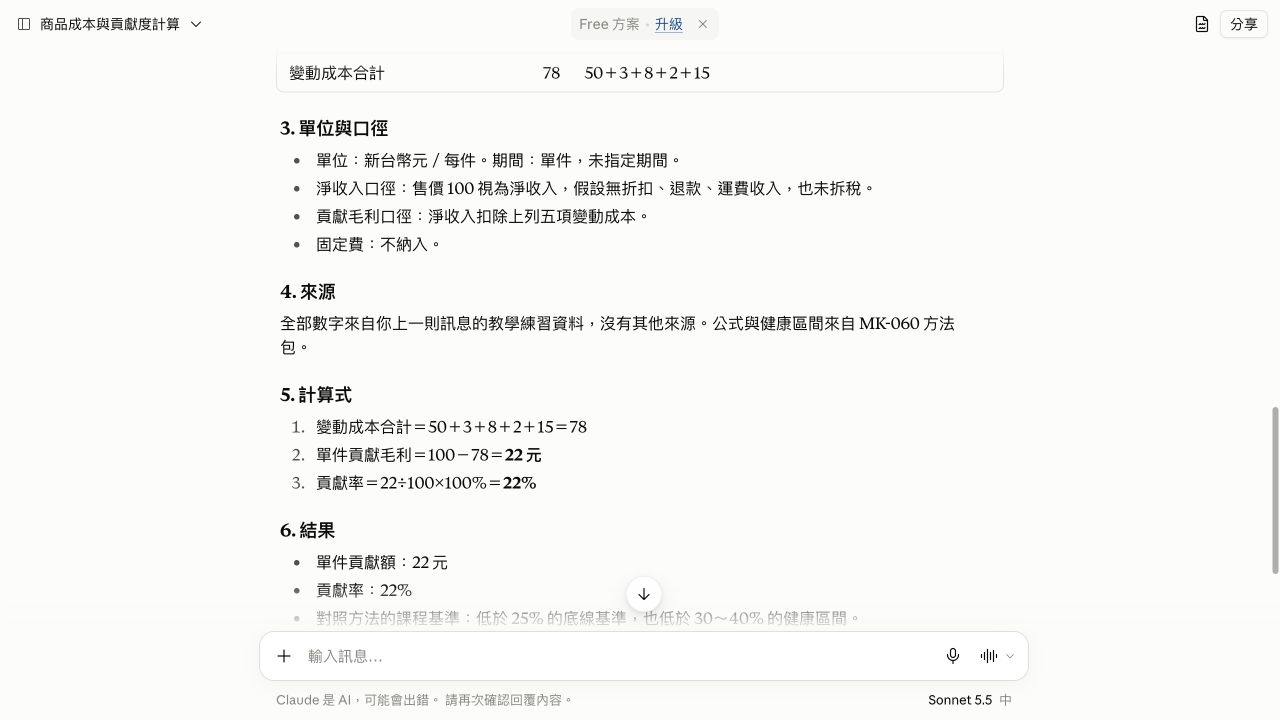
Fictional practice data for one item: selling price NT$100; purchase cost 50 + payment fee 3 + shipping 8 + packaging 2 + advertising allocated in this example 15 = NT$78 in variable costs. Price minus the costs in this example: 100 − 78 = 22. Contribution per item is NT$22, or 22% of the selling price
Get the complete MK-059 method →
Steps shown in the original recording
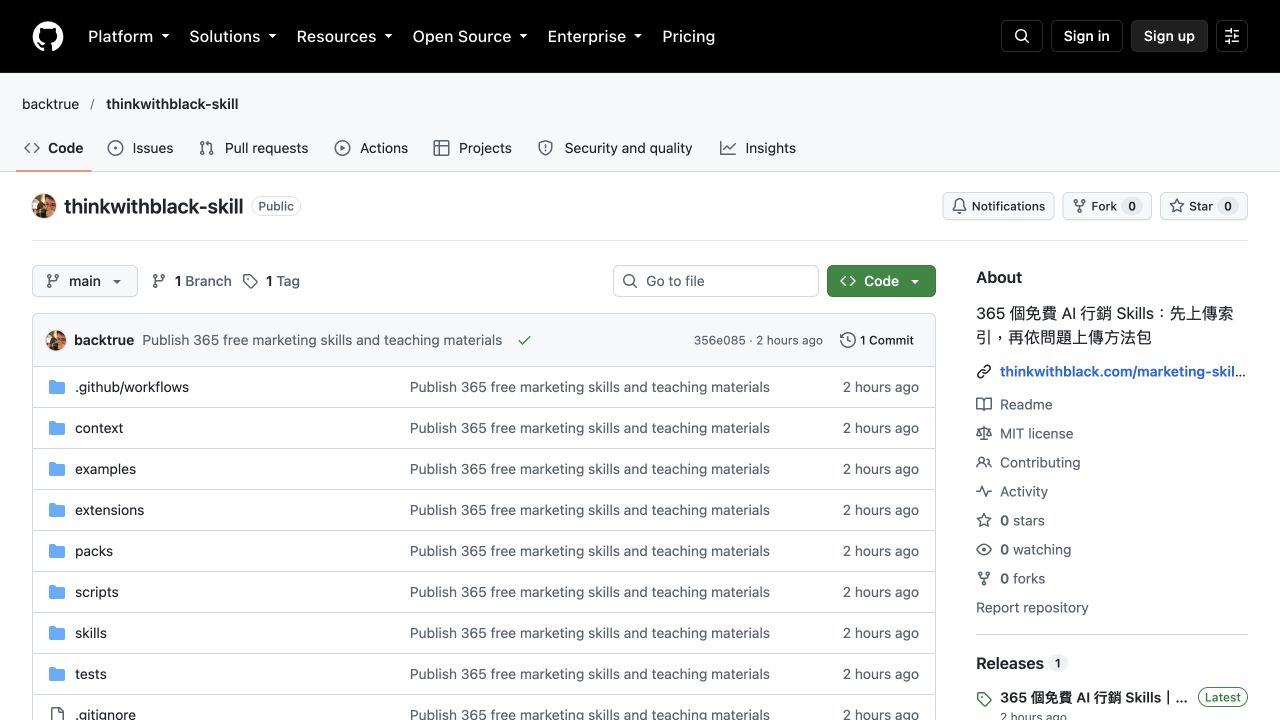
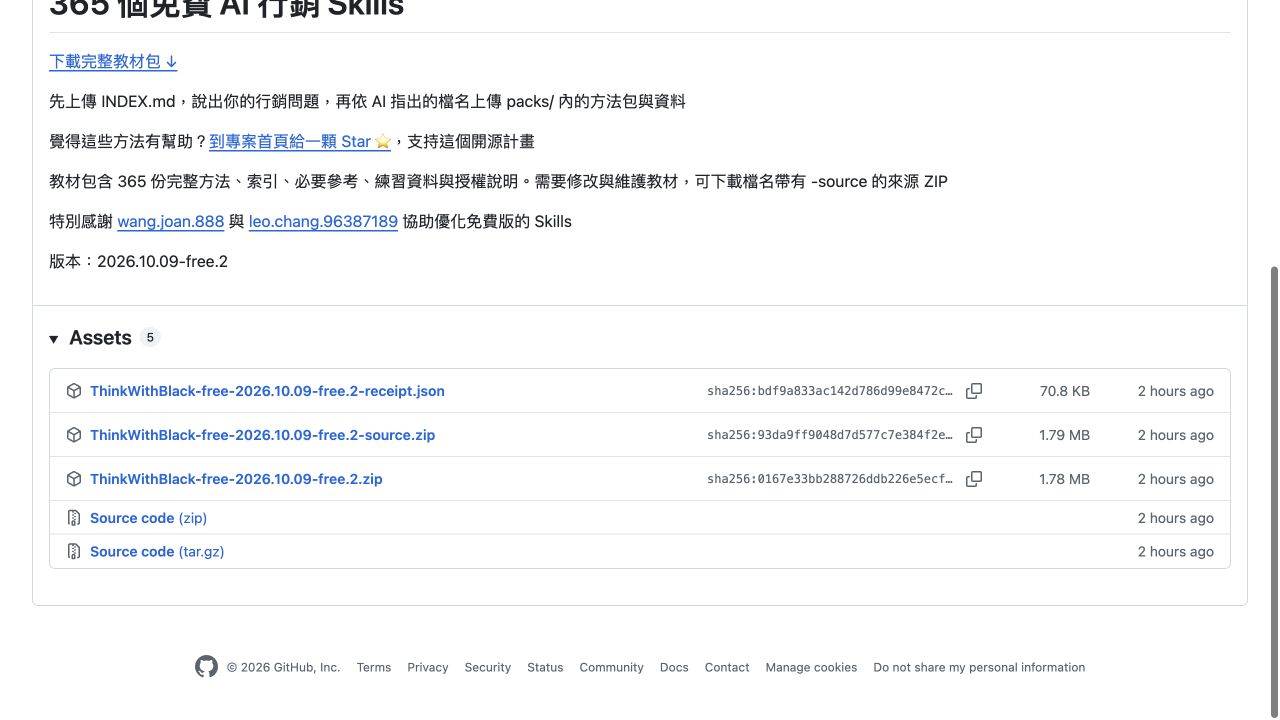
- Open the GitHub release, download ThinkWithBlack-free-2026.10.09-free.2.zip, and extract it
- Upload INDEX.md in the AI conversation and paste the exercise from this page
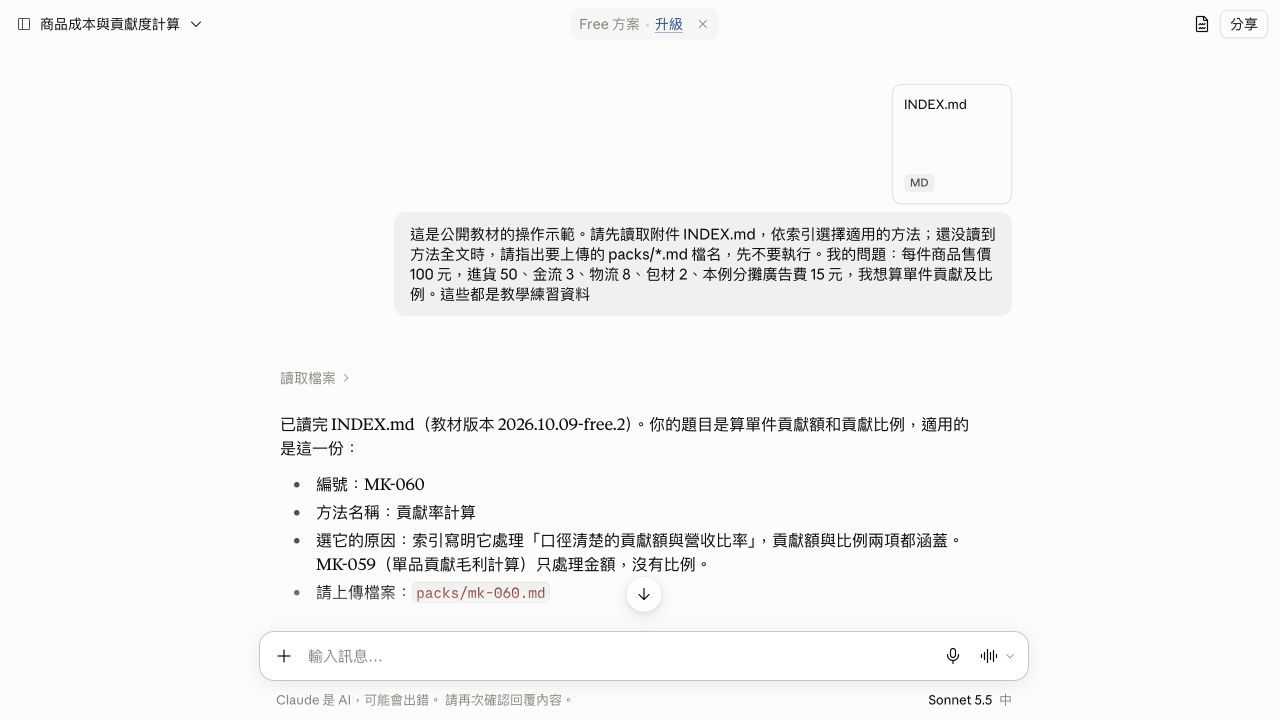
- In this recording, the AI selects MK-060 and requests packs/mk-060.md
- Upload the named file from the extracted packs folder and ask the AI to read the full method before running it
- Check the formula, cost definitions, and result: NT$22 contribution per item, or 22%
- If the materials help, sign in to GitHub and click Star in the repository's upper-right corner
① Read the index first: the AI names the method and file, then waits for the full method upload
② Add the method: check the calculation and cost classification against the fictional practice data
Give this exercise to your AI
Attach INDEX.md first, then paste this prompt. Once the AI selects a method, upload the filename it gives you; different questions may call for different methods
Frequently asked questions
How do I start if I do not know which Skill to use?
Upload INDEX.md and describe your problem. The AI uses the index to name a method and its file; upload that method pack next
Should I paste the entire method into the conversation?
Upload the .md method pack. It includes the full method, shared rules, and required references
Do I need to upload again when I switch tasks?
Ask the AI to choose from the index again. Upload any selected method it has yet to read
How do GitHub and Google Drive differ?
Both provide the same free content scope. GitHub also shows version history and changes; Google Drive provides a download entry point
ThinkWithBlack × Shumai
Bring these methods into your company's work
Led by Chiu Yu-Ting, known as Teacher Black, in collaboration with Shumai, the service supports e-commerce brands and corporate marketing teams with MCP integration, software development, custom Skills, and team training
AI implementation for marketing teams
Start with one real workflow, review the requirements, then agree on scope and pricing
Explore implementation services (Chinese) →Initial 30-minute consultation: free
ThinkWithBlack Skills / Applied marketing
Can a free-shipping bundle support your ads with fewer orders?
Check shipping at checkout and compare contribution per order, ad spend, and the order threshold for continuing the campaign