Orders climbed throughout the last promotion, so Xiaoya, who runs the campaigns, sat down with her team to plan the next one: should they raise the ad budget, keep free shipping, and still offer the discount of 150 New Taiwan dollars (NT$150)? Xiaoya opened the store backend, found the NT$1,000 product that sold best in the last campaign, and pulled a single-item order to check the numbers.
When she first set up that promotion, Xiaoya looked at two numbers: the NT$1,000 list price and the NT$500 purchase cost. That left a NT$500 spread. After giving buyers a NT$150 discount, NT$350 remained on paper. The team expected that NT$350 to cover free shipping and ads while the extra orders brought in cash for the company.
To see how much room she actually had for the next campaign, Xiaoya put the order's NT$850 post-discount revenue on the same sheet as every bill and matched them line by line. She entered the NT$500 purchase cost first, then pulled a NT$100 platform commission and a NT$30 payment processing fee from the platform settlement statement. Next, she asked her warehouse and marketing colleagues for the NT$80 logistics fee paid by the store, the NT$20 packaging cost, and the NT$150 in advertising cost incurred with each sale of this item. Those five expenses—each previously sitting in a separate report—added up to NT$380, which was NT$30 more than the NT$350 left after the discount. The flagship product everyone assumed was making money actually lost NT$30 on every unit sold.
Since a NT$150 discount left every unit NT$30 short in the last campaign, the team had to recalculate before launching the next one: how far should the discount come down, and how should the free-shipping terms be set, so each unit keeps money instead of losing it?
I organized the cost-breakdown method from Marketing Strategy in Practice Program Day 2 — Begin with the End × Reduce Costs × Improve Metrics (original course slides) into MK-059, "Per-Product Contribution Margin Calculation," in ThinkWithBlack Skills (see the complete MK-059 method pack). The slides split costs into period fixed costs and variable costs that move with sales. You calculate unit contribution by subtracting same-unit variable costs from net revenue per unit (the slides also measure the thin margin left on each unit by subtracting variable expenses such as marketing, returns, and platform commissions from gross profit), then review the cost structure item by item across purchasing, packaging, payment processing, logistics, and advertising.
For the next campaign, start by checking how much each unit can still keep. When buyer-paid shipping is NT$0, there are no refunds, and per-unit variable costs stay at NT$880 across all options, a NT$1,000 list price can be discounted by at most NT$120 to break even. Cut the discount to NT$100, and each unit keeps NT$20. If you want each unit to keep NT$50 to help cover fixed expenses and hit your profit target, you can discount at most NT$70. If platform fees, payment processing fees, logistics, or ad costs change with the discount or threshold, recalculate each option using its actual rates and fees.
Lay out a single-unit order first
Xiaoya put the NT$1,000 product order she had just checked into a single-product cost table. Every figure in this calculation is in New Taiwan dollars (NT$), before tax, with no refunds, NT$0 in buyer-paid shipping, and the NT$150 ad spend treated in this example as a per-unit expense incurred with the sale. Every line is aligned to the same basis: one unit sold.
| Item | Amount per unit |
|---|---|
| List price | NT$1,000 |
| Promotional discount | −NT$150 |
| Post-discount revenue | NT$850 |
| Purchase cost | NT$500 |
| Platform fee | NT$100 |
| Payment processing fee | NT$30 |
| Store-paid logistics fee | NT$80 |
| Packaging cost | NT$20 |
| Advertising cost incurred with the sale | NT$150 |
| Total variable costs | NT$880 |
| Unit contribution: 850 − 880 | −NT$30 |
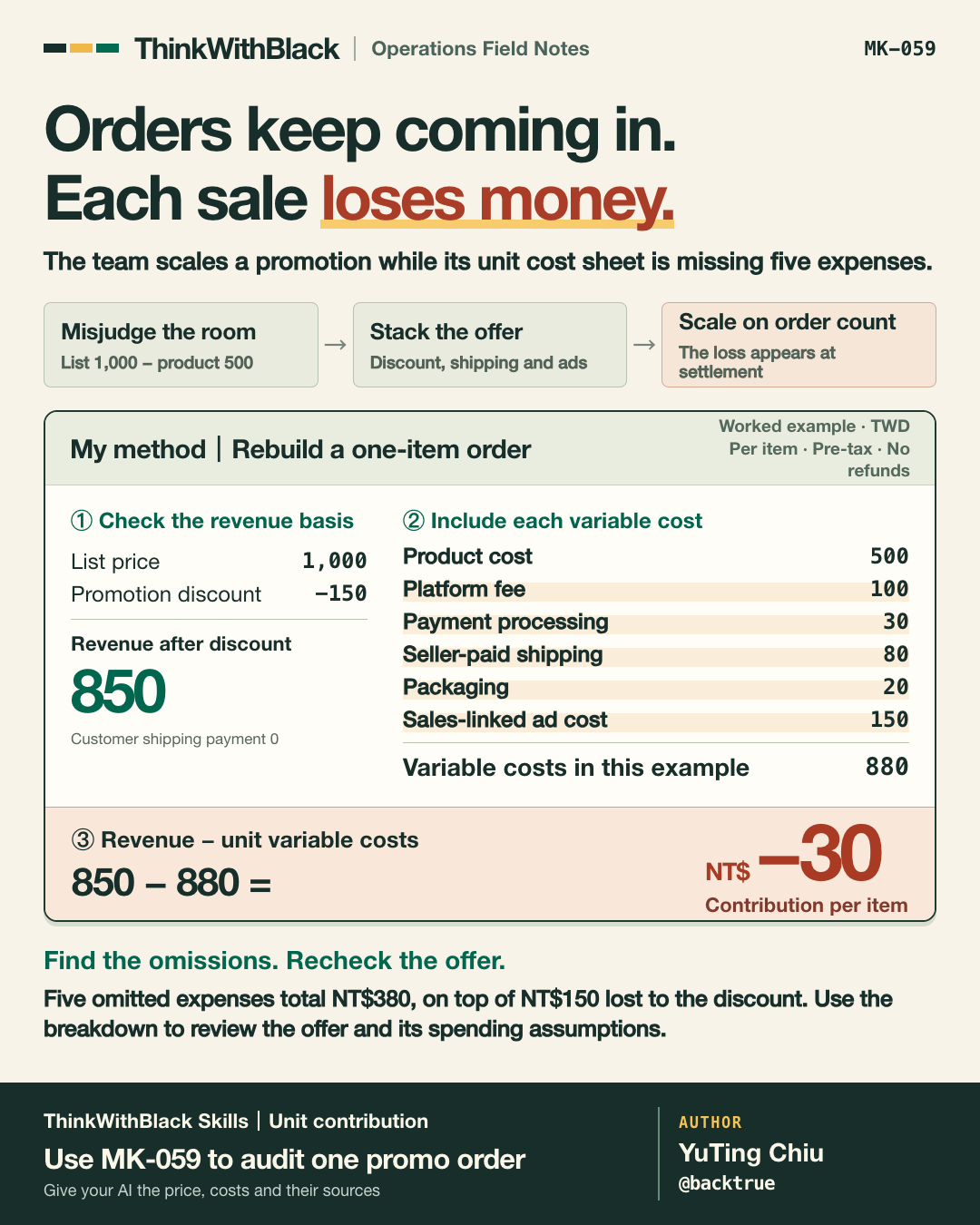
Putting the numbers in one table makes the hidden gap obvious. The NT$500 spread between the NT$1,000 list price and the NT$500 purchase cost drops to NT$350 after the NT$150 promotional discount. Subtracting the five remaining variable expenses—NT$100 platform fee, NT$30 payment processing fee, NT$80 logistics fee, NT$20 packaging cost, and NT$150 ad cost, totaling NT$380—leaves a unit contribution of −NT$30.
With this table in front of the team, Xiaoya can point to specific lines in the meeting: how much revenue the discount gives up, how much the store pays in logistics on a free-shipping order, and how much room per-unit ad spend takes up. Every figure traces back to an actual bill.
Check discounts, refunds, and shipping so each item is deducted only once
Before using this table to model the next campaign, Xiaoya checks the accounting basis for every addition and subtraction so revenue and expenses match up cleanly.
First, verify the NT$150 discount and any refunds so nothing is deducted twice. Xiaoya checks the checkout details to see which promotions were applied, whether multiple coupons were stacked, and whether the revenue column exported from the backend already subtracts the NT$150 discount. If the exported order amount already shows the post-discount NT$850, use NT$850 directly; only subtract NT$150 in the formula if the export shows the NT$1,000 list price. Handle refunds the same way: if reported revenue already nets out refunds, use that figure as is; if the report has not deducted refunds yet, subtract the refunds that occurred within the same order scope and observation period.
Second, separate "shipping collected from the buyer" from "shipping paid to the logistics provider." On this free-shipping order, shipping revenue collected from the buyer is NT$0, while the fee the store pays the logistics provider is NT$80—one sits on the revenue side, the other on the cost side. Under other order rules—such as "buyer pays shipping," "order below the free-shipping threshold," or "store absorbs shipping"—split the rule into two concrete numbers from the bills: put the shipping fee actually collected from the buyer under revenue, and put the fee actually paid to the carrier under variable costs.
Match the remaining platform fees, payment processing fees, packaging costs, and sales-driven ad costs against contract rates or billing statements, confirm the product and time period they cover, and convert each into a per-unit amount. If any item does not have a bill backing it yet, mark it "to be checked" on the table, note the missing data, and update the unit contribution once you have the number. When the course slides look for room to cut costs, they walk through these same categories item by item: purchasing and production, packaging and consumables, payment processing fees, warehousing and logistics, and customer acquisition marketing.
Calculate the discount ceiling: if per-unit variable costs stay at NT$880 across all options, NT$120 is the break-even limit
Once Xiaoya confirms that variable costs total NT$880 per unit, she calculates how much discount the next campaign can afford: what is the maximum discount that keeps unit contribution at NT$0 or above, and what discount leaves the target amount the company needs?
Under this order's conditions, if purchasing, platform, payment processing, logistics, packaging, and advertising add up to the same NT$880 per-unit variable cost across every option, each NT$1 reduction in the discount increases post-discount revenue by NT$1 and raises unit contribution by NT$1. At a NT$150 discount, unit contribution is −NT$30. Trimming the discount by NT$30 to NT$120 brings post-discount revenue up to NT$880; subtract NT$880 in variable costs, and unit contribution is exactly NT$0.
Written as a direct formula when per-unit variable costs stay unchanged across options: Break-even discount ceiling = Original product price − Per-unit variable costs. Subtracting NT$880 from NT$1,000 gives a maximum break-even discount of NT$120.
If the team rounds the discount to NT$100, post-discount revenue becomes 1,000 − 100 = NT$900. Subtracting NT$880 in variable costs leaves a unit contribution of NT$20 on every item sold.
Taking it one step further, Xiaoya needs this product to help cover the company's period fixed expenses—such as rent, full-time payroll, and fixed monthly software fees—while leaving a target profit. The team sets a target contribution of NT$50 per unit sold, which means post-discount revenue must reach 880 + 50 = NT$930. Subtracting NT$930 from the NT$1,000 original price leaves a maximum affordable discount of NT$70 (formula: Target-contribution discount ceiling = Original product price − Per-unit variable costs − Target contribution per unit).
Xiaoya puts the four discount options—NT$150, NT$120, NT$100, and NT$70—into one table so the team can compare the per-unit impact side by side:
| Discount per unit | Post-discount revenue | Variable costs | Unit contribution | Change vs. current −NT$30 |
|---|---|---|---|---|
| NT$150 | NT$850 | NT$880 | −NT$30 | Current baseline |
| NT$120 | NT$880 | NT$880 | NT$0 | +NT$30 per unit |
| NT$100 | NT$900 | NT$880 | NT$20 | +NT$50 per unit |
| NT$70 | NT$930 | NT$880 | NT$50 | +NT$80 per unit |
Under the same single-unit order conditions, lowering the discount from NT$150 to NT$100 moves unit contribution from −NT$30 to +NT$20, improving each unit sold by NT$50. Lowering the discount to NT$70 moves unit contribution from −NT$30 to +NT$50, improving each unit sold by NT$80.
When weighing the NT$100 and NT$70 options, Xiaoya also puts sales volume and period costs onto the checklist for the next campaign. The four rows above show per-unit math, and cutting the discount from NT$150 to NT$100 or NT$70 may change buyers' willingness to order and the actual number of units sold. To see how much total profit the entire campaign leaves behind, multiply the unit contribution (recalculated with actual fees) by actual effective unit sales, then subtract period fixed expenses and any new execution costs added by the change.
When fees move with the discount, recalculate each candidate option
Next, Xiaoya checks a practical wrinkle: the figures above—NT$120 to break even, NT$100 to keep NT$20, and NT$70 to keep NT$50—only hold if per-unit variable costs stay fixed at NT$880. If the platform contract charges commission as a fixed percentage of the post-discount checkout amount, or if the payment processor charges a percentage of the actual card payment, then shrinking the discount from NT$150 to NT$100 or NT$70 raises post-discount revenue and pushes platform and payment processing fees up with it.
When variable fees change with the discount, Xiaoya tests each candidate option—NT$120, NT$100, NT$70—one by one. For each candidate, she calculates the post-discount revenue first, applies the actual contract rates to find that option's platform fee, payment processing fee, and other variable expenses, and adds them up to get that option's total variable costs per unit. Then she subtracts those variable costs from the option's post-discount revenue to see whether unit contribution hits NT$0 or the NT$50 target, and picks the candidate with the largest discount that still meets the goal.
Before running multiple discount scenarios, test a NT$0 discount first (selling the item at its full NT$1,000 list price) and check the unit contribution. If the product already loses money at full price—and discounts only reduce revenue while per-unit variable costs stay the same—you need to fix the price or cut costs before running a discount at all. If platform fees, shipping subsidies, or ad spend change with price or order volume, recalculate the zero-discount baseline and each candidate option under its own terms to see which one hits the target.
Plug in your own numbers to check your next campaign
After finishing the single-unit breakdown and discount-ceiling math, Xiaoya turned the steps into a two-part worksheet the team can fill out whenever they plan a promotion.
Pick one product you plan to feature in your next campaign. Record each item's name, value, unit, and source in Table A, then bring those verified numbers into Table B to fill in the formulas, results, and conditions. Both tables below are pre-filled with Xiaoya's NT$1,000 product and the NT$70 discount option that keeps NT$50 per unit—replace them directly with your own figures.
Table A: Single-product data and source check (Name / Value / Unit / Source)
| Name | Value | Unit | Source |
|---|---|---|---|
| List price | 1,000 (enter your list price) | NT$/unit (before tax) | Product master file / storefront price |
| Current promotional discount | 150 (enter current discount) | NT$/unit (before tax) | Promotion campaign settings |
| Buyer-paid shipping | 0 (enter shipping collected) | NT$/unit (before tax) | Order checkout details |
| Refunds incurred | 0 (enter per-unit refund) | NT$/unit (before tax) | Returns & refunds report (confirm not deducted twice) |
| Purchase cost | 500 (enter purchase price) | NT$/unit (before tax) | Purchase order |
| Platform fee | 100 (enter platform commission) | NT$/unit (before tax) | Platform contract rate / settlement statement |
| Payment processing fee | 30 (enter payment fee) | NT$/unit (before tax) | Payment processor billing statement |
| Store-paid logistics fee | 80 (enter actual shipping cost) | NT$/unit (before tax) | Logistics provider monthly statement |
| Packaging cost | 20 (enter box & packing cost) | NT$/unit (before tax) | Warehouse consumables purchase order |
| Advertising cost incurred with the sale | 150 (enter per-unit ad cost) | NT$/unit (before tax) | Ad manager cost per conversion (mark "to be checked" if missing) |
| Target contribution per unit | 50 (enter target amount to keep) | NT$/unit (before tax) | Team's campaign profit & fixed-cost allocation target |
Table B: Single-product formulas, results, and conditions (Name / Formula / Result / Conditions)
| Name | Formula | Result | Conditions |
|---|---|---|---|
| Current post-discount revenue | List price 1,000 − discount 150 + buyer shipping 0 − refunds 0 | NT$850/unit | Discount and refunds each deducted once; buyer shipping listed separately |
| Total variable costs per unit | Purchase 500 + platform 100 + payment 30 + logistics 80 + packaging 20 + ads 150 | NT$880/unit | All 6 cost items aligned to a per-unit basis; missing items must be marked "to be checked" |
| Current unit contribution | Post-discount revenue 850 − total variable costs 880 | −NT$30/unit | Current NT$150 discount, free shipping, and variable costs totaling NT$880 |
| Break-even discount ceiling | List price 1,000 − total variable costs 880 | Max discount NT$120 (contribution NT$0) | Per-unit variable costs stay at NT$880 across options; +NT$30/unit vs. current |
| Candidate option: NT$100 discount | Post-discount revenue (1,000 − 100) − variable costs 880 | Unit contribution NT$20 | Per-unit variable costs stay at NT$880 across options; +NT$50/unit vs. current |
| Target-contribution discount ceiling | List price 1,000 − variable costs 880 − target contribution 50 | Max discount NT$70 (contribution NT$50) | Per-unit variable costs stay at NT$880 across options; post-discount revenue NT$930, +NT$80/unit vs. current |
Once you have gathered your numbers, download the MK-059 method pack and hand it to an AI along with the tables above and this prompt to verify your math:
Please use MK-059 "Per-Product Contribution Margin Calculation" to organize the per-unit revenue and variable costs for this promotional product. List the name, value, unit, source, formula, result, and conditions for each item. Confirm that discounts and refunds are deducted only once, and list shipping collected from the buyer separately from the store's logistics expense. Flag any cost items that still lack a source as "to be checked," and first calculate the unit contribution that can be confirmed from the current data. Next, assuming per-unit variable costs stay unchanged across options, calculate the maximum discount to break even and the maximum discount that leaves my specified target contribution per unit. If platform fees or payment processing fees vary with the discount, recalculate each candidate discount option one by one so I can verify the worksheet for our next campaign.
When the next campaign runs, bring back the actual effective order count and billing statements to check three things: first, whether the checkout discount and free-shipping threshold were applied at the exact amounts set; second, how far the actual per-unit expenses—purchasing, platform, payment processing, logistics, packaging, and sales-driven advertising—differed from the NT$880 estimate; and third, since changing the discount to NT$100 or NT$70 may shift actual effective sales volume, recalculate unit contribution using the actual expenses, multiply by actual effective units sold to get total contribution, and subtract period fixed expenses and new execution costs to verify whether the campaign hit its overall profit goal. Whenever a single fee or rate changes, update that line in Table A and let Table B recalculate the discount ceiling for your next run.
Visit ThinkWithBlack Skills to download the index and method packs, or read MK-059 "Per-Product Contribution Margin Calculation" directly. Plug in the numbers for the next product you plan to promote and spot the missing cost lines on your campaign sheet before you launch.
Bring your data into MK-059
Download the MK-059 method pack
First time using Skills? Download the index first so your AI can pick the right method, then upload the full method pack along with your data for this problem.
Download the INDEX.md file · Read the full how-to guide
Social posts for this Skill
Pick a platform to view the infographic cards and post for this Skill:
邱煜庭(小黑老師) · @backtrue · ThinkWithBlack
Compiled for this Skill guide: Author bio and courses