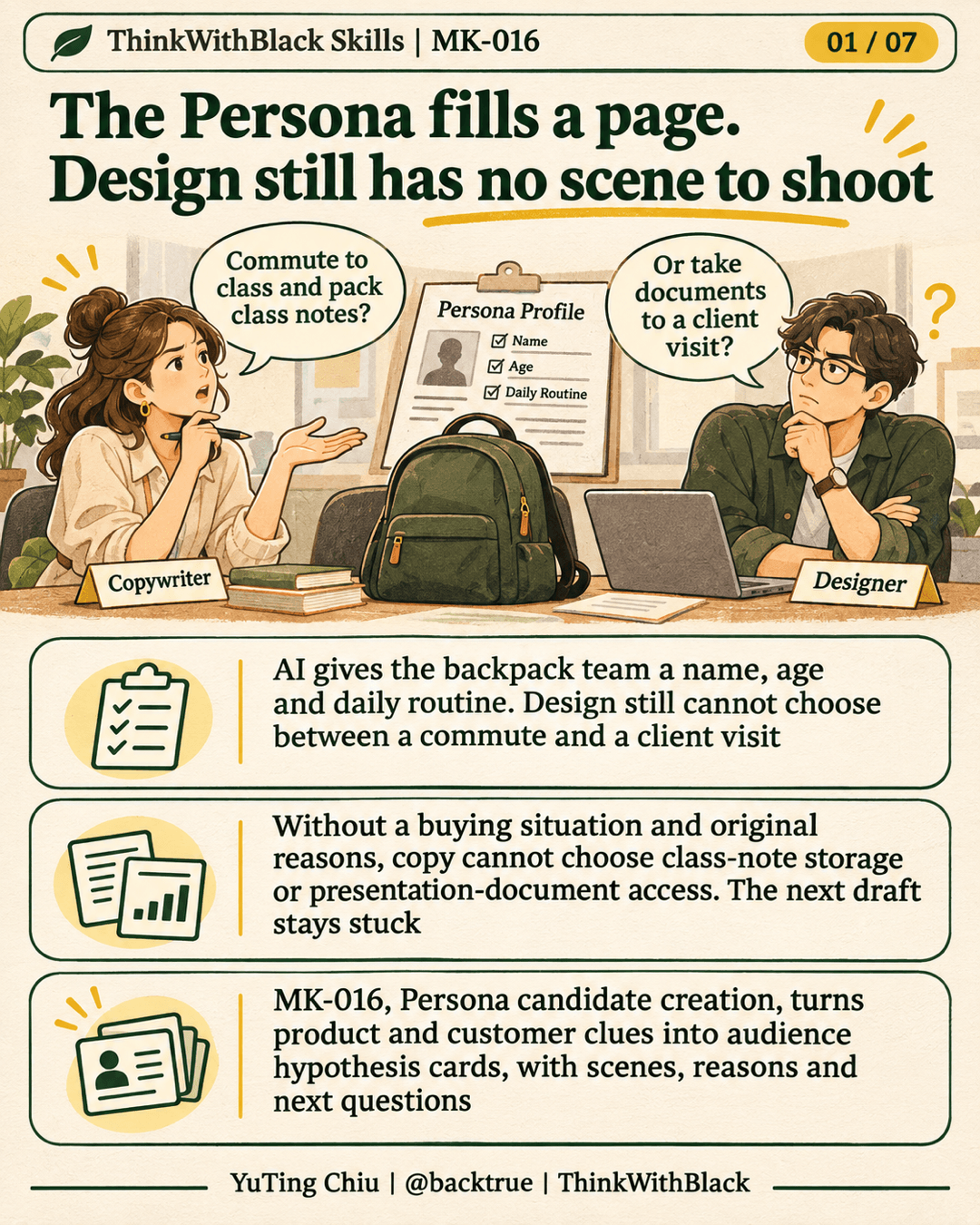
While preparing an ad for a backpack, project marketer Lin Yijun asked AI to write a Persona—a profile of the customer the team wanted to reach. The draft came back quickly with a name, age, occupation, and daily habits. It read like someone the team already knew well. When Yijun pasted that page into the group chat, she felt relieved. She figured that once design and copy had this profile, the next round of ad creative would move forward.
Then the designer, Azhe, asked in the group: "So should this image show a commute to work, or a client visit?" The copywriter, Xiaomin, followed: "Should the opening paragraph talk about storing lecture notes, or pulling out presentation documents?" The profile filled a whole page, yet the actual work everyone needed to do was still stuck.
Yijun stared at the page for a long time. The name, age, and occupation read smoothly, but they couldn't answer why the team was talking to this person right now. What I look for in a persona card is whether the next person who picks it up can find the reason for this message. Why is the customer looking for this product? What problem are they handling right now? Which parts have data behind them, and which parts still need to be asked? Leave those answers on the card, and the team can actually prepare the next batch of creative.
To get past the block, Yijun set the AI persona details aside and went back to the backpack's product specs, order summary, and customer service logs on hand. Looking through them, she realized the material needed to answer Azhe and Xiaomin had been there all along—it just needed to be organized into cards. This method of turning product records, customers' exact words, and willingness-to-pay clues into audience hypothesis cards is numbered MK-016 in the ThinkWithBlack Skills method pack, titled "Persona candidate creation"[1].
"Candidate" here means keeping the customer profiles worth verifying next, so the team knows what to produce now and what information to gather later[1]. You start with the product to confirm three selling points, the average order value, and the purchase frequency, then check willingness-to-pay clues, and build multiple candidates from customers' own words. Every field is marked as sourced, hypothesized, or unknown, while counterexamples and items to validate stay attached to the card. Creative production and later testing both tie back to the cards, and new replies get filled in as they arrive. Compared with handing a single unsourced "urban office worker" profile straight to a shoot, building separate candidate cards for distinct uses tells design exactly which packing action to shoot, tells copy which situation to open with, and tells customer service which size and price conditions to follow up on. That cuts down creative revisions and repeated service questions, and later lets paid traffic match clicks and inquiries back to specific uses. Four conditions change how you use this method and how many cards you make:
- When the product has a single clear use and customer messages support only one situation, build just one candidate card and prepare creative for that single scenario.
- When customers' own words still need more clues to support three selection values or three purchase motivations, mark those fields unknown. Use the card to plan the next round of customer service or survey questions, and wait until you have those answers before judging paid-traffic performance.
- When later responses show that the same person has two uses at once, add that fact to the original card and reorder the messaging while keeping the existing number of candidates.
- When the product is brand-new and you have not yet accumulated customer quotes, surveys, or service logs, use these fields to draw up a "to-validate checklist," collect your first batch of customer quotes, and then build candidate cards ready for paid traffic.
MK-016 seven-page guide · 1 / 7 (/assets/skill-articles/mk-016-zh-01.png)
Start with the product before deciding how to write the profile
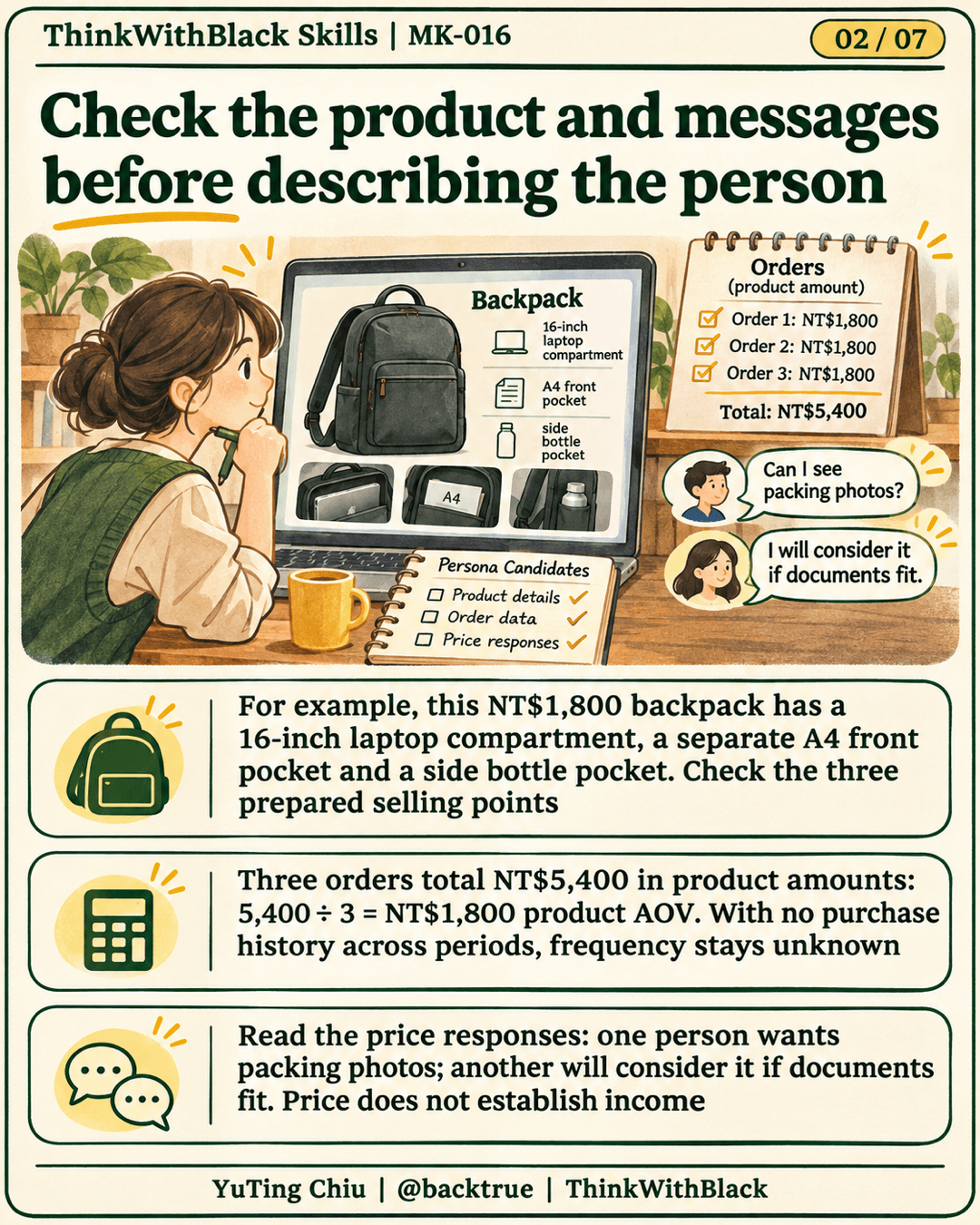
To answer Azhe and Xiaomin, Yijun held off on describing customers and first checked the three organized selling points, the average order value, and the purchase frequency, along with the willingness-to-pay clues on hand. Those facts shape the persona cards directly: what the product can physically do, what existing orders actually paid, and whether customers have said they would consider this price[3].
She pulled up product record P1 for the backpack, priced at NT$1,800. P1 lists three selling points: a 16-inch laptop compartment, a separate front pocket that fits A4 documents, and a side water bottle pocket[2]. Because the bag actually has these specs, Yijun and the team knew they could talk specifically about keeping a laptop and documents separate, pulling documents from the front pocket, and stowing a bottle on the side.
Next, she opened order summary O1. Three valid orders totaled NT$5,400 in product revenue, giving a product average order value of NT$5,400 ÷ 3 = NT$1,800. This calculation includes product amounts only, excluding shipping and other fees. Because the team had no cross-period purchase records on hand, she marked purchase frequency as unknown[2].
Seeing that the list price and the average order value were both NT$1,800, Yijun noted in the record that price and average order value matched as a product-level transaction record, while customer income would have to be confirmed separately from real data. Whether a customer is willing to buy still depends on what they say, what they ultimately choose, and what shows up in completed transactions[2].
Checking product and order facts first determines whether the resulting creative matches real demand. Once you lock down what the product does, what buyers have paid, and what willingness-to-pay clues exist before describing the customer, every persona detail ties back to product facts and gives Azhe and Xiaomin a concrete brief[3].
MK-016 seven-page guide · 2 / 7 (/assets/skill-articles/mk-016-zh-02.png)
Two customer messages, two candidates worth keeping
With the product and order facts in place, Yijun opened the backpack's customer service logs and found two distinct inquiry scenarios. She broke both messages down line by line to build the persona cards directly from real conversations.
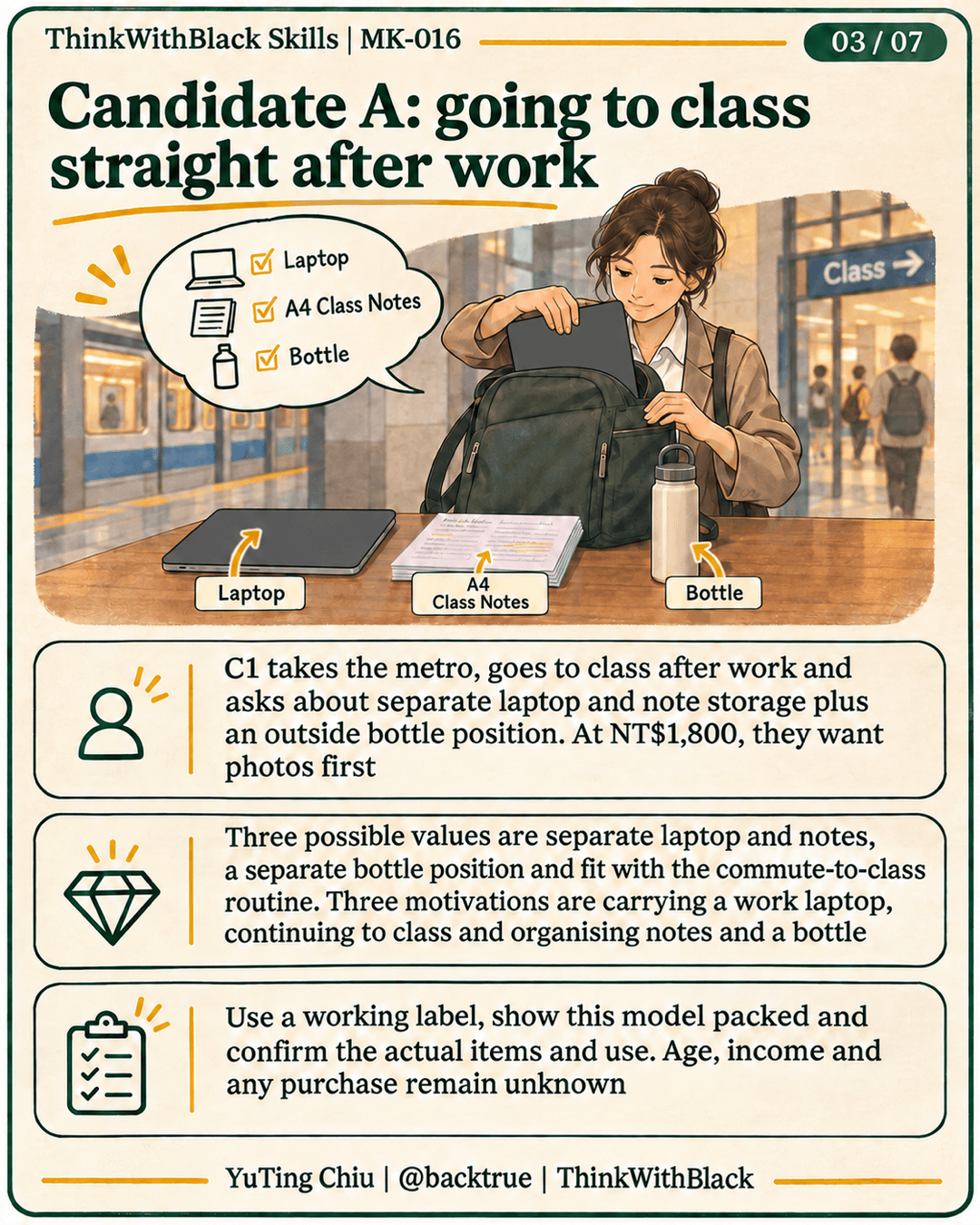
The first service log, C1, read: "I take the metro every day and go straight to class after work. Can my laptop and lecture notes go in separate spots? Can a water bottle go on the outside? At NT$1,800, I'd like to see packing photos first"[4].
That short message already gives the commute mode, the after-work class routine, and the items that need to stay separate. Yijun gave candidate A the working label "commuter going to class after work," recorded the buyer as the inquirer, and left whether they were buying for their own use to be confirmed next.
Following C1's questions, Yijun listed candidate A's three selection values: keeping the laptop and lecture notes separate, storing the water bottle separately, and using a single bag for both commuting and class. She listed the three purchase motivations as carrying a laptop to work, heading straight to class after work, and organizing lecture notes and a water bottle. The uses and motivations came from C1, and she checked whether the bag could deliver on them directly against P1's three selling points[4]. On the card, she marked these values and motivations as hypotheses to be validated.
Because C1 specifically asked for packing photos, Yijun asked Azhe to prepare shots showing where the laptop, A4 notes, and side water bottle fit, and asked customer service to follow up on whether those were the exact items the customer planned to carry. For NT$1,800 price acceptance, she recorded C1's exact condition: "wants to see photos before deciding."
MK-016 seven-page guide · 3 / 7 (/assets/skill-articles/mk-016-zh-03.png)
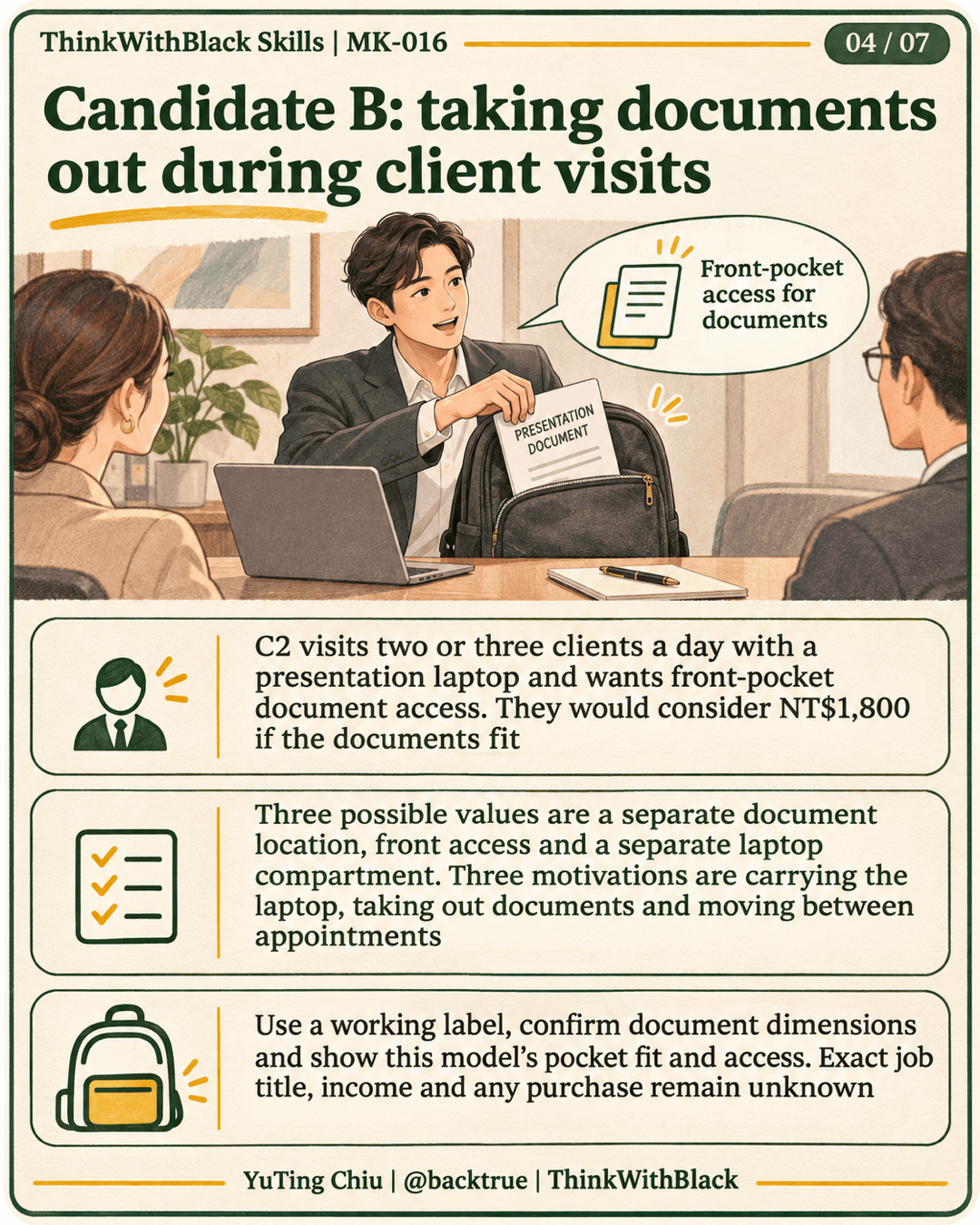
Reading further down the log, Yijun found a second service message, C2: "I visit two or three clients a day and bring a laptop for presentations. When I pull out documents, do I have to open the whole main compartment? If the front pocket holds my documents, I'd consider NT$1,800"[5].
From that message, Yijun created candidate B, "presenter visiting clients." The quote shows a job involving client visits and presentations, though it leaves exact job title, age, and income unstated. She also kept a separate field to check whether the buyer and the end user were the same person.
For candidate B's three selection values, Yijun wrote down: a dedicated spot for documents, front-pocket access to those documents, and a separate compartment for the laptop. The three purchase motivations were bringing a laptop for presentations, pulling out documents during client visits, and carrying both between client meetings. Each point tied back to C2's work routine and P1's product specs, and she marked them as hypotheses as well[5].
This inquirer had one clear condition for paying NT$1,800: the front pocket had to fit their documents. Yijun wrote down the team's next steps: confirm the customer's actual document size, send photos showing documents going into and coming out of that front pocket, and log how the customer responded after seeing them.
The same backpack now had two distinct candidates worth following up on. Yijun kept both cards so Azhe and Xiaomin could build two separate sets of creative—"packing for night class" and "pulling documents on client visits"—rather than collapsing everything into a generic "urban office worker." As the MK-016 method notes, a single product can have multiple Personas; AI helps generate candidates, which you then test with paid traffic and real transaction data[3].
MK-016 seven-page guide · 4 / 7 (/assets/skill-articles/mk-016-zh-04.png)
What to do with blanks like name, age, and income
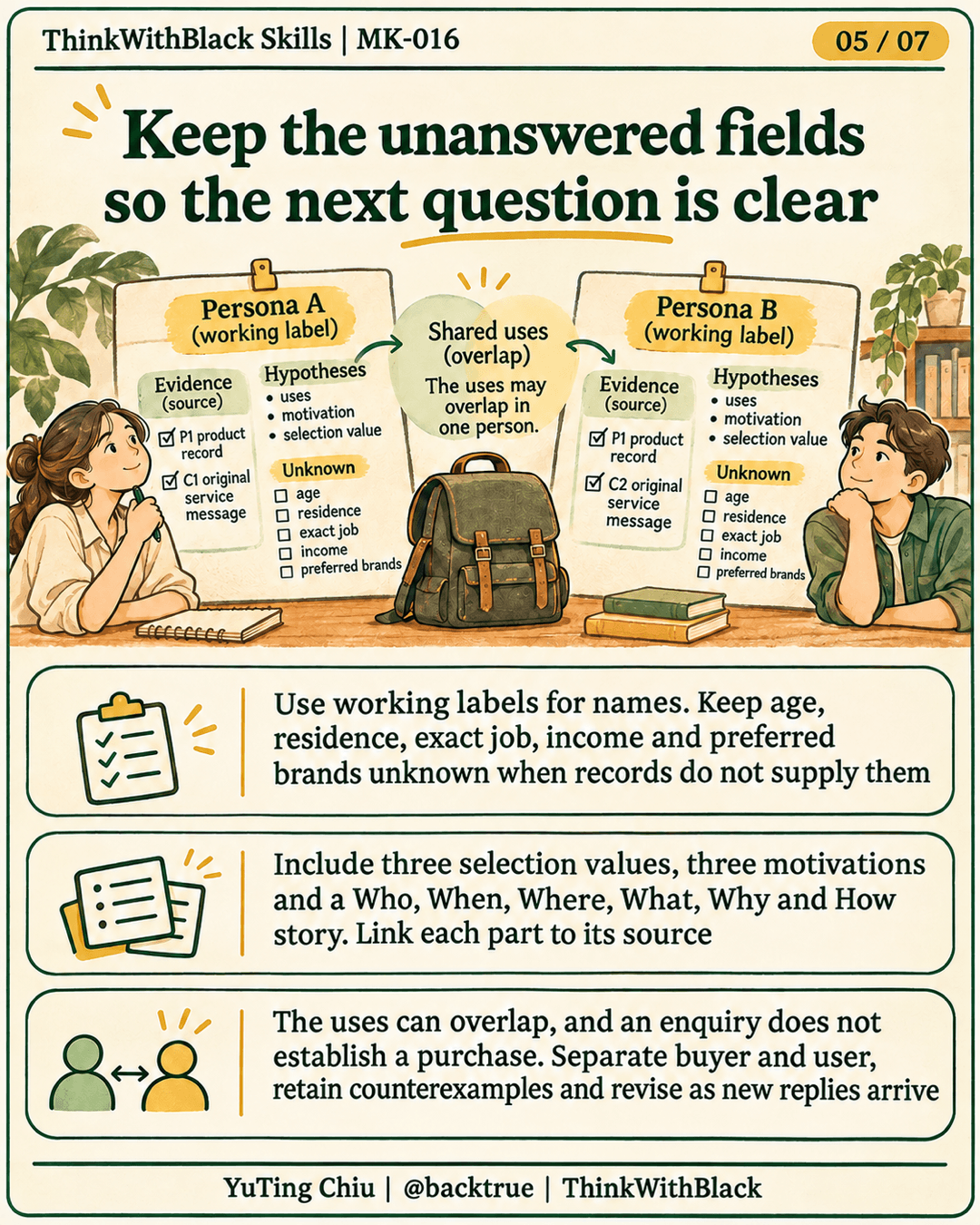
Once both candidate cards had uses and motivations, Yijun dealt with the blank demographic fields. The method calls for each card to include a name, age, residence, occupation, income, three selection values, three purchase motivations, preferred brands or competitors, and a 5W1H short story[6]. Yijun kept every one of those fields on the card so the team could see at a glance what was still missing, marking any unconfirmed item as unknown.
In the name field, she entered the working labels for candidates A and B. Neither customer had given an age, residence, exact job title, income, or preferred brand, and leaving those blank didn't stop the team from acting on the uses already in hand. Under occupation, she noted C2's client visits and presentations while leaving the exact job title to be confirmed.
Next, she used 5W1H—who, when, where, what, why, and how—to turn each card into a short handoff story. For candidate A, she wrote: "An inquirer who commutes by metro and goes straight to class after work wants to know how to pack a laptop, lecture notes, and a water bottle separately in one backpack, and is waiting to see packing photos." Every detail came from C1, while the class location and whether they ended up buying stayed marked for follow-up.
For candidate B, she wrote: "An inquirer who visits clients with a presentation laptop wants to pull documents from a separate front pocket during visits, and is checking whether the documents fit before considering the NT$1,800 bag." The visit locations, job title, purchase outcome, and actual usage also remained unknown.
Alongside those two short stories, Yijun laid out the supporting evidence so Azhe, Xiaomin, and customer service could check the source at any time. Here is how she filled out the eight required fields from the Chinese method pack:
- Hypothesis group
A|Someone who goes to class after work and wants to organize commuting items; working label A
B|Someone who visits clients and carries presentation materials; working label B - Buying / using role
A|C1 is the inquirer; whether they buy and whether they use the bag themselves remain to be confirmed
B|C2 is the inquirer; whether they buy and whether they use the bag themselves remain to be confirmed - Trigger situation
A|Takes the metro, goes straight to class after work, and is checking how items fit inside
B|Visits two or three clients a day and is checking how to pull out documents on the go - Tasks and concerns
A|Three values: keep laptop and notes separate, store water bottle separately, fit both work commute and after-work class; three motivations: carry a laptop to work, go to class after work, organize notes and water bottle; all are candidate hypotheses supported by C1
B|Three values: dedicated spot for documents, front-pocket access, separate laptop compartment; three motivations: carry a presentation laptop, pull out documents during visits, carry gear between client stops; all are candidate hypotheses supported by C2 - Supporting clues
A|P1 product record and C1 quote; O1 is the batch-wide product average order value, not matched to C1 individually
B|P1 product record and C2 quote; O1 is the batch-wide product average order value, not matched to C2 individually - Counterexamples
A|Someone commuting to work and night class might also visit clients; C1's inquiry is not proof of a completed purchase
B|Someone visiting clients might also take evening classes; job duties and an inquiry are not proof of a completed purchase - To validate
A|Name, age, residence, exact occupation, income, brand preference, and purchase frequency unknown; confirm self-use, item dimensions, and response to the NT$1,800 price after seeing packing photos
B|Same demographic fields and purchase frequency unknown; confirm self-use, document dimensions, and response to the NT$1,800 price once front-pocket fit is shown - Suitable messaging
A|Frame around the commute-to-class routine: first show how the laptop, A4 notes, and water bottle sit in separate compartments, then check whether that matches what they carry
B|Frame around client visits: first show documents sliding into and out of the front pocket while the main compartment stays shut, then check whether their actual documents fit
Those eight rows map directly to the eight core deliverables in the method pack: Persona name; age, residence, occupation, and income; three values; three motivations; preferred brands and competitors; 5W1H; item-by-item source, hypothesis, or unknown status; and validation tasks[6]. The two cards can overlap. Yijun and the team agreed that if later replies showed one person doing both, they would add that fact back to the existing card and adjust the messaging order rather than inventing a third card.
To show why concrete detail matters for real business decisions, the course slides cite Japanese soup chain Soup Stock Tokyo's persona "Akino Tsuyu" as an external public benchmark (referenced strictly to illustrate field specificity, unrelated to this team or client): a 37-year-old woman working in a city who values function over decorative flair, prefers affordable liver dishes to foie gras, and swims freestyle rather than breaststroke[7]. According to the slides, Soup Stock Tokyo grew to ¥4.2 billion in annual revenue and 52 locations within ten years. The lesson isn't to make up quirky details—it's that when persona fields are grounded in real observations and specific enough, a team can use them to choose menu items, store locations, and interior design in a way the label "urban office worker" never could.
MK-016 seven-page guide · 5 / 7 (/assets/skill-articles/mk-016-zh-05.png)
Turning the two candidate cards into ad creative
When Yijun posted the two finished candidate cards back into the group chat, the questions that had stalled Azhe and Xiaomin had direct answers.
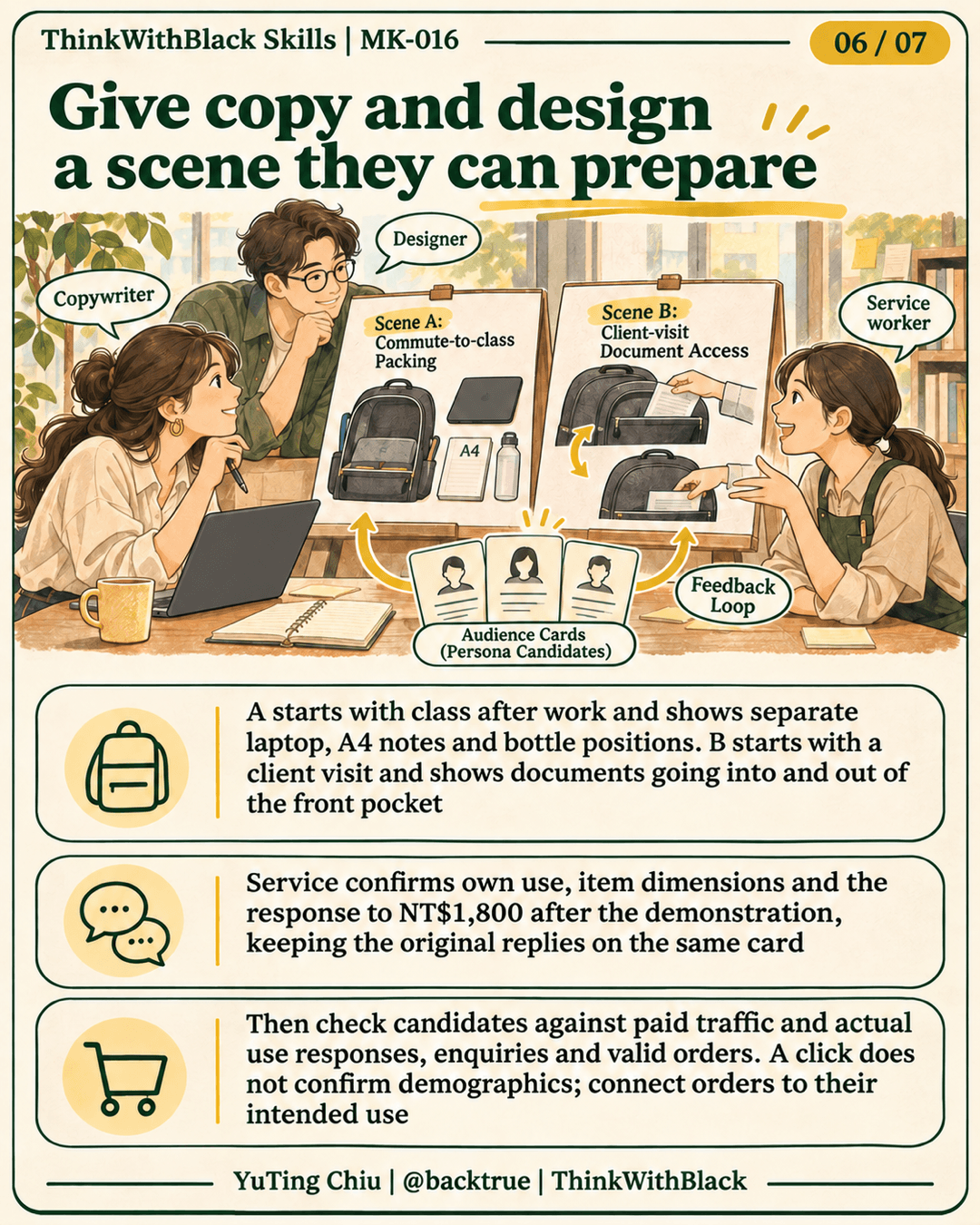
Xiaomin could now write two distinct openings. For candidate A, she opened with heading straight to class after work while keeping a laptop, A4 lecture notes, and a water bottle separate, then walked through the laptop sleeve, front pocket, and side pocket. For candidate B, she opened with pulling out documents during a client visit without unzipping the main bag, then showed how the front pocket works.
Azhe also had a clear shot list for each card: for A, shoot where the laptop, A4 notes, and side bottle each go; for B, shoot a hand sliding documents into and out of the front pocket. Meanwhile, customer service used row 7 ("To validate") on both cards as a checklist during replies—recording what the inquirer actually planned to carry, the dimensions of their items, and how they reacted to the NT$1,800 price after seeing the demo shots.
With creative and service actions lined up, Yijun added the verification rules to the project log: once paid ads started running, the team would match incoming use-case replies, inquiries, and completed orders back to the two candidate cards one by one. An ad click only proves the image caught someone's eye—confirming age or income still requires real customer data. And when a valid order closes, the team still needs to note what the buyer actually bought the bag for[2].
Connecting cards to creative this way rests on two principles from the course slides. First, values act as underlying coordinates while purchase motivations act as concrete triggers; you need both to write creative that gets people to act[8]. Second, in Jobs to Be Done (JTBD) terms, customers "hire" a product to get a job done across functional, social, and emotional dimensions[9]. Checking her two cards against that framework, Yijun saw that candidate A (keeping gear separate and easy to grab) and candidate B (pulling documents from the front pocket with the main compartment closed) both had clear functional jobs behind them. Because the service logs said nothing yet about social or emotional jobs, she left those as unknown until real customer feedback came in.
By the end of the exercise, MK-016 gave the team two audience candidate cards tied to real records, ready to brief the next round of creative, and structured to update as new replies arrived. At their next creative review, Yijun, Azhe, and Xiaomin could point to any visual and say which use case it answered, which customer quote backed it up, and what customer service still needed to ask.
MK-016 seven-page guide · 6 / 7 (/assets/skill-articles/mk-016-zh-06.png)
Keep the candidates grounded, then let real data take over
This workflow comes from the Persona module of YuTing Chiu's (Black's) Marketing Strategy Practical Course Day 1 — Niche Is Mass × Precise Persona × Digital Assets[10]. The core sequence is straightforward: confirm the product's three selling points, average order value, and purchase frequency; build multiple candidates from willingness-to-pay clues; and verify them through paid traffic and transaction records. As the course slides remind teams under the banner "niche is mass," you lock a Persona onto a specific niche scenario first, then use paid traffic to test whether the hypothesis holds[11]. The full workflow and source rules are available in the MK-016 Chinese method pack.
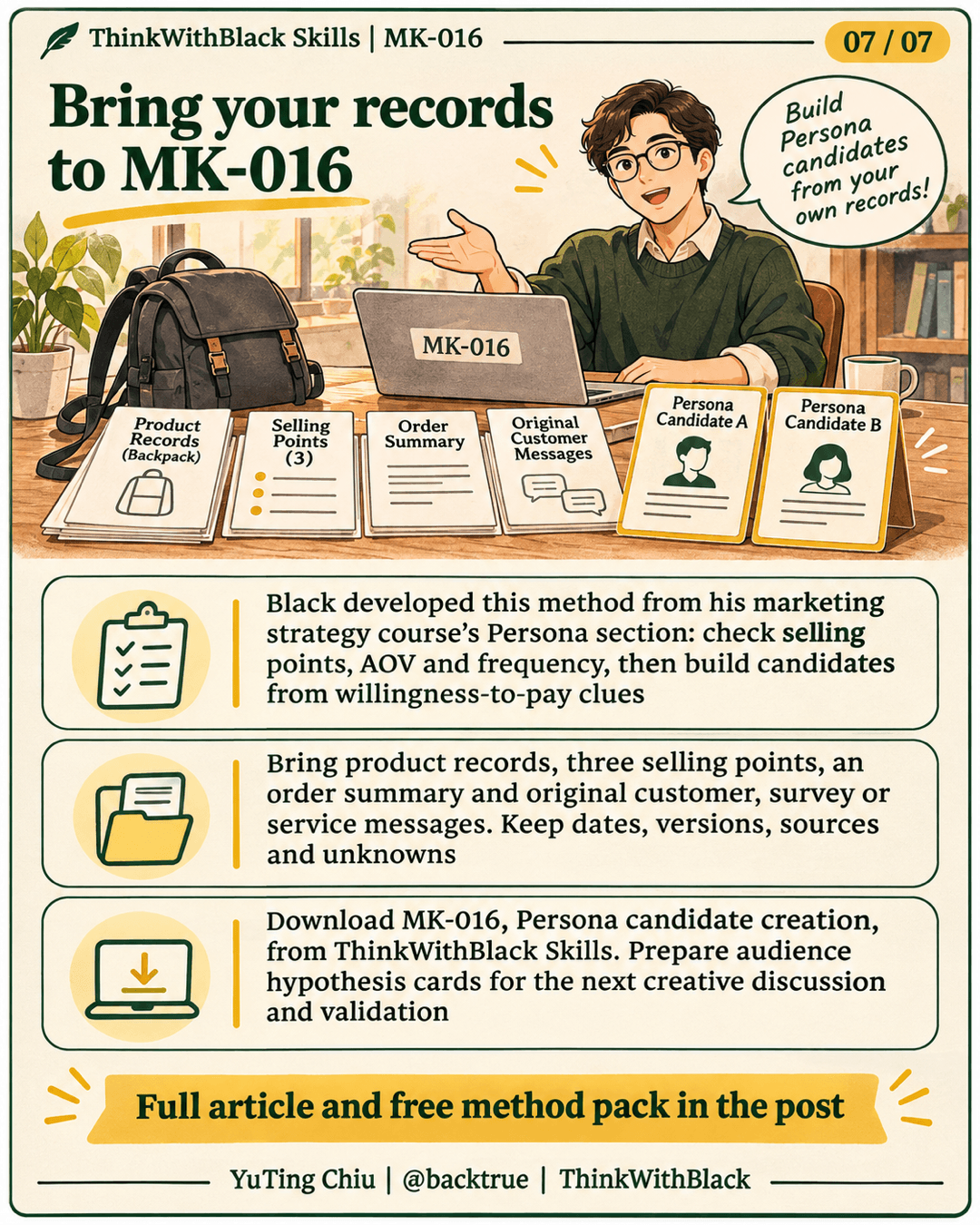
When you run this process on your own product, gather four inputs first: product specs, three selling points, an order summary, and raw quotes from customer reviews, surveys, or service logs. Keep the dates, product versions, and source locations attached as you organize; tie every filled field back to its source, and mark everything else unknown[1].
Once your records are ready, you can pass them to AI along with this prompt:
Use MK-016 to build Persona candidates. First check the three selling points, average order value, and purchase frequency, keeping the source for each item. Use working labels to separate candidates, and organize the demographic fields, three selection values, three purchase motivations, preferred brands, and a 5W1H story. Mark anything without data as unknown, list the buyer and end user separately, keep counterexamples and the items to validate next, and finish with the required output fields.
You can get the free materials at ThinkWithBlack Skills. Read INDEX.md first, then download the MK-016 complete method pack and run it with your own product records and customer logs before your next creative meeting.
MK-016 seven-page guide · 7 / 7 (/assets/skill-articles/mk-016-zh-07.png)
Bring your records into MK-016
- Download the MK-016 method pack
- First time? Download the index, let AI select the method, then upload the complete method pack with your records.
- Download the INDEX.md index · View full instructions (full URL: https://thinkwithblack.com/marketing-skills/#how)
This Skill's social posts
Choose a platform to view this Skill's infographic and post.
YuTing Chiu (Black) · @backtrue · ThinkWithBlack
Published 2026-11-06 · Updated 2026-11-06
This Skill article compiled from: Author background and courses
Find other Skill articles by operational problem → (full URL: https://thinkwithblack.com/marketing-skills/articles/)
References
- MK-016|Persona candidate creation (v0.3 method draft). ThinkWithBlack Skills, version v0.3 method draft. ↑
- The Persona fills a page, but design still has no scene to shoot: MK-016 Persona candidate creation. ThinkWithBlack, 2026-11-06. ↑
- MK-016 method draft, Section 3, "The specific method". ThinkWithBlack Skills. ↑
- MK-016 seven-page guide 3/7: C1 and candidate A. ThinkWithBlack, 2026-11-06. ↑
- MK-016 seven-page guide 4/7: C2 and candidate B. ThinkWithBlack, 2026-11-06. ↑
- MK-016 method draft, Section 6, "Required output fields". ThinkWithBlack Skills. ↑
- ペルソン設定〜Soup Stock Tokyoの「秋野つゆ」の成功事例からみるペルソナの作り方とは? (external public case, as a reference for field specificity). BRANDINGLAB. See also Marketing Strategy Practical Course Day 1 slide 42. ↑
- Marketing Strategy Practical Course Day 1 — Niche Is Mass × Precise Persona × Digital Assets, slides 50–52: values × purchase motivations → creative language. YuTing Chiu (Black), 2026. ↑
- Same slides 53–54: Jobs to Be Done and the three task categories. YuTing Chiu (Black), 2026. ↑
- Same slides 1, 10–11, 59: course topics and the digital assets section. YuTing Chiu (Black), 2026. ↑
- Same slides 12–14: niche is mass, let the Persona lock onto the niche and confirm through paid traffic. YuTing Chiu (Black), 2026. ↑
Image credits
- Featured image:
/assets/skill-articles/mk-016-zh-01.png(MK-016 seven-page guide 1/7) - Inline images:
/assets/skill-articles/mk-016-zh-02.pngthroughmk-016-zh-07.png(seven-page guide 2/7–7/7, placed in body order)