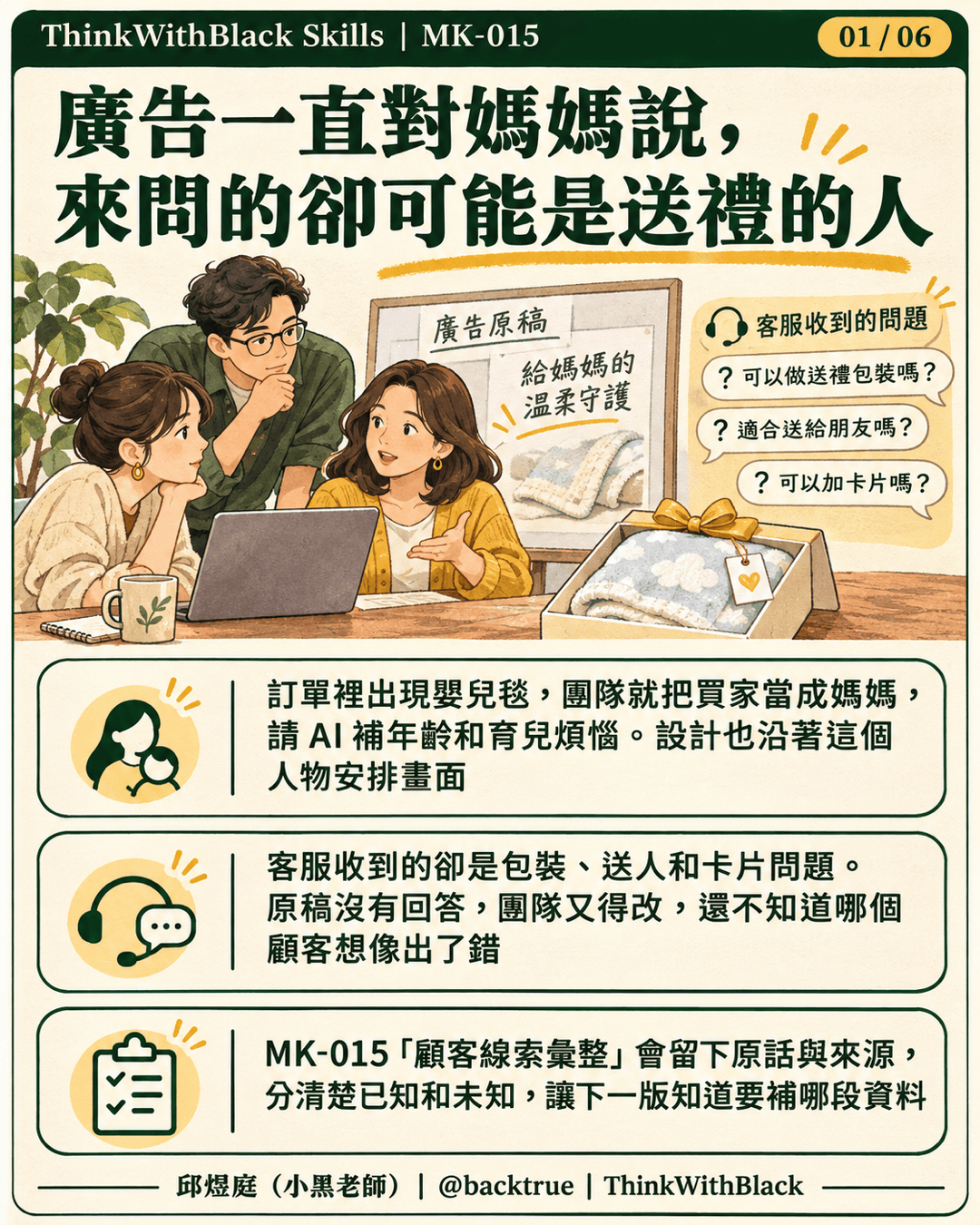
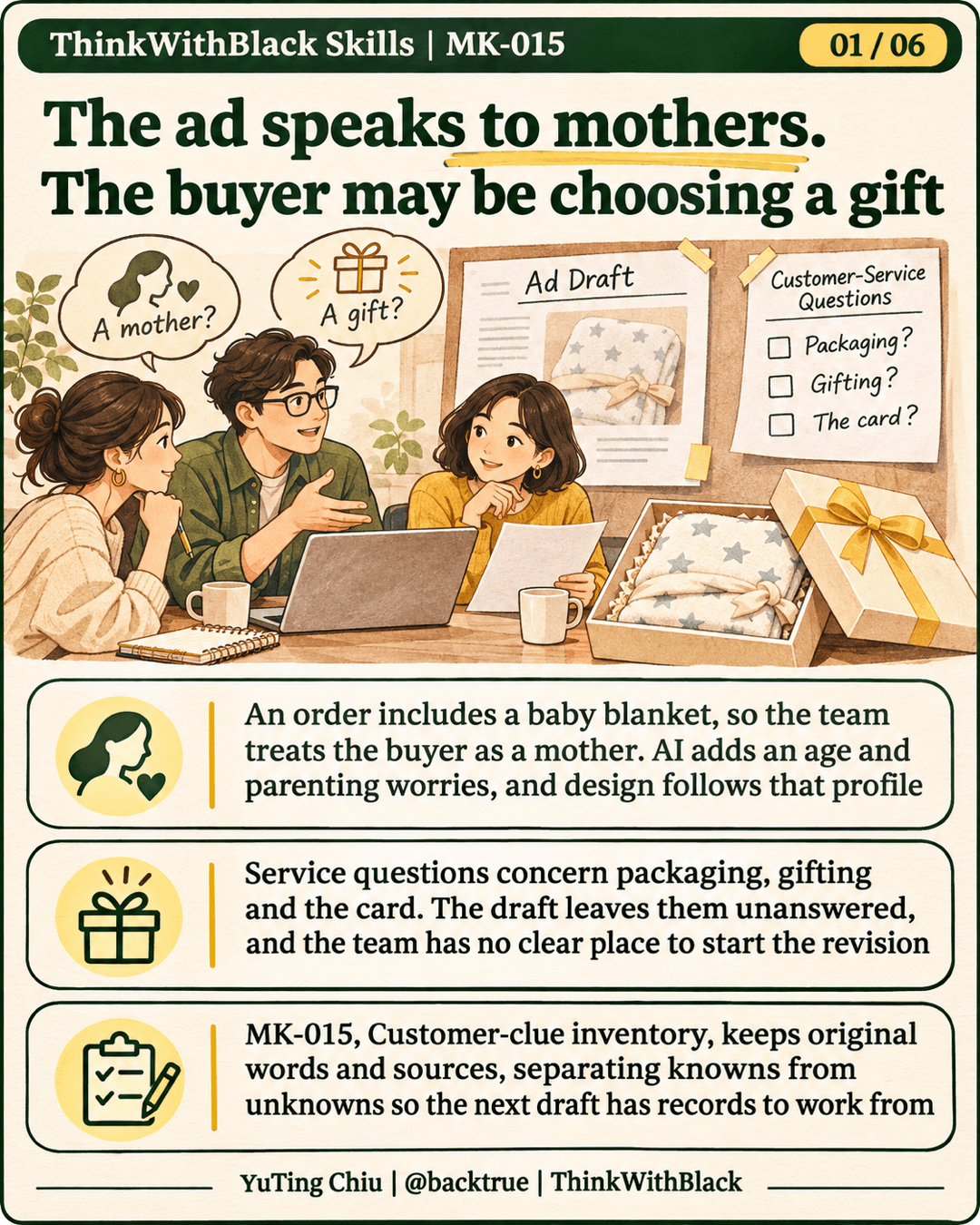
Yi-Ting had the order dashboard open on her left screen and a baby-product ad draft on her right. Her job that day was straightforward: find an audience direction from past orders for a baby blanket gift set and write ad copy that would speak to those buyers. The order list showed one unit purchased, a product amount of NT$1,200, and the buyer's name beside the purchase record. Yi-Ting glanced at the product name and turned to her team. "Anyone buying a baby blanket is probably a mother," she said. She asked AI to fill in the buyer's age, daily routine, and parenting worries. Within minutes she had a detailed customer profile, and she wrote the entire draft around a mother choosing a blanket for her child. The designer, Che, shot parent-and-child photos to match that persona. Mei-Hui, who handled customer service, was briefed to answer incoming questions using the product page once the ad went live.
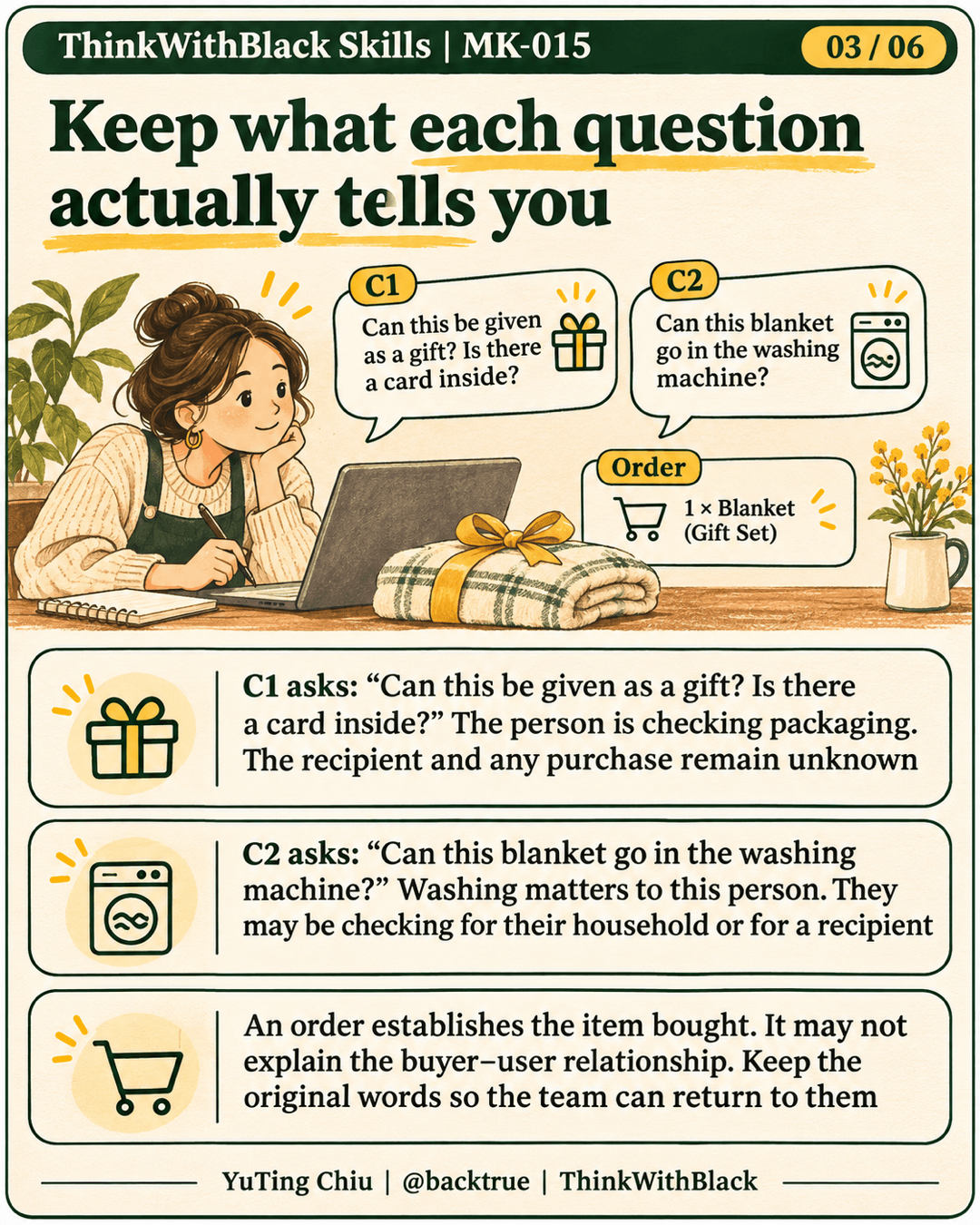
Three days later, Mei-Hui pasted two customer-service chats into the team channel. The first asked: "Can this be given straight to someone as a gift? Is there a card inside?" The second asked: "Can this blanket go in the washing machine?"
Yi-Ting stared at the two messages, then looked back at her finished ad copy. The second question was about washing instructions, which sounded like someone buying for their own home—though a gift buyer might also check care instructions on behalf of a friend. The first question clearly pointed to gifting, yet someone asking about a card might also want to write a keepsake note for their own child. A shopper choosing a present needs to know about the box and card right away, which is completely different from what a parent caring for a baby at home looks for. Because the ad copy spoke only to mothers, it said nothing about gift packaging or cards, and Che's photos showed only parents and babies. Customer service had to explain what came in the box one message at a time, and the team was stuck, unsure what to fix first in the next version of the ad.
That evening, Yi-Ting stopped tweaking the persona and laid out everything the team actually had on the table: the features stated on the product page, the exact questions customers had asked, and the team's own guesses about the buyers. To decide which use case the next ad draft should lead with—or what single piece of data they needed to collect first to tell those uses apart—she had to put all of those clues into one table for comparison. That is the job of MK-015, Customer-clue inventory: before writing a customer persona, separate product facts, customers' exact words, and brand assumptions, while keeping source records and open questions visible so the team can see what evidence it actually holds.
An order tells you what sold, not who uses it
Yi-Ting went back to the order record that had sent her in the wrong direction. An order proves what item someone bought, how many units they ordered, and how much they paid. How the buyer relates to the actual user lies outside the order fields. Someone buying a baby blanket might be buying it for their own home or as a gift for a friend. The person paying with a credit card and the person putting the blanket into the washing machine while caring for the baby may not be the same person.
When you ask AI to fill in those blanks directly, the model follows your prompt and invents a complete set of ages, daily schedules, and parenting anxieties. The copy and visuals built downstream then carry that invention forward. On paper, the team holds a detailed audience profile; in reality, it still has no data confirming whether most customers buy the blanket for their own household or as a gift.
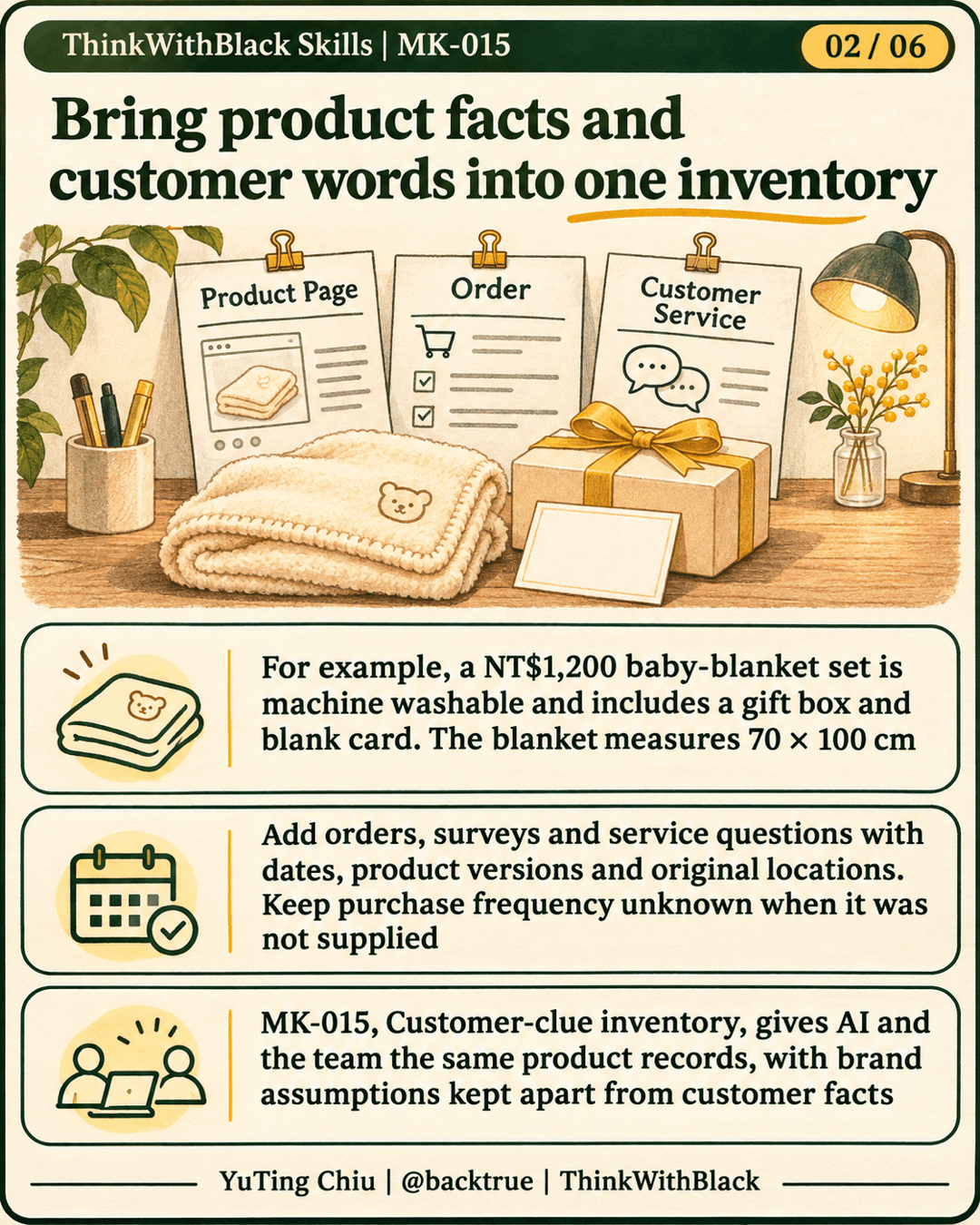
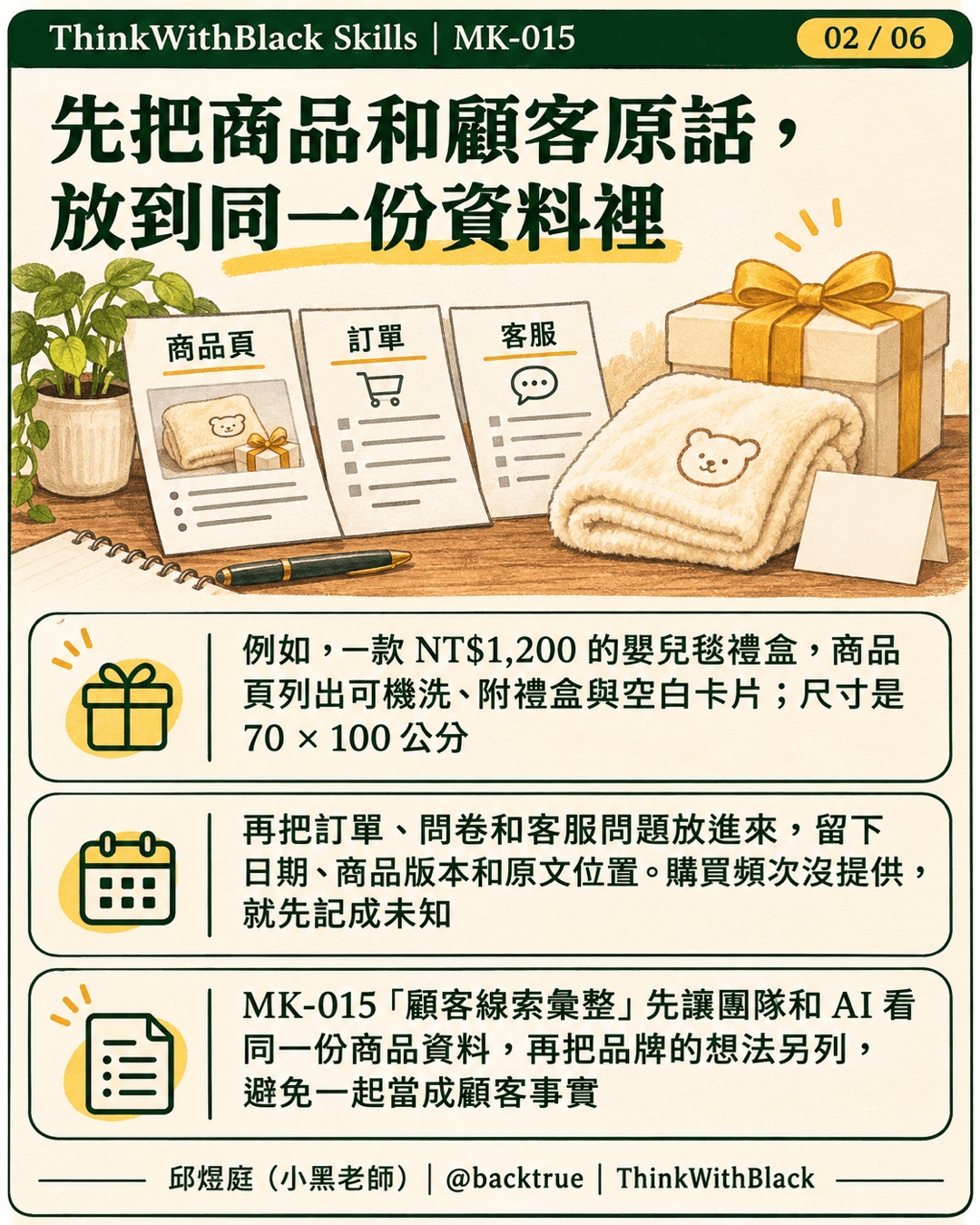
To avoid rebuilding campaigns on guesswork, Yi-Ting reorganized the team's records using MK-015. She gathered the product photos, the product page or sales kit, three established selling points, the price, purchase frequency, and existing customer data, then added survey responses and customer-service chats. Keeping product facts, customers' exact words, and brand assumptions in separate columns gave AI and the team a shared baseline to work from.
Organize the records for one baby blanket gift set
Yi-Ting laid out the records for the store's baby blanket gift set one by one, checking what each record actually proved and what it left unanswered. The gift set sells for NT$1,200 and measures 70 × 100 cm. The product page lists three selling points: a machine-washable blanket, an included gift box, and a blank card for a handwritten note. When customer service explains machine washing to shoppers, the reply must follow this specific item's care label.[1]
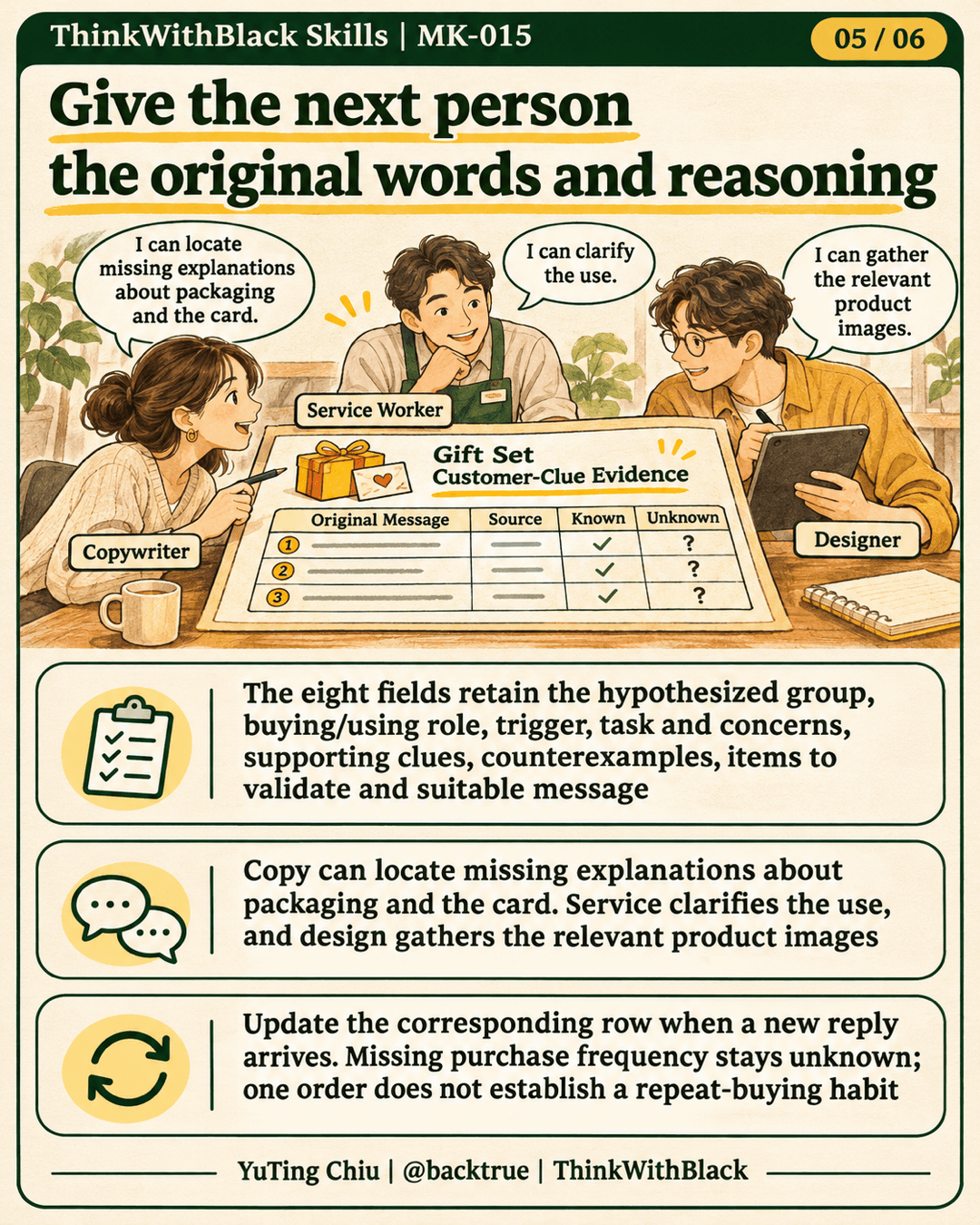
As she prepared the inventory, Yi-Ting noted the product-page version, the order date range and item model, and the dates and channels of the customer-service inquiries, putting them into an initial comparison table:
| Raw clue and source | What is known | What remains unknown |
|---|---|---|
| Product page P1: NT$1,200, 70 × 100 cm, machine washable, includes gift box and blank card | The item's price, dimensions, and what is in the box; machine-washing instructions must follow the care label | Which feature drives customers to buy; requires customer records |
| Order O1: 1 unit of this gift set purchased, product amount NT$1,200 | Someone bought one unit of this item | Buyer identity, who it was bought for, actual user, and purchase frequency are not provided |
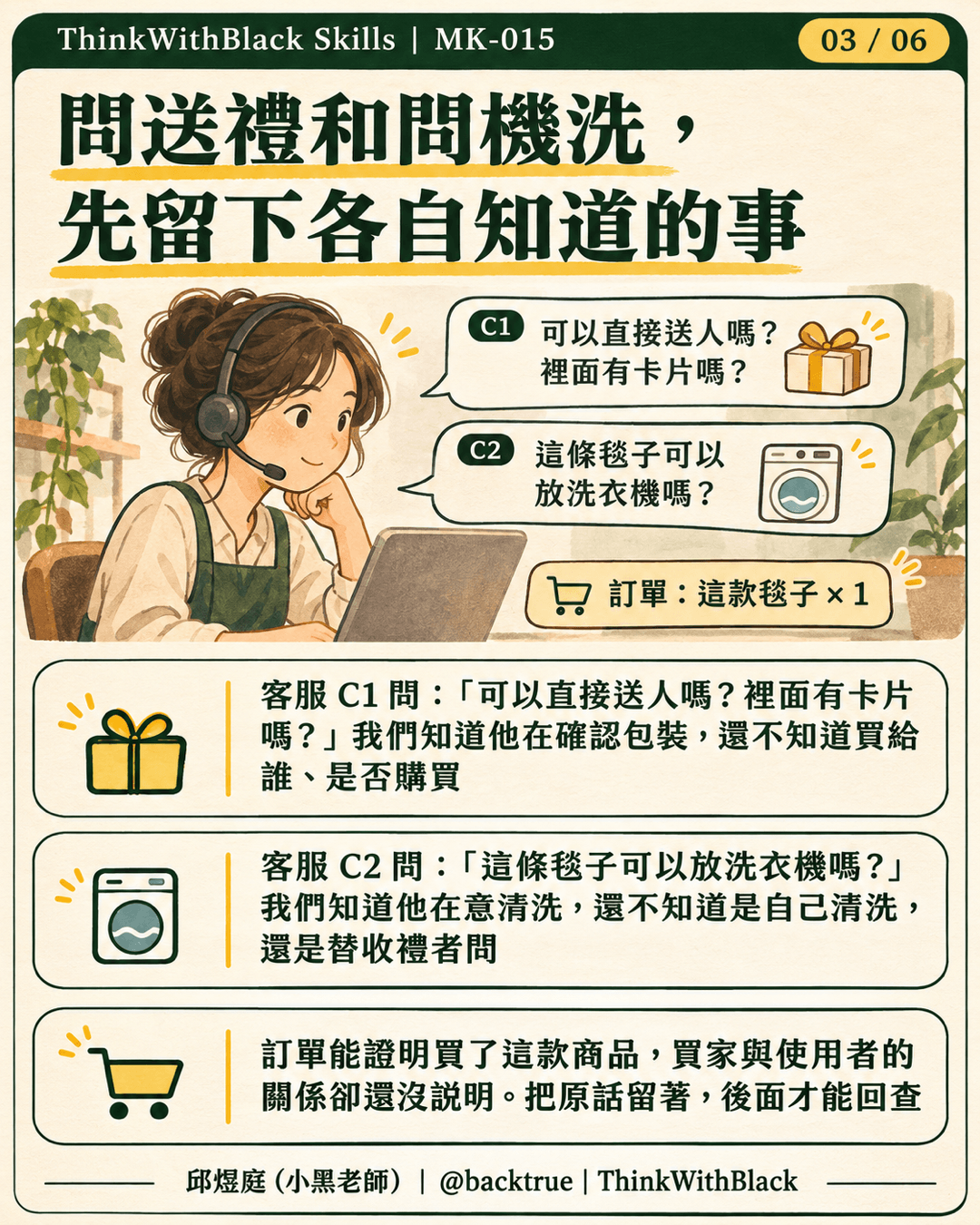
| Service inquiry C1: "Can this be given straight to someone as a gift? Is there a card inside?" | This shopper is checking gift packaging and whether a card is included | Whether it is for someone else, when it will be given, and whether the shopper bought it remain unconfirmed |
| Service inquiry C2: "Can this blanket go in the washing machine?" | This shopper cares about how to wash the blanket | Whether they will wash it themselves or are checking on behalf of a gift recipient remains unconfirmed |
| Brand discussion B1: "The main buyers are probably mothers" | The team currently holds this assumption | No data yet supports the buyers' identity or their share of orders |
Keeping customers' exact words intact shows where to look next. C1 asks whether the set can be given straight to someone and whether it includes a card, giving the team a direct lead on gifting needs. C2 asks about machine washing; besides someone washing the blanket at home, a gift buyer might also ask this to make sure the blanket is easy for a friend to care for. A single question is not enough to lock a customer into a fixed identity without further records.
Yi-Ting also drew a strict line here: the price, dimensions, included gift box and blank card, and machine-washable specification stay anchored to the product page and care label. Those product facts do not change; only "who buys and why" is left for follow-up clues to answer.
Hold both use cases open until new records separate them
With the five clues on the table, Yi-Ting saw that the evidence pointed to two possible use hypotheses at the same time: "preparing a gift" and "household use." Here, a hypothesis is simply a direction for the team to verify next—used to decide which records to check or what follow-up question customer service should ask, not to estimate demographic breakdowns or market share.
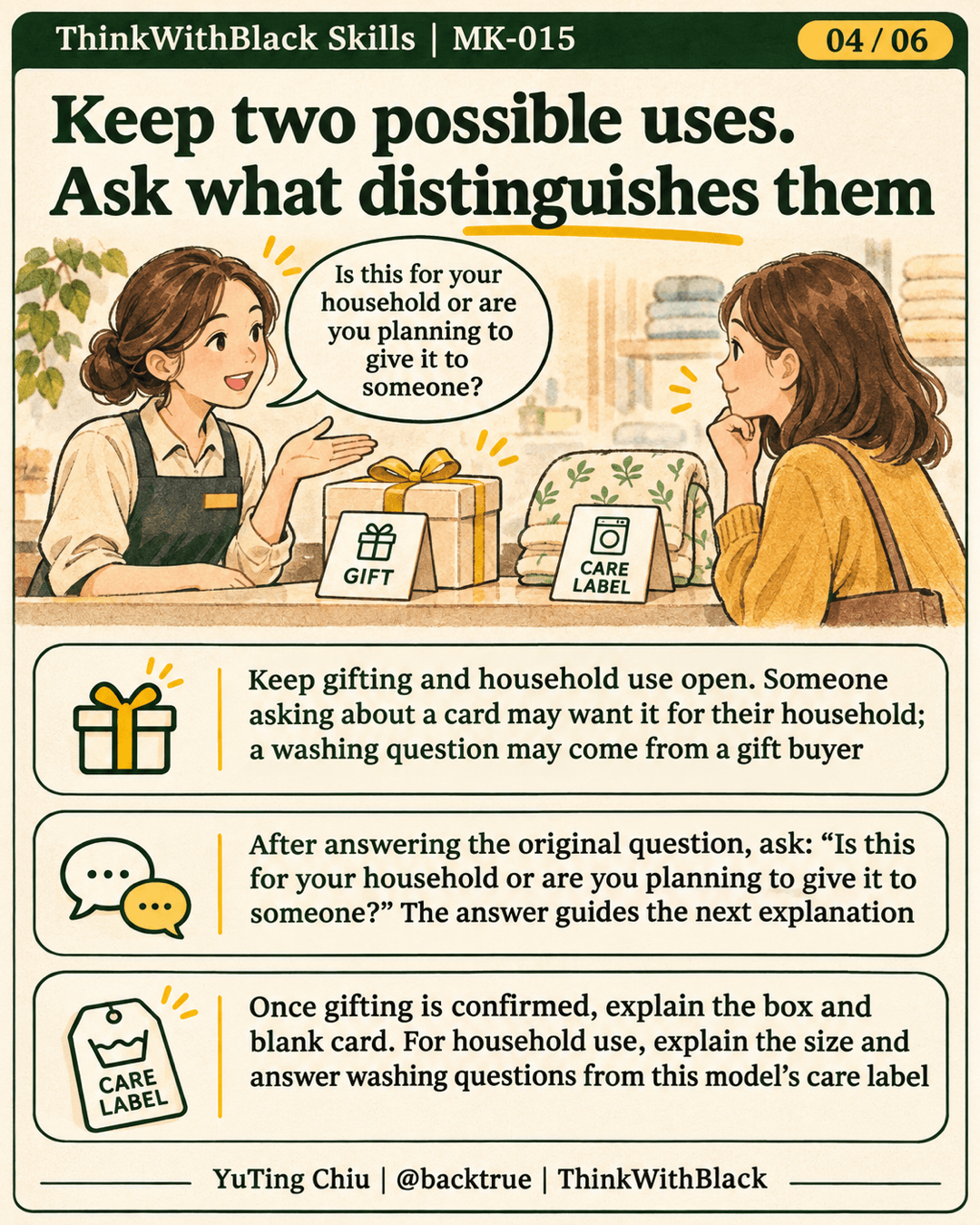
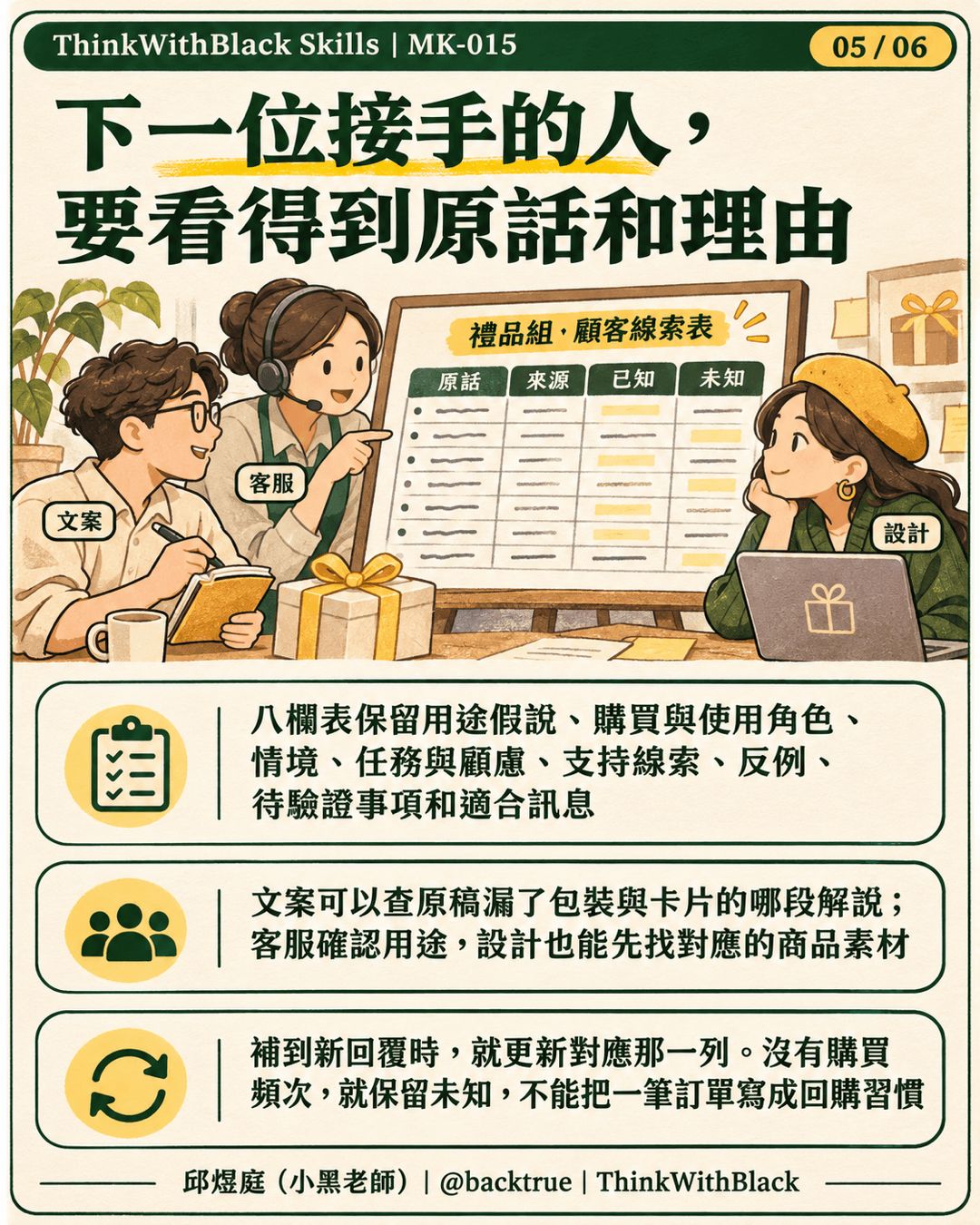
Yi-Ting placed both use cases side by side across the eight required fields of MK-015. That way, the copywriter revising the ad, Che preparing visuals, and Mei-Hui answering chats could see at a glance which clue supported each inference and what still needed confirmation:[2]
| Required field | Hypothesis: Preparing a gift | Hypothesis: Household use |
|---|---|---|
| Hypothesized group | People choosing a baby gift | People choosing a baby item for their own household |
| Buying / using role | The buyer may give the blanket to someone else; exact relationship unconfirmed | The buyer may use it themselves or buy for family; primary caregiver unconfirmed |
| Trigger situation | Asking about the gift box and card; recipient and occasion timing unconfirmed | Asking about machine washing; actual usage timing unconfirmed |
| Tasks and concerns | Wants to verify how to present the gift and what is inside the box; other concerns yet to be asked | Wants to verify how to wash the blanket later; other concerns yet to be asked |
| Supporting clues | Exact wording of C1, plus gift box and card details from P1 | Exact wording of C2, plus machine-washable spec from P1 |
| Counterexamples | Someone asking about a card may want a keepsake for their own child; C1 does not confirm gifting | A gift buyer may also check washing instructions for the recipient; C2 does not confirm household use |
| Items to validate | Household use vs. gift, buyer–user relationship, when it will be given, and whether a purchase followed | Household use vs. gift, who washes it, usage setting, and purchase frequency |
| Suitable message | Once gifting is confirmed, lead with the included gift box and blank card so the buyer knows what else to prepare | Once household use is confirmed, state the 70 × 100 cm size and explain machine washing and care according to this item's care label |
Every role and motivation in the eight fields traces straight back to a supporting clue. B1—"the main buyers are probably mothers"—remains a team assumption and stays out of the supporting-clues row until real records back it up. Yi-Ting also recorded counterexamples in both columns: a shopper asking about the card might want to write a keepsake note for their own baby, and a shopper asking about machine washing might be shopping for a friend. Whenever a counterexample turns up, the team updates the use hypothesis while keeping the original source and chat log intact.
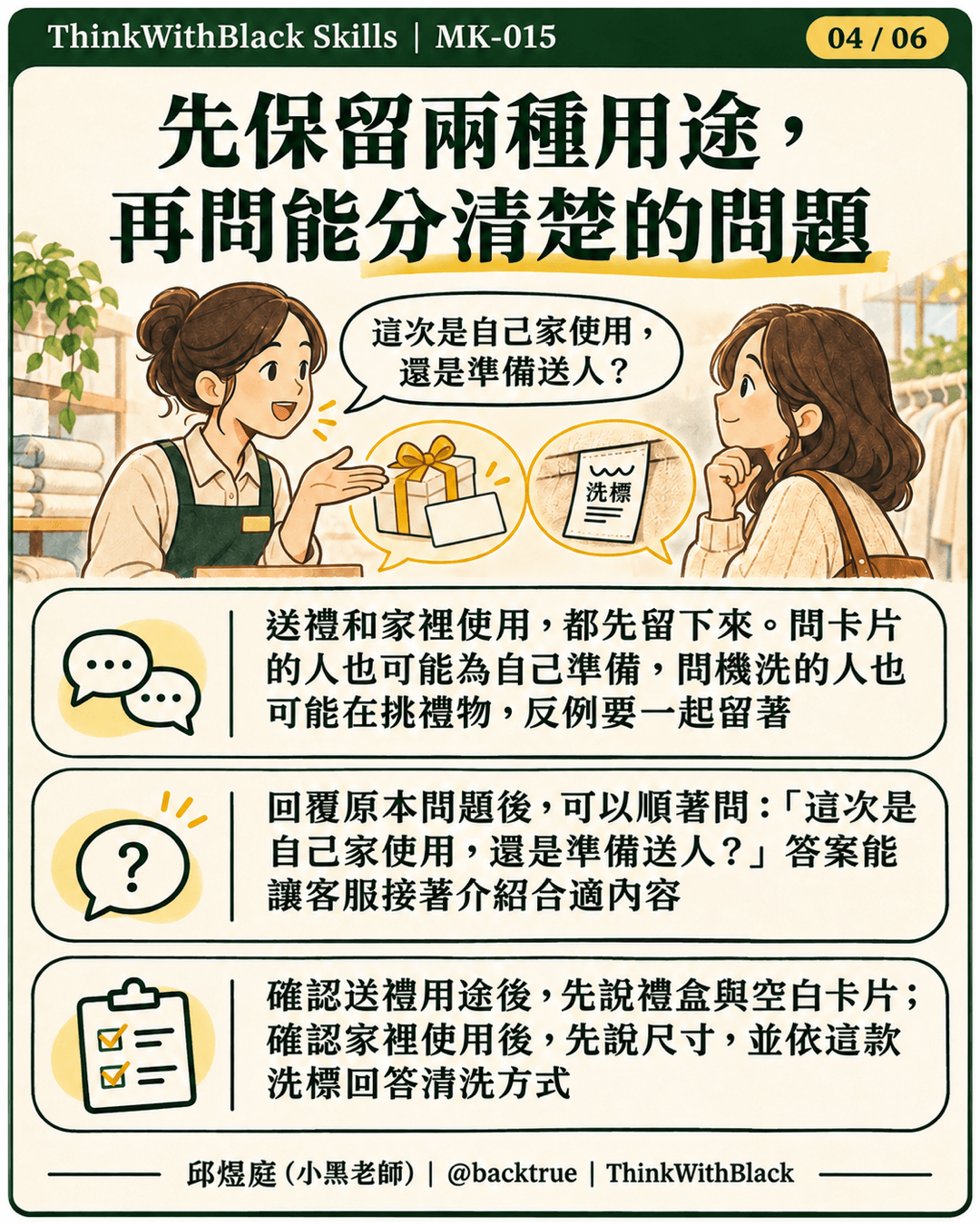
Laying out the eight-field table also made it obvious what single question would separate the two uses. Yi-Ting and Mei-Hui agreed that after customer service answered any question about packaging or washing, Mei-Hui would add one natural follow-up question: "Is this for your own home, or are you preparing a gift?"[3] The customer's reply tells the team what the purchase is for right away, and tells Mei-Hui whether to highlight the gift box and blank card next or walk through care instructions from the care label.
Bring the table back to the desk to guide the next revision
With the eight-field table in hand, Yi-Ting, Che, and Mei-Hui each knew their next step, and the team had a clear rule for making decisions.
Comparing the eight-field table against her original ad draft, Yi-Ting immediately saw the gap: the entire draft talked about mothers caring for babies and never mentioned the gift box or card. She logged that missing piece and added the verified gift box and blank card details from the product page. For whether the next ad campaign should lead with a gifting angle, she set a clear threshold: wait until Mei-Hui's chat logs accumulate enough confirmed gifting replies before switching the primary ad angle to gifting. Until then, keep both use hypotheses open side by side.
Che changed how he prepared visual assets. He put together clean shots of the gift box exterior, the blank card, the 70 × 100 cm dimension graphic, and the care-label instructions first. Once the team confirmed which use case the next campaign would focus on, he could assemble the matching ad visuals right away.
With that one follow-up question added to her customer-service replies, Mei-Hui could also answer shoppers from the same verified product sheet. What the team kept was a living customer-clue table built from customers' exact words, sources, knowns, and unknowns. Whenever new survey responses or chat logs arrive, the team opens the table, finds the matching row, and updates the use case and role directly—without guessing an entire persona from scratch. As for the missing purchase frequency in order O1, it stays marked as unconfirmed until new data comes in, and a single order is recorded strictly as one purchase.
When you bring this workflow back to your own team, you can track two practical indicators before and after the change: first, check your customer-service logs and order records to calculate the share of total inquiries where the reply clearly identifies the buyer's intended use; second, watch whether the team spends less time redoing ad visuals or repeating basic product explanations because the buyer's use case was unconfirmed. Once incoming records clearly show whether customers are buying for themselves or for gifts, you can stop carrying both hypotheses in parallel and organize your messaging around the confirmed use. And if your product serves only one use case from the start, the clue inventory shifts its focus to checking whether the person paying and the person actually using the product are two different roles.
Why Black starts with this step
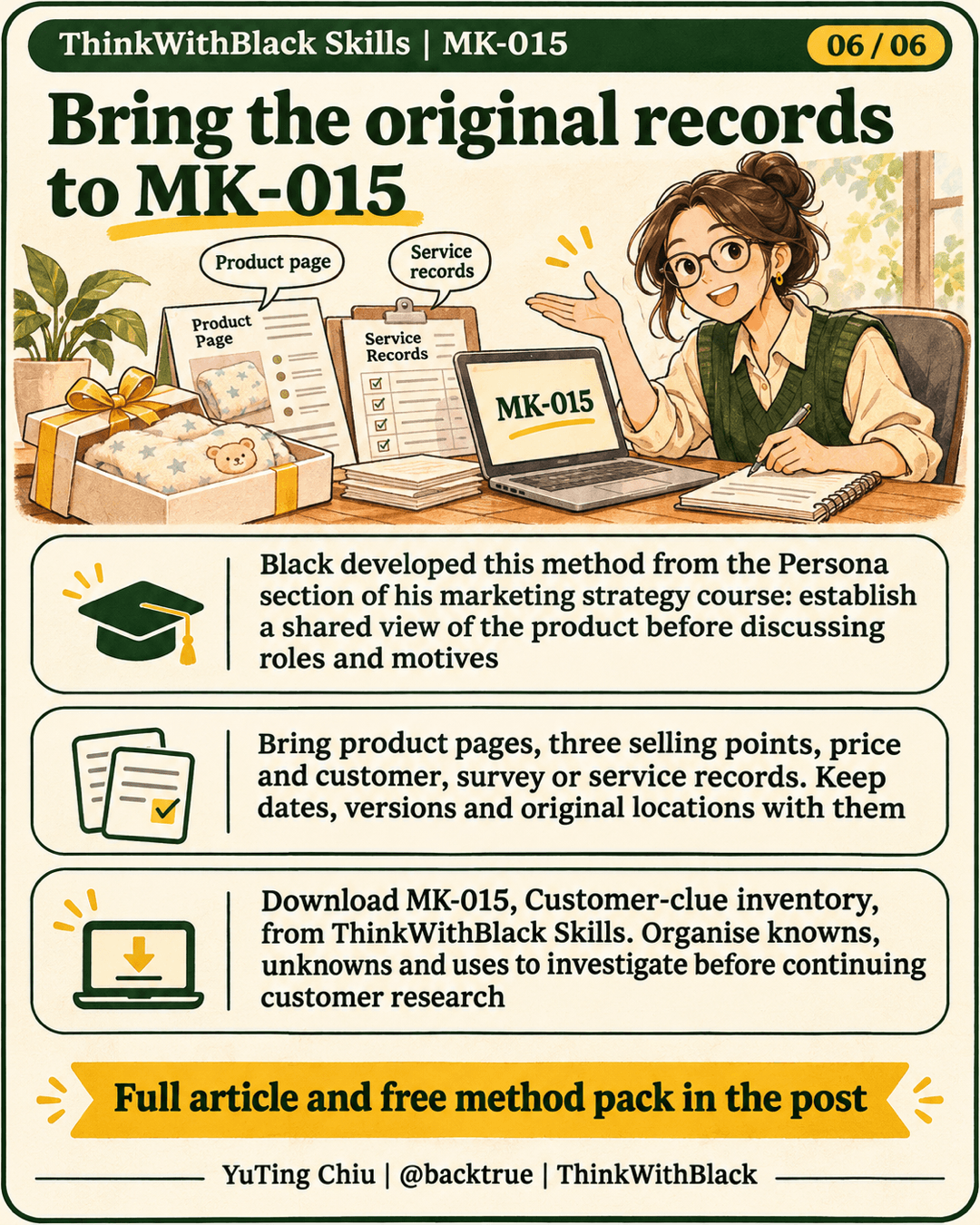
Cataloging clues before generating a persona comes from the Persona module of Marketing Strategy Practical Course Day 1 – Niche Is Mass × Precise Persona × Digital Assets. Slide 18 of the course handout notes that the most important step before prompting AI is building a "shared view"—giving AI the product photos, product page, or sales kit so both the model and the team understand the product's actual specifics first.[4] Slide 17 breaks the sequence down: verify that AI understands the product, extract three core unique selling points (USPs), discuss pricing and willingness to pay, and only at Slide 41 move into generating a persona.[5]
MK-015 turns that preliminary "shared view" step into an auditable table. It aligns AI and the team on product facts before anyone discusses customer roles or motivations, and it keeps product facts, brand assumptions, and untested hypotheses in separate buckets. Walking through this round showed Yi-Ting that the earlier you separate what is known from what still needs checking, the firmer the ground your later copy and visuals stand on. The full method and source notes are preserved in the MK-015 Chinese method pack.
Bring your own data into MK-015
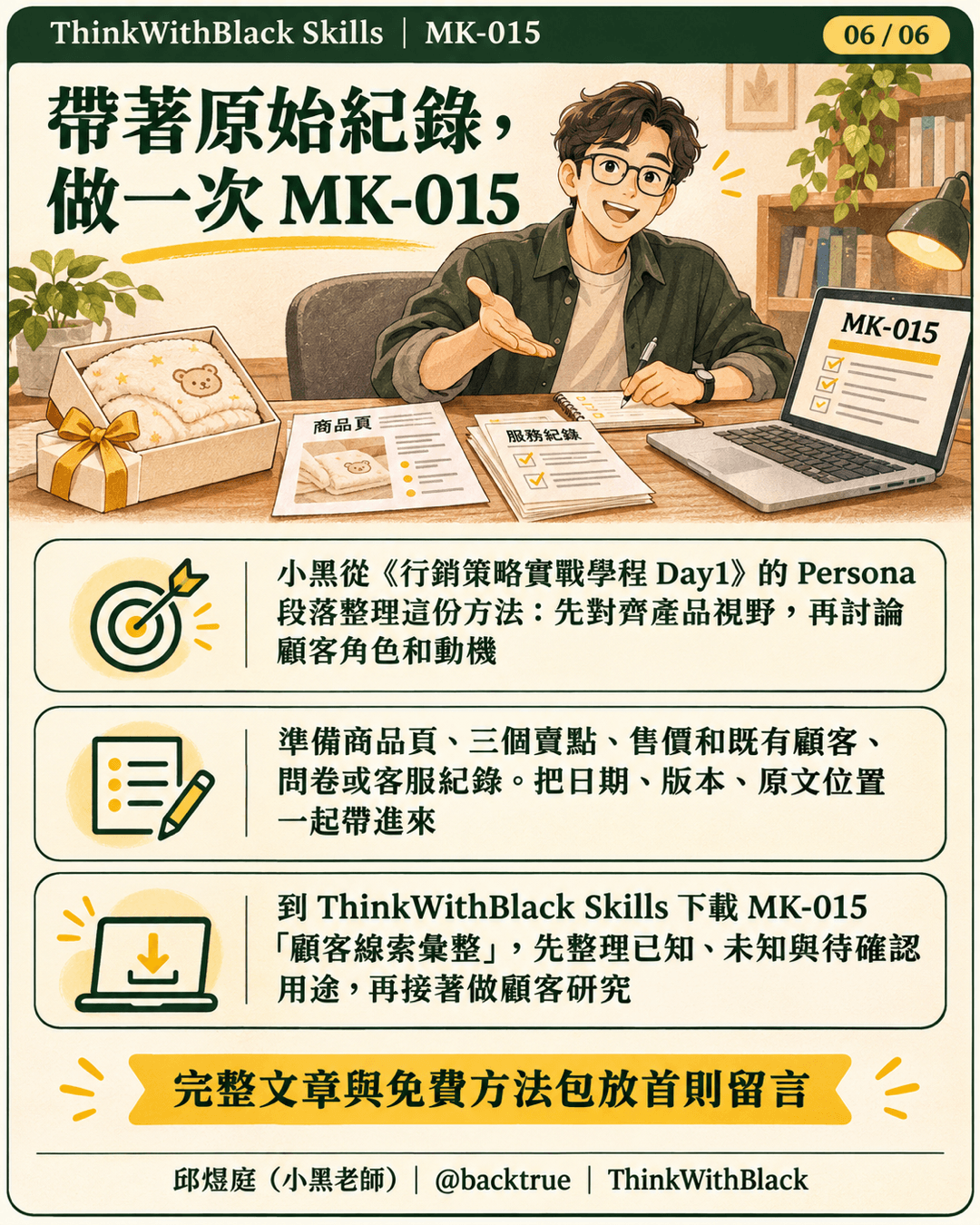
To run your own product and customer records through MK-015, gather your product page or sales kit, three established selling points, price, and any existing customer data, surveys, and customer-service logs. Include purchase frequency if you have records for it; if not, mark it as not provided. Record the date, version, scope, and original location for every file so any later decision can be traced back to its source.[6]
Once your materials are ready, give AI this prompt to build the initial table:
Use MK-015 to organize these product and customer records, keeping raw clues, sources, knowns, and unknowns intact. Separate product facts, brand assumptions, and use cases to be verified. List buyers and users separately, keep counterexamples and follow-up questions that distinguish use cases, and organize the result into the eight required fields.
After AI generates the first draft, review each row with your team to make sure every claim links back to a real supporting clue, leaving anything without a source in the items-to-validate row so your next ad draft and customer-service questions build on verified ground.
Get the free materials at ThinkWithBlack Skills: read INDEX.md first, then download the complete MK-015 method pack. Bring your raw records and put this table together first.
Bring your data into MK-015
- Download the MK-015 method pack
- First time using the packs? Download the INDEX.md index first to let AI select the right method, then upload the full method pack along with your data for this task
- View the full operating instructions
Social posts for this Skill
Select a platform to view the infographic and post for this Skill
YuTing Chiu (Black) · @backtrue · ThinkWithBlack
Skill guide compiled by: Author background and courses
Find other Skill articles by operational problem →
References
- 廣告一直對媽媽說,來問的卻可能是送禮的人:MK-015 顧客線索彙整 (The Ad Speaks to Mothers, but the Buyer May Be Choosing a Gift: MK-015 Customer-Clue Inventory). ThinkWithBlack, 2026-11-06
- MK-015|顧客線索彙整 v0.3 方法稿 (MK-015 Customer-Clue Inventory v0.3 Method Pack). ThinkWithBlack Skills, version v0.3
- Ibid., Section 3 (Specific method for this item) and Section 6 (Required output fields)
- 行銷策略實戰學程 Day1-小眾就是大眾 × 精準 Persona × 數位資產 (Marketing Strategy Practical Course Day 1 – Niche Is Mass × Precise Persona × Digital Assets), Slide 18. 2026
- Ibid., Slide 17, Slide 41
- Same as Note 2, Section 2 (Required data and how to obtain it first)