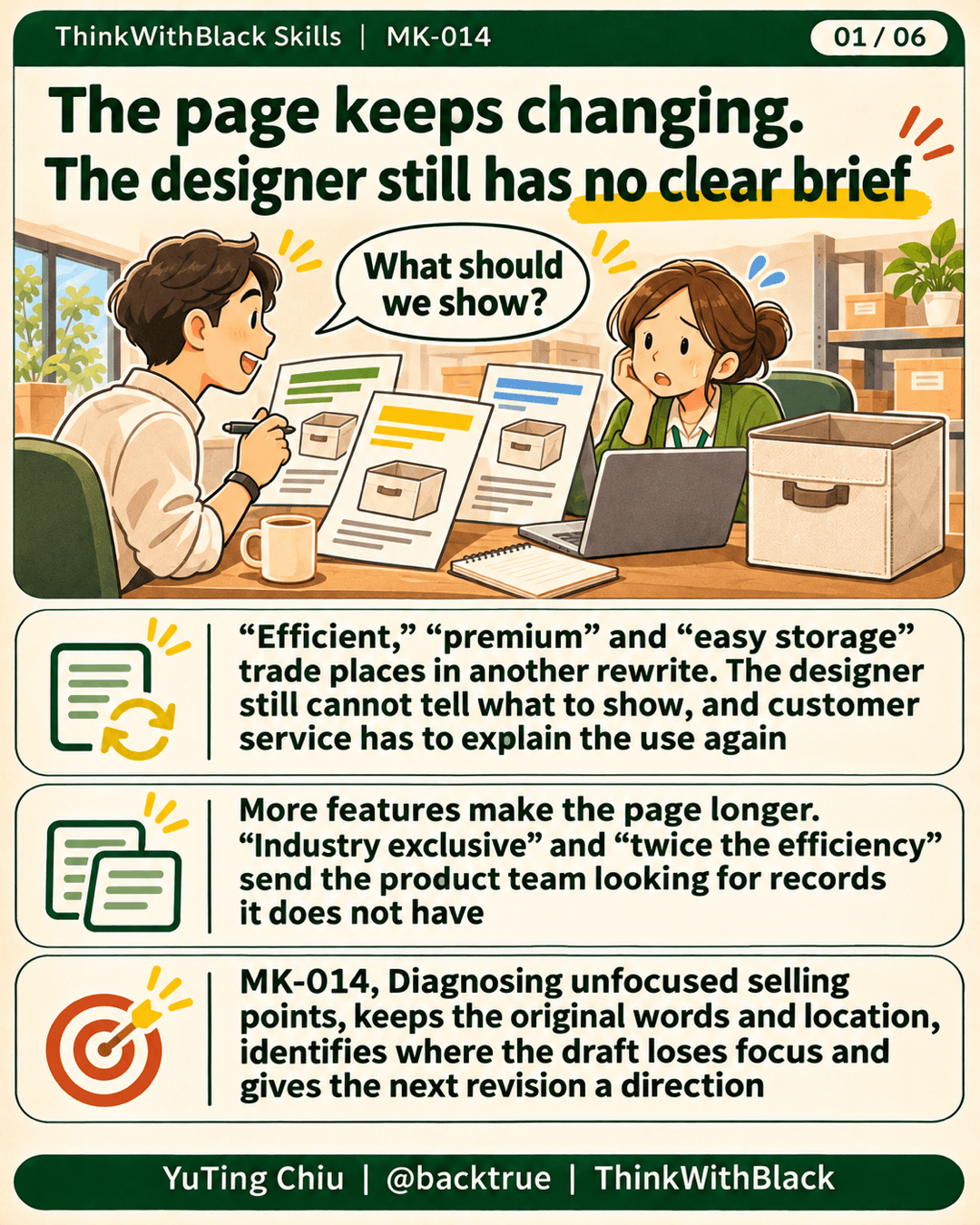
When copywriter Lin Yijie pasted the third draft of the hero section for a storage box product page into the team group chat, designer Zhou Pinyu replied right away: "So should the key visual show the box, or a person?"
The chat went quiet. The page had already gone through three rounds of edits. Its hero line had shifted from "efficient, premium, easy storage" in the first draft to "the industry's only efficient storage assistant" in the third. The opening paragraph read, "This product features a front door, side handles, and a folding structure." Below that, the selling-point section listed the front door, handles, foldability, color, material, and appearance at the exact same level, with a "twice the efficiency" badge tucked into the corner. Each revision added more words and stretched the page longer, yet Zhou Pinyu's photo shoot brief was still blank. Customer service representative Chen Boyu faced the same issue: every time a shopper asked about the box, he had to explain from scratch how it was meant to be used and then ask where they planned to put it. Meanwhile, when the product team saw "industry's only" and "twice the efficiency" in the draft, all they could do was check whether anyone actually had competitor comparisons or timed test records on hand.
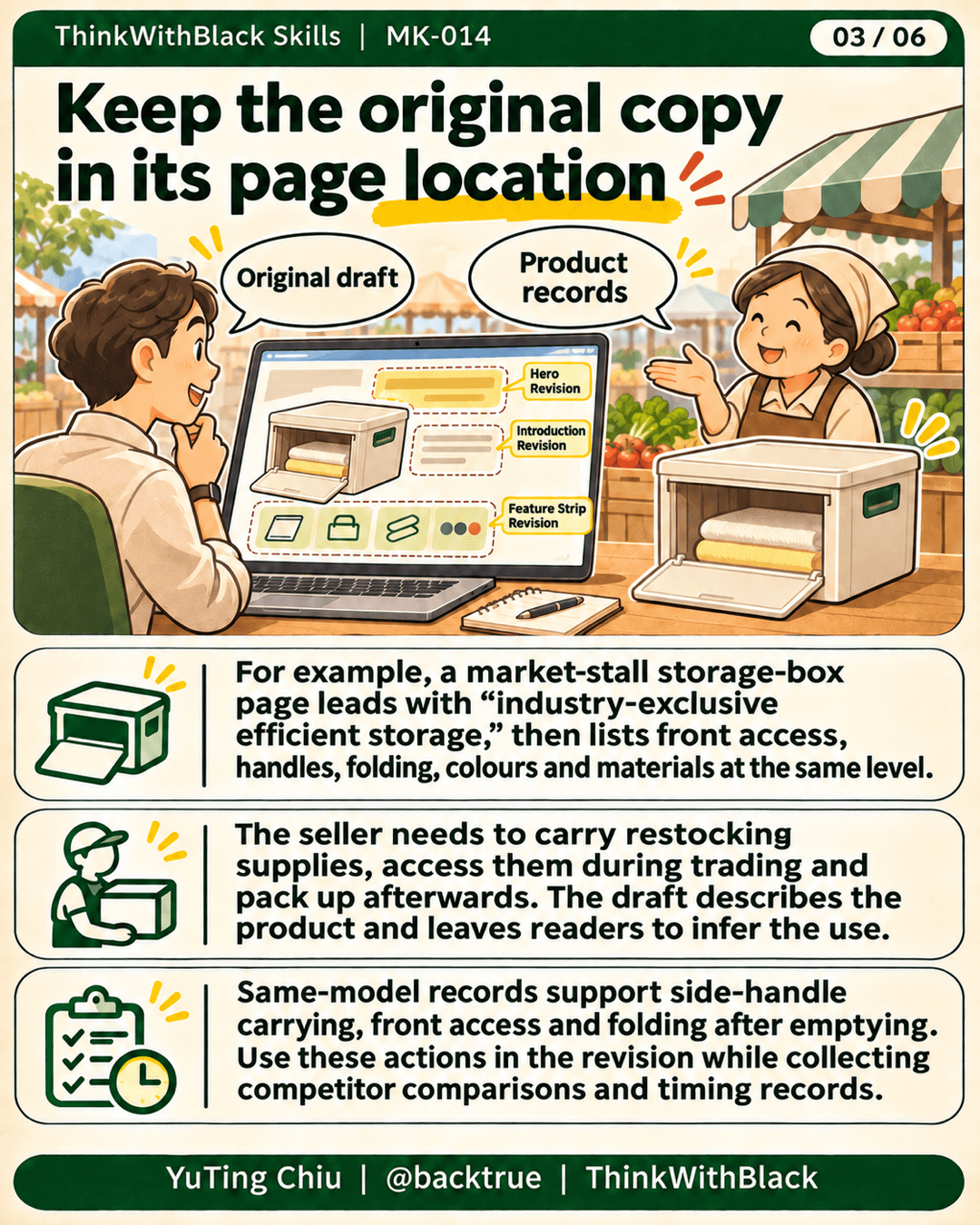
Lin Yijie laid all three drafts side by side and decided to stop swapping out adjectives. She kept the existing lines and their exact page locations intact, then checked every sentence against the spec sheet and operating demo for that exact storage box model. The product documentation was already specific: this box is built for market-stall vendors carrying restocking supplies to their booths. A vendor grips the side handles to carry the box to the stall, opens the front door to grab supplies during business hours, and empties the box at closing time before folding it flat by hand and sliding it back onto a trolley. Those three actions were exactly what the demo video showed. By contrast, nothing in the product files backed up the hero section's "industry's only" claim or the badge's "twice the efficiency"—there were no competitor comparisons and no time measurements for the task.
Comparing the draft against the product files showed Lin Yijie where the page had drifted from the product's actual value. The hero slogan could be pasted onto almost any product; the opening paragraph described hardware without a single user in sight; the selling-point section gave every spec equal weight; and the badge promised a number with no records behind it. She put the original lines from those four spots, the reason each one stalled, and the next revision step into a single table so the team could start from the same page.
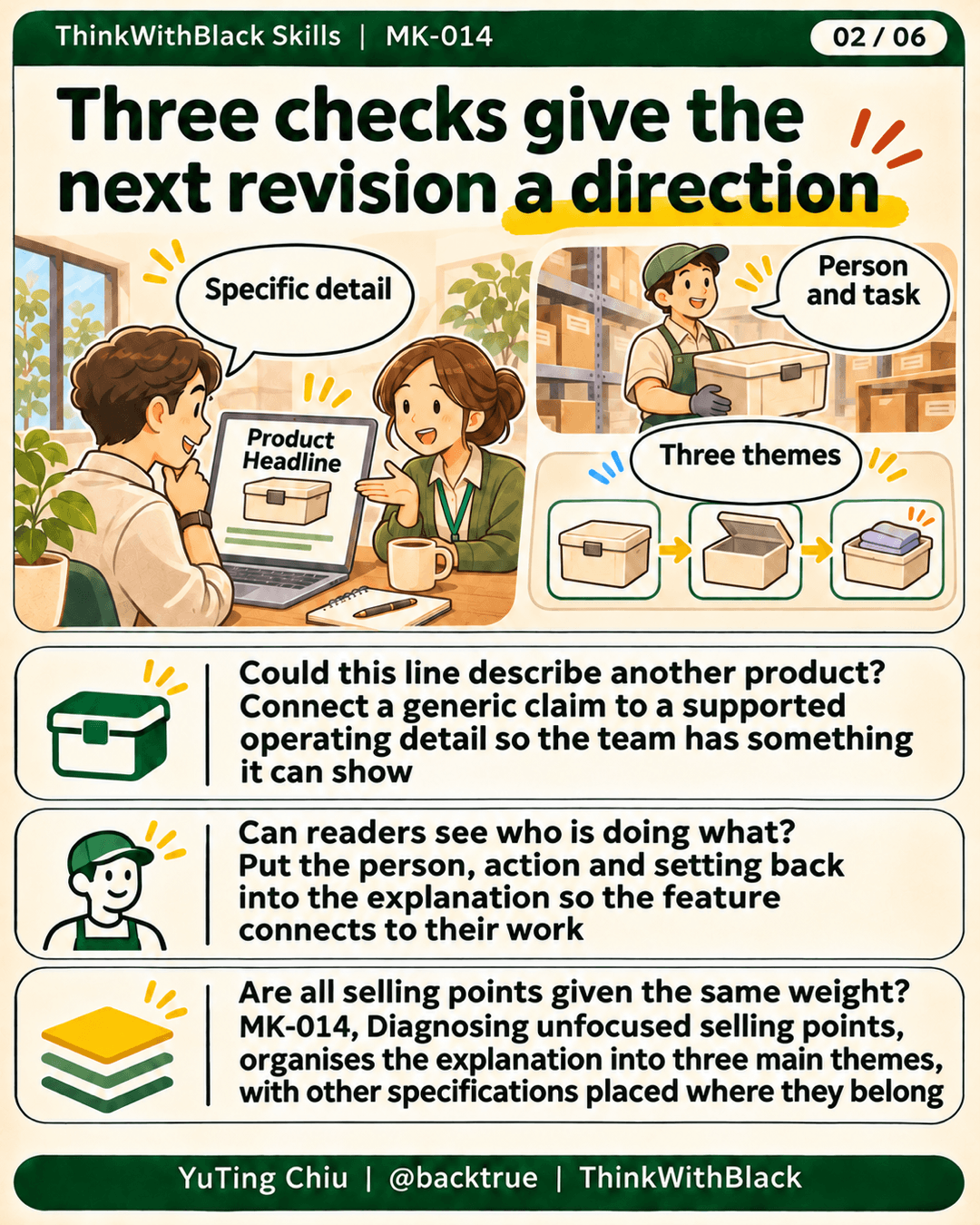
When a product page goes through round after round of word edits without giving the designer a clear shot list, start by keeping the original text and its page locations, then ask three questions: Could this sentence apply to a completely different product? Can the reader tell who is doing what? Have you grouped a long list of features into three main angles? That is what MK-014, "Diagnosing Unfocused Selling Points," is built to do. It locates where copy drifts from the product's core value, separates features from benefits and evidence, narrows operations backed by same-model specs and demos into three main themes, and flags claims that still need competitor comparisons or same-condition timing as pending verification—so the team knows where to start the next draft, which three actions the designer needs to shoot, and which records the product team needs to gather first [1][3].

Find where the draft is stuck before you rewrite
Lin Yijie looked back at the first draft's "efficient, premium, easy storage." Those words could describe almost anything. When copy stops at broad adjectives instead of naming what the product actually does, Zhou Pinyu is left hunting for generic "nice-looking" photos, and sales and customer support have nothing concrete to build on. That is the first common way copy loses focus: it leans on a generic slogan that would fit another product category just as well.
Next, she checked the opening description carried over from the second draft: "This product features a front door, side handles, and a folding structure." It lists the hardware thoroughly—materials, build, colors, and parts—without ever showing a person using the box. Shoppers are left to figure out on their own what those parts have to do with their work. Putting the user, the action, and the setting back into the sentence is what lets the team decide which feature belongs at the top of the page.
The third bottleneck for Zhou Pinyu sat in the selling-point section. Front door access, handles, foldability, color, material, and appearance were all presented at the same hierarchy. When every detail looks equally important and the layout is crowded with badges and specs, a designer cannot tell what the first image should show or how the next image should follow. Grouping the pitch into three main themes—and moving color, material, and appearance into supporting roles under those themes—gives copy and design the same sequence to work from.

Black's method: go back to the original lines and mark where they drift
The three questions Lin Yijie used to check the draft line by line match the three checks in MK-014: exclusivity, personal relevance, and focus. In plain terms, you check whether a claim is grounded in the product itself, whether it connects to the user's job, and whether too many points are crammed into one place. You run the check in three steps:
- Exclusivity: If a unique selling proposition (USP) could be dropped straight onto another product, flag it as unfocused on exclusivity.
- Personal relevance: If the product is the only subject in the sentence and there is no user or action, flag it as unfocused on relevance.
- Focus: If a section piles up selling points without three clear themes, narrow the copy back down to three USPs. Whenever a numerical claim lacks backing data, state clearly which record is missing and keep the published wording within what your current evidence supports [1].
During the review, you also split every point into feature, benefit, and evidence:
- Feature: How the product is built and how it works—such as side handles, a front door, and a folding frame.
- Benefit: How that build helps a specific user do a specific job—such as a market-stall vendor carrying restocking supplies to a booth, grabbing items during business hours, and folding the empty box flat onto a trolley after closing.
- Evidence: The proof behind those statements—same-model spec sheets, operating demos, competitor comparisons, or timed task records.
Separating these three layers makes the next move obvious: you know right away whether to fill in operating details, reorder the page, or ask the product team to gather missing data first. This rule also draws a firm line for the page: publish only product differences you can verify now, and hold any claim that still needs comparison or measurement in a "pending verification" bucket until you have checkable records [1].
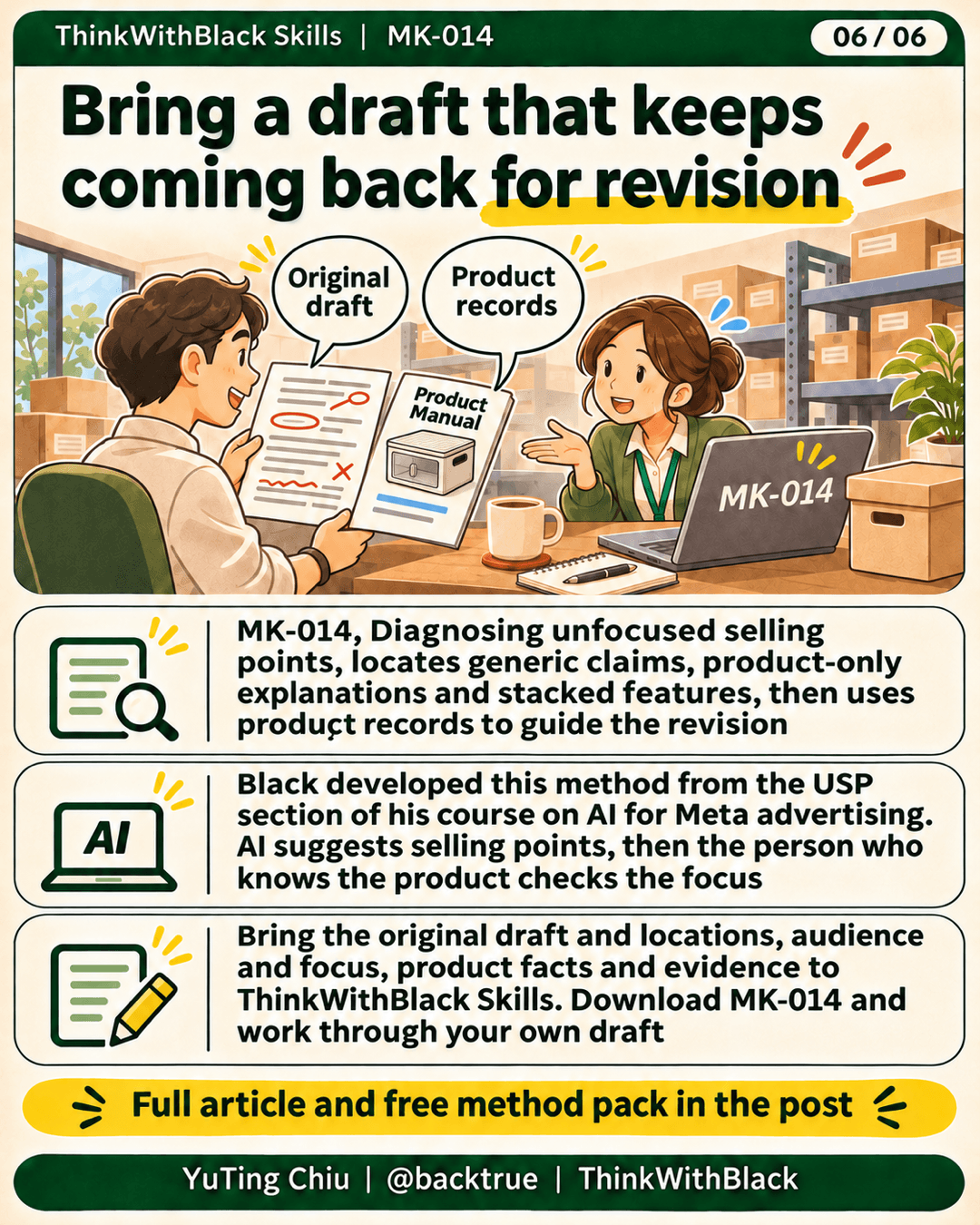
This framework comes from the USP unit in YuTing Chiu (Black)'s course Meta廣告學程 101 讓AI幫你投出廣告 (Meta Advertising Course 101: Let AI Place Your Ads). In the original class handout, students first use AI to surface product selling points, and people who know the product then review whether the output actually hits the mark. Slide 9 asks, "Why only three? The more selling points, the lower the profit," which sets the rule for narrowing copy down to three main themes. Slides 13 and 14 break basic USP logic into three checks: exclusivity, personal relevance, and quantification [2]. MK-014 turns those classroom criteria into a diagnostic workflow tied directly to line locations on a draft page. Both the link to the original slides and the full workflow are archived in the MK-014 Chinese method pack [1][2][3].
Worked case: a product page for a market-stall storage box
With those criteria in place, Lin Yijie returned to the storage box page and matched the target buyer's workflow against the evidence on hand. A market-stall vendor needs to haul restocking supplies to the booth, reach into the box while serving customers, and fold the emptied box flat onto a trolley at closing time. The spec sheet and operating demo for this exact model already back up three concrete actions: lifting the box by its side handles, reaching supplies through the front door, and folding the emptied box flat by hand. The demo footage shows this exact model performing those three steps under the stated conditions. What the team does not have yet are side-by-side competitor comparisons or timed records for the same task.
She placed the original copy from the four main page sections in the left column, noted why each section lost focus in the middle, and wrote the exact revision task in the right column:
| Original text and location | Where it gets stuck | How to revise the next draft |
|---|---|---|
| Hero headline: "The industry's only efficient storage assistant" | "Efficient storage assistant" fits countless products; "industry's only" has no competitor comparison | Open with the market-stall vendor's job and tie it to confirmed operating details |
| Opening description: "This product features a front door, side handles, and a folding structure" | Only the hardware appears; shoppers still have to guess how it fits their work | Put the vendor back in: carrying supplies to the stall, grabbing stock during sales, and packing up |
| Selling-point section: front door, handles, foldability, color, material, and appearance all listed at the same level | Features are piled together, giving the designer no visual order | Group the page into three themes—carrying to the stall, grabbing stock during business hours, and packing up after closing—and tuck the remaining specs under them as support |
| Performance badge: "Twice the efficiency" | No task definition, comparison baseline, or timing records | Move to pending verification; define same-condition timing tests and collect records before deciding whether to use a number |
That three-column table turned a vague group-chat debate over whether the copy "felt compelling enough" into four concrete edits. Lin Yijie knew the hero and opening needed to center on the vendor's workflow. Zhou Pinyu could see the selling-point section reorganized around three physical actions. And the product team had a clear hold list: keep "industry's only" and "twice the efficiency" off the page until they defined a single task, matched the test conditions, set timing start and end points, and logged the results.

After the rewrite, all three themes translate straight into shots
Using the diagnostic table, Lin Yijie rewrote the hero section first:
"For market-stall vendors hauling restocking supplies to their booths. Grip the side handles to carry the box to your stall, open the front door to grab stock while you sell, and fold the empty box flat by hand to slide back onto your trolley at closing."
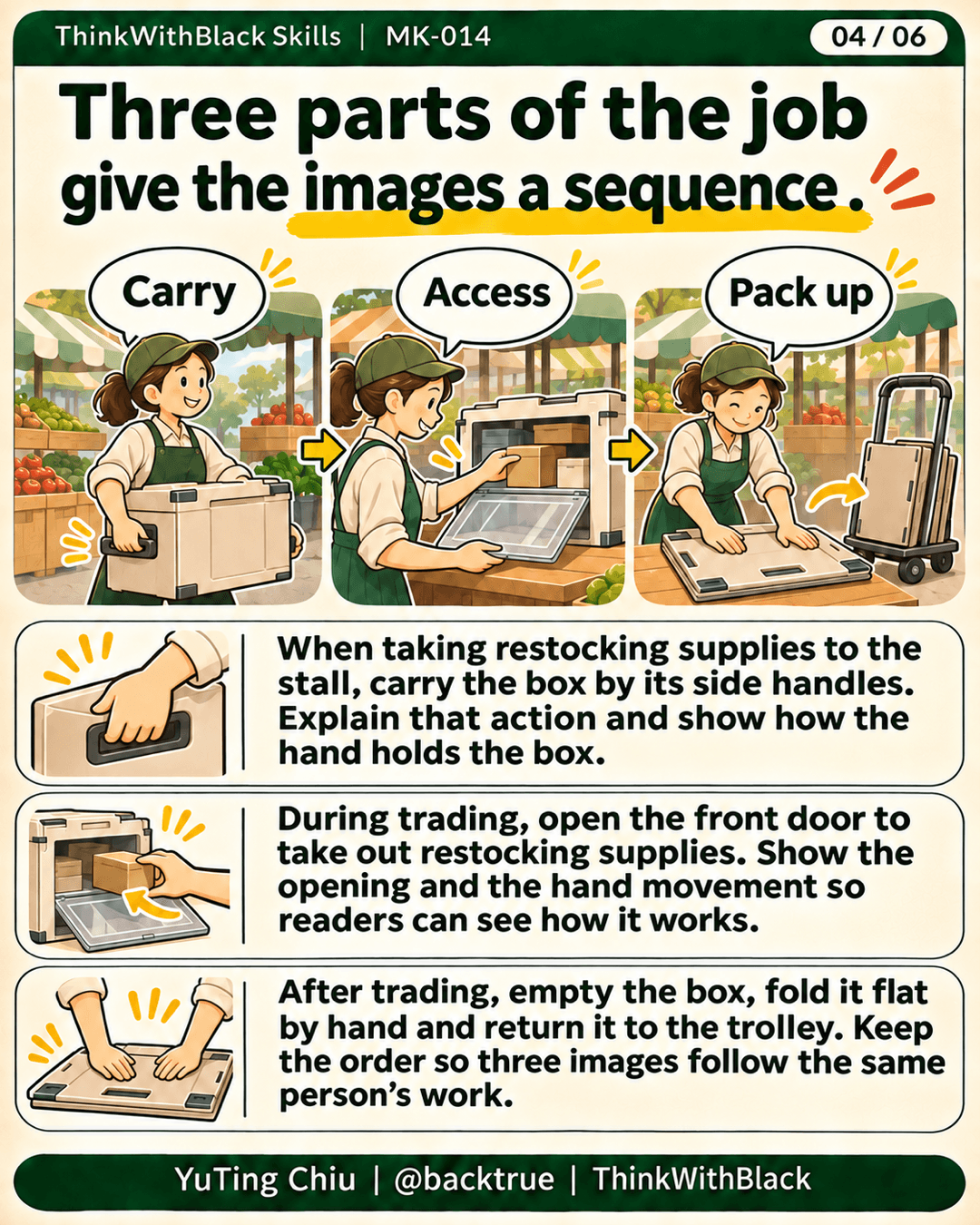
With the hero anchored, the three explanatory visuals below follow the vendor's workday in order: setting up, selling, and packing up. Each visual starts with what the vendor is doing at that moment, then connects the part of the box that supports that move. Zhou Pinyu pulled her photo shoot brief straight from this second table:
| Main theme | Copy ready to use | What the designer shoots next |
|---|---|---|
| Carrying to the stall | "When hauling restocking supplies to your booth, grip the side handles to carry the box so shoppers immediately see how it handles." | Hands gripping the side handles, showing the vendor carrying the loaded box |
| Grabbing stock during sales | "When you need backup stock during business hours, open the front door and reach in—showing both the opening and the hand movement." | Opening the front door and pulling an item out through the front opening from start to finish |
| Packing up after closing | "After closing, empty the box, fold it flat by hand, and slide it back onto its spot on the trolley." | Emptying the box, folding it flat, and placing it back on the trolley in sequence |
All three themes rely strictly on known use cases and same-model documentation, while color, material, and appearance drop into supporting lines under each section. From this table, Zhou Pinyu locked in a three-shot list right away: the market-stall vendor working with restocking supplies is the subject, and the box is the tool being handled in each frame. Later, when the product team gathers competitor specs, they can check those three exact actions to see where true product differences lie. And if they want to add a time-saving claim, they already know which three actions need a shared task definition, identical test conditions, and start-to-finish timing records before the copy changes.

Log the reason behind every edit so the next revision stays on track
Once the revised copy and shot list were done, Lin Yijie saved the diagnostic table alongside the original draft in a single record. If someone suggests putting "twice the efficiency" back into the headline a few weeks later, the team can open that file, see why the claim was marked pending verification, check which same-condition timing records are still needed, and skip another round of debating word choices by gut feel.
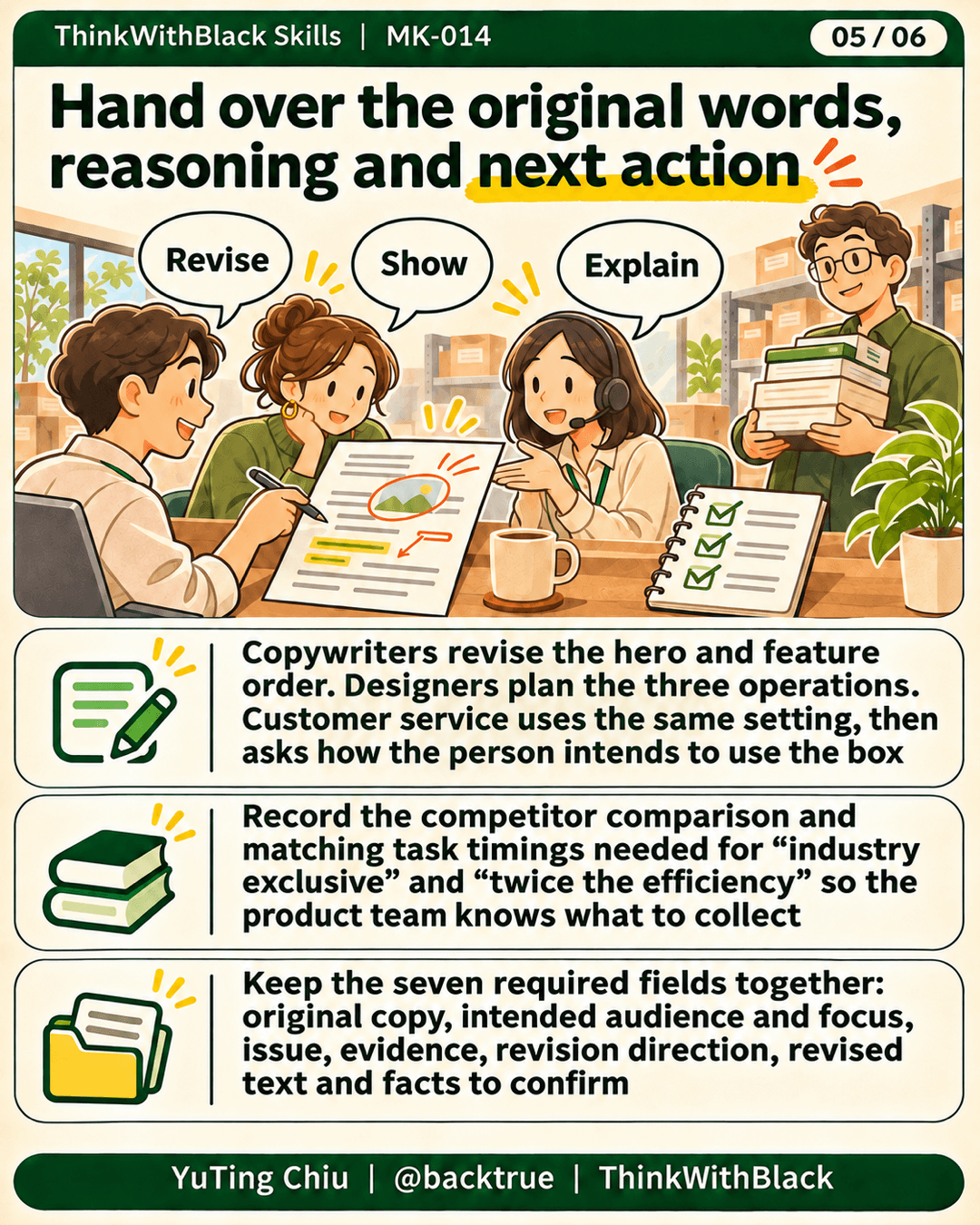
To give every role a shared reference during handoffs, the page summarizes seven core items for this case: factual features, customer task, perceivable benefit, comparison basis, suitable angle, primary/supporting/pending verification status, and rationale. Meanwhile, both the MK-014 Chinese method pack and the English method pack require seven fixed delivery fields that tie every edit directly to its original page location and supporting evidence [1][3]. Lin Yijie saved both seven-part records side by side so product managers, designers, and customer support reps could each check the angle they needed:
| Fixed field (Chinese summary view) | What this case records |
|---|---|
| Factual features | Same-model specs and demo video confirm carrying via side handles, reaching items through the front door, and folding flat by hand once emptied |
| Customer task | A market-stall vendor needs to haul restocking supplies to the booth, grab items during sales, and pack the box back onto a trolley after closing |
| Perceivable benefit | Every action ties directly to what the vendor is doing at that step of the workday, paired with a matching visual |
| Comparison basis | Actions verified against same-model specs and demo footage; competitor comparisons and same-condition timing tests remain pending |
| Suitable angle | Follow the workday sequence—setting up, selling, and packing up—to show carrying, front-door access, and folding flat after emptying |
| Primary / supporting / pending verification | Primary: three workday themes; supporting: color, material, and appearance; pending verification: "industry's only" and "twice the efficiency" |
| Rationale | Help the target buyer see immediately how the box fits their work, while keeping a paper trail of the evidence behind every edit |
Mapped against the seven required delivery fields in the method pack (which match the seven Required fields in the English pack), the same diagnosis is logged by original location and revision action [1]:
| Method pack delivery field (Required field in the English pack) | What this case records |
|---|---|
| Original text and location | Hero headline, opening description, selling-point section, and performance badge, with every original sentence preserved |
| Intended focus and audience | Market-stall vendors hauling restocking supplies to their booths, grabbing stock during sales, and packing up after closing |
| Exclusivity, relevance, quantification or focus issue | Generic exclusivity claim, product-only opening with no user, stacked selling points, and an unverified efficiency number |
| Evidence | Same-model specs and demo footage support carrying by side handles, front-door access, and folding flat by hand after emptying; competitor comparisons and timing tests remain pending |
| Revision direction | Open with the vendor's workflow, narrow the body to three main themes, and pair each theme with a matching shot |
| Revised text | The rewritten hero copy and the three visual scripts shown above |
| Facts to confirm | Competitor feature differences, task definitions, and comparable timing records |
Keeping both tables aligns all four roles around the same decisions: Lin Yijie rewrites the hero and reorders the selling points from the diagnostic table; Zhou Pinyu schedules the shoot around the three physical actions; the product team gathers competitor specs and timing measurements; and Chen Boyu in customer service uses the exact same stall-vendor scenario to explain the box and ask shoppers how they plan to use it. That solves three business problems at once: fewer subjective rewrite loops, a photo shoot that captures the right actions on the first try, and customer support answers that match what the product page promises—while holding unverified claims like "industry's only" and "twice the efficiency" out of live copy to protect brand trust and compliance.

Run MK-014 on a draft your team keeps rewriting
If you have a product page or sales script that has been through multiple rewrites and still leaves design or sales guessing, gather four inputs before touching the wording:
- The current draft and the exact page location of every line under review.
- The target buyer and the main point this page is supposed to land first.
- The product's own spec sheet and operating demo.
- Any verified competitor comparisons or measurement records you already have on hand.
Keep the original lines and their page locations intact first so your diagnosis—and any future audit—has clear coordinates. Once those four pieces are ready, pass them to your AI tool with this prompt:
"Please review this copy using MK-014. First keep the original text and page locations intact, then flag generic slogans, product-only lines with no user in sight, and sections where selling points are piled at the same level. Using the supplied product data, propose revision directions and rewritten copy, list the exact records needed for any claims lacking comparison or measurement, and output the complete diagnosis alongside the seven-field record."
When you get the diagnosis and rewrite back, use three decision rules to choose your next move:
- Ready to revise and shoot: Every edit points back to an exact line location and a specific focus issue in the draft, and the designer can read the three main themes and know right away what human actions to shoot. Move into layout and photography.
- Still vague ("just sounds smoother"): If the team can only say the new copy "reads better," go back through the three checks—exclusivity, personal relevance, and focus—and split features, benefits, and evidence into separate rows again.
- Missing core data: If your current product files cannot even support three clear usage themes, or if the core selling point depends entirely on a competitor comparison or same-condition timing test that hasn't been run yet, pause the rewrite and have the product team collect those records first.
- Already on target: If your line-by-line check shows the existing copy already names the specific user, walks through three clear actions, and backs each one with solid evidence, keep the current page live, monitor its performance, and log the review reasons in the seven-field record [1].
You can grab the free materials now at ThinkWithBlack Skills. Read INDEX.md first, then pair your draft and product files with the complete MK-014 method pack. Next time a page stalls, start by marking the exact line, naming why it drifted, and writing down the physical action a camera can actually capture.

Bring your own data into MK-014
- Chinese version materials and entry points: Download the MK-014 method pack | Download the INDEX.md index | View the complete instructions | ThinkWithBlack Skills homepage
- English Version & Materials: Read in English → | Download the English MK-014 method pack | Download the English INDEX.md
- First time using it: Download the index first, let AI select the method, then upload the complete method pack and your data for this topic
Social posts for this Skill
Choose a platform to view the infographic cards and post for this Skill:
Facebook Chinese | Instagram Chinese | Threads Chinese | LinkedIn English | X English
YuTing Chiu (Black) · @backtrue · ThinkWithBlack (Published: 2026-11-05 · Updated: 2026-11-05)
Author background and courses for this Skill article | Find other Skill articles by operational problem →
References
- MK-014 | Diagnosing Unfocused Selling Points v0.3 method draft. ThinkWithBlack Skills; method draft review date stated as 2026-09-19.
- Meta廣告學程 101 讓AI幫你投出廣告. YuTing Chiu (Black), Google Slides, Slides 9, 13, 14; reviewed 2026-09-19.
- 商品頁改了好幾輪,設計還是不知道該拍什麼:MK-014 賣點失焦診斷 (English version: The product page keeps changing, but the designer still has no clear brief: MK-014). YuTing Chiu (Black) @backtrue, ThinkWithBlack, 2026-11-05.