Beside the packing desk in a small warehouse, sales rep Yiting replayed the video showing how to change a label roll on the Model A printer. Across from her, the shipping clerk watched the screen, glanced down at the Model B manual in his hand, and asked again: "Both of these look like they can print. What's the actual difference?"
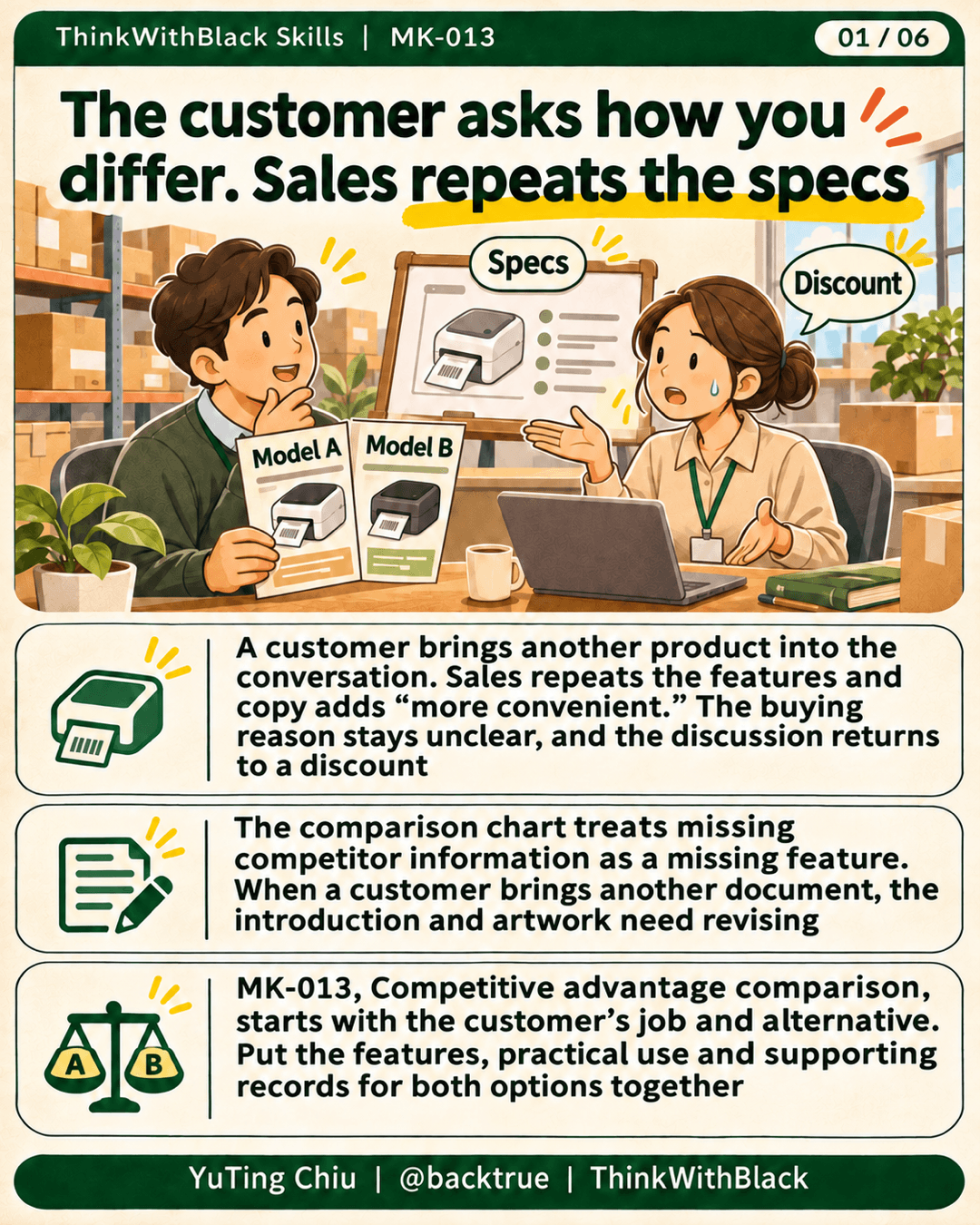
It was the third time that week Yiting had run into the same question. Using her company's product sheet, she walked through Model A's features from the top: direct thermal printing, how the label roll loads, and the machine's dimensions. The clerk tapped the spec table in the Model B manual. "Those specs are listed here too." Yiting fell back on standard marketing copy, saying their machine was easier to reload and made the work more efficient. The clerk paused, then asked: "So can you give me a lower price?"
Back at the office, Yiting described the three visits to Jianhong, who handles copy and marketing. Jianhong pulled up the comparison page the team had launched the month before. To help sales, they had put a check mark next to every feature their product had and an X wherever the competitor's manual page was blank, hoping customers would see at a glance which machine offered more. Then last week, another customer pulled out a different version of the competitor's manual on the spot and showed that a feature marked with an X was actually listed in the appendix. Yiting's pitch stalled right there. Jianhong took the comparison page down and rewrote it that day, while Yawen, the designer, had to redo three finished product graphics.
Jianhong spread the old check-and-X chart across the meeting table and reviewed the rework with Yiting and Yawen. The customer already had Model B's materials in hand; what he wanted to know was how switching to Model A would change his daily work at the packing desk. Listing features or polishing the adjectives still left the customer to translate specs into on-site actions on his own—so the conversation naturally went back to price.
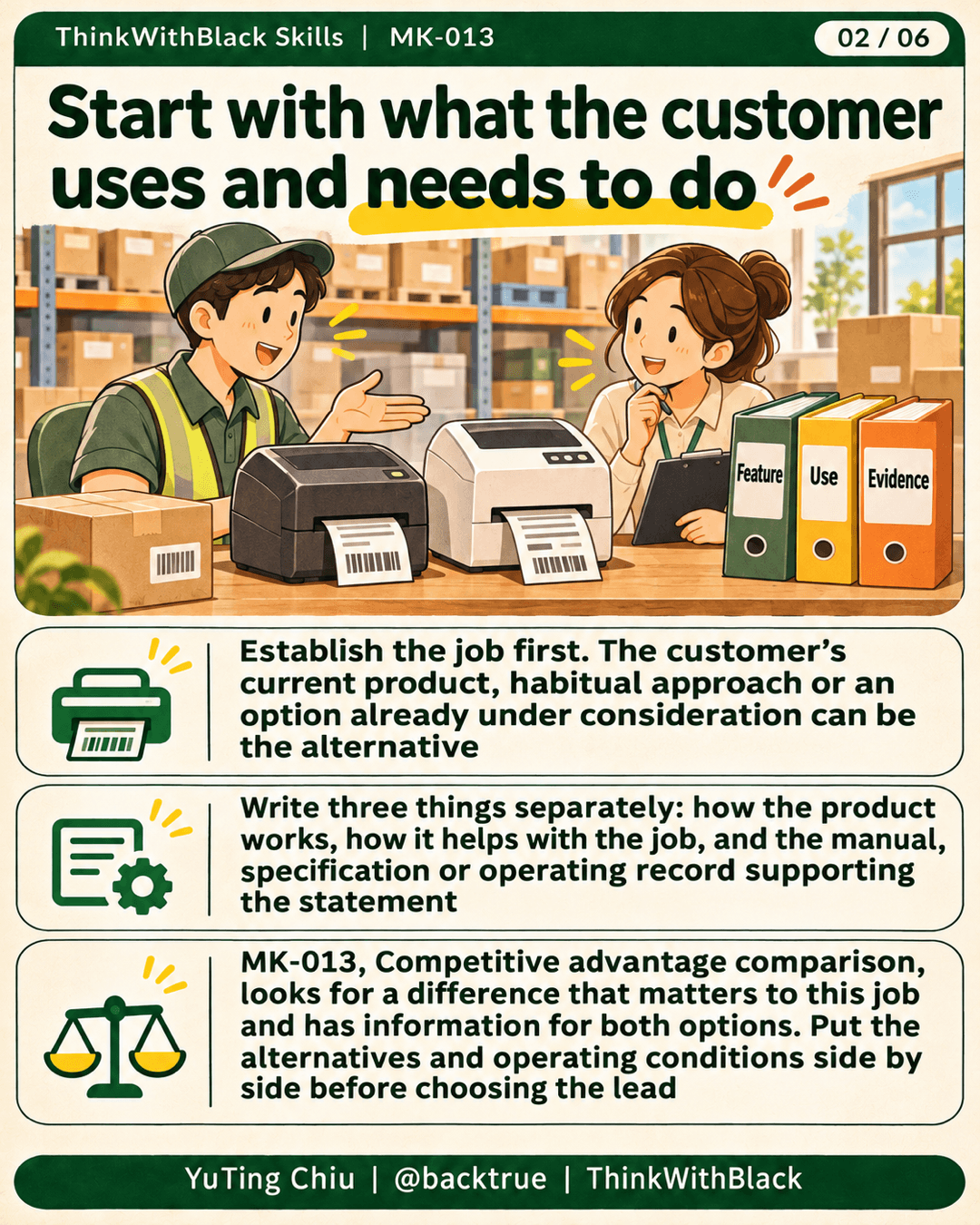
When a pitch stalls like this, the comparison has to start with the customer's actual job and the alternative in their hand: What work are they doing? Which product or method do they use now, or which option are they considering? Once you identify the job they need to get done, you can put both products' features, their effect on the work, and the verifiable records for each side into a single table. That gives the team an evidence-backed comparison, saves rounds of rewriting and design rework, and lets sales address the buying criteria directly when quoting.

Match the customer's buying question and operating conditions—not just a feature list
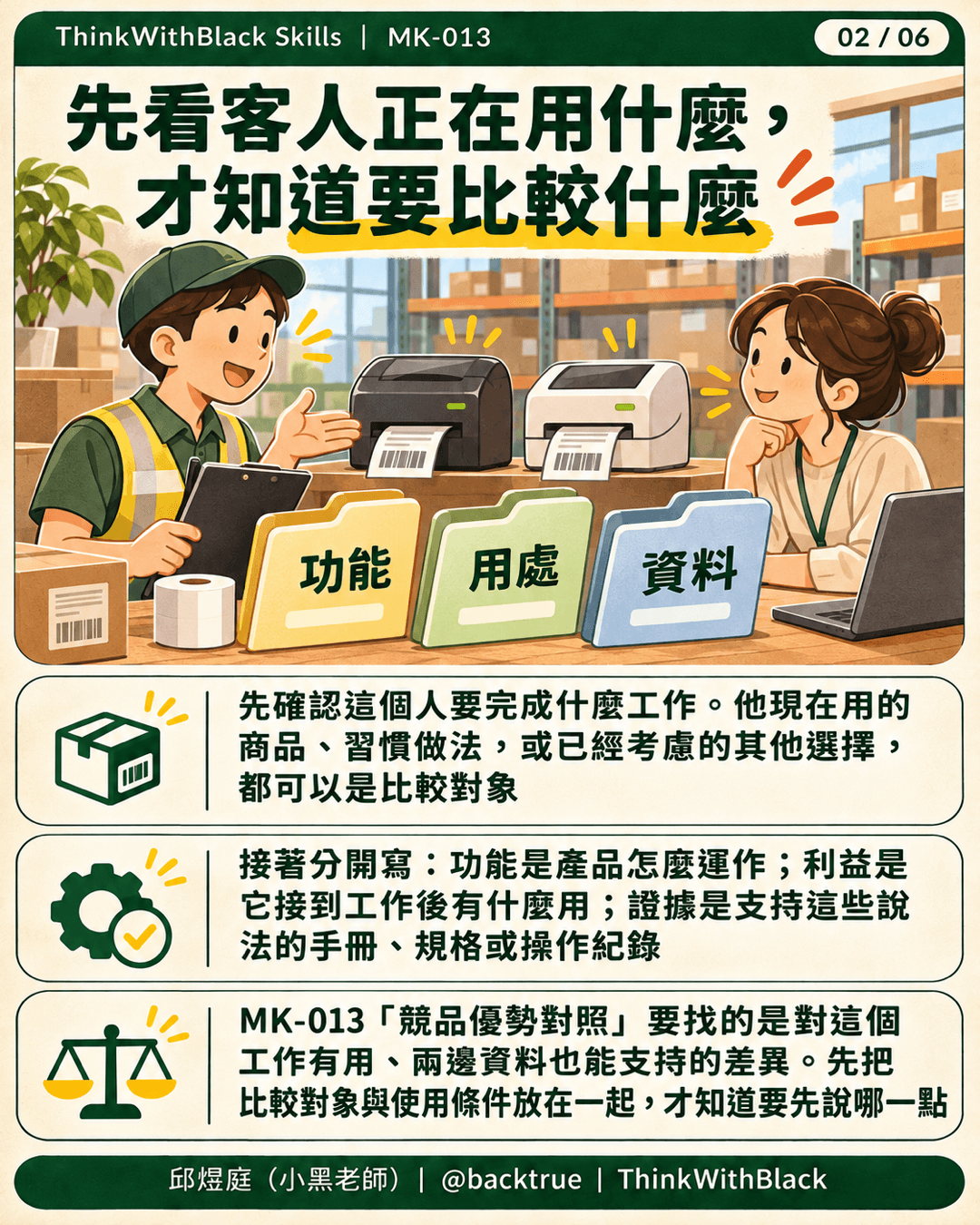
What Yiting and Jianhong saw in the old chart is the most common gap in product comparisons. A feature table explains what a product can do, but a customer holding another option is asking a different question: "If I switch to your model, which step of my work gets easier?" When both products have the same feature, highlighting it in isolation just shows the customer identical specs. They still need more context to make a decision.
Before choosing which difference to lead with, you have to factor in the customer's operating conditions. How a label roll loads matters very differently to a shipping clerk who changes rolls several times a day than to someone who prints the same label all month. Asking what job the customer needs to finish and what space they work in gives the team a clear standard for deciding which difference comes first.
When compiling competitor materials, you will also run into features that aren't mentioned on a manual page. That means the team doesn't yet have a verification record for that feature—the next step is to find the matching manual version or a live demonstration. Until you verify it, put the item in a "to compare" column so everyone can see what data still needs to be gathered and keep every column accurate.
Start from the customer's alternative and separate features, benefits, and evidence
Seeing where the old chart failed, Jianhong introduced the steps in MK-013, "Competitive Advantage Comparison." The method comes from the unique selling proposition (USP) section of Black's course Meta廣告學程 101 讓AI幫你投出廣告 (Meta Advertising Course 101: Let AI Run Your Ads). In the course, participants first use AI to identify a product's unique selling points, then people who know the product discuss whether those points fit real buyer situations. Slide 13 notes that the basic logic of a USP is to "first let the other person compare against their current situation: what they use now, the solution they're used to, or other options they've already considered." Slide 73 defines Advantage in the FABE framework as "the relative advantage compared with competitors." MK-013 turns these two concepts into three steps a team can run directly (the full method and links to the original slides are saved in the MK-013 Chinese method pack):
- Start from the customer's concrete baseline—the product they use now, their usual method, or the other options they are considering—and look for differences from there.
- In the advantage column, list only real advantages relative to that alternative, tying each one to a known customer task and verifiable records.
- Put any item where competitor or alternative records are still missing into a "to compare" list until you have records tested under the same conditions.
To get sales, copy, and design working from the same baseline, Jianhong drew three separate columns on the whiteboard:
- Feature: how the product works
- Benefit: how that feature helps once it connects to the customer's daily work
- Evidence: the spec sheet, manual, or operating record that backs up the claim
Writing the three out separately lets the team see right away whether they are comparing the same physical work step across both products or just trading adjectives.
Run a complete comparison from one set of on-site records: a label printer inside a packing-desk shelf
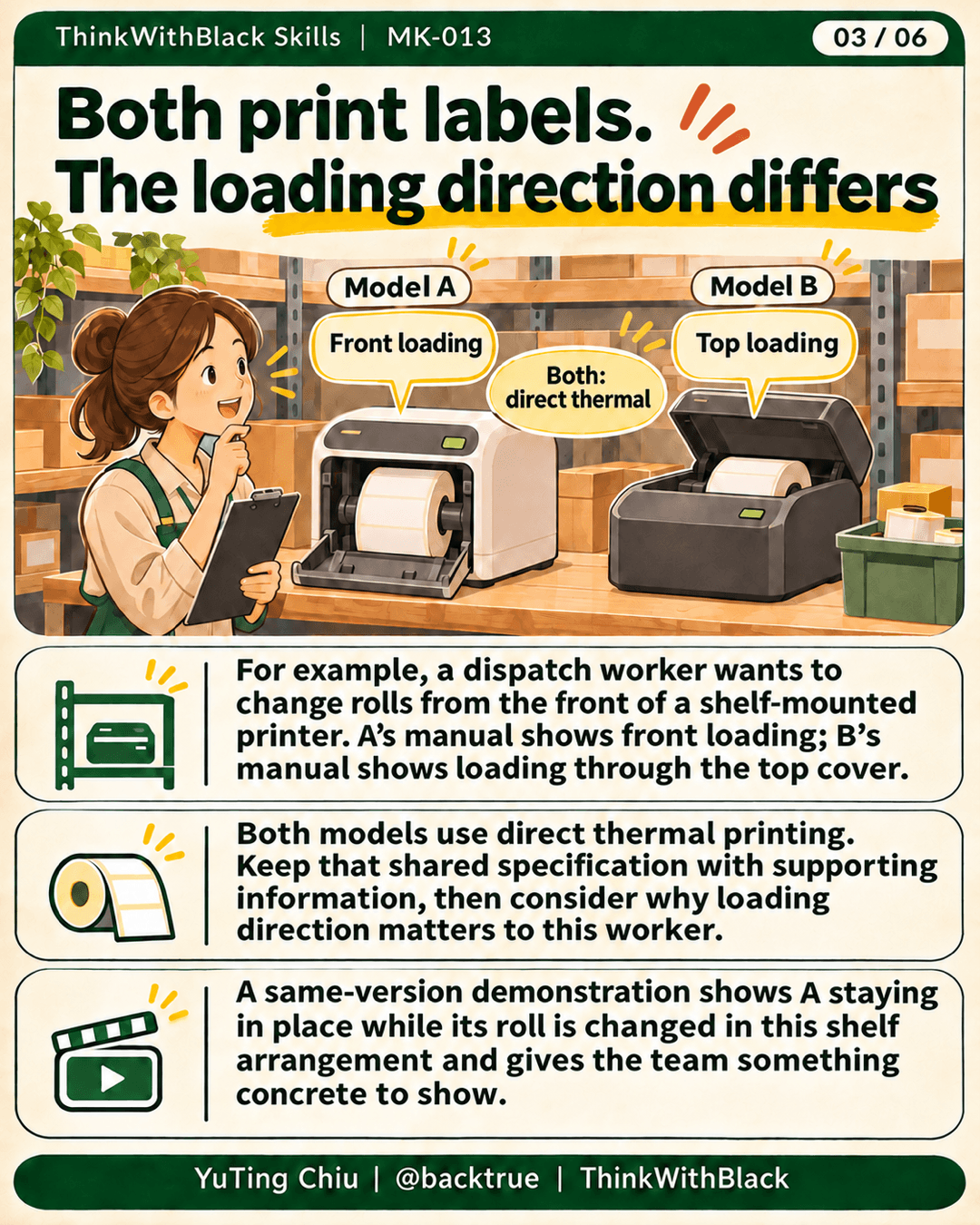
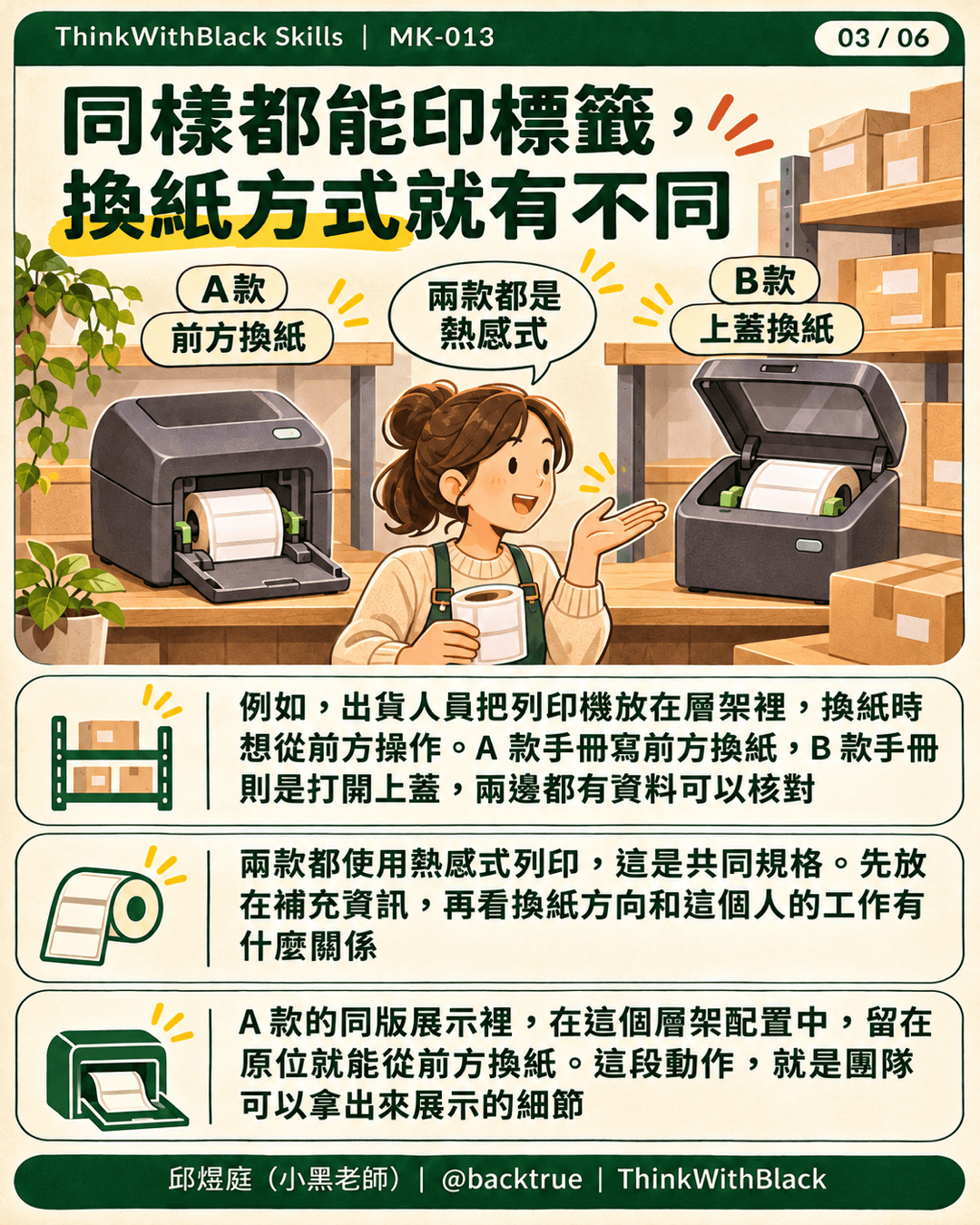
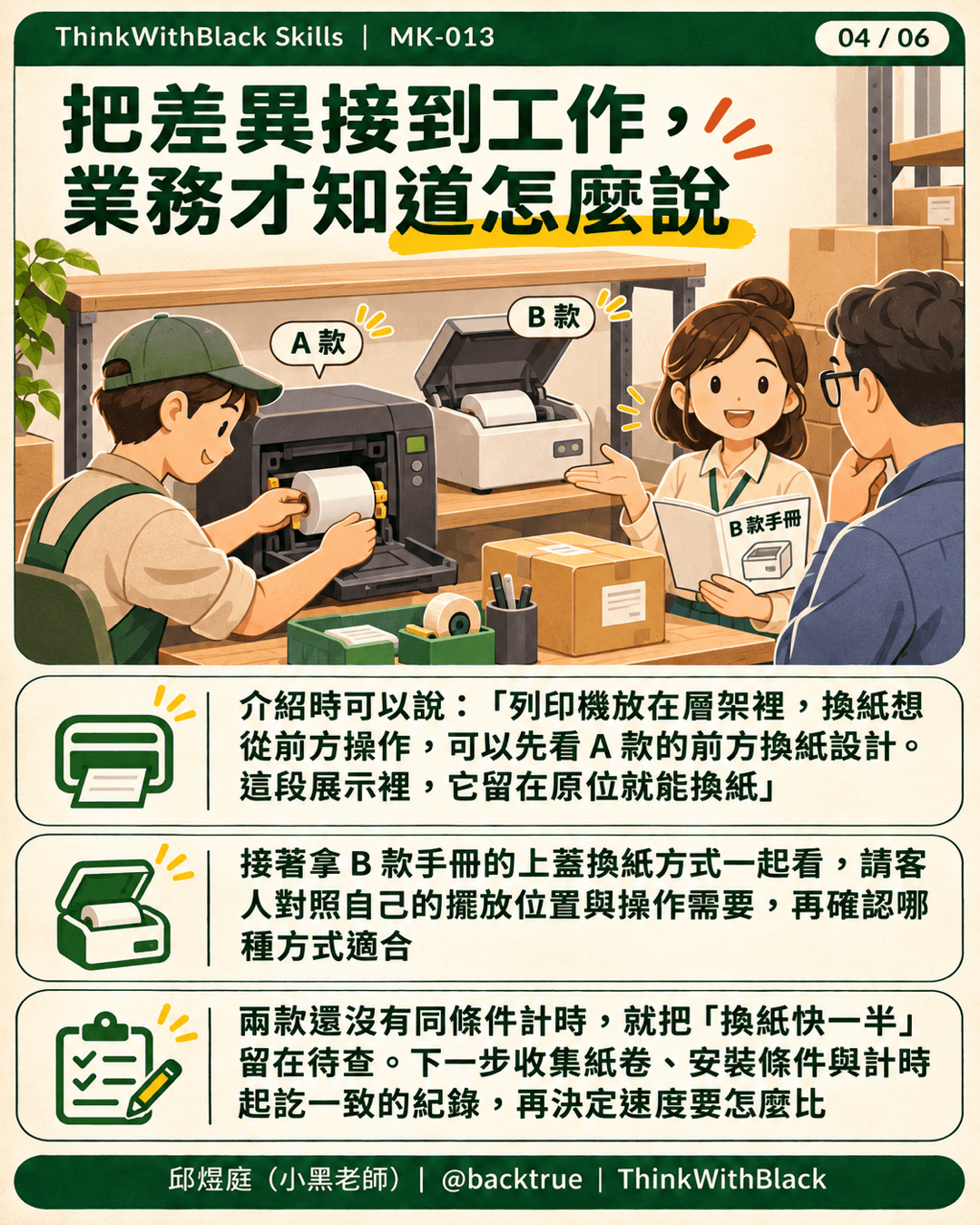
Yiting thought back to the shipping clerk's workspace: his label printer sat inside a shelf on the packing desk with very little clearance above it, so he wanted to load label rolls from the front. Because the clerk was comparing their Model A against the Model B he was already considering, Yiting and Jianhong put his workspace requirement, both product manuals, and a demonstration of the same Model A version into one table to check them side by side:
| Record | Details in this case | How it is used in the comparison |
|---|---|---|
| On-site requirement R1 | The printer sits inside a shelf with limited clearance above; the clerk wants to load paper from the front | Sets the priority: compare paper-loading access and operating direction first |
| Model A manual S1 | Direct thermal printing; label rolls load from the front | Verifies Model A's printing method and loading design |
| Model B manual S2 | Also uses direct thermal printing; loading paper requires opening the top cover | Verifies Model B's confirmed features and operating direction |
| Model A same-version demo D1 | In this shelf setup, Model A stays in place while the roll is changed from the front | Supports the operation that can be demonstrated in this case |
| Roll-change time C1 | Same-condition timing records for both models have not been collected yet | Lists the comparison data to gather next |
With the five records laid out, the overlap and the difference between the two machines were clear. Direct thermal printing is a shared spec on both S1 and S2. Front access versus top-cover access is the concrete difference backed by documentation. And on-site requirement R1 shows why that difference matters for this purchase: because shelf clearance is tight, front loading lets the printer stay in place during a roll change—the exact thing this clerk needed to confirm first.
Looking at the table, Yiting realized that when she had said "more convenient" at the warehouse, what she actually meant was "the printer stays in place on the shelf while you load paper from the front." Tying that motion directly to the customer's shelf height and loading direction let him picture it at his own packing desk right away.
Put shared features, usable differences, and items to verify into one shared team table
Once the records were sorted, Jianhong turned the comparison into a single reference table for copy, sales, and design:
| Comparison item | Records for Model A and Model B | Wording to use on the job |
|---|---|---|
| Printing method | Both S1 and S2 specify direct thermal printing | Treat as a shared spec, then move on to differences that affect this buying decision |
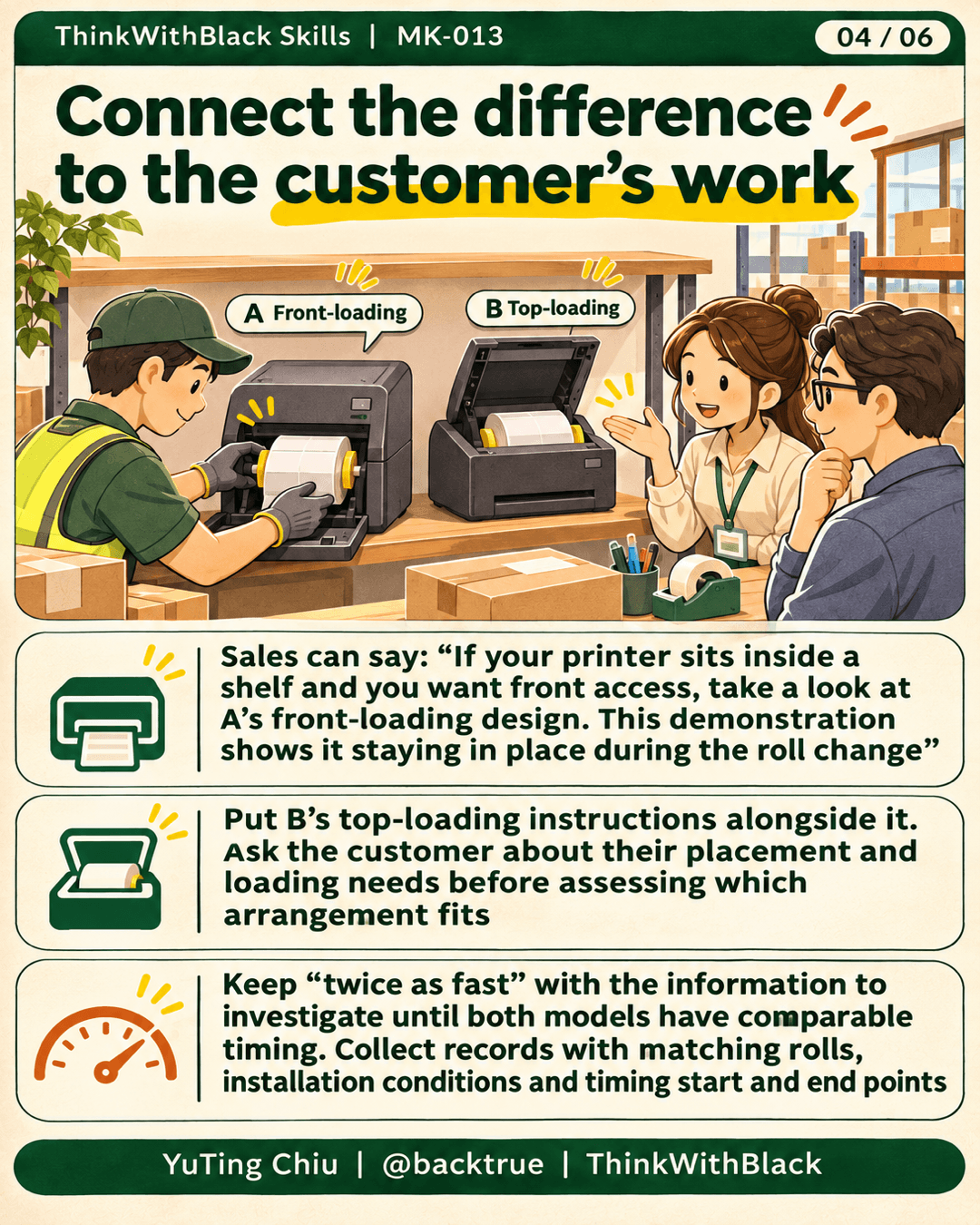
| Paper-loading access | Model A loads from the front; Model B requires opening the top cover. D1 shows Model A changing rolls inside this shelf setup | For packing desks that need front access, show Model A's roll-change motion first, then let the customer compare it against their own shelf layout |
| Roll-change speed | C1 does not yet have same-condition timing for both models | Keep "changes paper in half the time" in the to-verify column; first gather timing records using the same roll, setup, and start/stop points |
Using this table, Yiting rewrote her pitch for the next visit as a direct comparison:
"If your printer sits inside a shelf and you want to change rolls from the front, take a look at Model A's front-loading design. In this demo, you can see it finish a roll change in this shelf setup without being moved. Model B's manual shows the roll loading through the top cover, so you can compare how each one would work at your desk."
Every part of that pitch connects to the clerk's daily roll change and traces back to a specific record: front loading comes from S1, opening the top cover comes from S2, and finishing the change without moving the printer comes from D1. As for the casual claim that it "changes paper in half the time," the team agreed to hold it in the to-verify column until the product team ran C1 under matching conditions—using the same paper roll, the same installation setup, and the same timing start and stop points.
From the same table, Yawen knew right away what to shoot for the next batch of assets: a single uncut clip showing a front roll change inside the shelf, so buyers could see the machine stay in place. Yiting decided that before playing the demo on future visits, she would ask customers to show where the printer sits and how they load paper, confirming together whether the setup matched their desk.
Deliver a fixed seven-field table so the next person can see the reasoning
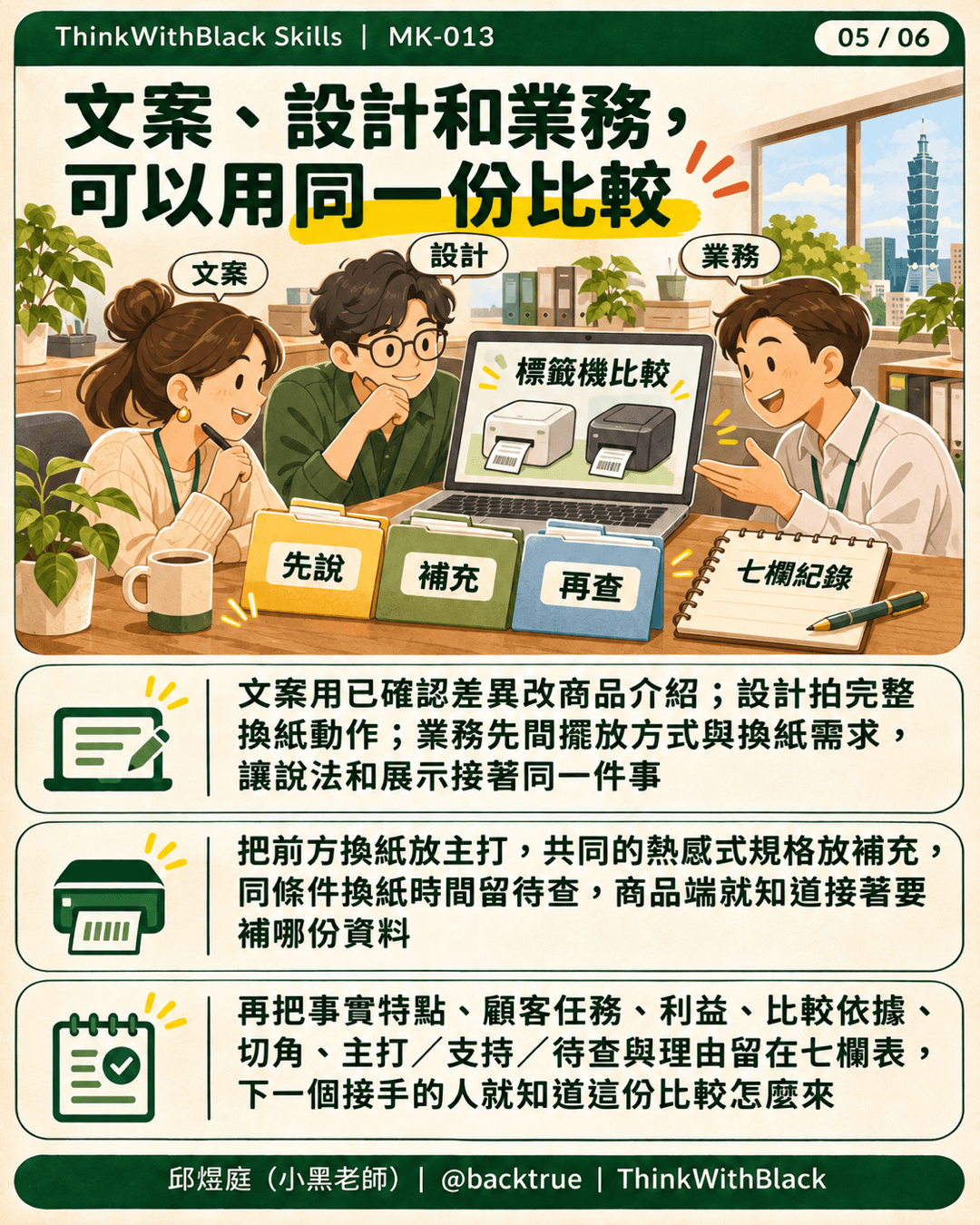
So that anyone taking over or updating the material later can see how the decision was made, MK-013 uses a fixed seven-field deliverable. Jianhong logged the comparison basis, the lead message, and the follow-up items for the label printer into the seven-field table:
| Fixed field | Content for this case |
|---|---|
| Factual features | Model A loads paper from the front; Model B loads by opening the top cover; both use direct thermal printing (per S1, S2) |
| Customer task | The shipping clerk needs to change label rolls inside an existing shelf setup and wants to operate from the front (per R1) |
| Perceived benefit | In the D1 setup, Model A stays in place during a front roll change, matching the clerk's known operating need |
| Comparison basis | S1 and S2 compare paper-loading access; D1 supports Model A's operation in this setup; C1 timing is still pending |
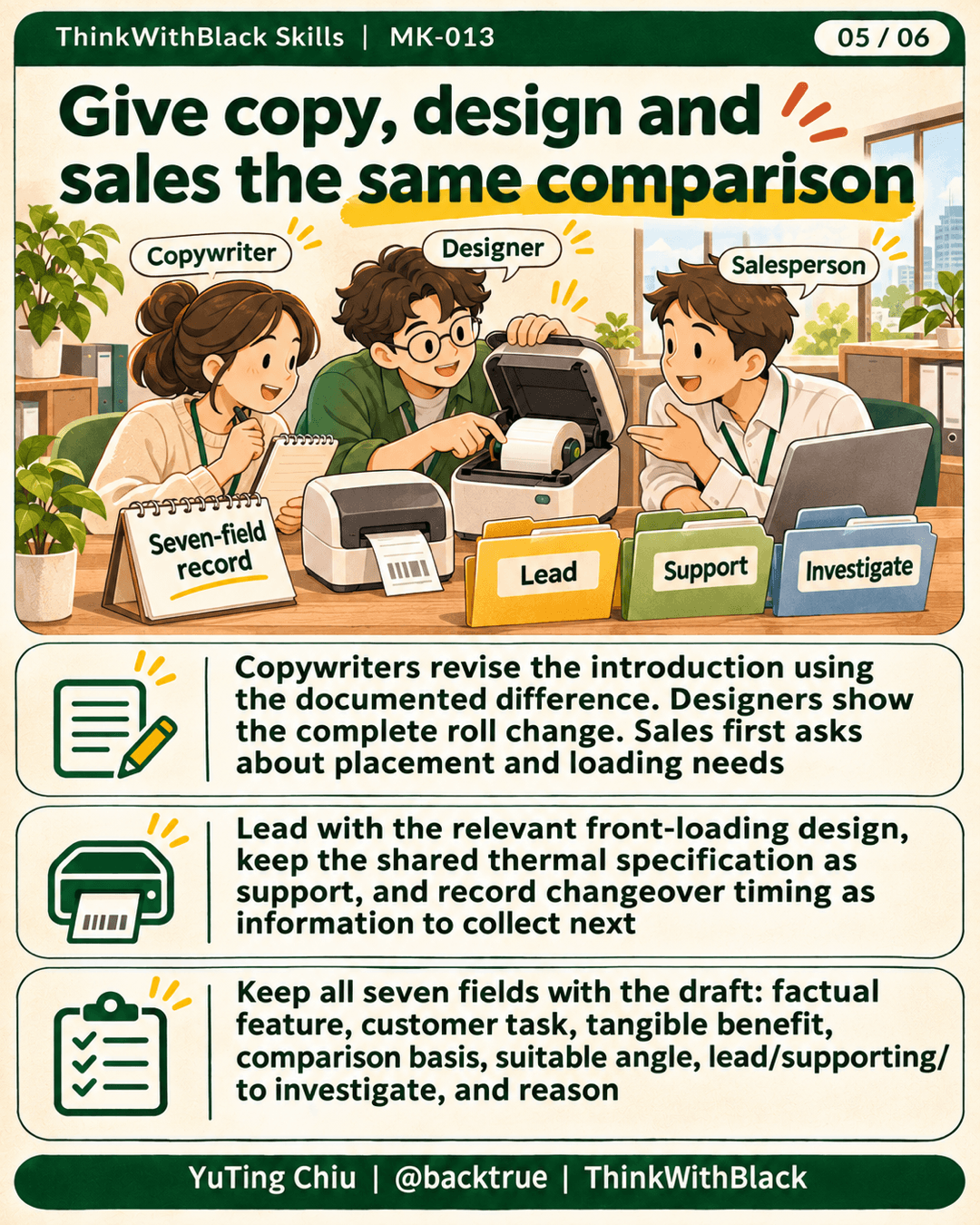
| Best angle | Shoot the full front-loading roll change so the customer can compare it against their own packing desk |
| Lead / Support / To verify | Lead: loading design that fits front-access needs; Support: shared direct thermal spec; To verify: same-condition roll-change time |
| Reasoning | Both sides have records on loading direction, and the customer's workspace requirement is clear, making this the right difference to lead with |
Those seven fields double as a work order for the team:
- Copy (Jianhong): Use the "Lead / Support / To verify" and "Reasoning" fields to revise the website comparison page and product descriptions—grouping shared specs together and showing how front loading works inside a shelf.
- Design (Yawen): Follow the "Best angle" field to film the cover-opening direction and the full front roll change inside the shelf.
- Sales (Yiting): On site visits, ask how the customer's printer is positioned and how they load rolls; when the conditions match, open with the D1 demo video.
- Product team: Run C1 by timing roll changes on both machines with the same roll, the same installation setup, and the same start and stop points, then decide whether to add a speed comparison to the pitch.
When to update the comparison table and change the lead advantage
When Jianhong saved the seven-field table in the shared team folder, he added rules for when to review and switch the pitch: whenever a competitor updates its manual, the shelf setup in the demo changes, or a customer works in a different layout, the team goes back to update the table and the affected copy.
That gives the team a clear standard for adjusting to different buyers and new records:
- The customer's task or workspace changes: If the next customer keeps their printer on an open tabletop with plenty of room above and changes rolls only once a month, front loading no longer changes their daily work in the same way. Sales first confirms the new on-site requirement (a new R1), then picks the matching lead item from the shared table.
- A manual version or demo setup changes: When a competitor releases a revised manual or the shelf height in the demo changes, the team checks the "Comparison basis" field to see whether S1, S2, and D1 still hold, updating only the affected lines instead of rewriting the whole page.
- Pending records are completed: Once the product team finishes the same-condition timing for C1, if the two models take about the same time, speed stays a background record. If the test shows a clear gap—and the roll, installation setup, and timing start and stop points are identical—the speed difference moves into the approved pitch.
Before publishing new comparison copy or sales scripts, the team checks each claim with one question: "Which manual section, which demo record, and which customer requirement does this line point to?" Claims that can be matched to all three go into the lead or support columns; anything still waiting for proof stays in the to-verify column for the next round of testing.
Run the workflow once with your own product and its alternative
You can run this exact workflow on a product you sell right now. Before you start, gather four sets of records:
- Your product's specifications
- Your target buyer and their daily work environment
- The product the buyer uses now, their usual workaround, or the alternative they are considering
- Competitor manuals, same-condition demos, or other verifiable records
Specify the exact product versions and operating conditions first so the resulting table addresses a real buying decision. Once your materials are ready, you can pass them to AI with this prompt:
"Using MK-013, compare this product with the alternative the customer is considering. First state the job the customer needs to get done, then separately list the features, benefits, and evidence for both sides. Clearly distinguish shared features, confirmed differences, and comparison data that still needs to be gathered. Deliver the seven-field table along with wording that copy, design, and sales can use right away."
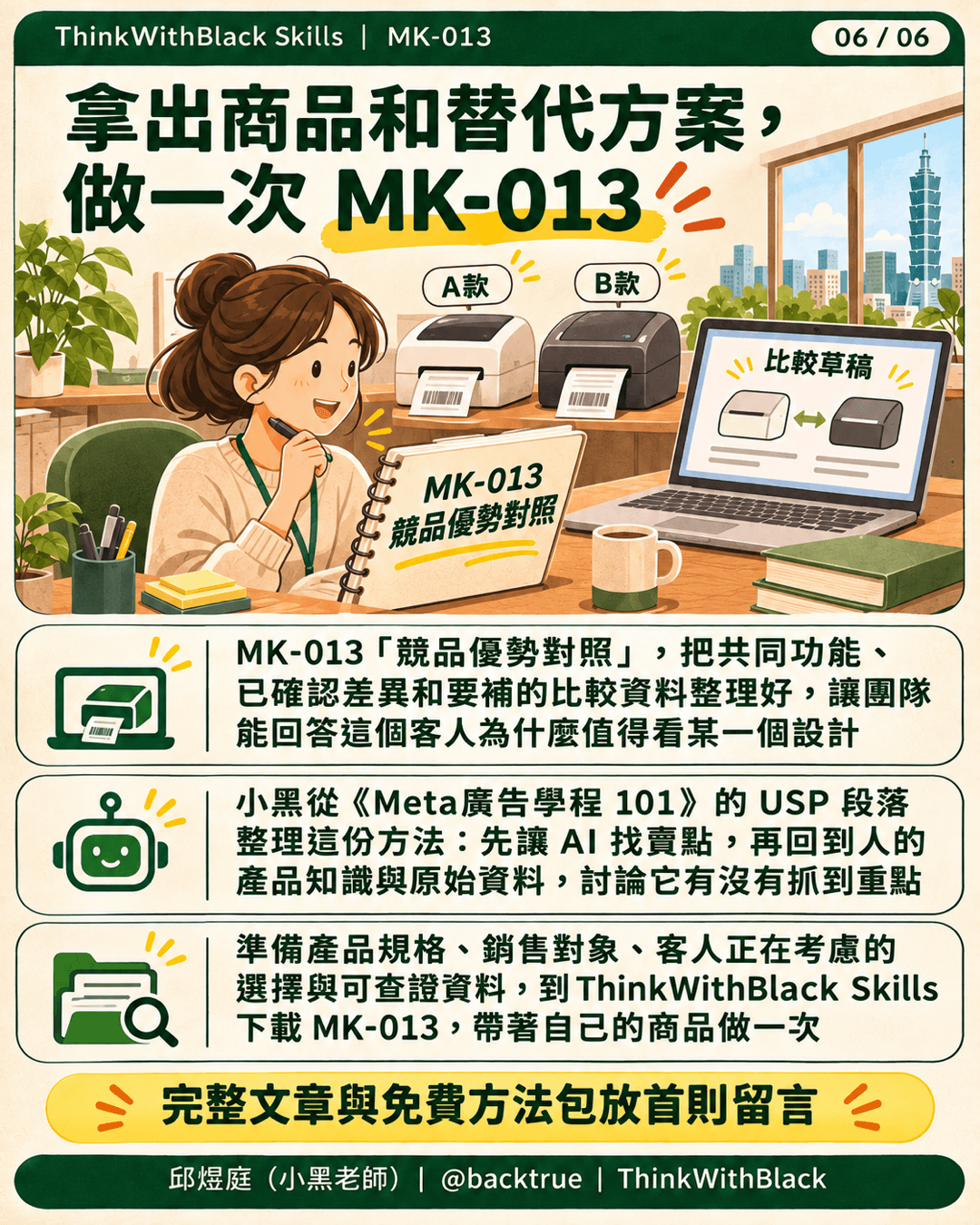
Download the free materials at ThinkWithBlack Skills: read INDEX.md first, then bring your own records into the complete MK-013 method pack. Next time a customer holds up another product and asks how yours differs, your team will have a comparison built on their actual workflow and verifiable proof.
Bring your records into MK-013
- Download the MK-013 method pack
- First time using the packs? Download the index first so AI can pick the right method, then upload the full method pack along with your case records
- Download INDEX.md · Read the full setup guide
Sources
- MK-013 | Competitive Advantage Comparison v0.3, ThinkWithBlack Skills (Sections 1, 2, 3, 4, 6, 8, 9.5, and 10)
- YuTing Chiu (Black), Meta廣告學程 101 讓AI幫你投出廣告 course slides (Slide 9: discussing USP with AI; Slide 13: USP baseline logic—comparing against the current situation; Slide 14: making claims exclusive, personal, and data-backed; Slide 73: FABE—Advantage as the relative advantage over competitors)
- Original Chinese article: 客人問跟別家差在哪,業務卻只剩規格和折扣:MK-013 競品優勢對照
- Original English article: A customer asks how you differ, and sales falls back on specifications and discounts: MK-013 (English method pack: en/packs/mk-013.md, English index: en/INDEX.md, Getting-started instructions (Chinese): /marketing-skills/#how)
Social posts for this Skill
Select a platform to view the graphics and post for this Skill:
YuTing Chiu (Black) · @backtrue · ThinkWithBlack Skill guide compiled by: Author bio and courses | Browse other Skill articles by business problem →