Lin Ya-Ting pasted the third inquiry of the day from customer service into the team's shared sheet and tagged it: "Looking for a website build."
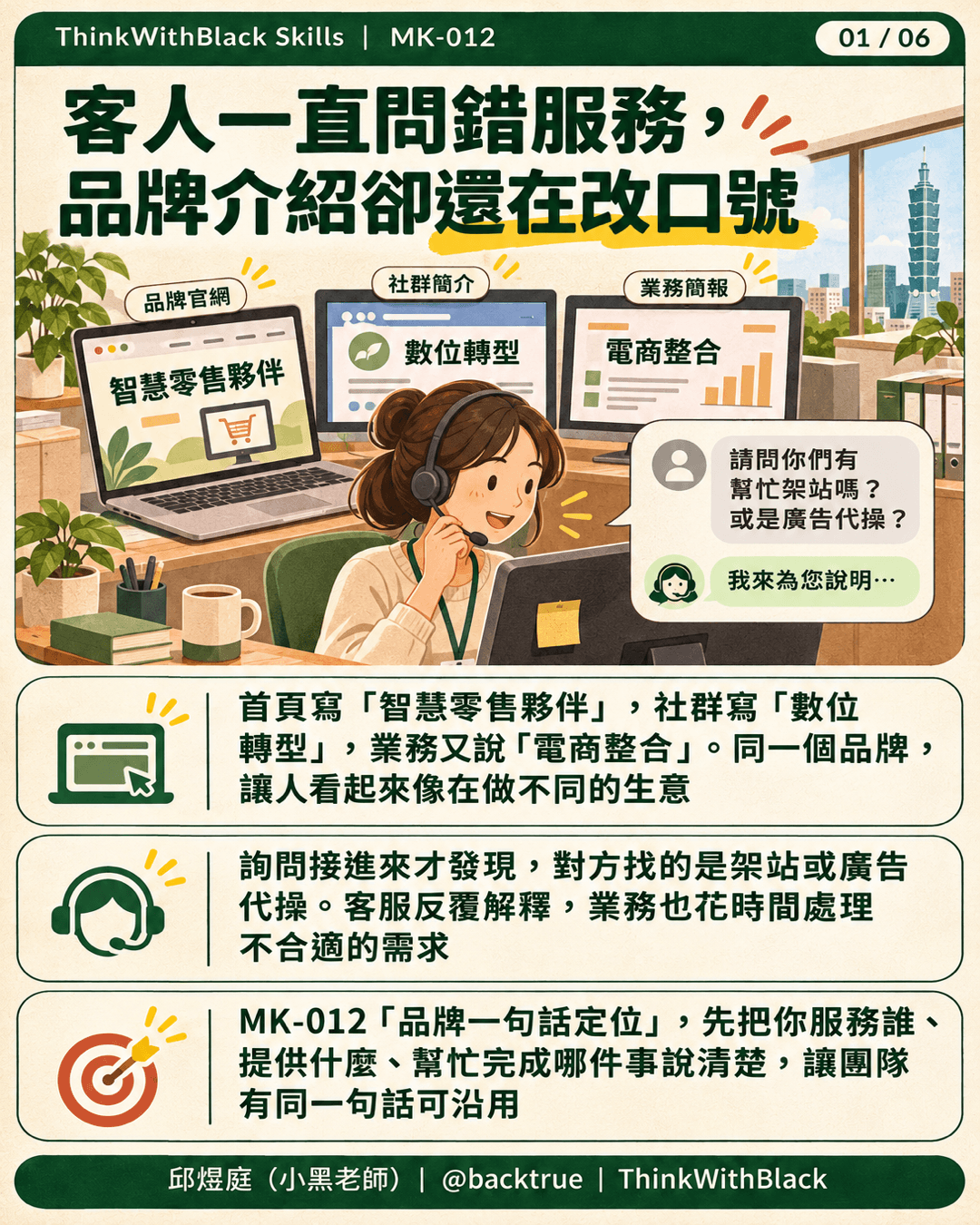
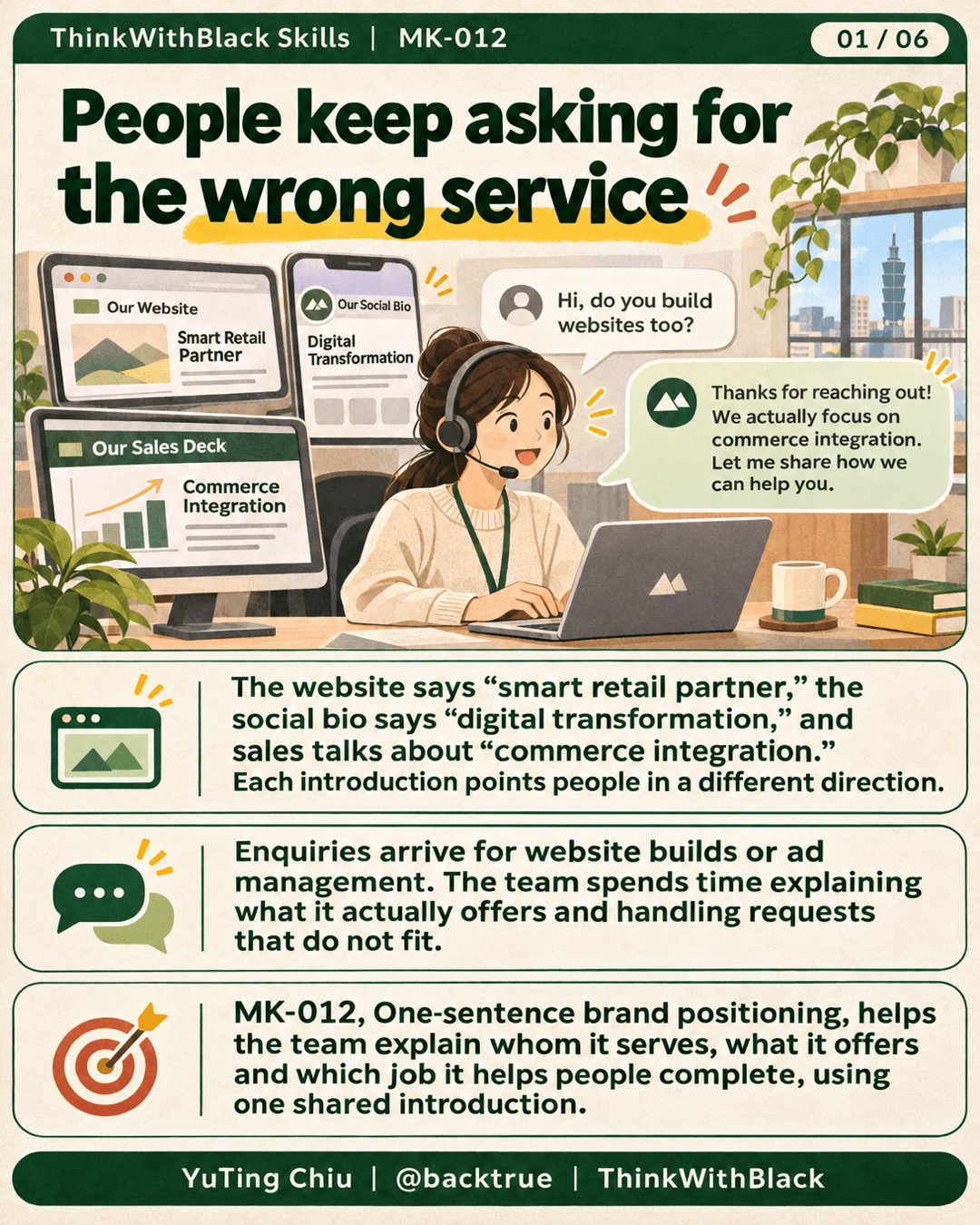
As the marketing lead at a retail systems company, her job that quarter was to fix how the company introduced itself to the public. At the time, the website hero read "Smart Retail Partner," the social media bio said "Digital Transformation," and the sales deck opened with "E-commerce Integration." Each phrase sounded like a company introduction on its own. Read together, they left outsiders guessing what the company actually sold.
When the wrong inquiries kept coming in, Ya-Ting and her team first tried changing the slogan. They met twice, replaced "Smart Retail Partner" with a bolder line, updated the social bio to match, and rewrote the opening of the sales deck. New inquiries came in, and nothing changed. Customer service still had to ask callers what they were looking for. Sales reps spent time qualifying leads only to learn the prospect wanted a website built or ads managed, forcing them to explain the product's scope from scratch. When the team met to revise the introduction again, the discussion circled right back to trading one grand slogan for another.
Ya-Ting finally pasted the text from all three channels side by side in a single document to compare them word for word. On the same page, the problem was obvious: the website talked only about vision, the social bio talked only about industry trends, and sales filled in how the product was used in their own words. Each touchpoint left out a different piece of information, forcing potential customers to guess again at every stop.
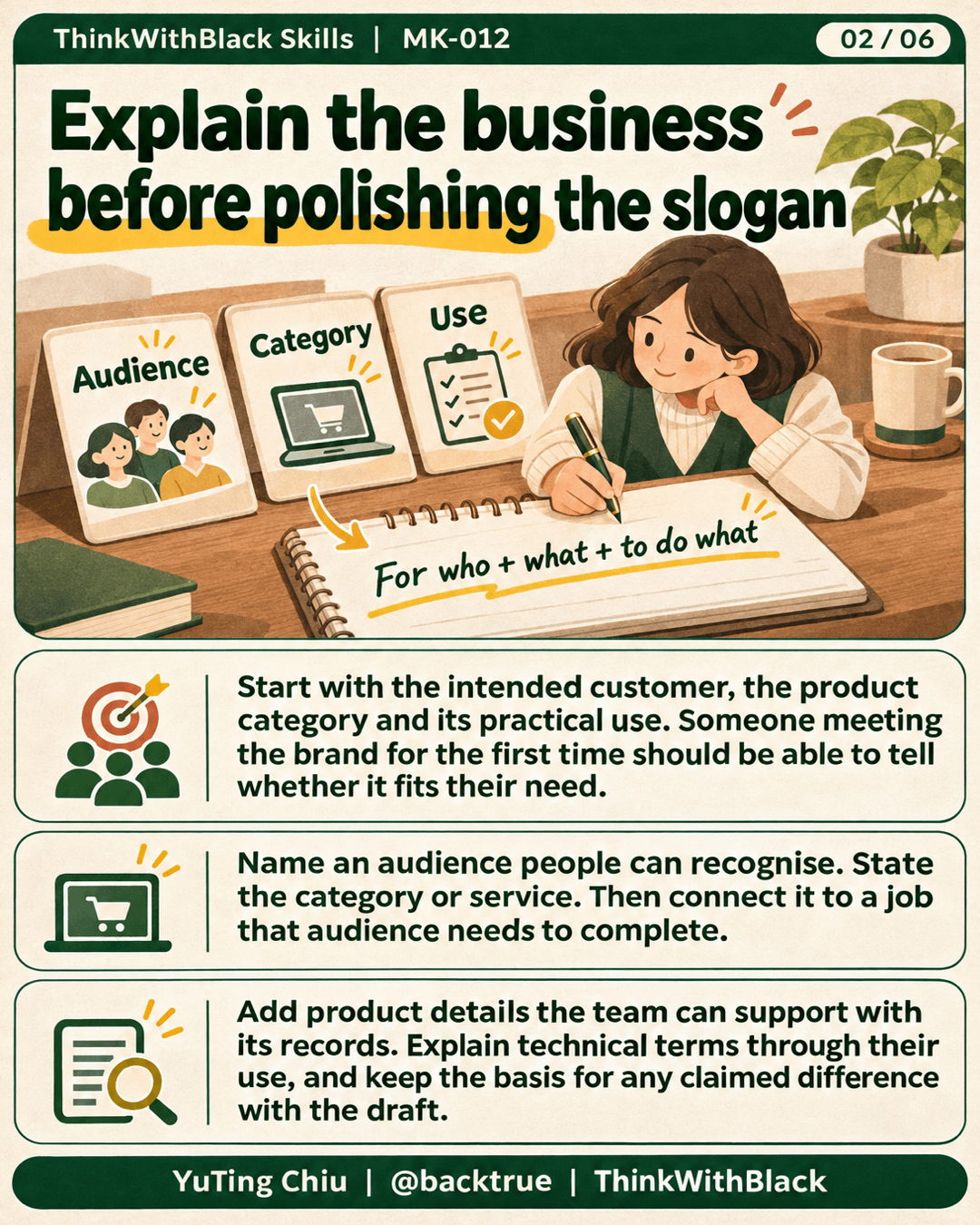
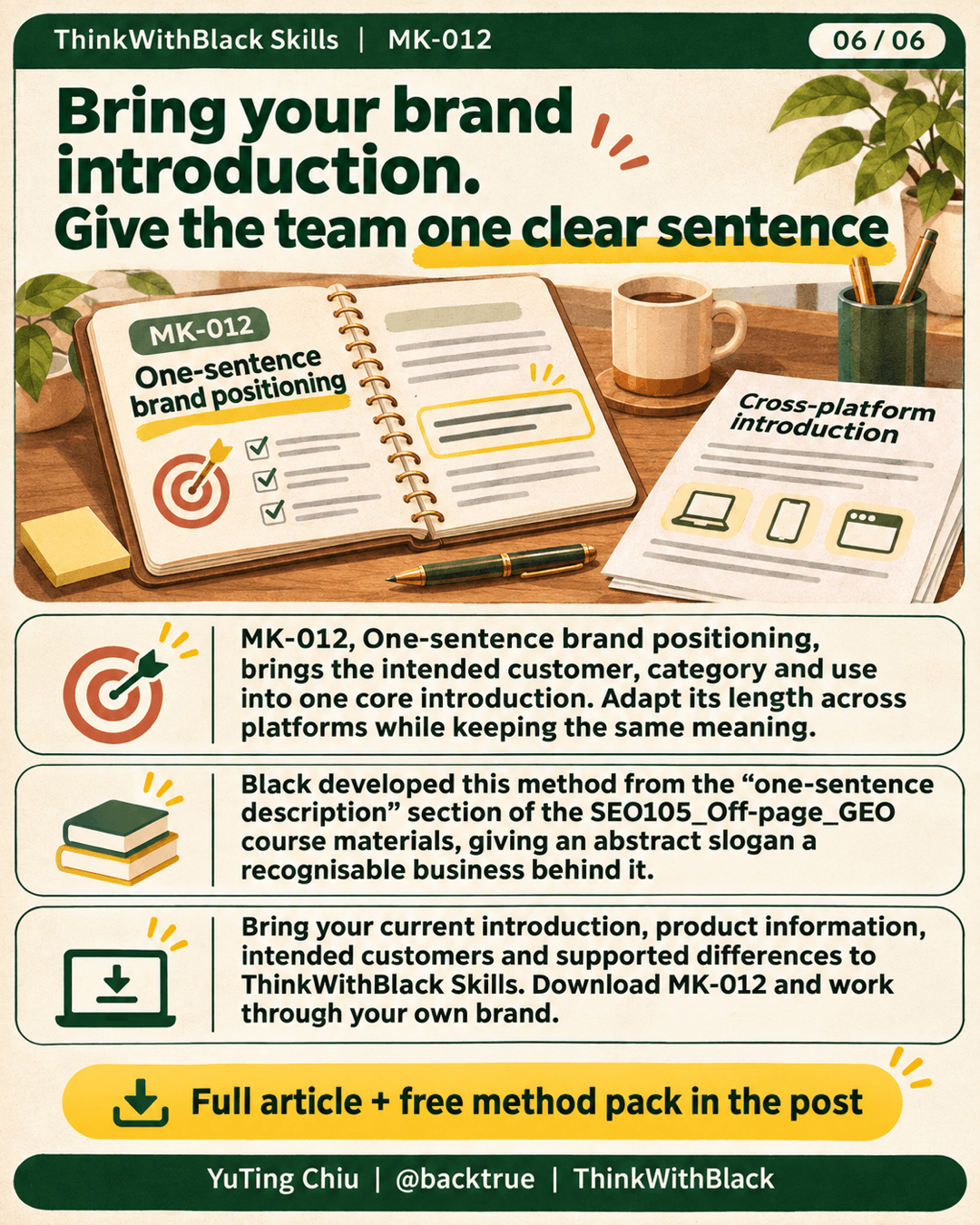
When a team gets stuck here, I start by putting the confirmed target customer, product category, and practical use side by side. What single sentence does a first-time visitor need to read to know who we serve and what we can do for them? MK-012, "One-Sentence Brand Positioning," is a method for writing that core introduction—clearly stating who you serve, what you provide, and what job you help them get done—and then adapting it to fit the length of each channel without changing your positioning.
You revise this core sentence under two conditions: first, if the product adds new services or your target customer changes, you update the core sentence and every channel version together; second, until you have apples-to-apples comparison data on competitors, the introduction states only the product uses your own records can prove, leaving claims about being different, "the only," or "the first" until that data is in hand.
Why changing the slogan didn't change the inquiries
MK-012 Six-Page Guide|1 / 6 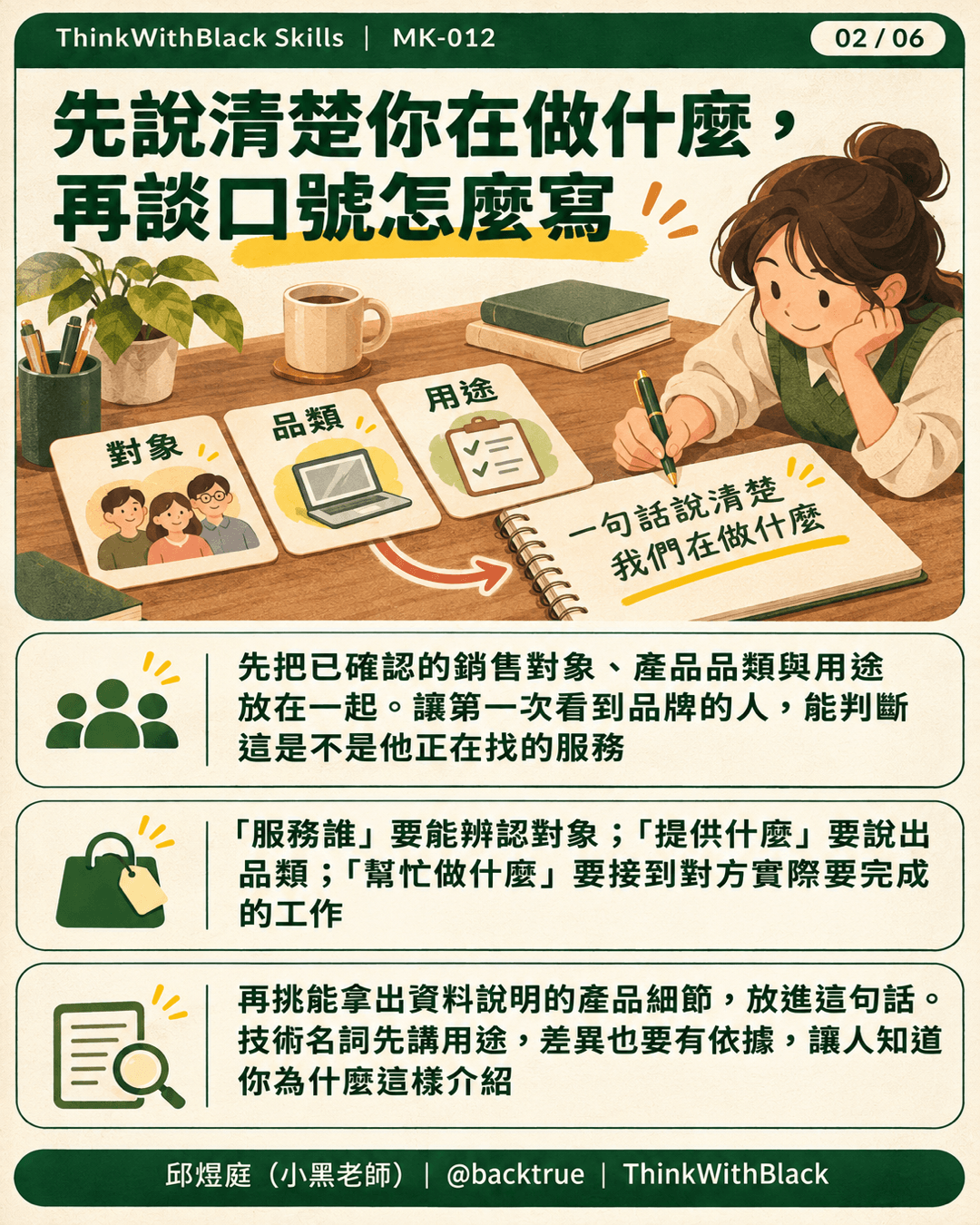
Words like "smart," "innovative," and "transformation" signal the direction a company wants to go, but readers still need to know what product or service sits behind them. Plenty of companies work in retail: one sells checkout hardware, another builds online stores, and a third manages in-store pre-orders. When outsiders see only a broad theme, they cannot tell which specific problem to bring you.1
Once Ya-Ting laid the three original texts side by side, she could see what each channel had dropped. The website left out who the customer was, the social bio left out the product category, and sales reps filled in the practical use in their own words. Any single channel read fine on its own, but together they didn't describe the same company. She added a column to her shared sheet and marked whether each channel was missing the "customer," "category," or "use." Each of the three touchpoints was missing a different piece, so prospects had to piece the puzzle together themselves.
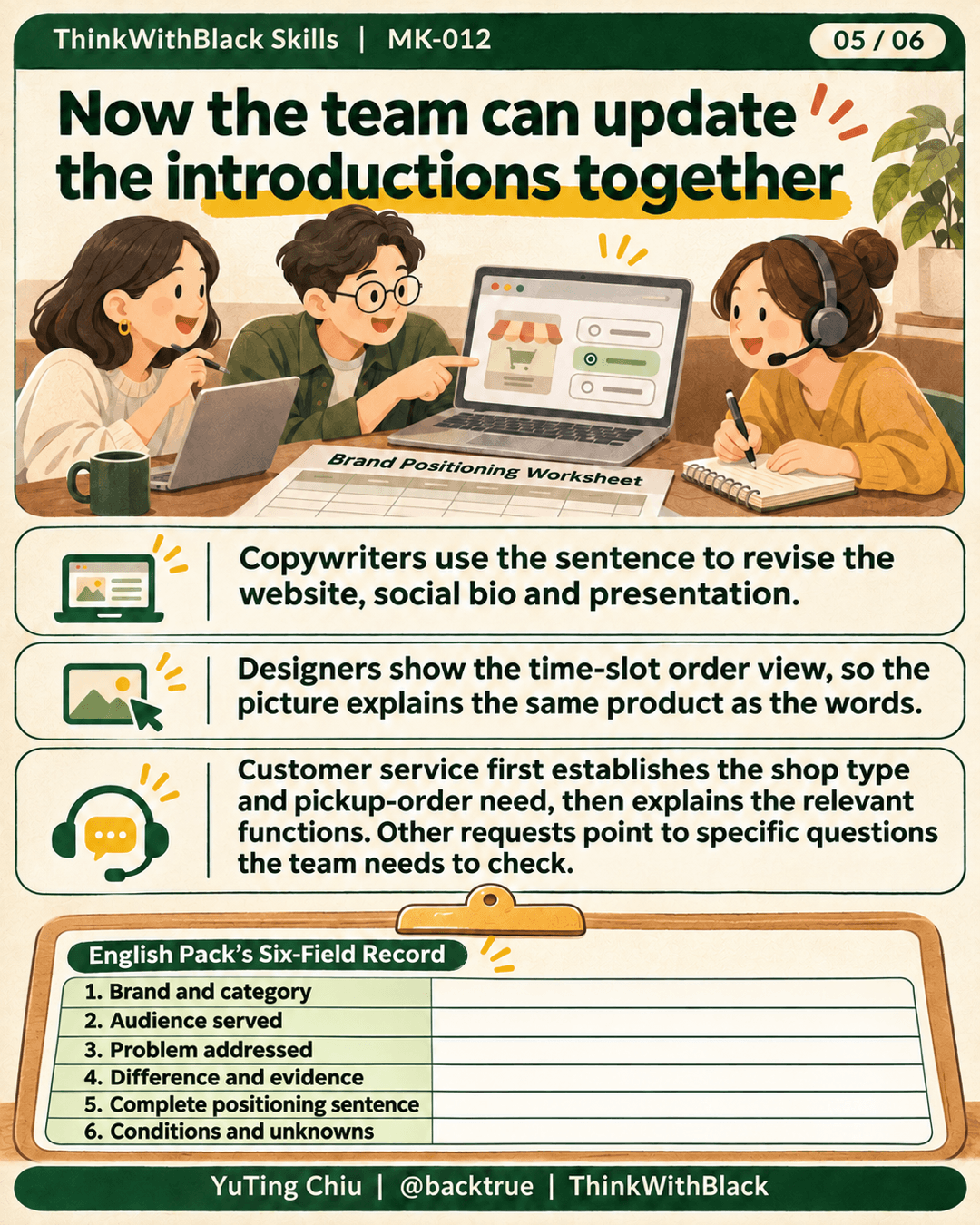
Writing one clear core introduction gives copywriters, designers, and customer service the same starting point. Later, whether you are trimming a sentence to fit a bio, pairing it with a product screenshot, or writing follow-up copy, everything builds from the same customer, category, and use.2
Black's method: help outsiders recognize the brand first
MK-012 Six-Page Guide|2 / 6
To make all three channels describe the same brand, Ya-Ting needed a fixed routine to inventory the material she had on hand. MK-012 starts by checking product specifications, target customers, competitor differences, and verifiable records, then condenses that positioning into one sentence. That sentence must name a recognizable product category or service and a specific audience; by the end of it, the reader should also know what day-to-day work the product handles.3
I start by writing a plain-language introduction that links "who we serve," "what we provide," and "what job we help them finish." Then I go back and pick concrete details that the product actually delivers and our existing records can back up. When drafting, keep features, benefits, and evidence separate: features backed by internal documents or product screens go straight into the sentence, while unproven claims get flagged as missing data. Until you have comparison data measured under the same conditions as your competitors, stick to describing your own features and the work they support.4
This process comes from the "one-sentence description" section of my SEO105_Off-page_GEO course materials.5 In the chapter on official brand profiles, the course requires every public channel to clearly answer three questions: "Who are you, what do you do, and what topic are you connected to?" MK-012 turns that requirement into a repeatable workflow: define the brand clearly in one core sentence, then carry that same sentence across every channel. The original course link and full step-by-step instructions are saved in the MK-012 Chinese method pack.
A concrete example: a pre-order and pickup system for bakeries
MK-012 Six-Page Guide|3 / 6 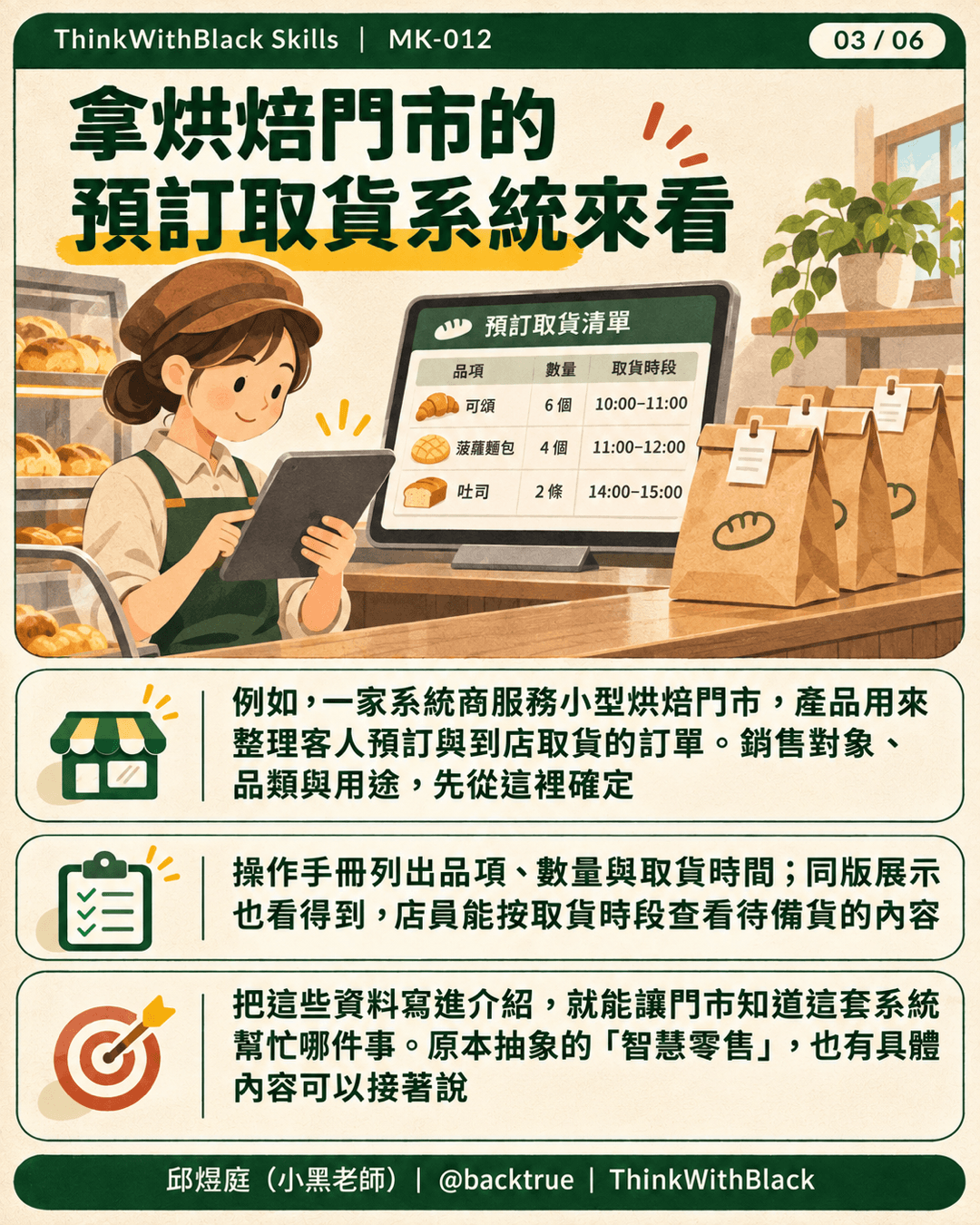
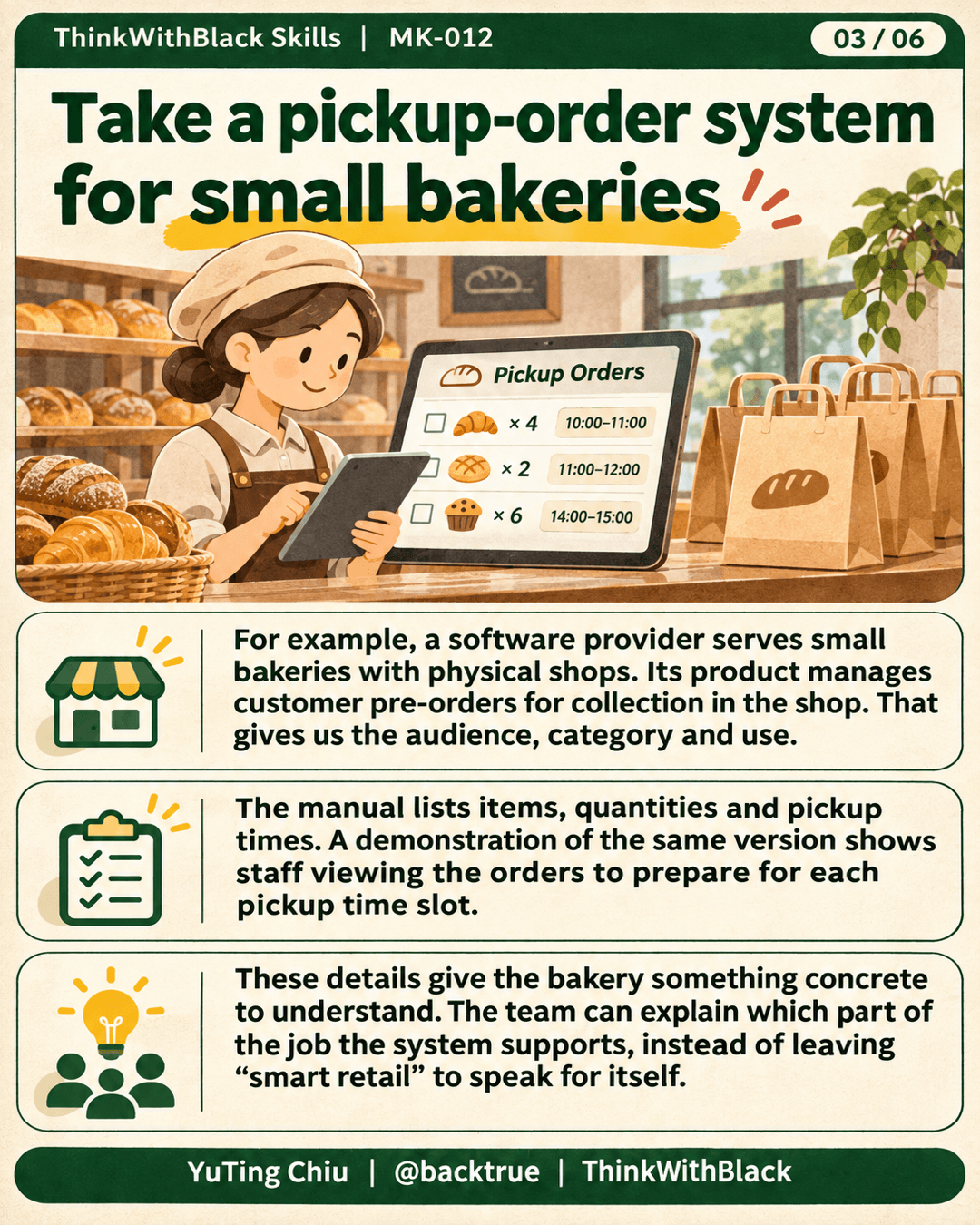
Ya-Ting tested the workflow on a system built for small bakeries. In this case, a software provider serves small bakeries that run brick-and-mortar shops, and its product organizes customer pre-orders for in-store pickup. Before drafting the introduction, she put the target customer, product category, and internal operating records into one table to verify what she could prove:
| Record | Details in this case | How it is used |
|---|---|---|
| Target customer | Small bakeries with physical shops that need to organize customer pre-orders for pickup | Names the audience in the sentence |
| Product category | Pre-order and pickup management system | Tells readers what kind of product this is |
| Operating manual S1 | Order records include fields for item, quantity, and pickup time | Backs up the order details mentioned in the introduction |
| Live-version demo D1 | Staff view the items and quantities to prepare, sorted by pickup time slot | Backs up the practical use and provides a screen to show prospects |
| Comparison record C1 | Competitor features and shop operating times under the same conditions have not been collected yet | Marks comparison data to gather later |
Manual S1 and live-version demo D1 translate technical specs into daily shop work a bakery owner immediately recognizes. Bakery staff prepare baked goods each day around the pickup times promised to customers. When orders are scattered across chat messages, paper slips, and spreadsheets, staff have to check and recheck them while prepping trays. What they actually need is a direct view of which items—and how many of each—are due in every time slot. Connecting that daily task back to the target customer and product category gives the sentence a clear spine.
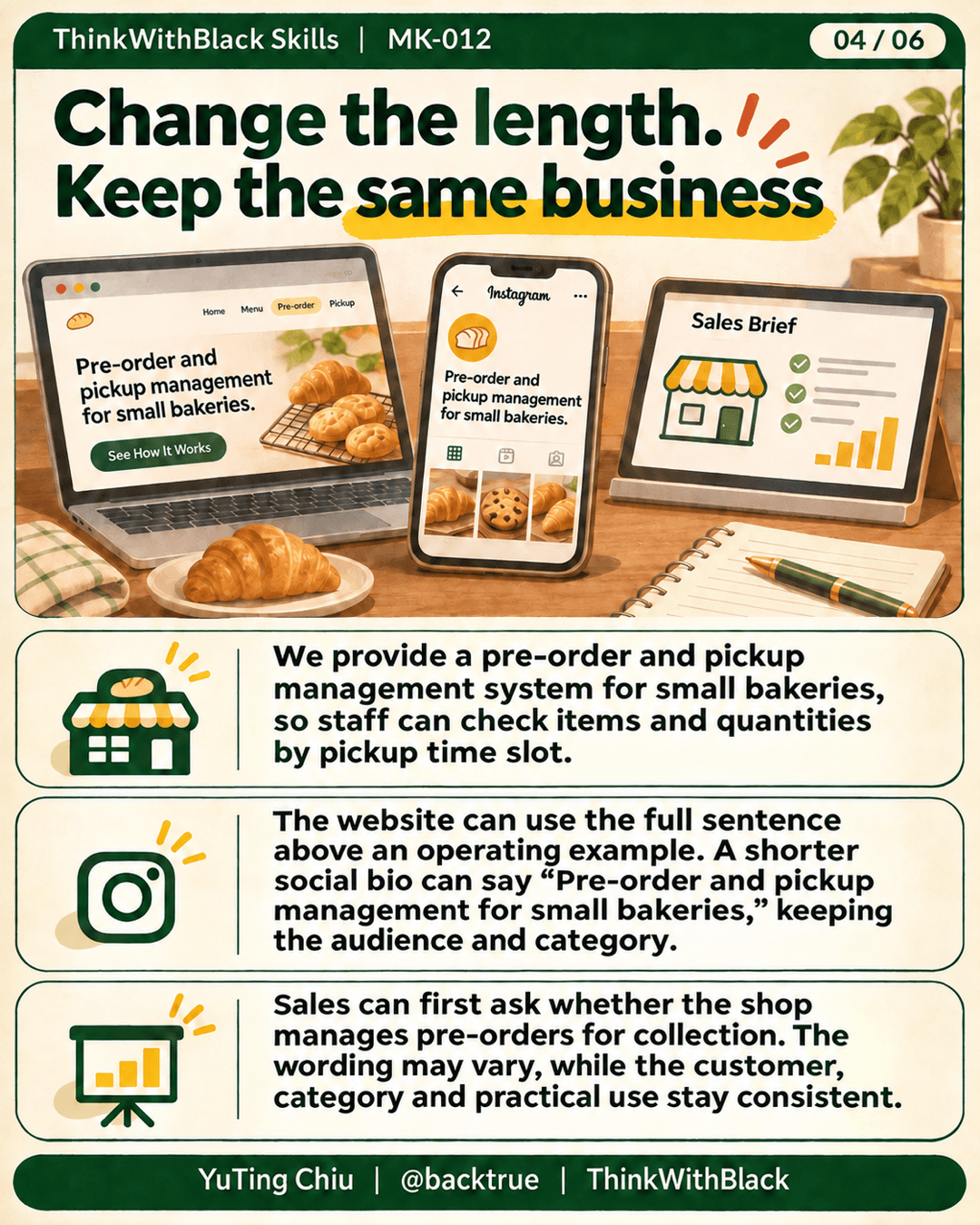
Built from those records, the core introduction reads: "We provide a pre-order and pickup management system for small bakery shops, so staff can check the items and quantities in each order by pickup time slot."
The first half tells an outsider the target customer (small bakery shops) and the product category (pre-order and pickup management system) right away. The second half explains how the system fits into the shop's prep work (checking items and quantities in orders by pickup time slot). Anyone checking the claim can pull up the fields in manual S1 and the screen in demo D1 to verify it.
Because comparison record C1 notes that "competitor features and shop operating times under the same conditions have not been collected yet," this positioning sentence sticks strictly to what S1 and D1 prove—"check the items and quantities in each order by pickup time slot." Any claims about saving more time than competing systems or offering unique features wait until C1 is complete.
Adapting one core introduction across channels
MK-012 Six-Page Guide|4 / 6 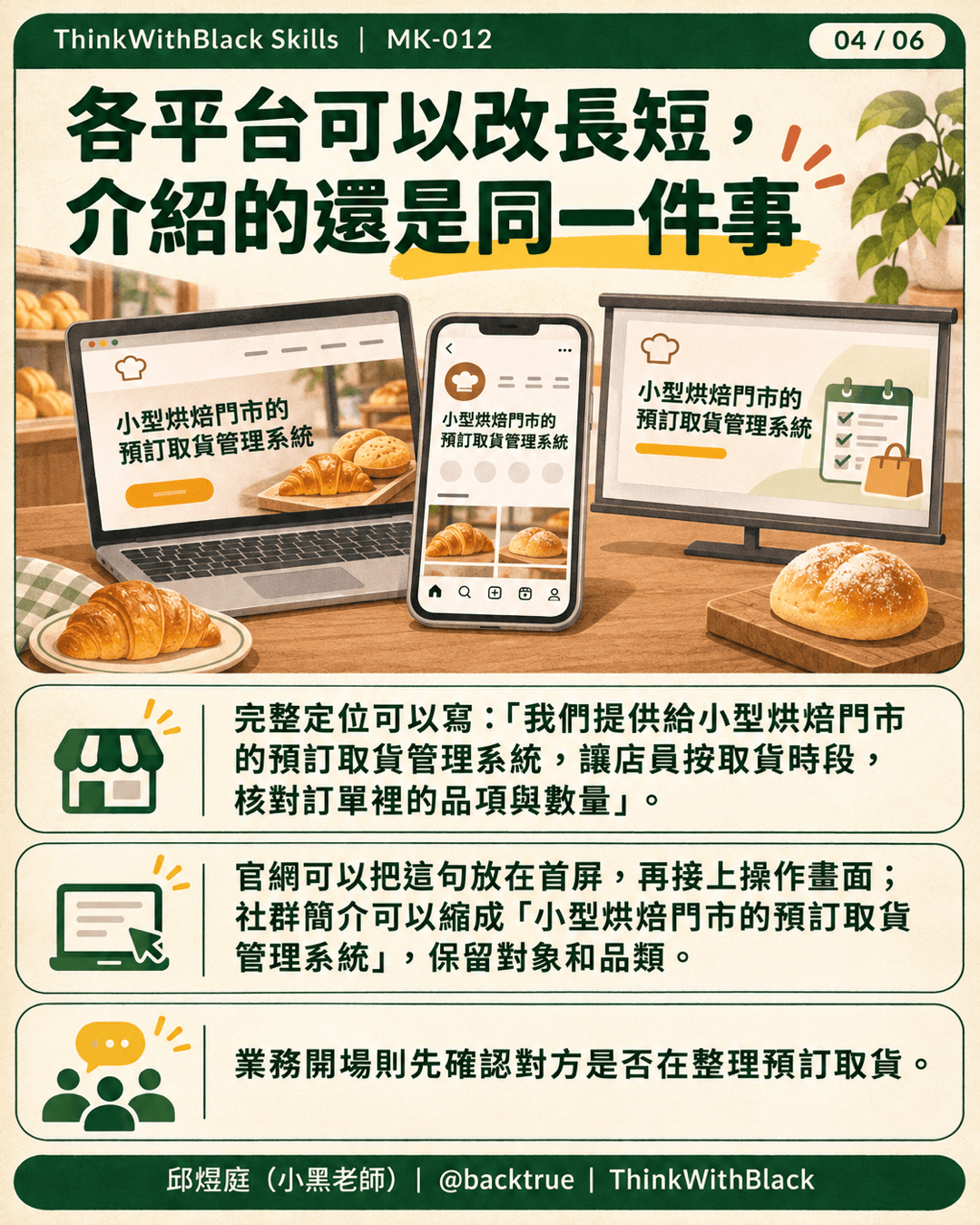
With the core sentence set, Ya-Ting went back to the three touchpoints that had been contradicting each other. Each channel has different space limits and reader expectations, so she adapted the sentence to fit each spot while keeping the same customer, category, and use across all three:
| Channel | Introduction copy | What comes right after |
|---|---|---|
| Website hero | A pre-order and pickup management system for small bakery shops, so staff can check the items and quantities in each order by pickup time slot | Pair with the product screen showing orders sorted by time slot |
| Social bio | A pre-order and pickup management system for small bakery shops | Follow up in regular posts showing how shops use it during daily prep |
| Sales opening | We provide a pre-order and pickup management system for bakery shops that lets staff view items and quantities by pickup time slot | Ask first whether the shop is managing this type of order, then walk through how it works |
All three versions anchor on the same customer, category, and use. The website hero has room for the full sentence alongside a screenshot of orders sorted by time slot. A social media bio is tight on characters, so it holds onto the customer and category—"A pre-order and pickup management system for small bakery shops"—and leaves the daily prep workflow for regular feed posts. The sales opening states the customer, category, and time-slot view upfront, then immediately asks whether the prospect's shop handles pre-order pickups before diving into a product demo.
Ya-Ting also set a simple rule for future edits: whenever anyone on the team rewrites copy on any channel, they first ask, "Can a reader still tell who we serve, what we provide, and what job we help them do?" As long as that channel's copy and its accompanying visuals answer all three questions directly, outsiders will recognize the business. If one piece drops out during an edit, the team puts the missing customer, category, or use right back in.
A seven-column table preserves the reasoning for the next person
MK-012 Six-Page Guide|5 / 6 
Writing the three new lines solves today's copy problem, but if you simply drop those three sentences into a team chat, the next person who updates the website won't know why they were written that way—and will likely drift right back to vague slogans.
To give copywriters, designers, customer service, and sales a shared record when work changes hands, the method pack uses a seven-field delivery table. Ya-Ting logged the positioning sentence alongside the supporting S1 and D1 records and the pending C1 item, so anyone on the team can see why this customer was chosen, which product detail leads the pitch, and what evidence still needs to be gathered:6
| Fixed field | Details for the bakery system example |
|---|---|
| Factual features | Orders record items, quantities, and pickup times; viewable by pickup time slot, backed by S1 and D1 |
| Customer task | Small bakery shop staff need to organize pre-orders and prepare baked goods around customers' pickup times |
| Tangible benefit | Staff can check the exact items and quantities to prepare for each time slot, fitting directly into their daily prep routine |
| Comparison basis | C1 unknown; competitor features and operating times under matching conditions still need to be collected |
| Best angle | Show the screen that sorts orders by pickup time slot, then walk through how the shop uses it to prep |
| Lead / support / pending | Lead: pre-order and pickup management for small bakery shops; Support: order fields and time-slot view; Pending: competitor comparisons and actual operating times |
| Reasoning | The target customer, category, and practical use form a complete introduction, and S1 and D1 provide verifiable proof |
This seven-column table keeps handoffs clean across departments. Copywriters work from it when updating the website, social bios, and sales deck openings. Designers check "Best angle" and "Factual features" and know the website hero needs the screenshot of orders sorted by pickup time slot. Customer service and sales read "Customer task" and "Lead / support / pending," so when an inquiry comes in, they first verify the caller's shop type and pre-order pickup needs. Each role can add the details their job requires while still describing the exact same product.
The "Lead / support / pending" row also sets clear guardrails for what the team can claim in public: order fields and time-slot views backed by S1 and D1 are cleared for immediate use in marketing and sales materials, while the competitor comparisons and operating times listed under "Pending" stay out of copy and pitch decks until someone gathers the data to prove them.
Later, if the product adds new capabilities or expands to a new type of store, the team updates this core positioning sentence, the seven-column table, and the channel versions together, leaving a clear trail for whoever takes over next.
Run this on your own brand introduction
MK-012 Six-Page Guide|6 / 6 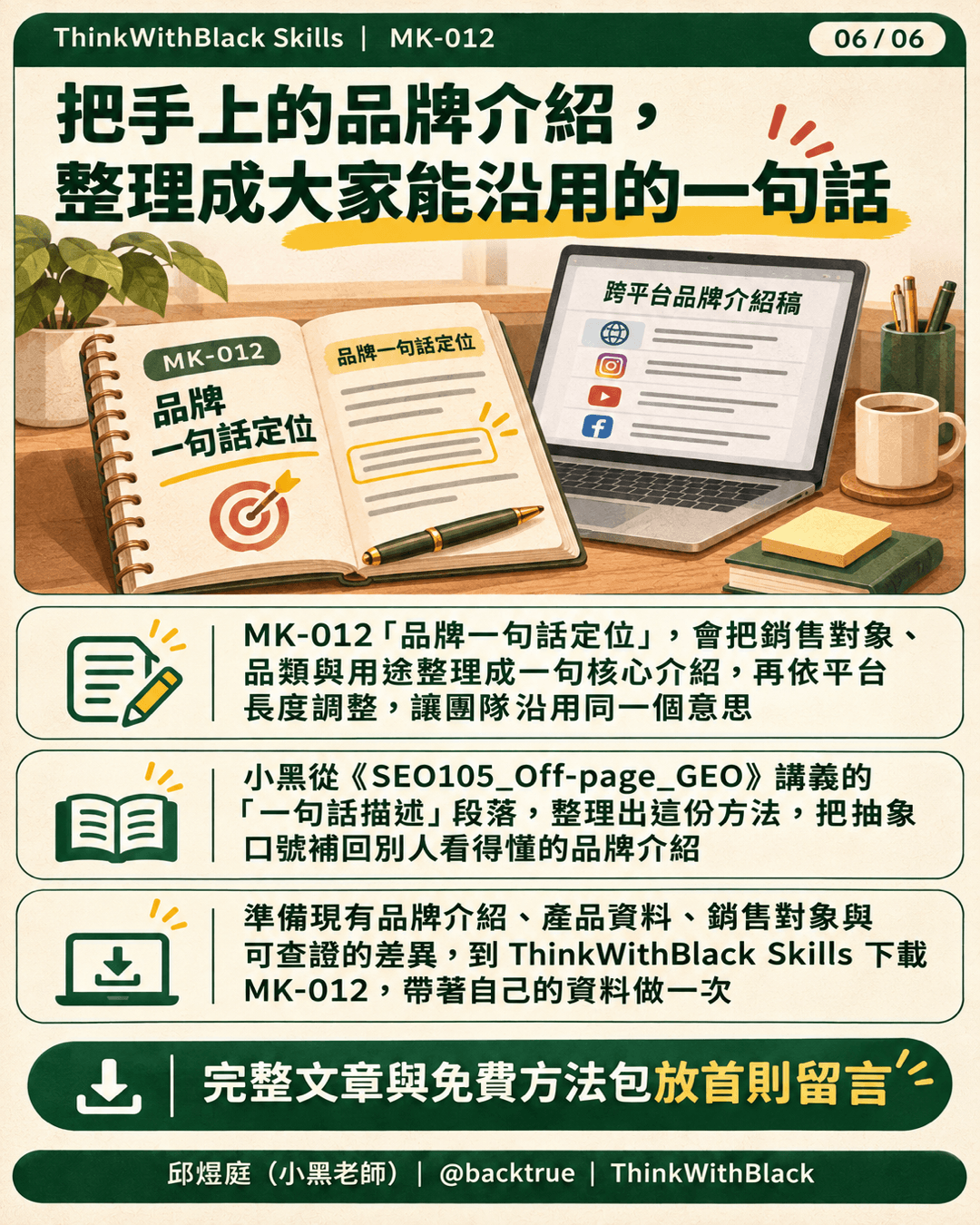
To align your own brand's public introductions around a single message, gather your materials the same way Ya-Ting did: pull the current copy from your website hero, social bio, and sales opening, along with your product specs, target customer profile, verifiable differentiators, and internal proof. Paste the current text from each channel side by side in one document and mark, phrase by phrase, where each one names the customer, the category, and the practical use. You will see right away which channel is dropping which piece.
Once your materials are in one place, you can use AI to draft the first pass with this prompt:
"Using MK-012, take these existing brand introductions, product records, and target customer details and write a one-sentence brand positioning statement that an outside reader can immediately understand. Keep the target customer, product category, job to be done, and verifiable details, then adapt that sentence into three versions: website hero, social media bio, and sales opening. Output the method pack's seven-column table so our team can verify the reasoning behind each line and see what data still needs to be collected."
When the AI returns the draft sentences and the seven-column table, review them yourself before publishing: check that the brand name, target customer, product category, and tone match how you actually operate, and look closely at the "Comparison basis" and "Pending" fields. Make sure the draft only claims features backed by existing records like S1 and D1, and keeps any unverified C1 comparisons parked in the pending column.
You can download the free materials at ThinkWithBlack Skills: start with INDEX.md, then open the complete MK-012 method pack to turn scattered channel bios into one clear sentence your whole team can use.
When to revise this sentence: business decisions and how to check
Aligning your website hero, social bio, and sales opening around the same positioning sentence solves a concrete operational problem: it lets outside readers tell at their very first touchpoint whether your product is built for them, increases the share of incoming inquiries that match what you actually sell, and cuts the hours customer service and sales waste explaining what you don't do.
Once the new copy goes live, Ya-Ting and her team use two decision points to guide their next move:
Decision point 1: Track incoming inquiries before and after the change with a shared log Before the rewrite, because the website, social bio, and sales deck each left out different facts, customer service and sales regularly fielded inquiries asking for website builds or ad management and had to explain the company's scope from scratch. After launching the new copy, Ya-Ting asked customer service and sales to log incoming inquiries over a set period in a shared sheet split into two buckets:
- Fits product scope: The caller matches the target customer (for instance, a small bakery with a physical storefront) and is asking about work within the product's category and use (managing pre-orders and in-store pickups).
- Requires re-explaining scope: The caller is looking for a different service altogether (such as building a website or running ad campaigns), or their business type doesn't match the product's setup.
Reviewing this log tells the team exactly what to adjust (time saved and inquiry fit rates are tracked and measured by each team on their own traffic):
- If inquiries that "require re-explaining scope" still show up frequently, check which channel those callers came from first. Look back at that channel's copy to see whether the rewrite dropped the "target customer" or "product category," and restore the missing piece on that channel rather than throwing out the whole positioning framework to brainstorm new slogans.
- If callers already understand what category of product you sell but ask how the daily workflow operates in practice, the core positioning sentence is doing its job of identifying the brand. The next move belongs to design and content: add product screens and step-by-step walkthroughs (like D1) to the website hero or social feed posts.
Decision point 2: Update when your product scope, target customer, or evidence changes
- The product adds new services or your target customer shifts: When the business genuinely expands its service lines or decides to sell to a new customer segment, go back to the core positioning sentence and the seven-column table first, then update the website hero, social bio, and sales opening together so every touchpoint reflects the new scope at the same time.
- Comparison data (C1) is collected and verified: Until you have apples-to-apples data on competitor features and shop operating times (C1), every public sentence stays within "uses backed by existing records" (such as checking order items and quantities by pickup time slot).7 Once the team measures and verifies C1 data, update the "Comparison basis" and "Lead / support / pending" rows in the seven-column table, and decide then whether adding a verifiable comparison makes the positioning sentence stronger.
Bring your own records into MK-012
Download the MK-012 method pack
First time using these skills? Download the index first so your AI tool can select the right method, then upload the full method pack alongside your own company records.
Download the MK-012 method pack · Download the INDEX.md index · View the full instructions
English method pack: Download the English MK-012 method pack · Download the English INDEX.md
This Skill on social media
Pick a platform to view the six-page guide and post for this Skill
Facebook Chinese · Instagram Chinese · Threads Chinese · LinkedIn English · X English
YuTing Chiu (Black) · @backtrue · ThinkWithBlack
Skill guide compiled by: Author background and courses
Find other Skill articles by business problem →
References
Links and resources from the original article
SEO 105|Off-page GEO: Helping AI Understand Your Brand on the Public Web, Slide 5 "Identity confirmation signals" and Slide 6 "Consistency matters more than volume." Black (SEO105 course materials), undated.↩︎
When Your Website, Social Bio, and Sales Deck Say Different Things, Customer Service Gets the Wrong Inquiries: MK-012 One-Sentence Brand Positioning, Guide 1/6. YuTing Chiu (Black) · ThinkWithBlack, published 2026-11-05 / updated 2026-11-05.↩︎
MK-012|One-Sentence Brand Positioning (v0.3 method draft), Section 3 "Specific method for this item," points 1–3. ThinkWithBlack Skills, undated.↩︎
Ibid., Section 1 "Purpose and boundaries of the work" and Section 4 "Original method and limitations."↩︎
Same as note 1, Slide 5 and Slide 15 "Exercise 1: Official identity outpost completion check"; MK-012 Section 10 "Source location" records the original excerpt under "One-sentence description."↩︎
Same as note 3, Section 6 "Fixed delivery fields."↩︎
Same as note 3, Section 5 "Outcome branches" and Section 8 acceptance case MK-012-C05 "Specs are real, but there is no peer data": you may state the functional benefit now and evaluate comparative claims once peer data has been collected.↩︎