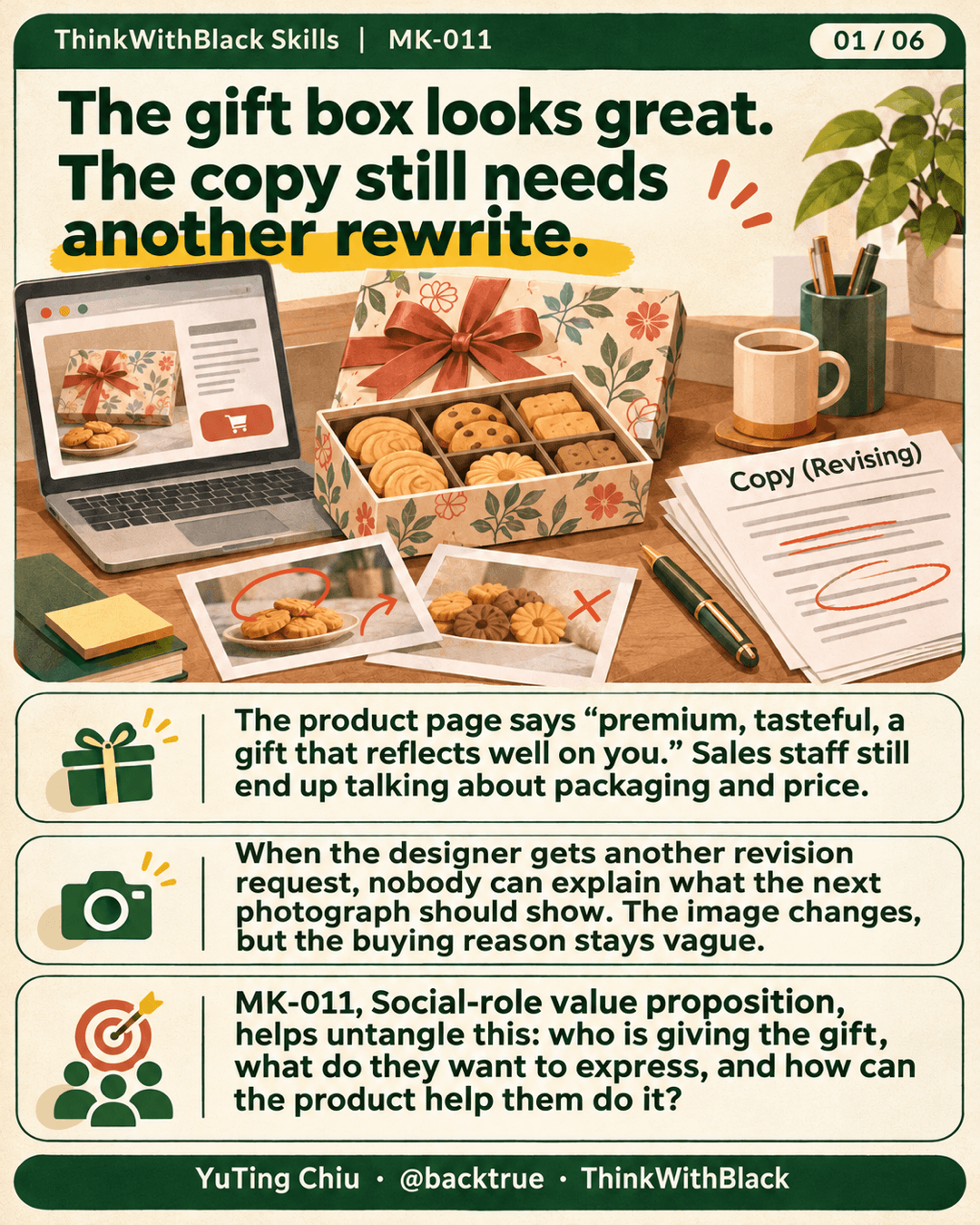
Yi-Ting (怡婷), a sales rep for a cookie gift-box brand, pulled up the revised corporate gifting page on the meeting room screen to walk a partner contact through this season’s client visit gift. The headline read, “Premium, tasteful, a gift that reflects well on you,” paired with close-ups of a ribbon, a gift bag, and the box itself. Two sentences into her pitch, she realized all she had left to talk about were the box material and the price tiers. The moment the contact asked what kind of visit this box suited, or why the packaging inside the box mattered, the page gave her nothing to work with.
Back at the office, Yi-Ting asked the team to add the buying reasons she needed on client visits to the page, only to find everyone stuck in the same spot. Mei-Chi (美琪), the copywriter, had rewritten the opening paragraph several times. Each draft swapped in a new set of adjectives, and at the next day’s meeting the team still felt it wasn’t convincing enough. Kuan-Yu (冠宇), the designer, looked at the new revision brief and the existing ribbon-and-box photos, unable to decide what scene to shoot next. Because the team didn’t share a single set of reasons to pitch the box, the product page, the sales pitch, and the photo shoot each improvised their own angle. Revisions kept piling up, and in client meetings Yi-Ting still had to fall back on outer packaging and price.
Yi-Ting thought back through several visits to partner companies. What separates corporate gifting from an individual retail purchase, she realized, is that the gift’s job doesn’t end when it lands in the contact’s hands. If the contact opens the box and passes the cookies around the office, the individual packets inside and the flavor label on each packet start doing real work. If the recipient plans to keep the box for themselves, the selling points are completely different. The original “premium gift box” visuals only showed how impressive the outer box looked; they never explained how the gift gets used after it’s handed over.
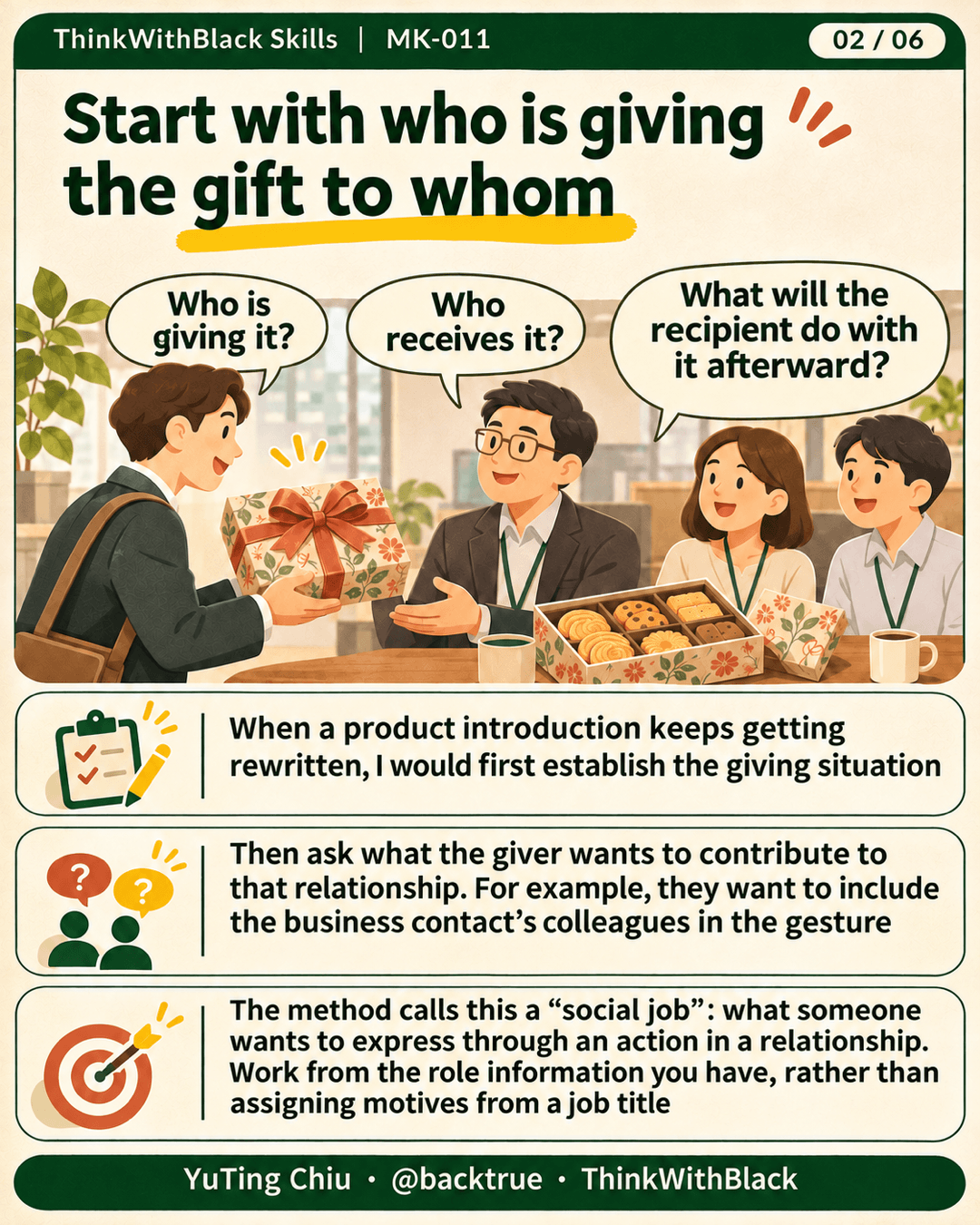
To make the next version of the page ready for actual sales conversations, the team first had to answer three questions: Who is giving this gift to whom? What will the recipient do with it after receiving it? And what does the giver want that gesture to say? Once you connect what the giver wants to express with what the product can physically do, the team knows which scenario to write about and which detail to photograph.
Black’s Method: Pair the Social Job with the Functional Job
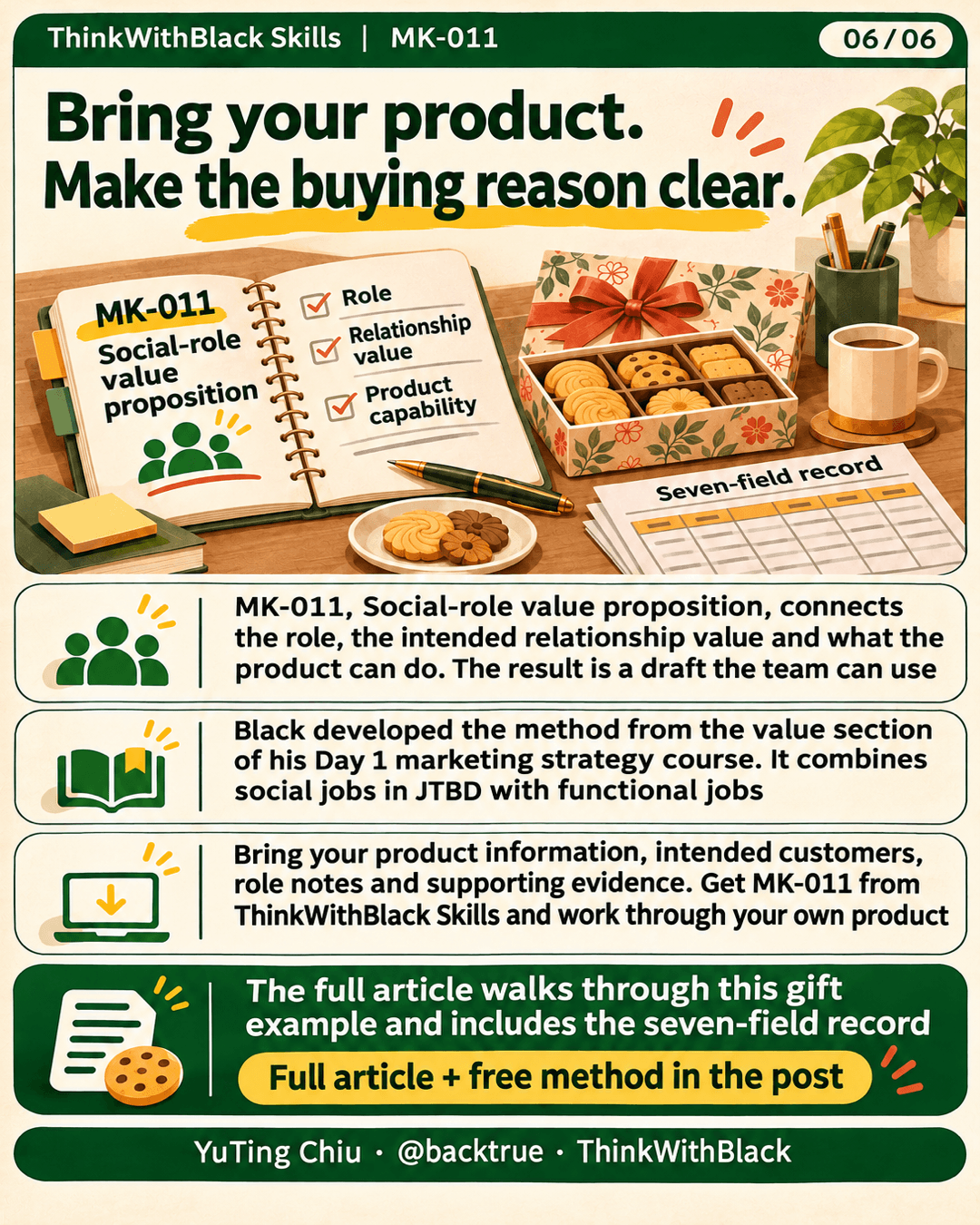
When a team is stuck writing image slogans, MK-011 (“Social-Role Value Proposition”) starts by identifying the giver’s role, the recipient, and the setting where they interact. Next, it asks what the giver wants to express through the act of giving, and matches that intent to a specific product feature that carries it out in practice.
This method applies the concept of “social jobs” from Jobs to Be Done (JTBD) to capture how customers want others to see them, or what value they hope to add to a relationship. It comes from the value section of the course handout Marketing Strategy Practical Course Day 1 — Niche Is the New Mass × Precise Persona × Digital Assets (《行銷策略實戰學程Day1-小眾就是大眾 × 精準 Persona × 數位資產》). On Slide 54, the handout breaks customer jobs into three types: functional jobs (“What practical work do I want to get done?”), social jobs (“Does this help me look good in front of others?”), and emotional jobs (“Does it put me in a better mood?”). It states directly that “a good product needs functional + social or emotional” and “your product must have a 1+1 job” [1]. The official method pack preserves the handout source and original link. It requires you to document the source for the role and scenario first, then pair them with the product’s functional job to form a 1+1 value proposition backed by concrete usage details. You can check the full process in the Chinese MK-011 method pack [2].
Confirming a role’s motive means sticking to the records you actually have in hand. When Yi-Ting visits a partner company, she wants the gift to take care of the contact’s office colleagues as well—that serves as the giver’s motive in this scenario. If all you know is that the recipient’s title is “manager,” you record only that known title and the visit relationship; any claims about wanting prestige or status wait until you have an actual record from a customer. Section 3 of the method draft sets this rule explicitly: social value must map to a real role and scenario, staying within the bounds of social recognition that your existing evidence can support [3].
Once the Box Reaches the Contact, It Still Has to Be Shared with the Office
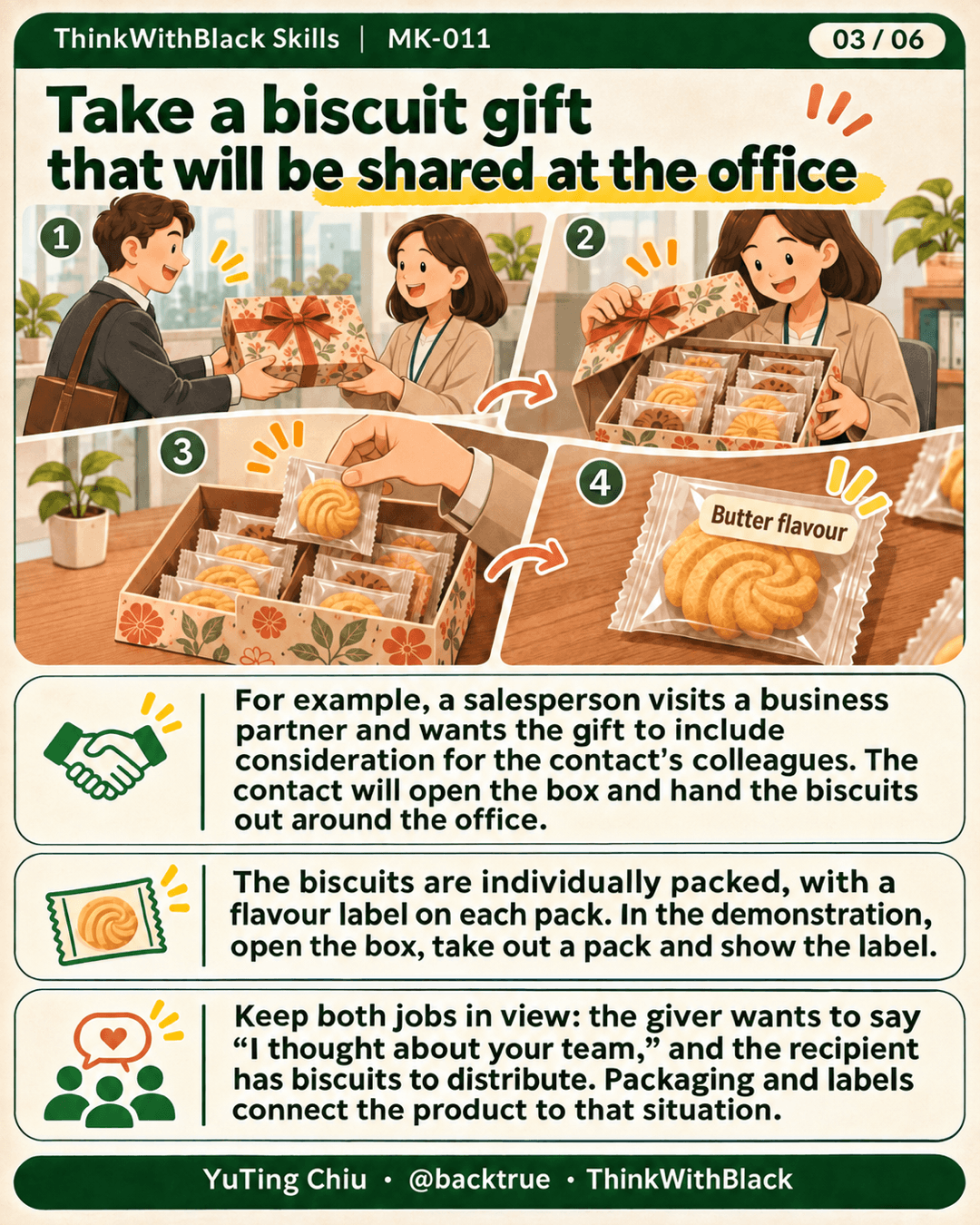
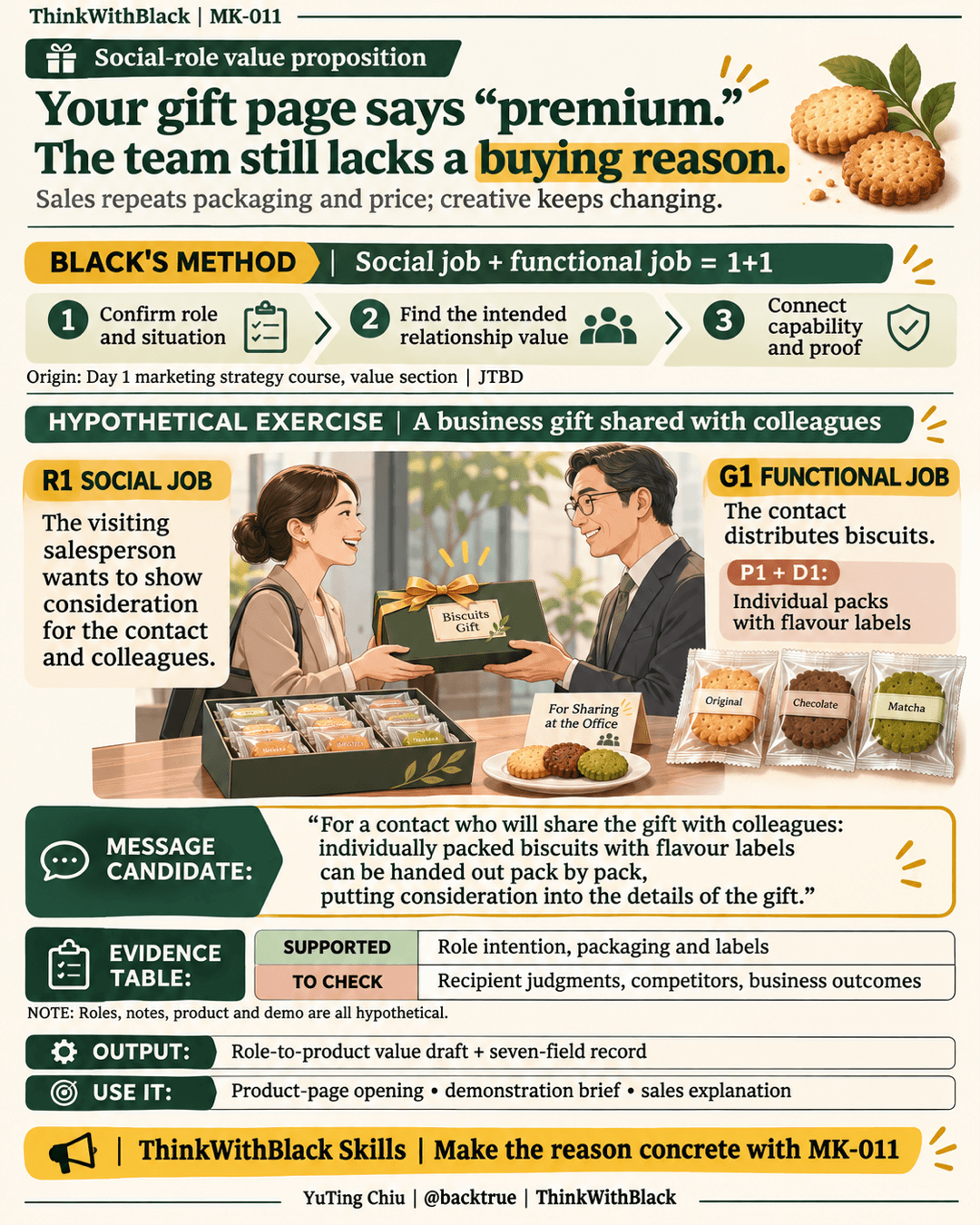
With the sequence clear, Yi-Ting laid out the specific corporate visit scenario alongside the product specs she had on hand: a sales rep visits a business partner and wants the gift to look after the contact’s colleagues too; after receiving the box, the contact opens it and passes the cookies out around the office. She organized the gifting situation, product details, and missing evidence into a reference table:
| Code | Evidence in this case | What it supports |
|---|---|---|
| R1 Giver | A sales rep visiting a business partner wants the gift to also take care of the contact’s colleagues | The role in this case and the thoughtfulness they want to express |
| G1 Recipient scenario | The partner contact opens the box and passes the cookies out to office colleagues | The practical task that happens after the gift changes hands |
| P1 Product specs | Each cookie inside the box is individually wrapped, with a flavor label on every packet | Easy to grab and pass around, with clear flavor info |
| D1 Visual demo | Open the same gift box, pull out an individual packet, and show the flavor label clearly | The physical action and detail that photos can capture |
| C1 Comparison data | No same-condition data on competing gift boxes, and no recorded feedback from recipients | Competitor comparisons and recipient reactions remain to be verified |
Working from this table, Yi-Ting first stated the functional job: after the contact opens the box to share the cookies, the individual packets let people grab one at a time, and the label on each packet lets colleagues see the flavor right away as it’s handed over. Then she connected the social job: the visiting sales rep wants to show they thought ahead for both the contact and the whole department, and that thoughtfulness comes through in the practical details of handing the cookies out.
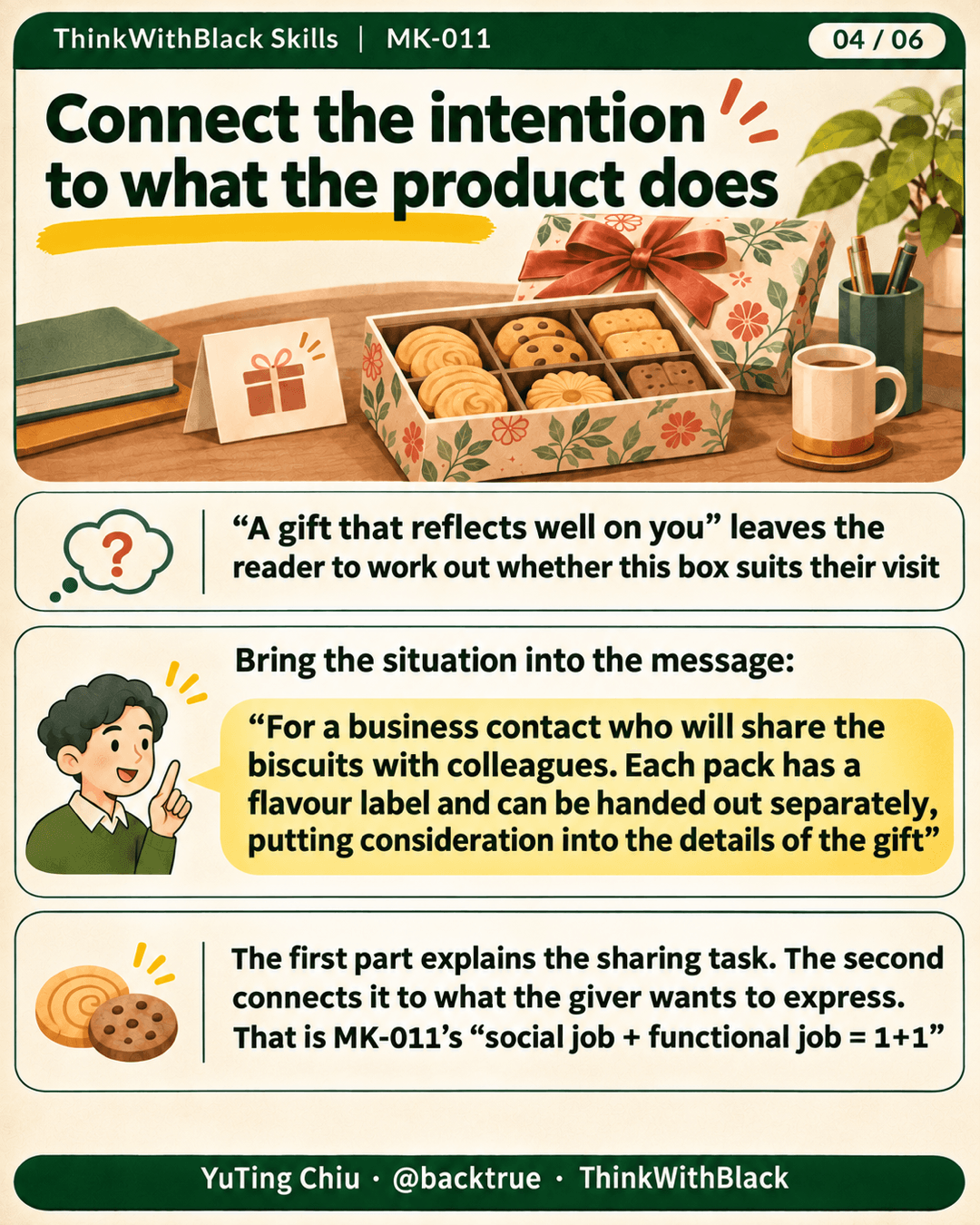
Putting the scenario and the product capability together, Yi-Ting drafted a candidate opening line: “Made for partner contacts who share gifts with their team. Every individually wrapped cookie is labeled by flavor, so packets are easy to grab and pass around—putting your thoughtfulness for their whole office into the details of the gift.”
The first half of that pitch explains how the cookies get distributed in an office, backed directly by the packaging specs in P1 and the demo action in D1. The second half ties back to the thoughtfulness the giver wants to express in R1. That combination of social job and functional job is a 1+1 value proposition.
While putting the table together, Yi-Ting used row C1 to note that the team had no same-condition competitor data or recorded recipient reactions. Even so, this alignment brief gives the team enough grounded material to decide how to pitch the box and what to shoot. Claims like “recipients find it tasteful,” “this gift helps close deals,” or “the only box of its kind in the industry” stay on the unverified list until the team gathers actual recipient feedback or apples-to-apples competitor evidence.
How the Seven-Field Alignment Brief Works Across the Team
So Mei-Chi and Kuan-Yu could immediately see the reasoning behind every choice, Yi-Ting used the seven fixed fields from Section 6 of the Chinese method pack to put the role, social job, functional features, and evidence limits into a single shared table [3]:
| Fixed field | Content compiled from this gifting case |
|---|---|
| Factual features | Individually wrapped cookies with a flavor label on each packet, backed by P1 and D1 |
| Customer jobs | R1: Sales rep giving a client-visit gift wants to look after both the contact and their colleagues; G1: Contact opens the box and passes cookies out to the office |
| Perceivable benefit | Individual packets with visible flavor info that are easy to hand out; uses these details to show consideration for the recipient’s team as a candidate social-role appeal |
| Comparison basis | C1 unknown; no same-condition competitor data or recipient feedback on file |
| Suitable angle | Film or photograph the contact opening the box, picking up a single packet, checking the flavor label, and handing it to a colleague |
| Primary / supporting / unverified | Primary candidate: gifting details built for office sharing; Supporting: individual wrapping and flavor labels; Unverified: actual sharing demand, recipient praise, and competitor comparisons |
| Rationale | R1 supplies the gifting motive, G1 supplies the post-receipt scenario, and P1 + D1 provide demonstrable features, giving the 1+1 claim a traceable basis |
When Yi-Ting brought this seven-field brief back to the meeting, all three teammates immediately had the same baseline to work from:
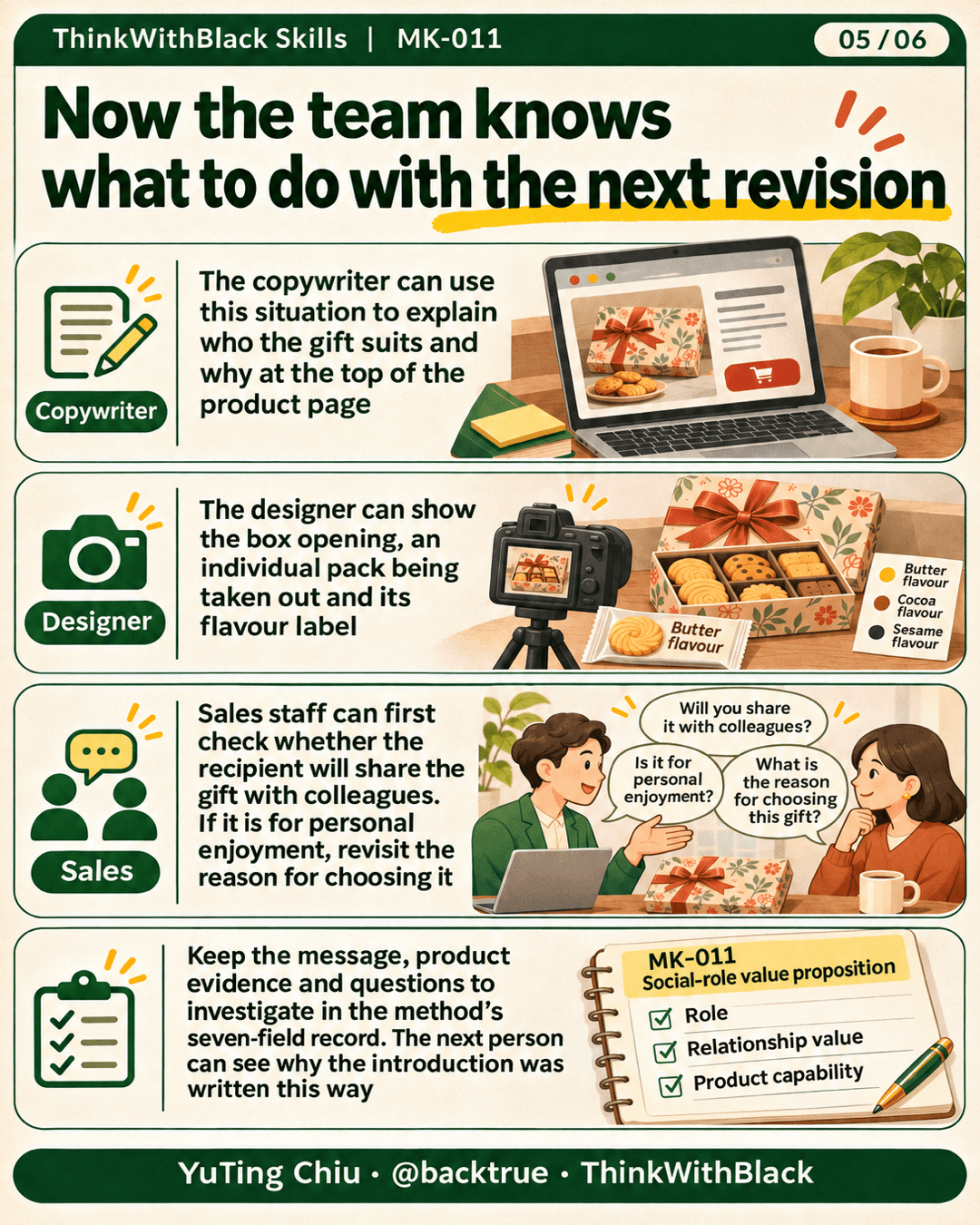
- Copywriting rewrites the lead: Mei-Chi used the 1+1 candidate pitch from the brief to replace the vague prestige slogans at the top of the corporate gifting page with the specific scenario of a contact opening the box to share with colleagues.
- Design shoots the missing visual: Working from “Suitable angle” and D1, Kuan-Yu set up a shoot showing an open box of the same model, a hand lifting out a single packet, a clear view of the flavor label, and the handoff to a coworker—skipping another round of guessing what photo to take.
- Sales qualifies the pitch: Before a client visit or price quote, Yi-Ting now asks whether the recipient typically shares gifts with their department. When office sharing is part of the picture, she leads with the individual packets and flavor labels instead of repeating box materials and price tiers.
The brief also tells the team exactly when to switch angles. If Yi-Ting learns before a visit that the recipient plans to keep the gift for themselves, or works in a setting where nobody passes snacks around the office, the G1 scenario no longer applies. When that happens, the team goes back to the table, checks which functional jobs fit personal enjoyment, and rebuilds the brief around the product features that support solo use. Because the claim, the supporting specs, and the unverified items live in the same table, every page update and sales pitch can be traced back field by field to its source, cutting out rounds of cross-team guesswork.
Run It Once on Your Own Product and Role Notes
To apply this process to a product you’re working on, gather four types of material first: product specs, target buyer descriptions, verifiable evidence, and competitor comparison data. When you review your notes on the customer’s role, look for who they interact with, in what setting, and what they want that interaction to achieve. Mark any motives you haven’t confirmed with real customers as hypotheses, and list missing records plainly as unknown.
Once your materials are ready, paste them into an AI tool with this prompt:
Follow MK-011 to turn these product specs and raw role notes into a role-identity and product-value alignment brief. First list the role and its data source, the interaction scenario, and the social job. Next, pair them with the functional job and supporting evidence to write a 1+1 value proposition, and deliver the result using all seven fixed fields from the method pack. Keep unconfirmed motive hypotheses, unknowns, and missing evidence explicitly labeled item by item.
When you get the seven-field brief back, run three checks before publishing the copy:
- Trace every field back to a source: Make sure each line in the table points back to a product spec or role note you actually provided, so only sourced claims make it onto the product page.
- Enforce the evidence boundary: Check that the social job rests on a documented role and interaction scenario. Keep subjective recipient praise, deal-closing claims, and unproven competitor comparisons parked in the “unverified” field; let the page claim only the practical usage details that your packaging and specs can prove.
- Keep or switch based on real inquiries: Have sales and customer support watch what buyers actually ask. If buyers and recipients really do use the gift for office sharing, keep running with this brief; if most recipients keep the box for themselves, pick a different functional job and rebuild the table. If your campaign depends on current platform specs or time-sensitive rules, verify the platform’s live policies before launch.
You can download the free materials from ThinkWithBlack Skills—start with INDEX.md, then pair it with the full MK-011 method pack [2][4]. Bring a product your team keeps rewriting, and build one alignment brief that your product page, photo shoot, and sales pitch can all use together.
Bring Your Data into MK-011
Download the MK-011 method pack [2]. First time using it: download the index first so your AI tool can pick the right method, then upload the full method pack alongside your product and customer notes.
Download the INDEX.md index [4] · View the complete operating instructions [5]
Also available in English: Read in English → (English method pack: complete English MK-011 pack)
Social posts for this Skill—click a platform to view the carousel and post for this Skill:
- Facebook (Chinese) [6]
- Instagram (Chinese) [7]
- Threads (Chinese) [8]
- LinkedIn (English) [9]
- X (English) [10]
Single infographic card and original social posts: to see the full decision flow on a single image, open the infographic card below, where we’ve also kept the links to the five original social posts:
- Facebook (Chinese) [11]
- Instagram (Chinese) [12]
- Threads (Chinese) [13]
- LinkedIn (English) [14]
- X (English) [15]
YuTing Chiu (邱煜庭, Black) · @backtrue · ThinkWithBlack | Published 2026-11-05 · Updated 2026-11-05
About the author and courses behind this Skill tutorial: Author background and courses [16]
Find other Skill articles by operational problem → [17]
References
- ↑ Marketing Strategy Practical Course Day 1 — Niche Is the New Mass × Precise Persona × Digital Assets. Google Slides, 2026. Slide 54
- ↑ MK-011 Chinese method pack. ThinkWithBlack
- ↑ MK-011 Social-Role Value Proposition v0.3 method draft. ThinkWithBlack. Sections 3 and 6
- ↑ INDEX.md index. ThinkWithBlack
- ↑ Complete operating instructions. ThinkWithBlack
- ↑ Facebook post (Chinese). ThinkWithBlack
- ↑ Instagram post (Chinese). ThinkWithBlack
- ↑ Threads post (Chinese). ThinkWithBlack
- ↑ LinkedIn post (English). ThinkWithBlack
- ↑ X post (English). ThinkWithBlack
- ↑ Facebook single-infographic post (Chinese). ThinkWithBlack
- ↑ Instagram single-infographic post (Chinese). ThinkWithBlack
- ↑ Threads single-infographic post (Chinese). ThinkWithBlack
- ↑ LinkedIn single-infographic post (English). ThinkWithBlack
- ↑ X single-infographic post (English). ThinkWithBlack
- ↑ Author background and courses. ThinkWithBlack
- ↑ Find other Skill articles by operational problem. ThinkWithBlack