Yi-An in marketing stared at the revised product page for the Model A travel mug on the meeting room screen while Bo-Han in design pulled up the latest layout file. Their brand wanted to highlight a lid that comes apart for washing, but the first draft of the page had listed only materials, capacity, and part names. Because the team decided that version read too cold, they had tried to soften it: Yi-An rewrote the main headline around peace of mind, comfort, and everyday calm—"A little more peace of mind, every day"—and Bo-Han replaced the plain product shot with a warm lifestyle photo of the mug sitting on an office desk.
The page now had a mood, and it looked warmer, but the revision quickly stalled. Shoppers who read the page still had to guess how the product solved their daily frustrations, and the sales team still had to explain the product from scratch—walking customers through what everyday hassle the lid actually solved. Back in the revision meeting, when Yi-An and Bo-Han tried to decide which line to add next, which detail to reshoot, and how to reorder the page, they realized they had no shared standard.
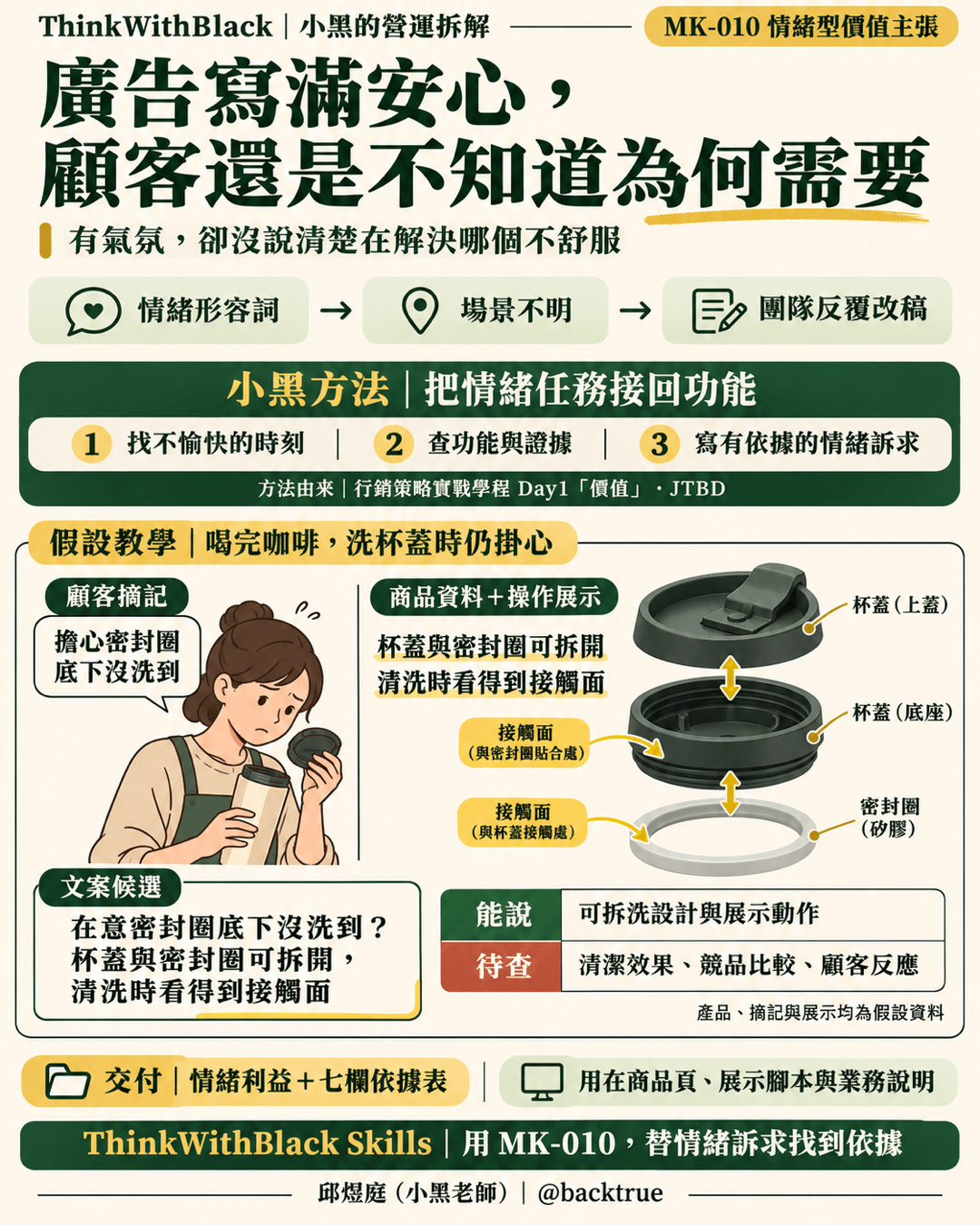
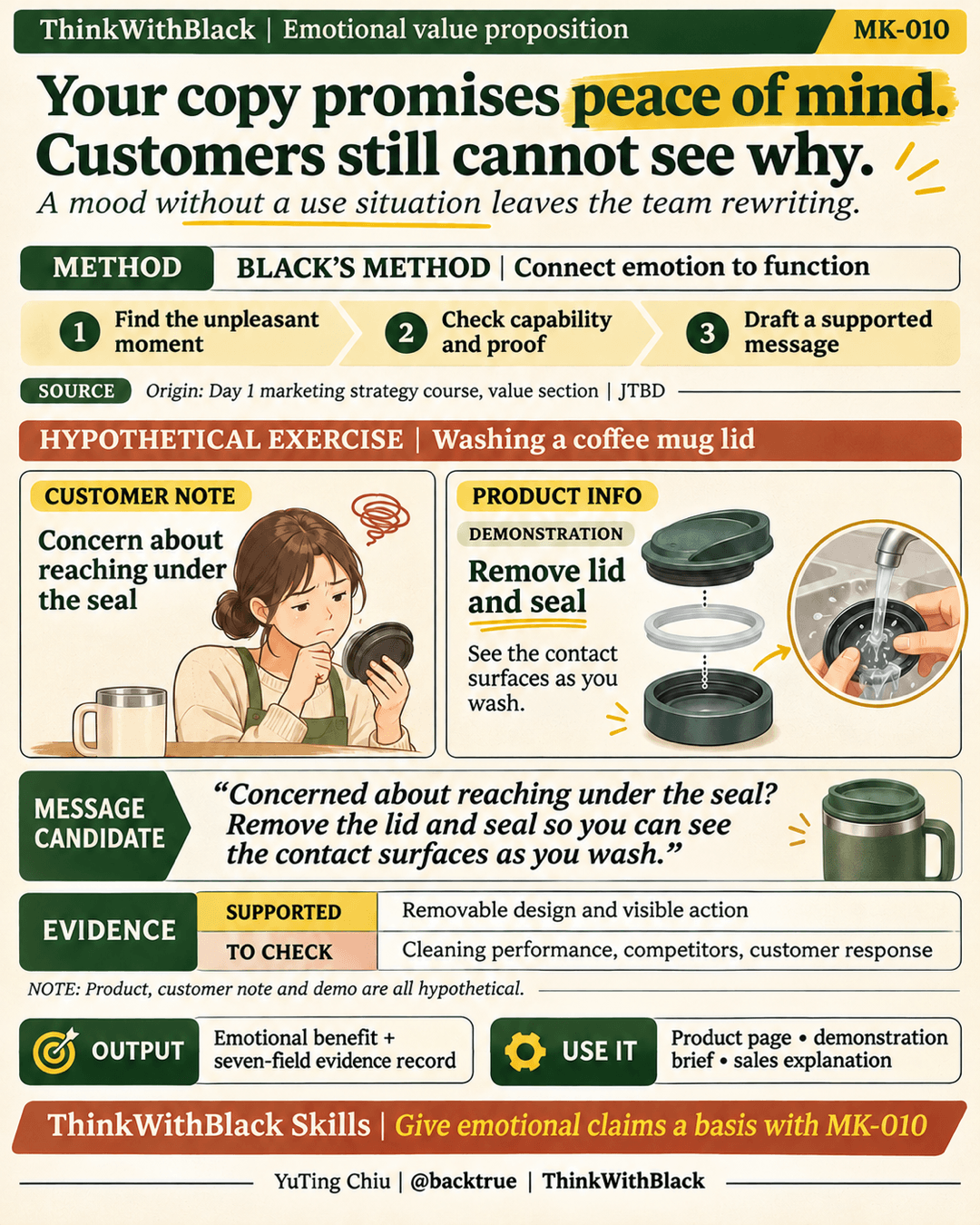
Why softer adjectives still leave the next revision stuck
Yi-An pointed to "peace of mind" in the headline and asked the room: "When we say peace of mind, do we mean it won't leak in a bag, the material handles heat, the lid washes clean, or it's easy to carry?"
Nobody could answer right away because each of those four claims requires completely different proof:
- Leak resistance requires seal and waterproof test results.
- Material safety requires lab inspection reports.
- Cleaning requires the disassembly scope and the washing conditions in the manual.
- Carrying requires structural specs or drop-test data.
When the headline says "A little more peace of mind, every day" without naming a moment, the copy cannot connect to specific proof. Worse, the broader the adjectives get, the easier it is to promise untested results by accident. That was why the team had spent hours revising the page without getting any closer to the next version. Moving forward required picking one moment from daily use and checking it against the evidence on hand.
Black's method: locate the frustration first, then match the product capability
When a team is stuck in that exact loop, the fix is to tie "peace of mind" to one specific moment and one product capability you can verify. In MK-010 (Emotional Value Proposition), I look at the functional job and the personal/emotional job together. What is the customer doing? Which moment in that routine leaves them uneasy or frustrated? Which product capability handles that exact step?
Start with a concrete annoyance the customer wants to deal with during use (the emotional job), match it to the product capability that handles that moment (the functional job), and record the result in the seven fixed fields of MK-010. That gives every emotional claim a traceable situation, function, and piece of evidence.
This framework comes from the value section of the course slides Marketing Strategy Practical Program Day 1 – Niche Is Mass × Precise Persona × Digital Assets (Slides 45–57 and the Slide 6 master table excerpt). The slides divide customer jobs into three categories:
- Functional jobs: the practical work a person wants to get done
- Social jobs: how a person wants to be seen by others
- Personal/emotional jobs: how a person maintains a good mood or deals with unpleasant feelings
Strong product propositions pair a functional job with a social or emotional job. The slides also treat values as the underlying coordinate and purchase motivation as the specific trigger; combining the two produces grounded claims such as "a centerpiece for your new home that stays with you for over ten years."
The official method pack turns that logic into three working steps:
- Use the personal/emotional job in Jobs to Be Done (JTBD) to name the uneasy feeling the customer wants to resolve.
- Place that feeling inside a specific moment of everyday use.
- Pair the feeling in that moment with the product's functional job.
You can check the background and full workflow in the complete Chinese method pack. MK-010 focuses on pairing a personal/emotional job with a functional job. How a feature completes a practical task belongs to MK-009 (Functional Value Proposition), and how a product shapes public image belongs to MK-011 (Social-Role Value Proposition). Keeping these three tracks separate ensures your emotional claim matches the right kind of evidence.
To keep the team from slipping back into vague adjectives or unbacked promises, three conditions decide which line can go live and when to adjust your angle:
- Commit to a claim only when you can verify the product capability: Every line must point back to a specific moment of use and the product documentation you already hold. If cleaning-performance test reports or other data are still pending, hold that claim in the "to investigate" column until the reports arrive.
- Make comparative claims only when you hold same-condition competitor data: Evaluate comparative copy only when you have competitor tests run under matching conditions. While competitor data is missing, describe the disassembly scope and cleaning steps you can verify for your own product, and leave words like "only" or "first" on the investigation list.
- Feed new customer reactions back into the same table: Once the page is live, bring customer questions, support tickets, and actual responses straight back to the seven-field table to update the emotional job and candidate copy.
Any team can apply these rules to another product. When you break a feeling down into which moment, which action, and which piece of evidence, the copywriter, the designer, and the sales rep all work from the same record.
Worked example: breaking "peace of mind" into verifiable records
Following this sequence, Yi-An moved the team's discussion away from the office desk photo and toward what happens after someone finishes their coffee and washes the mug. She focused on what bothers the user while washing the lid, then opened the product sheet and manual to check how far the lid comes apart, whether the silicone ring comes off, what the washing instructions allow, and which claims the current documentation supports.
Yi-An and Bo-Han compare the product notes, customer comment, demo, and open comparison question in H1–H4.
| ID | Hypothetical input | What this record supports |
|---|---|---|
| H1 Product documentation | The lid and sealing ring on the Model A travel mug can be detached and washed as instructed | Supports the removable design and the scope of detachable parts |
| H2 Customer note | The sample user carries coffee every day and worries while washing whether trapped residue stays under the sealing ring | Supplies the emotional job and the specific moment of use for this example |
| H3 Demonstration record | A demonstration shows taking off the sealing ring and washing the contact surfaces | Supports the action to show in product visuals; does not include a cleaning-efficacy test |
| H4 Comparison data | No same-condition data has been collected for competing mugs | Keeps the comparison field on the "to investigate" list |
Yi-An checked the four possible directions from the meeting against H1–H4. Leak resistance, material safety, and carrying convenience had no backing in H1–H4, so all three went onto the investigation list. Only cleaning had matching records: H2 noted that the user carries coffee daily and worries whether the groove under the sealing ring gets clean, while H1's detachable parts and H3's washing demonstration addressed that exact step.
Those three records connected directly:
- Functional job: Take apart the lid and sealing ring to wash the contact surfaces (sources: H1, H3).
- Emotional job: Relieve the nagging doubt after washing about whether the area under the sealing ring is actually clean (source: H2).
- Copy action: Describe the concrete step of taking the parts apart and seeing the surfaces being washed.
From there, Yi-An drafted a single candidate line for the team to review:
"Worried about what's left under the sealing ring? The lid and ring come apart so you can see and wash the contact surfaces directly."
That one sentence gave all three roles a clear next step:
- Copywriting knew which concern in H2 the headline answered.
- Design (Bo-Han) knew to replace the static desk photo with a demonstration shot showing a hand removing the sealing ring, exposing the contact surface, and rinsing it under water (H3).
- Sales could answer customer questions about cleaning by walking through the exact detachable parts.
When your own brand runs this process, replace H1–H3 with your product specifications, raw customer notes, and demonstration assets, then verify the copy against the washing conditions in your manual.
What the team gets: MK-010's seven fields and business decision rules
To make sure reviewers could see right away what was ready to publish and what had to wait for proof, Yi-An logged the evidence behind the new copy into MK-010's seven fixed delivery fields:
| Fixed field | Entry for this hypothetical exercise |
|---|---|
| Factual feature | The lid and sealing ring can be detached and washed as instructed (sources: H1, H3) |
| Customer task | Carries coffee daily and washes the lid afterward; wants to resolve the worry that the area under the sealing ring wasn't washed clean (source: H2) |
| Tangible benefit | Lets the user see the exposed contact surfaces while washing; addresses the cleaning worry in H2 and serves as the emotional-appeal candidate for this scenario |
| Basis for comparison | H4 is unknown; same-condition competitor data is still missing |
| Suitable angle | Open with washing the lid after coffee, then show removing the sealing ring and rinsing the contact surfaces |
| Lead / supporting / to investigate | Lead candidate: visible contact surfaces during washing; Supporting: detachable lid and ring design; To investigate: competitor comparisons, cleaning-efficacy test results, and live customer reactions |
| Reason | H2 names the specific worry, and H1 and H3 cover the physical action, linking the feeling to a verifiable product capability item by item |
In practice, this table replaced subjective debates over whether a line "sounds good" with verifiable business rules for Yi-An, Bo-Han, and the sales team:
- Baseline vs. revised workflow: Previously, the team added emotional adjectives and lifestyle photos first, leaving copy, design, and sales to interpret "peace of mind" on their own. With MK-010, all three roles align on the H2 moment and the H1/H3 capabilities before anyone writes copy or books a shoot. Working from one shared table cuts down repeat page revisions, keeps sales from having to re-explain the basics, and raises the share of emotional claims backed by documentation.
- Publishing and review gate: Every claim placed on the page must trace back to H1–H3. If a reviewer suggests adding "completely odor-free," "99% bacteria removal," or "the only mug on the market," the table stops the overclaim immediately: H3 shows the disassembly action without a lab test for hygiene or odor, and H4 has no same-condition competitor data. Visuals can show taking the ring off and rinsing it, while sanitation claims and exclusivity stay in the "to investigate" column until test reports and competitor benchmarks are in hand.
- Post-launch verification: Once the revised page and visuals go live, the team logs incoming customer questions, support records, and conversion responses back into the seven-field table. That record shows whether washing under the sealing ring is indeed the moment customers care about most, guides the next version of the emotional job and candidate copy, and lets the team compare revision rounds and hours spent before and after adopting the workflow.
Run MK-010 on your own product
Take a product page you are revising right now and gather four inputs:
- Product specifications (your H1)
- Target customer notes describing a specific annoyance during a real moment of use (your H2)
- Verifiable demonstrations or test reports (your H3)
- Same-condition competitor comparisons (your H4)—mark any missing material as "unknown"
Feed those records to your AI tool, specify MK-010, and require source tags across all seven fields. You can copy this prompt directly:
"Using MK-010, organize these product specs and raw customer notes into an emotional value proposition. First identify the specific moment of use and the emotional job, then pair them with the matching functional capability. Deliver the result in the seven fixed fields, list every unknown or missing piece of evidence in the 'to investigate' column, and provide one candidate line of copy whose claims trace directly back to the supplied sources."
When the AI returns the table, verify it in three steps:
- Check the lead copy candidate: Confirm that every action and scenario in the sentence traces back word for word to your H1–H3 records.
- Check the "to investigate" list: Make sure any unverified inference about cleaning efficacy, sterilization, odor removal, or competitor superiority is isolated in the "to investigate" column until proof arrives.
- Decide whether to switch angles: If your current product capabilities cannot honestly resolve the frustration in that moment, pick another moment of use where you do have solid documentation and run the table again. Put your budget behind an angle you can prove.
Download the free materials at ThinkWithBlack Skills. Start with INDEX.md and pair it with the MK-010 complete method pack (English-language readers can use the English INDEX.md and the English MK-010 method pack). Bring your own product specs and customer notes to build a deliverable where copy, visuals, and proof all match.
Bring your data into MK-010
- Download the MK-010 method pack
- First time using the packs: download the index first so the AI can select the right method, then upload the full method pack along with your product data.
- Download INDEX.md · Read the full operating guide
Social posts for this Skill
Select a platform to view the infographic and post for this Skill:
Sources and references
- Original course slides: Niche Is Mass × Precise Persona × Digital Assets, Marketing Strategy Practical Program Day 1, Slides 45–57 (values and the three JTBD job types) and Slide 6 (master table excerpt), 2026 (accessed 2026-09-19)
- Chinese method pack: MK-010 Emotional value proposition (v0.3), ThinkWithBlack
- English method pack: MK-010 Emotional value proposition, ThinkWithBlack
- Method index: Chinese INDEX.md | English INDEX.md
- Bilingual article URLs: Chinese original | English Version
YuTing Chiu (Black) · @backtrue · ThinkWithBlack
Skill guide compiled by: Author profile and courses
Browse other Skill articles by business problem →