Xiaolan (record ID: P1), an office administrator responsible for case filing, is standing at the office scanner with a two-sided delivery receipt in her hand. Her daily routine centers on the task logged in record J1: saving a single two-sided delivery receipt for a case as one PDF, then naming and filing it under the case ID. Under her original workflow (J1), Xiaolan puts the receipt into the scanner to capture the front, takes the sheet out, flips it over to scan the back, walks back to her computer to manually merge the two separate files into one PDF, and finally types in the case ID by hand to name and save the file.
At the same time, the team selling the new scanner model is stuck in a loop of deck rewrites. Their product presentation runs page after page, listing every feature, specification, and technical term. When procurement reads through it, they ask only about the price. To break the stalemate, the sales team goes back to the slide deck, adds two more features and another comparison table, and brings the updated pitch to the next meeting—only to watch the conversation circle right back around discounts.
That stall keeps proposals in a constant cycle of revisions. The product page and the sales deck pile up separate sets of material, while customer support still lacks a single opening sentence they can actually say out loud when a prospect calls. Meanwhile, buyers and end users like Xiaolan are left to figure out on their own what any of these technical features have to do with their daily filing work.
The gap sits right where features meet the job to be done. In their draft materials, the team relied on broad phrases like "Turn paper into digital files" or technical labels like "duplex scanning" and "ADF." While "Turn paper into digital files" points in a general direction, and terms like "duplex scanning" and "ADF" describe how a machine is built, none of them explain who needs the machine or which specific task it helps them finish. As the team adds more material to the pitch, stating a clear, practical reason for procurement to evaluate the product becomes even more important.
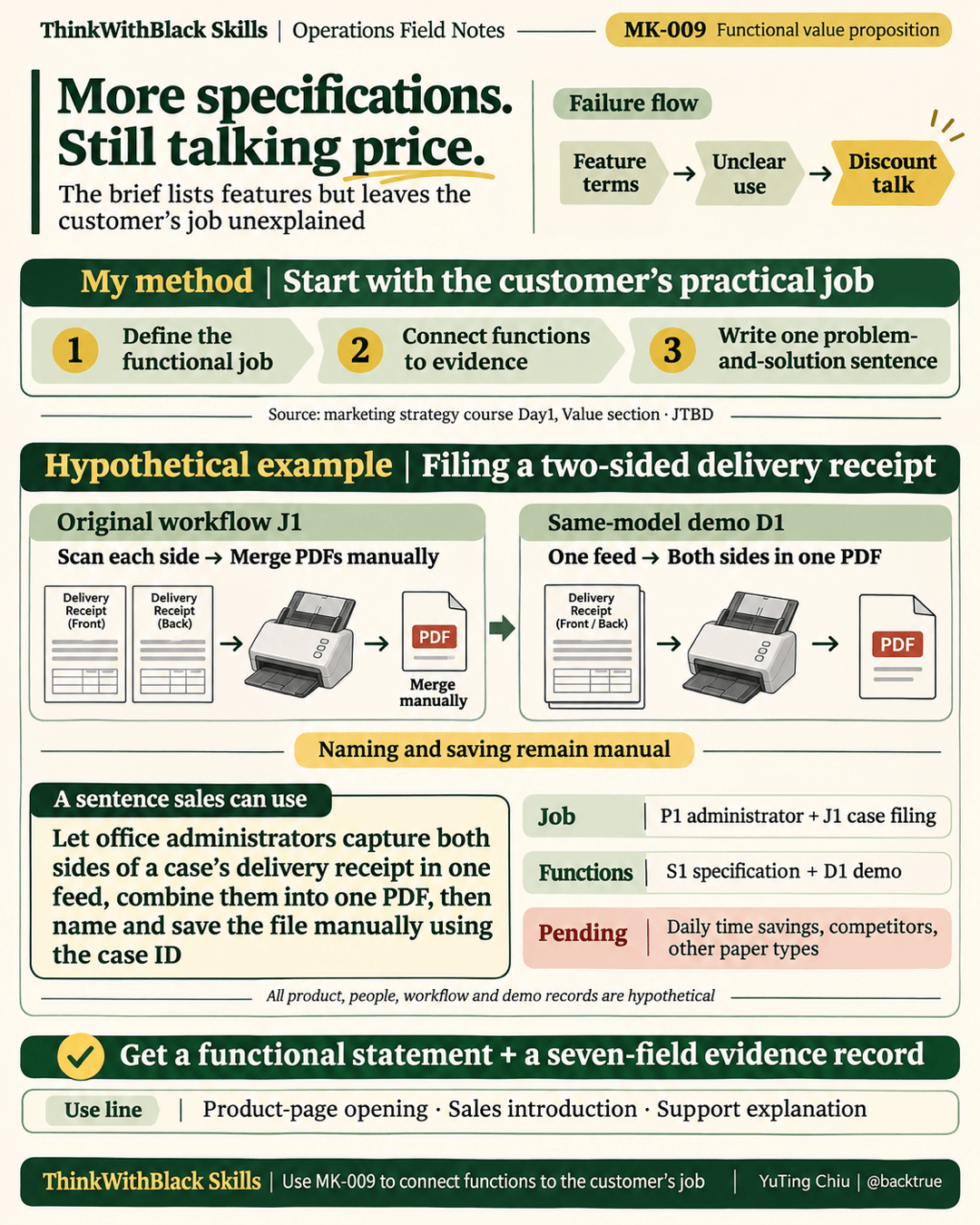
Reversing the preparation order by examining Xiaolan's actual job
To stop guessing which specifications will persuade procurement, the team decides to reverse the order in which it prepares its pitch material. Instead of looking at a spec sheet and reaching for adjectives, they look directly at Xiaolan's desk and ask three specific questions: what kind of document is on her desk, how does she handle it today, and where does the process bog down?
By observing Xiaolan's J1 workflow—scanning the front, flipping the sheet over to scan the back, manually merging the two files, and typing the case ID—the team sees immediately where the product's capabilities connect to her work. Duplex capture and PDF combination map directly to the exact steps that slow down her filing routine.
Starting from the work itself changes the entire evaluation conversation. Confirm the task the customer handles first, then check which feature connects to it, and you can write a sentence the buyer can evaluate right away: is this a task we do every day, do our documents fit this process, and who handles naming and saving the files? Sales also knows exactly which sequence to show in a live demo, shifting the pitch from a feature list to an actual workflow.
Starting from a specification sheet does the opposite—it produces descriptions the buyer has to translate on their own. Take the same feature, "duplex scanning." For an administrator like Xiaolan filing two-sided delivery receipts, it means replacing separate front-and-back scans and manual file merging with a single paper feed that outputs one PDF. For a procurement buyer who needs to scan bound contracts, the team first has to verify how the machine handles bound pages. The feature hasn't changed, but as soon as the customer's documents and workflow change, the opening sentence of the pitch must change with them.
Checking the specifications, demonstration records, and method rules
While evaluating the new scanner model against Xiaolan's J1 task, the team reviews two pieces of source material: the S1 specification sheet and the D1 same-model demonstration. The S1 specification states that this hypothetical model can capture both sides of a sheet in a single paper feed and output them as one combined PDF. Xiaolan and the team then watch the D1 same-model demonstration, which uses the same two-sided delivery receipt: after the sheet is fed once, both the front and back appear in a single PDF file, and the operator then types the case ID on the computer to name and save the document manually.
In the source material, the team also encounters the technical abbreviation "ADF," defined in this case as an automatic document feeder, alongside draft marketing copy claiming the machine "saves two hours a day," is "the only scanner in the industry," and helps administrators "feel more confident when handing over case files."
On its own, the label "ADF" only confirms that the machine has a feeder mechanism; verifying two-sided capture and single-PDF output requires checking the S1 specification and the D1 same-model demonstration. Meanwhile, as recorded in D1, file naming remains a manual step performed by the operator. Furthermore, after reviewing everything on hand, the team takes stock of the evidence scope: the verified records cover only the P1 role, the J1 original workflow, the S1 model specification, and the D1 same-model demonstration. Competitor comparisons, daily operating hours saved, tests on other paper weights or stocks, and file-accuracy rates are all unknown.
To sort out what can go into the pitch and what must be held back, the team applies MK-009, "Functional value proposition." This method handles the translation between specifications and daily work and delivers one sentence linking a functional problem to its solution.
The complete Chinese MK-009 method pack traces its source to the "Value" section of Marketing Strategy Practical Course Day 1 — Niche Is Mass × Precise Persona × Digital Assets, adapted from the course handouts [1]. The method starts with the functional task in Jobs to Be Done (JTBD) to identify the practical job a customer wants to complete or the problem they need to solve. Here, JTBD refers strictly to the work the customer is trying to get done; once that is clear, you connect the product's features to the task it helps complete and write the value proposition [2].
The course materials also note that a strong product can pair a functional job with a social or emotional job in a "1+1" combination [3]. MK-009 focuses on getting the functional layer right first. A claim like "feel more confident when handing over case files" can be recorded separately as an emotional hypothesis for user interviews—and until the team has actual interview data to back it up, it stays marked as a hypothesis.
Under MK-009's operating rules, the team must follow a strict preparation sequence and verification contract:
- Identify the job the customer is already doing (P1, J1).
- Check which product feature connects to that job.
- Verify how much of the claim is actually supported by current specifications (S1) and demo evidence (D1).
- Write one sentence around the verified workflow steps, keeping manual steps and operating conditions visible, marking unverified claims as pending, and pairing the sentence with a seven-field evidence table so anyone can trace each claim to its source.
The Chinese method uses seven fixed fields: factual feature, customer job, tangible benefit, comparison basis, suitable angle, lead/support/pending status, and reason [4]. The English method pack structures its seven fields around the functional problem, solution, feature-to-job mapping, and the complete one-sentence statement. If the customer's document type changes (say, to bound contracts), if their requirements expand to automatically recognizing the case ID and saving the file to a designated cloud folder, or if the team gathers measured data on competitors and daily operating hours, the team must rewrite the sentence to match the new conditions and evidence.
Connecting the feature back to Xiaolan's job in one usable sentence
Based on Xiaolan's filing task (P1, J1) and the verified S1 and D1 records, the team drafts the following one-sentence statement:
Let office administrators capture both sides of a case's delivery receipt in one feed, combine them into one PDF, then name and save the file manually using the case ID.
Every phrase in that sentence traces back to a specific record: "office administrators," "a case's delivery receipt," and "both sides" come from P1 and J1; "capture ... in one feed" and "combine them into one PDF" map to the S1 specification and the D1 same-model demonstration; and "name and save the file manually using the case ID" keeps the human step recorded in D1 intact. Procurement buyers and end users like Xiaolan can see right away what the machine handles and where a person takes over.
When the team compares Xiaolan's original workflow (J1) against the new demonstration (D1) to support a buying or pitching decision, the basis of comparison is the sequence of operating steps: scanning two sides separately and merging two files by hand versus feeding the sheet once to get a single PDF. Because the D1 demonstration only covers a single paper feed—with no measurements of full-day operating time and no competitor benchmarks—draft copy such as "saves two hours a day" or "the only scanner in the industry" cannot be used in the pitch. Instead, rather than getting dropped or guessed, those unknowns stay attached to the deliverable in the "Pending" column of the evidence table as a checklist for follow-up testing.
Building the seven-field evidence tables
Writing the sentence is half the job; pairing it with an evidence table lets the next person working on the product page, sales deck, or customer support script trace every claim to its source. The team compiles both the Chinese method's seven-field structure and the English method pack's seven-field breakdown so any team member can compare and use either version. Here are the seven fixed fields from the Chinese method:
| Factual feature | Customer job | Tangible benefit | Comparison basis | Suitable angle | Lead / Support / Pending | Reason |
|---|---|---|---|---|---|---|
| S1, D1: one feed, both sides combined into one PDF | J1: file a case's two-sided delivery receipt | In this example, no separate scans and manual merge | J1 original workflow and D1 same-model demo; competitors unknown | Functional sentence for office filing | Lead | The feature maps directly to this document's handling steps |
| D1: case ID entered by a person, named and saved manually | J1: make the file identifiable by case ID | Filename matches the case; a person still performs the work | D1 naming and saving actions | Retain manual steps in the introduction | Support | Manual work is not described as automatic filing |
| Technical term: ADF | J1: feed the document with a feeder | Specific effects depend on specifications and demonstration | The term itself does not establish every function | Explain its purpose first, then attach S1, D1 | Support | An abbreviation cannot replace the job and its evidence |
| Draft: saves two hours a day, the only one in the industry | J1: shorten the workflow and assess alternatives | Timing effect and market difference unknown | Timing measurement and competitor data missing | Keep the supported functional sentence | Pending | A demonstration does not establish numbers or exclusivity |
The team also breaks the functional statement down into the seven fields used in the English method pack so anyone picking up the copy can verify each part against the source records:
| Field | Example record |
|---|---|
| Feature and evidence | S1 specification, D1 same-model demo; one feed, both sides in one PDF |
| Customer job | P1, J1: organize two-sided delivery receipts by case |
| Functional problem | The original process scans the sides separately and merges files manually |
| How the product addresses it | Capture both sides in one feed and output one PDF |
| Feature-to-job mapping | Duplex capture and PDF combination support document digitization; naming and saving remain manual |
| Complete one-sentence statement | Let office administrators capture both sides of a case's delivery receipt in one feed, combine them into one PDF, then name and save the file manually using the case ID |
| Unknowns and validation | Timing, competitors, other paper types and accuracy need evidence; repeat the demonstration when the document or model changes |
For direct comparison with the Chinese method pack's English reference table, here is the exact row-by-row wording from the English pack:
| Field | Example record |
|---|---|
| Feature and evidence | S1 specification and D1 same-model demo: both sides in one PDF from one feed |
| Customer job | P1, J1: organize two-sided delivery receipts by case |
| Functional problem | The original process scans the sides separately and merges files manually |
| How the product addresses it | Capture both sides in one feed and output one PDF |
| Feature-to-job mapping | Duplex capture and PDF combination support document digitization; naming and saving remain manual |
| Complete one-sentence statement | Let office administrators capture both sides of a case's delivery receipt in one feed, combine them into one PDF, then name and save the file manually using the case ID |
| Unknowns and validation | Timing, competitors, other paper types and accuracy need evidence; repeat the demonstration when the document or model changes |
Both tables enforce the same verification rule: every row must point back to the input records on hand (P1, J1, S1, D1). Claims where a feature maps directly to a core workflow step and is backed by both specifications and a demonstration are marked Lead. Claims that clarify operating conditions, preserve manual steps, or explain what a technical term means in practice are marked Support. Claims waiting on time measurements or competitor benchmarks are marked Pending. Leaving pending items inside the table gives the team a ready-made checklist for the next round of product testing or user interviews.
Putting the sentence to work across the product page, sales proposals, and support scripts
With the one-sentence statement and the seven-field evidence table complete, the team makes a concrete operational decision: use "Let office administrators capture both sides of a case's delivery receipt in one feed, combine them into one PDF, then name and save the file manually using the case ID" as the opening line across the product page, sales proposals, and customer support scripts—replacing the habit of stacking up disconnected spec tables and rewriting slide decks after every meeting.
On the product page, the team places this sentence at the top of the feature section, followed by compatible document types, technical specifications, and step-by-step operation. In a sales proposal, sales uses it to confirm whether the prospect handles this exact task before showing how a delivery receipt turns into a single PDF. In customer support, reps use it to ask prospects about their document formats and file-naming rules.
All three touchpoints share the same sentence, and each uses it to verify a specific step in the buying conversation:
- Product page: Lets visitors like Xiaolan or her procurement manager tell from the first sentence whether the machine fits their daily filing work.
- Sales proposal: Once a buyer confirms, "Yes, right now we scan the front, flip the page to scan the back, and merge the two files by hand," sales can play the D1 same-model demonstration immediately.
- Customer support: Uses the second half of the sentence ("name and save the file manually using the case ID") early in the conversation to check the buyer's naming and filing rules, keeping expectations aligned with how the scanner actually works.
This operational decision comes with clear operating conditions and explicit thresholds for when to revise it. As long as the prospect's job is filing unbound, two-sided delivery receipts and they accept manual file naming and saving, the sentence and the D1 demonstration hold. When conditions on the ground change, the team's decision changes with them:
- The document type changes: If procurement needs to scan bound contracts, a single-sheet feed demonstration no longer applies. The team must verify how bound documents are handled and gather demonstration evidence for that process before rewriting the functional sentence.
- Automation requirements increase: If the buyer requires automatic case-ID recognition and automatic routing to a specific cloud folder, the team must obtain specifications and same-model demonstration evidence for optical recognition and cloud filing before adding those claims to the sentence.
- New evidence arrives: Once the team measures daily time savings, tests additional paper stocks, records file-accuracy rates, or compiles competitor benchmarks, those items move out of the "Pending" column in the seven-field table and become supported claims.
The business value of this deliverable is alignment: the product page, sales team, and support staff all work from one evidence-backed reason to use the product. The team stops burning time piling on extra specs and rewriting decks when features aren't connected to a job, while keeping a clear record of which data points still need to be measured. Whether that sentence ultimately wins the deal depends on the buyer's actual working conditions, the alternatives they are weighing, and how the machine performs during their on-site evaluation.
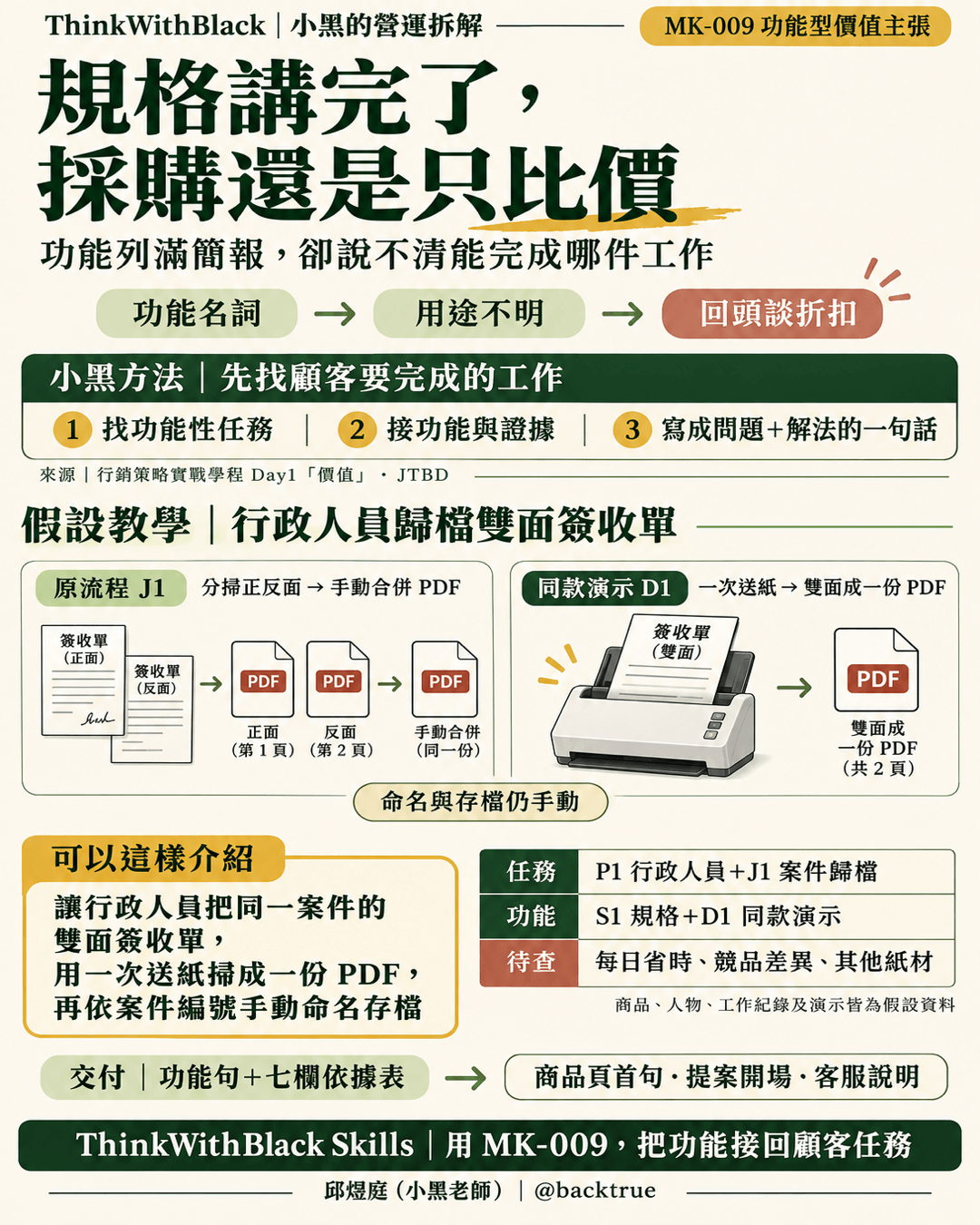 Hypothetical delivery-receipt scanning example | both sides in one PDF from one feed, naming and saving remain manual
Use MK-009 to draft the opening sentence of your next pitch
To apply this workflow to your own product, gather your product specifications, same-model demonstration records, notes on the customer's workflow, and any competitor data. Have your AI tool read the complete MK-009 method first, then give it this prompt:
Following MK-009, identify this customer's functional job, connect supported functions to the problem and solution, and deliver one complete sentence with its seven-field evidence record. Preserve manual steps, operating conditions and sources. Mark unmeasured timing, competitor differences and other unknowns as pending; list social or emotional value as a separate hypothesis.
Go to ThinkWithBlack Skills and download the complete MK-009 method pack. If you are using the system for the first time, pass INDEX.md to your AI so it can select the right method, then attach the full MK-009 pack and your product records to draft an opening sentence your buyers can test against their own workflow.
Once the AI generates the sentence and the seven-field table, run three checks before publishing:
- Can every person, document type, and operating step in the sentence be traced word for word back to your specifications (such as S1) and demonstration records (such as D1)?
- Are the steps that still require human work (such as typing the case ID to name and save the file) stated plainly inside the sentence?
- Does the Pending column capture unmeasured time savings, competitor differences, untested paper types, and accuracy rates?
When all three checks pass, the sentence is ready to go straight to the top of your product page and into your next sales presentation.
Bring your own records into MK-009
- Download the MK-009 method pack
- First time? Download the index, let the AI select the method, then upload the complete method pack with your records for this task.
- Download the INDEX.md index · View the complete operating instructions
English entry points: complete English MK-009 method, English INDEX.md, Getting-started instructions (Chinese)
This Skill on social media
Choose a platform to view the infographic and post for this Skill:
References
- MK-009 | Functional Value Proposition v0.3. ThinkWithBlack.
- Marketing Strategy Practical Course Day 1 — Niche Is Mass × Precise Persona × Digital Assets. Slide 53, JTBD definition. 2026.
- Marketing Strategy Practical Course Day 1 — Niche Is Mass × Precise Persona × Digital Assets. Slide 54, the 1+1 of functional plus social or emotional. 2026.
- MK-009 English method pack. ThinkWithBlack.
- Marketing Skills method overview. ThinkWithBlack.
YuTing Chiu (Xiaohēi) · @backtrue · ThinkWithBlack
Skill article credits: Author background and courses
Find other Skill articles by operational problem →