Xiao Chen, an event coordinator preparing for an event tonight, is urgently checking a display stand page to see if the stand can be picked up in time, while the marketing team in a proposal meeting keeps switching the hero image between the premium outer box and the color scheme based on internal preferences. When the team reviews the customer choice records and inventory documentation, they see that the buyer must first confirm same-day store pickup before the deadline, then verify tool-free hand assembly at the venue, and finally check how to fold and carry the stand out alone after the event. Seeing this gap between internal preferences and documented customer tasks leads the team to stop deciding the hero message by vote and start ranking selling points by fulfillment evidence and the sequence of work the buyer has to get done.
Why does the lead message keep changing?
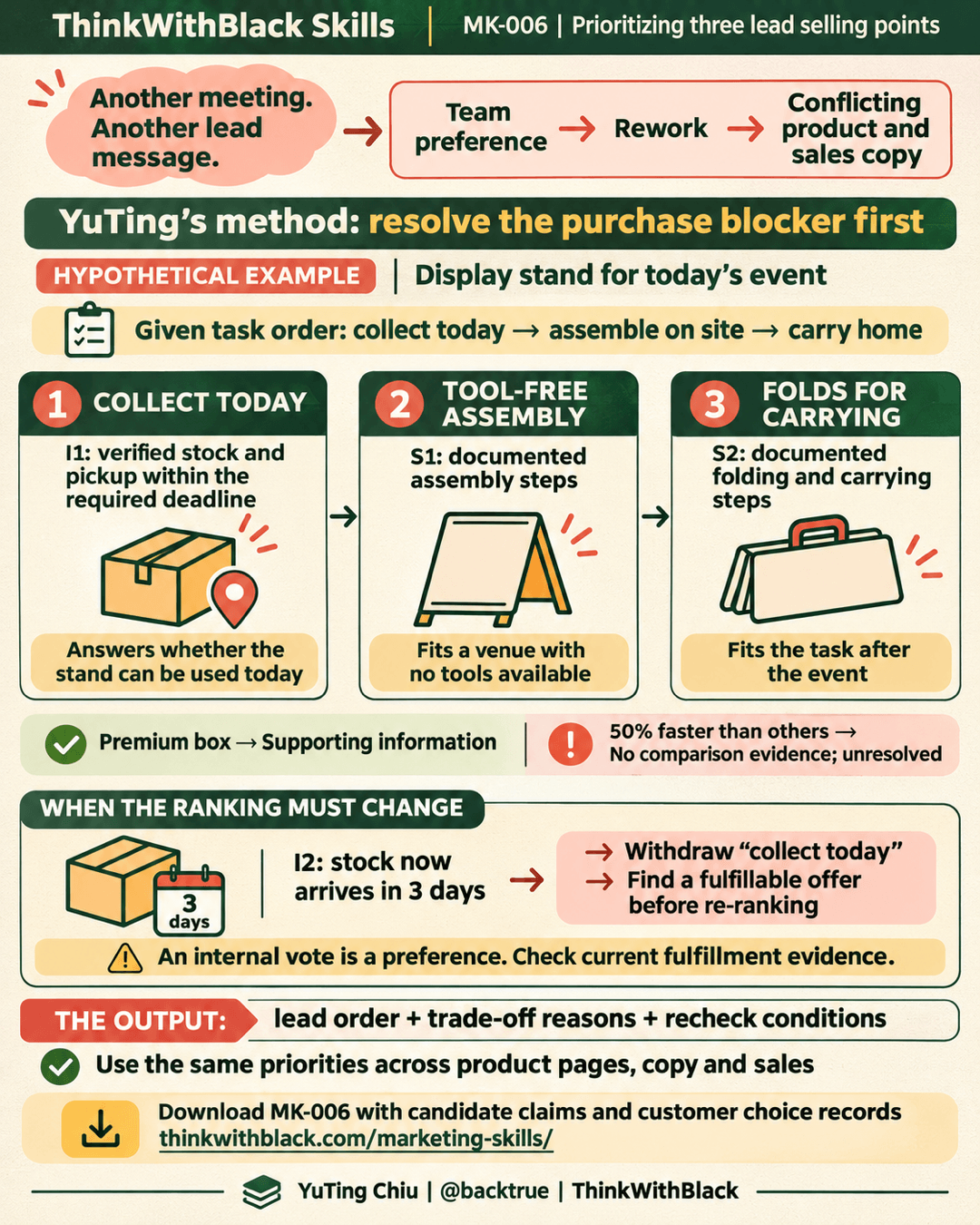
Xiao Chen has an event tonight and needs to confirm when he can pick up the display stand. Meanwhile, in a proposal meeting, the marketing team is debating whether the premium outer box or the color scheme makes a better hero image. Both are real product features, but the debate skips the first thing Xiao Chen has to confirm: the pickup deadline.
If the page states right away whether the stand can be picked up today, then confirms on-site hand assembly, and finally explains how to pack and carry it after the event, the order matches the exact sequence of work Xiao Chen has to get done today. Next time someone wants to change the lead message in a meeting, they have to point to what changed in the customer's task, the fulfillment conditions, or the evidence, keeping the discussion tied to checkable facts.
That is why MK-006 records the trade-offs alongside the ranking. The same worksheet shows why the number-one point leads the page and why the fourth-place option goes into the supporting specs. A team vote is still useful for getting everyone's preferences on the table, while the customer's immediate task and the product's documented capabilities decide the actual order.
When a product has several features, every proposal meeting brings out a different favorite. Today the hero image shows the gift-style outer box; tomorrow it switches to the lightweight build. Soon the product page, ads, and customer-service replies each tell a different story, and the copywriter and designer have to redo the assets again.
Meanwhile, the person ready to buy is checking something else entirely: Can I get it today? Can I assemble it at the venue with my bare hands? Can I pack it up and carry it out myself when the event ends? When those answers get pushed down the page, customer service has to explain the basics from scratch, and the buyer still has to spend time checking whether the offer fits the job right in front of them.
To stop the rework loop, rank selling points by checking purchase requirements and fulfillment evidence first. Confirm what the product can actually deliver, then rank at most three lead selling points in the order of the customer's real tasks, recording the trade-off reason and the condition that would trigger a re-rank for each one. Use internal votes to record team preferences, not to set the final order—that follows customer evidence. If the product fails a necessary purchase requirement, switch to an offer you can actually fulfill so the promise matches the facts. Re-check the ranking under four conditions: the customer's task changes, the product version changes, inventory or fulfillment evidence changes, or competitor comparison data arrives. When any of those shift, the team can check the record and note which point moves to supporting copy, which gets pulled, and which candidate replaces it—cutting asset rework while keeping orders you can actually fulfill.
MK-006 | Ranking three lead selling points turns candidate selling points into a deliverable priority order alongside the reasons for each trade-off. Your team can use it to decide what leads the product page, what moves to supporting copy, and what still needs verification. When conditions change later, the reason to re-rank is already on the record.
How Xiao Hei ranks selling points—and where the method comes from
The Chinese MK-006 method pack comes from the Unique Selling Proposition (USP) section (Slides 9–10) of Meta廣告學程 101|讓 AI 幫你投出廣告 (Meta Advertising Course 101: Let AI Help You Run Ads). Those slides lay out how YuTing Chiu (known as Xiao Hei) narrows down lead messages, evaluates candidates, and feeds the result back into the copy workflow[1].
In practice, AI first pulls candidate selling points from the product data. The team then evaluates them across four criteria: exclusivity, personalization, quantification, and Persona relevance (Slides 13–14). Right next to each candidate, the record notes who the product is being compared against, which buyer role it helps, and whether any number has a verifiable source. If competitor data is not yet available, you state your own product's capability plainly and mark exclusivity as to be verified.
The course slides set three explicit checks for any USP candidate[1]:
- Does it apply to any competitor? If the claim fits other products just as well, narrow the focus; generic claims belong in supporting information.
- Is the customer in the sentence? If the draft only describes the product, rewrite it around how it helps the user before ranking it.
- Do the numbers have a source? Sourced figures make a USP more credible, while comparisons that still lack a baseline or test source are marked to be verified.
The Chinese method caps the list at three selling points and feeds that order straight into the Persona and copy workflow so the product page and the FABE copy structure—Feature, Advantage, Benefit, and Evidence (Slides 73–74)—start from the same priorities. As the course notes put it: "When you build the product page later, put just these three USPs in the feature section—no more," and "the F in the FABE copy structure later needs these USPs to build on"[1]. Capping the lead points at three gives each one enough room on the page to be explained properly, and the ranked list plugs straight into FABE's Feature slot so copywriters can start drafting without re-sorting the features themselves.
The course also keeps its small-group workshop step (Slides 15–16): groups vote on the USPs drafted by the GPT-Persona or refine whether they are framed accurately, then feed the updated three USPs back to the GPT-Persona for sharpening[1]. In MK-006, that vote is recorded in its own column to capture team preferences separately from customer choice evidence, so the next person who picks up the file can tell the two apart and avoid another round of asset rework.
The current English method, compiled by ThinkWithBlack on 2026-10-14, sharpens the first gate: tie every benefit to product facts, verifiable evidence, the customer's current job, and documented competitor differences, keeping only promises that are backed by evidence, relevant to the task, and actually fulfillable. Start with the deal-breaking requirements shown in real inquiries or choice records. Select at most three qualifying benefits that each solve a distinct, important problem—and if the data only supports two, deliver two[2]. When a product fails a necessary purchase requirement, switch to an offer you can actually fulfill; when data updates, re-check the priority order and record why the former lead moved to supporting copy or was withdrawn, along with the replacement candidate and its evidence[2]. The walkthrough below shows how this works in practice.
Hypothetical walkthrough: What three things come first for someone who needs a display stand today?
The product details, specs, inventory records, and customer choice records below are hypothetical teaching data. Our buyer is Xiao Chen, an event coordinator running an event tonight. Customer choice record C1 states that Xiao Chen must get the display stand before 16:00 today. C2 notes that only bare hands are available at the venue—no tools. C3 notes that Xiao Chen has to fold the stand up and carry it away alone after the event. That gives a clear sequence of tasks: get the stand on time, assemble it on site, and pack it out afterward.
The team has four product records on hand:
- I1: The selected store has confirmed same-model stock ready for pickup before C1's 16:00 deadline.
- S1: The manual for this model shows step-by-step tool-free assembly.
- S2: The manual shows how to fold the stand and carry it by hand.
- S3: The stand comes in a premium outer box.
In addition, internal meeting note V1 favors leading with the outer box, and a copy draft claims the stand is "50% faster than others," though it lacks a comparison baseline or test data.
Because the team only has its own product data right now, this ranking matches documented capabilities against Xiao Chen's tasks and holds off on cross-brand claims like "the only," "number one," or "faster than competitors" until competitor data is on file.
| Factual feature | Customer task | Tangible benefit | Basis for comparison | Suitable angle | Lead / supporting / to verify | Reason |
|---|---|---|---|---|---|---|
| I1: Same-model stock available for pickup before deadline | C1: Get it before 16:00 today | Ready to use for tonight's event | I1 matches C1; competitors unknown | Same-day pickup | Lead 1 | Clears the deal-breaking handover deadline first |
| S1: Documented tool-free assembly steps | C2: No tools at the venue | Assemble on site by hand following the manual | S1 matches C2; competitors unknown | On-site hand assembly | Lead 2 | Solves the second on-site constraint |
| S2: Foldable, carry-out design | C3: Pack up and carry it out alone after the event | Fold and carry out following the manual | S2 matches C3; competitors unknown | Post-event pack-up and carry | Lead 3 | Solves the task after the event ends |
| S3: Premium outer box | Box not listed as a purchase condition in this case | Relevance of box to this job unconfirmed | S3, V1; insufficient customer evidence | Spec supplement | Supporting | Team preference does not match a required task in this case |
| Draft: "50% faster than others" | Wants the stand ready on time | Comparative effect unknown | No baseline or comparable test | Revisit after adding evidence | To verify | Cannot be used as a lead claim in this round |
This ranking follows the task order already recorded in C1, C2, and C3—no invented weights or point-scoring needed. Each of the three lead points answers Xiao Chen's question at a specific stage of the day, while the premium outer box stays in the supporting specs where it still backs up the product description.
Every row in this seven-column table points back to a specific source record: I1 to inventory, S1–S3 to the product manual, C1–C3 to customer choice records, and V1 to internal meeting notes. Any claim that cannot yet be matched to a source is marked To verify and held back until the evidence is in place.
Why does the first item beat the other options?
I1 determines whether Xiao Chen keeps reading at all. Only if the stand is in hand before 16:00 today do tool-free assembly and foldable portability matter for tonight's event. So the opening block of the product page states the pickup method and deadline first, while the worksheet keeps the stock confirmation, store location, and timestamp on record so anyone on the team can verify them.
S1 answers the next question—how Xiao Chen puts the stand together bare-handed at the venue—so copy and design can show the step-by-step diagrams straight from the manual. S2 covers how to fold it up and carry it out when the night is over. Both have clear documentation in the manual and match the on-site tasks in C2 and C3, putting them ahead of the outer box.
When two candidates are similarly relevant to the customer's task, pick the one backed by direct evidence and a difference the buyer can actually see in use. Features that are standard across the category belong in supporting copy. And until you have competitor data, stick to stating your own documented capabilities and keep cross-brand comparisons in the To verify column so every lead claim rests on solid proof.
Once the ranking is set, hand the full table—the top three points, the trade-off reasons, and the supporting items—to the team together. Keeping V1's preference for the outer box in its own column alongside the customer evidence means that if a new buyer segment later cares about gift packaging, the team can pull that record back up and re-evaluate it. As for the draft claim "50% faster than others," it stays on hold until someone supplies a baseline and test measurements.
When inventory changes, why can't you just bump number two up to number one?
Suppose that in the afternoon, the product team logs inventory update I2: the store that had same-day pickup stock is now out, restocking this model takes 3 days, and Xiao Chen's C1 requirement—getting the stand before 16:00 today—has not changed.
The team's first move is to pull "pick up in store today" from the ads, the product page, and the customer-service replies at the same time. If you simply bump the second-place point ("tool-free assembly") into the top spot, Xiao Chen still clicks through only to find out the stand won't arrive in time for tonight's event.
To solve the buyer's actual problem, the team first has to check whether another in-stock model can be handed over before 16:00 while still meeting the hand-assembly (C2) and fold-and-carry (C3) requirements—and re-rank once that fulfillment proof is confirmed. If the only option is waiting 3 days for a transfer, tell Xiao Chen the real arrival time up front so the promise across every channel matches the latest stock record.
The same rule applies when other conditions change:
- Product version change: If a revised stand requires tools to assemble, re-check C2 and switch to an offer that fits, or update who the offer is for.
- Customer task change: If the target buyer shifts to a permanent counter display at a fixed venue, C3's fold-and-carry requirement drops out; read the new buyer's usage records first, then re-rank the lead points.
Every time the ranking changes, record the trigger, which item moved to supporting copy or was pulled, and the source evidence for the replacement candidate right in the table.
How the team uses this worksheet day to day
With this worksheet in hand, each role knows what to do without starting another debate:
- Product page editor: Answers the pickup, assembly, and pack-up tasks at the top of the page using the first three items, and places supporting specs like the premium outer box further down.
- Copywriter: Plugs the same three priorities straight into the FABE framework.
- Customer service: Uses the same qualifying conditions and stock records to answer buyer questions.
- Product team: Keeps inventory, version specs, and fulfillment proof up to date.
Alongside each lead selling point, keep a five-part chain on file: Fact → Purchase barrier solved → Lead or supporting → Why the alternative was not chosen → What change triggers a re-rank. When two candidates are too close to call, keep both on the worksheet, check a real customer choice record or lost-sale log—or test how the audience responds to each message—and then lock in the order.
Once this workflow is running, the team can check three practical signals in its existing work logs to see whether the ranking is doing its job:
- Are the product page, ads, and customer-service replies all stating the same currently valid fulfillment promise?
- Are copywriters and designers spending less time redoing assets because the lead priorities stay fixed unless a recorded condition changes?
- Are customer-service reps spending less time repeatedly explaining the same basic purchase conditions?
All three show up directly in the team's daily records; actual results and costs depend on each team's own operations.
When you are ready to audit your own product's selling points, paste the prompt below into your AI tool along with your product data:
Please read MK-006 first and rank my candidate selling points using my product evidence, customer choice records, and competitor conditions. Check deal-breaking purchase requirements and whether they can be fulfilled first, then compare the remaining trade-offs. Deliver the seven-column table, up to three evidence-backed lead selling points, the reasons for not choosing the others, and the conditions that would trigger a re-rank. If the data only supports two lead points, deliver two; do not invent weights or data. When the product fails a necessary requirement, point out the offer conditions that need to change, and feed the ranking back into the copy workflow.
Rank your next lead message with ThinkWithBlack Skills
Go to ThinkWithBlack Skills and download the complete MK-006 method pack. Give the AI your candidate selling points together with the records of how customers actually choose, so every priority slot has a traceable reason behind it. If you want help picking the right method for a problem first, start with INDEX.md—and if you find the project useful, follow the link on the site to star the repository on GitHub.
Bring your data into MK-006
- Download the MK-006 method pack (English version: Download the English MK-006 method pack)
- First time using it: download the index first, let the AI select the method, then upload the complete method pack with your data for this task
- Download the INDEX.md index (English version: Download the English INDEX.md) · View the full usage instructions
This Skill on social media
Choose a platform to view the infographic and post for this Skill
YuTing Chiu · @backtrue · ThinkWithBlack
Skill article compilation: Author background and courses
Find other Skill articles by operational problem →
References
- Meta廣告學程 101|讓 AI 幫你投出廣告. Meta Advertising Course 101, lecture slides (platform interface time-sensitivity marked 2025/8); this article cites Slides 9–10 (USP section, three USPs and value proposition), Slides 13–14 (USP criteria: exclusivity, personalization, quantification), Slides 15–16 (group voting and reporting back), Slides 73–74 (FABE). ↑
- Another meeting, another lead message: use MK-006 to rank selling points with reasons. YuTing Chiu · @backtrue · ThinkWithBlack, 2026-11-04 (including the English decision rules authored on 2026-10-14). ↑
- 開會又換主打,素材一直重做:用 MK-006 排出三個賣點與取捨理由. YuTing Chiu · @backtrue · ThinkWithBlack, 2026-11-04.