Kai, the copywriter, finishes the commuter-bag ad, product page and customer-service script, then opens the test report for a final pre-launch check. Reading through the document, he finds that the report covers a swatch of outer fabric while all three drafts promise a waterproof bag. He starts matching each claim to the model, tested component and measurement conditions.
Why putting a report on the page still fails to prove the selling point
Kai starts by checking the commuter-bag copy line by line. When a test report only treats and inspects a single swatch of outer fabric, but the ad headline claims a "waterproof bag," shoppers read that as a promise for the entire backpack in the rain. What happens at the zipper, the seams, and other parts of the bag during a downpour requires test records for those specific parts. Pasting a screenshot of the report cover next to the product page still does not answer whether water gets inside the bag.
Adding "50% better waterproofing" to the headline introduces another set of conditions to verify: 50% better than which original baseline, measured by which metric, and tested under what matching before-and-after conditions? All of those answers have to come from the primary records. When the folder has no matching data, that percentage is just a draft number and needs to be removed before launch.
Placing each claim beside its evidence on the same row lets the team see how far every sentence can legitimately go. Functions backed by the records stay. Where numbers lack support, the percentage comes out and only the specification-backed fact remains. And if another report in the folder directly contradicts the draft claim, the team pulls that claim outright and updates every asset sharing that promise—rather than softening the sentence into something vague.
The lead claim is set. Kai, the copywriter, has finalized the ad images, the product page, and the customer-service script. Right before launch, he opens the lab report for a final check and realizes it only tested a swatch of the outer fabric—not the whole-bag waterproofing promised in the campaign. If he changes just one adjective in the main headline, the product page and ad creatives will still carry the same promise, forcing the team to hunt it down and revise everything a second time. Customer service, reading from the old script, will also keep repeating an unverified effect to shoppers as a guarantee.
The team's cloud folder already holds specification sheets, test reports, design-award records, and user notes. The problem is that in the rush to produce launch assets, nobody matched each document back to the exact sentence the ad is claiming. Having a report on file is one thing; whether that report proves the selling point in front of you is another. Product model, tested component, measurement conditions, and actual results all have to be checked item by item.
To fix all three sets of assets in one pass and lock down what can be published, use MK-005 | Selling-point evidence matching. Break each drafted claim into checkable statements, compare them against the full text and exact passage of the original evidence, and produce two working documents: a "Claim, Evidence, and Gap Comparison Table" and a working handoff sheet. Every decision follows the primary record:
- Keep the claim as written when the evidence supports the same model, version, tested component, and measurement conditions.
- Narrow the copy to the tested scope when the evidence covers only a single component or specific conditions.
- Remove the number, keep the verified function, and mark the figure as pending when the files lack a comparison baseline and measurement record.
- Withdraw the claim from all assets when a record for the same version directly shows a contrary observation.
This comparison shows copywriters and customer service which lines have backing, which must be narrowed, and which must come down. It also gives the product team a targeted list of missing documents to retrieve. Existing campaign results and revision costs are checked against the team's own records.
How Xiahei matches evidence, and where the method comes from
The complete Chinese MK-005 method pack traces this workflow to the USP section (Slide 9) of Meta Advertising Course 101 | Let AI Run Your Ads, and uses Evidence in the FABE framework (Slide 73) to define what evidence does in sales communication. The course deck defines FABE as a four-step chain—Feature → Advantage → Benefit → Evidence—where Evidence supplies "proof, cases, or data that build trust." In an actual pre-launch check, that evidence has to prove the specific feature, advantage, or customer benefit stated in the copy. Using an industrial design award to back a waterproofing claim exposes the mismatch as soon as you put both in the table.
Going through three steps in order untangles a folder of mixed files:
- Read the actual proof, case, or data. Open the file and check what product was tested, which version, which component, and what result came out under which test conditions. Report titles, lab names, and cover pages help the team index files quickly, but you have to read the body text and test conditions to know what the report actually supports.
- Verify every number in the selling point. Whenever the source file lacks a comparison baseline or calculation source, drop the number and keep only the supported non-numerical description. Even if the exact number appears in a file, confirm that it measures the same thing. Battery runtime measures power duration, whereas work-output efficiency requires a task test. Similarly, a test on a single piece of fabric only tells you how that swatch performed; turning it into a whole-bag improvement percentage requires a comparative test on the complete bag.
- Map the Evidence back to the corresponding feature, advantage, and benefit. If the file supports only one component or specific test conditions, pull the copy back to that scope. Where test proof is still missing, list the exact source passage or report to request from the product team. Whenever a test on the same version produces counterevidence, withdraw the contradicted claim right away.
The current English method pack, whose decision rules ThinkWithBlack compiled on 2026-10-14, spells out the breakdown in full: split each claim into product and version, use conditions, comparator, outcome, and time frame so every sentence becomes verifiable. Whenever the product model, measurement conditions, or source documents change later on, re-run the match on the affected claims and record both the publishable wording and the recheck conditions in the table. The hypothetical example below walks through these verification rules and the resulting business decisions step by step.
Hypothetical walkthrough: a fabric-swatch report written up as a waterproof bag
All products, specifications, reports, draft lines, and customer records below are hypothetical teaching materials. In this exercise, Kai is checking three lines of copy for the same version of a Model A commuter bag: "water-repellent outer fabric," "waterproof bag," and "50% better waterproofing."
He lays out the files in the folder and numbers them for inspection:
- Specification S1, section 2 records that Model A's outer fabric receives a water-repellent treatment.
- Report R1, section 3 tests only a swatch of that outer fabric and observes no water penetration under the indoor spray conditions recorded in this example.
- Report R2, section 4 tests the complete bag of the same version and, under its recorded indoor spray conditions, observes water entering at the zipper.
Both reports preserve their respective test specimen, conditions, method, and observations, and neither file contains a competitor comparison or an improvement-ratio test record.
Kai enters the three claims into the Claim, Evidence, and Gap Comparison Table to work out the required action for each line:
| Original claim | Evidence and location | Supported scope | Gap or contrary data | Usable revision and action |
|---|---|---|---|---|
| Water-repellent outer fabric | S1 section 2; R1 section 3 is fabric-swatch data | S1 supports the specification fact that this model's outer fabric is treated; R1's observation is limited to its fabric-swatch conditions | Does not prove how the complete bag performs in use | Keep "Model A uses water-repellent outer fabric" |
| Waterproof bag | R1 section 3; R2 section 4 | R1 answers only for the fabric swatch; R2 answers for the same-version complete bag | R1 cannot be extrapolated to the whole bag; R2 observed water entering at the zipper | Withdraw "waterproof bag"; update all related assets and customer-service promises together |
| 50% better waterproofing | No corresponding baseline or measurement report on file | Keep only the treatment specification verified by S1 | Missing improvement metric, original baseline, and difference under matching conditions | Remove 50%; keep the verified function; mark the percentage as pending |
Laying out the table makes the distinction on the second row—"waterproof bag"—unmistakable. If the folder held only the R1 fabric-swatch report, "waterproof bag" would lack whole-bag test data and be marked as pending. Once R2 is placed beside it, however, the same version of the complete bag has already been observed taking in water at the zipper under indoor spray conditions. That gives "waterproof bag" direct counterevidence, so the business decision is to pull the entire claim. Separating "contradicted by evidence" from "missing data" lets the team decide in the meeting to cut the contradicted line immediately and send the pending items to the product team for follow-up, instead of lumping both into "we'll look into it later."
Now look at the third row, "50% better waterproofing." After dropping the percentage, someone in the meeting suggests changing the line to "stronger waterproofing." Kai checks the rules: "stronger" is still a comparative claim, which requires the same measured metric, an original baseline, and a comparable difference under identical conditions. Until that comparison data arrives, the only non-numerical line ready to go live in this example is the fact supported by S1: "Model A uses water-repellent outer fabric."
When a team uses the eight-column fixed deliverable format from the English method pack, the same hypothetical teaching data breaks out applicable audience and recheck conditions into dedicated columns for cross-functional tracking:
| Original claim | Evidence source and location | Applicable audience, version and conditions | Supported scope | Unsupported or contradicted portion | Publishable revision | Supported, pending or withdrawn | Revision and recheck conditions |
|---|---|---|---|---|---|---|---|
| Water-repellent outer fabric | S1 section 2; R1 section 3 | Same-version Model A; R1 covers its fabric specimen under stated spray conditions | S1 supports the outer-fabric treatment specification; R1 supports only its recorded fabric observation | Fabric record does not establish whole-bag protection | Model A uses water-repellent outer fabric | Supported for this specification | Recheck when fabric, treatment, model version, or source changes |
| Waterproof bag | R1 section 3; R2 section 4 | R2 covers the same-version complete bag; retain R2 conditions and method | R1 addresses the fabric swatch; R2 records the complete-bag test outcome | R1 cannot establish whole-bag performance; R2 observes water entering at the zipper | Withdraw the waterproof-bag wording; retain the independently supported outer-fabric specification | Withdrawn | Before proposing a new whole-bag effect claim, obtain evidence for the corresponding complete-bag version and use conditions |
| 50% better waterproofing | No corresponding baseline or measurement report | Commuter use set in this example; comparison conditions undetermined | Establishes only the S1 outer-fabric treatment specification | Missing metric, original baseline, and comparable difference | Remove 50%; use the supported outer-fabric treatment statement | Percentage pending; remove from current copy | Recheck after obtaining the original baseline, defined metric, and measurements under matching conditions |
Turning the results into a seven-column working handoff
The comparison table shows which line broke and why. Next, Kai transfers the findings into the Chinese method's fixed seven-column handoff table, placing product facts, customer tasks, perceived benefits, and creative angles on a single sheet so copywriters and customer service can align their edits right away. Using the same hypothetical data:
| Fact / feature | Customer task | Perceived benefit | Comparison basis | Suitable angle | Lead / support / pending | Reason |
|---|---|---|---|---|---|---|
| S1: Model A uses water-repellent outer fabric | Evaluate the commuter bag's usable range when exposed to water (the need set in this example) | Shoppers know the outer-fabric treatment up front; whole-bag protection is checked separately against tests | S1 / R1; no competitor comparison | Outer-fabric treatment and tested component | Supported specification, usable | Specification has a verified source; copy stays within the outer-fabric scope |
| R2: Same-version complete bag showed water entering at the zipper under recorded spray conditions | Decide whether the bag can be used under a whole-bag waterproof promise | Original whole-bag waterproof benefit does not hold | R2 section 4 compared against original draft | Update complete-bag usage instructions and customer-service replies | Original lead claim withdrawn | Data for the complete bag shows a contrary result |
| Draft 50% figure has no source | Compare how much protection improved | Degree of improvement unknown | Missing metric, baseline, and same-condition test | Do not use comparative numbers before the report is supplied | Pending | Fabric-swatch observation and treatment specification cannot calculate this ratio |
This seven-column sheet pins down in one place what can go live today, what promises must come down, and what comparative data is still missing. Copy, product, and customer service can work off the same sheet to finish their revisions and document requests.
We have a design award and a user review—what else needs checking?
During the review meeting, someone pulls two more hypothetical files from the folder: a design-evaluation document, D1, covering the backpack's exterior styling, and a customer record, C1, noting that one user commuted once in light rain without water getting inside.
Kai runs D1 and C1 through the same matching rules. D1 verifies the exterior design award and can be cited directly if the copy mentions styling recognition. However, that design evaluation never tested how the bag handles water, so placing it on the "waterproof bag" row does nothing to resolve the zipper-leak finding in R2. As for C1, the team can record it accurately as "one user's personal experience during a single commute in light rain," but a single outing by one customer does not establish a guarantee across rainfall conditions, nor can it be used to calculate a "50% improvement."
When the product team follows up on missing documents, its requests need to match the exact gaps on the sheet:
- To make a new whole-bag protection claim: the product team must supply test data for the same version of the complete bag, tested under conditions matching actual use with a clearly defined measurement method.
- To claim an improvement ratio such as "50% better waterproofing": the product team must supply the original baseline value, the definition of the measured metric, and a record showing the comparable difference under identical test conditions.
- If comparative measurements are later supplied and the team calculates an improvement figure: keep both the calculation basis and the original baseline in the record. Relative improvement is calculated as
(change ÷ original baseline). If you subtract one percentage value directly from another, the difference is expressed in percentage points, not as a relative percentage improvement. Because this example has no usable comparison data, the figure stays pending and no improvement rate is calculated.
Spelling out what each gap requires keeps the product team from wasting time digging up irrelevant files or asking the factory for the wrong paperwork. Piling on extra certificates unrelated to water testing still will not back the headline claim.
Putting the table to work across copy, product, and customer service
With the comparison table and seven-column handoff sheet finalized, all three teams can execute their pre-launch updates in one pass:
- Copy and advertising: Put "Model A uses water-repellent outer fabric" into the product description, and pull both "waterproof bag" and "50% better waterproofing." Next, search every ad creative, product-page graphic, and sales script for those withdrawn promises and update them together, so an older long-scroll graphic does not sneak a pulled claim back onto the live page after the headline is fixed.
- Product and R&D: Use the gap list to request the exact primary test reports needed, keeping product model, version, tested component, measurement conditions, test method, and observed results intact during handoff.
- Customer service and sales: Answer shopper inquiries using the verified data for the exact model and version, and update the complete-bag care guide and rainy-day usage reminders to reflect the zipper ingress recorded in R2.
The table stays in the project folder throughout the product's lifecycle. If the zipper is redesigned, a new version of the backpack launches, or a lab issues a revised test report, the team simply re-runs the match on the affected claims. Test results from a redesigned bag apply only to the new version; keeping both the original version's record and the revision location in the same table lets everyone see which new creatives can carry the updated claim and which existing pages must keep the original specification wording.
Paste this prompt straight into your AI
Please read MK-005 first and check this copy sentence by sentence. Match each claim to the original evidence and its exact passage, verifying model, version, tested component, conditions, and results. Deliver a Claim, Evidence, and Gap Comparison Table plus the Chinese method's seven-column table (or the English method's eight-column table); also list publishable revisions, wording to withdraw, and recheck conditions. When a number lacks a baseline and comparable data, keep only the verified function; when counterevidence appears, withdraw the claim; do not use unrelated awards to fill evidence gaps.
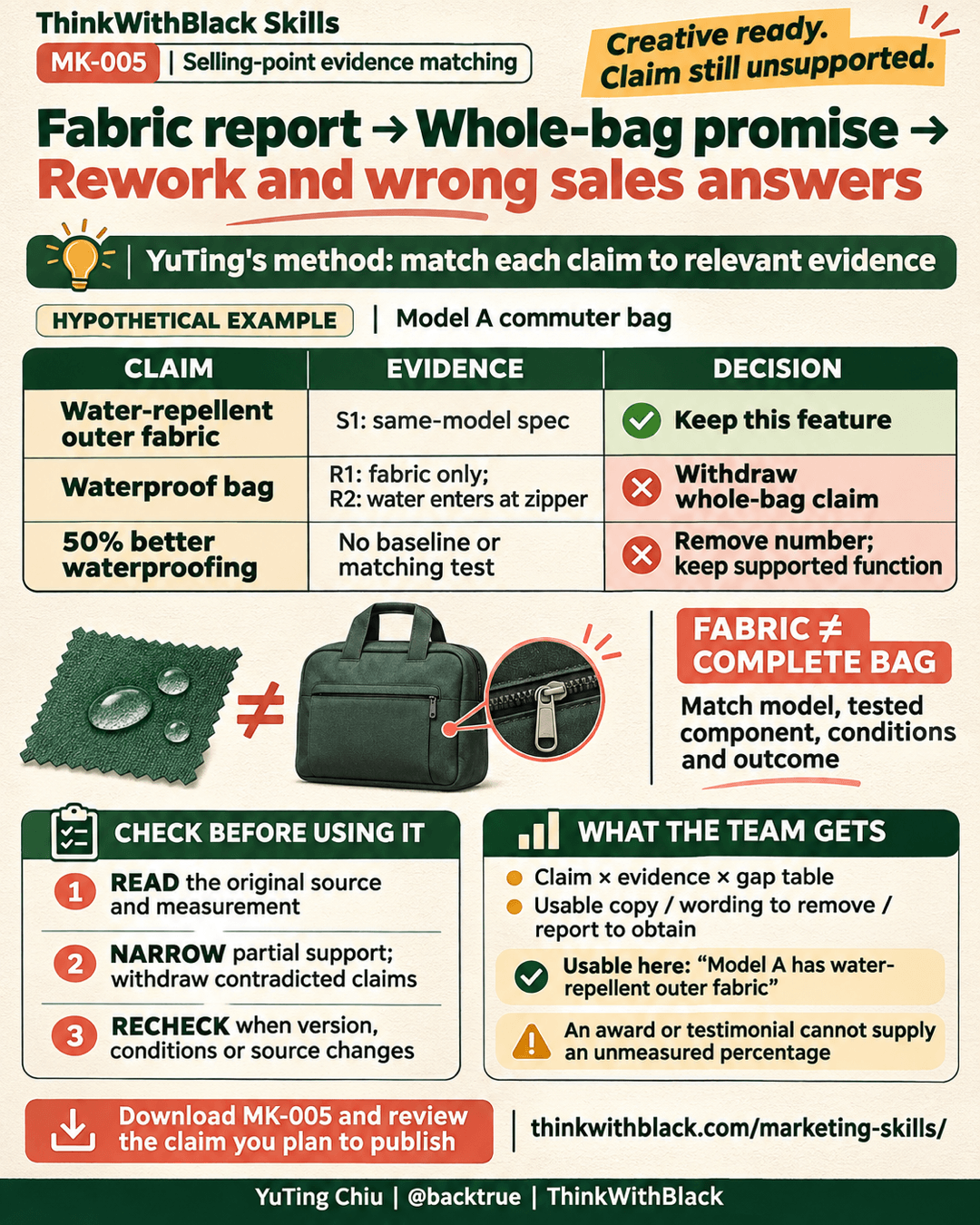 Hypothetical Model A commuter bag and reports | evidence retains tested component and conditions
Check your next launch claim with ThinkWithBlack Skills
Visit ThinkWithBlack Skills to download the complete MK-005 method pack, bring in your draft copy and full source evidence, and match one claim you are preparing to publish. If you want to pick a method based on your current business problem, download INDEX.md first. If the workflow helps your team, you can also click through from the website to give the project a Star on GitHub.
Bring your data into MK-005
- Download the MK-005 method pack (English version: complete English MK-005 method)
- Download the INDEX.md index (English version: English index)
- View the full operating instructions (full URL: https://thinkwithblack.com/marketing-skills/#how)
First time using the packs? Download the index first, let your AI select the right method, and then upload the complete method pack alongside your files for this task.
Social posts for this Skill
Select a platform to view the visual cards and post for this Skill:
YuTing Chiu (Xiahei) · @backtrue · ThinkWithBlack
Compiled for this Skill guide: Author background and courses
Find other Skill articles by business problem → (full URL: https://thinkwithblack.com/marketing-skills/articles/)
References
- Meta Advertising Course 101 | Let AI Run Your Ads. Course lecture deck, Slide 73 (FABE Evidence definition); Slide 9 (USP section, method source location). Verification record dated 2026-09-19 (the original deck carries no publication date).
- mk-005 Chinese method full text / English method full text. ThinkWithBlack MCP, v0.3 method draft; decision rules compiled 2026-10-14. §1 Purpose, §3 Method steps, §4 Original method and limitations (relative improvement rate vs. percentage-point basis, worked verification example), §6 Fixed deliverable columns, §9.5 Full-source verification, §10 Source location.
- 廣告都做好了,賣點卻拿不出對應證據:用 MK-005 完成賣點證據配對 (Chinese original) / Creative ready, evidence missing: use MK-005 to match each selling point to its proof (English original). YuTing Chiu @backtrue / ThinkWithBlack, published and updated 2026-11-04. Corresponding image assets:
/assets/skill-articles/mk-005-en.png,/assets/skill-articles/mk-005-en.png.