Copywriter A-Zhe reads the team chat logs where customer service keeps answering what the handheld scanner will actually do at a worksite, so he rewrites the battery life and connectivity specifications as long-lasting, convenient, and professional. When customer service manager Xiao-Yun shares inquiry records showing that field staff without fixed outlets and desk staff plugged into power face completely different shift conditions, A-Zhe sees why accurate specifications alone still leave buyers unable to choose a model. The team decides to break apart every proposed first-screen selling point and check product capability, usage conditions, customer task, and tangible outcome side by side before finalizing the product page and ad creatives.
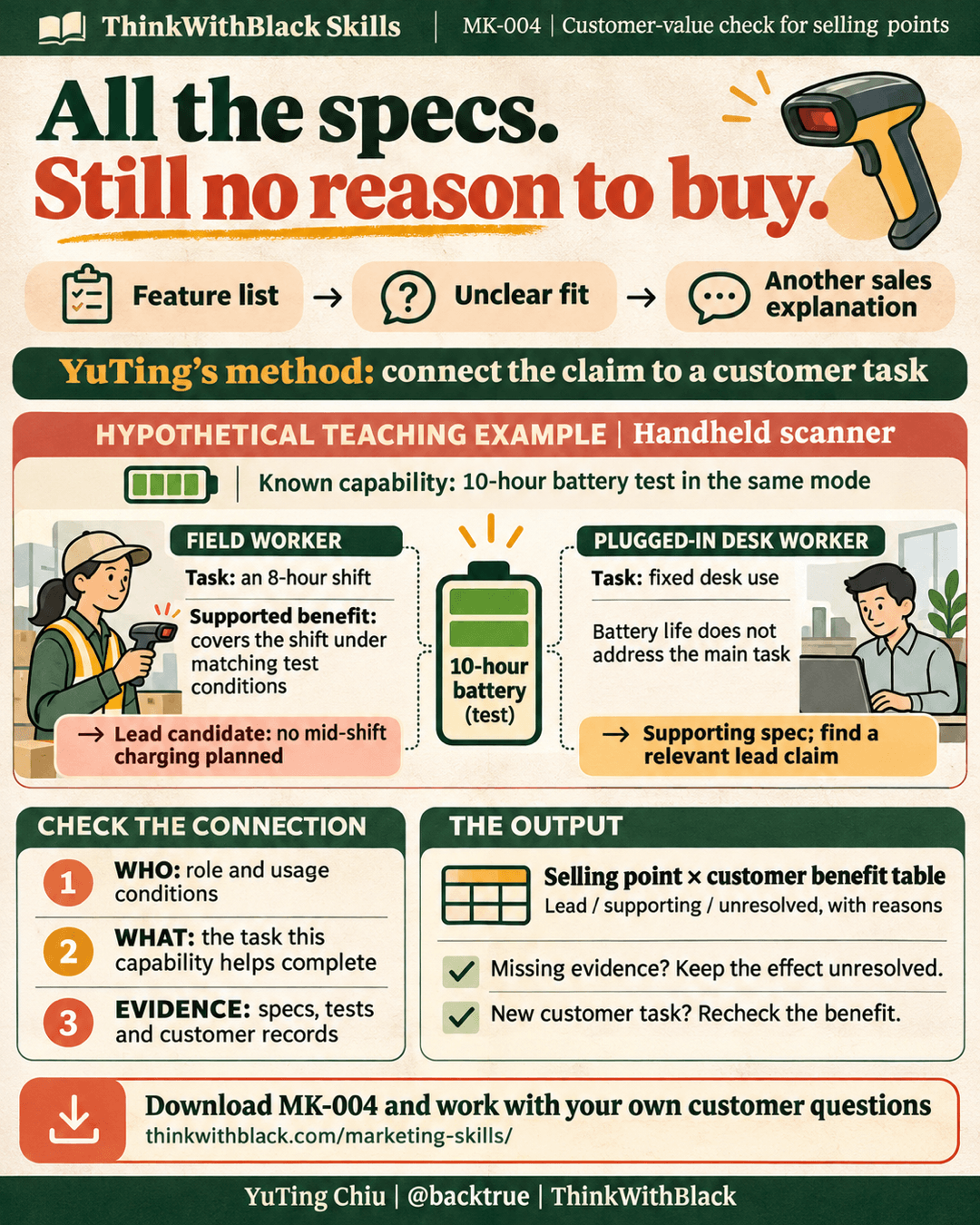
When the specs are accurate, how do you connect them to the buying question?
At the copy review meeting, A-Zhe opens the draft for a handheld scanner. The first screen reads, "10-hour battery life." That capability can be checked against test data, but the page stops at how long the machine runs. It never explains who needs ten hours or what job those ten hours cover.
Customer service manager Xiao-Yun (小芸) pastes two common inquiries into the meeting notes. The first customer works an eight-hour field shift with no fixed wall outlet on site; battery life determines whether they have to hunt for a charger mid-shift. The second customer works all day at a counter with the scanner plugged into fixed power; to them, ten hours is just a baseline spec. When the team groups both buyers together as "efficiency-minded professionals," every ad repeats the same line about long battery life, and neither buyer sees how the scanner fits their shift.
Building that link means checking four pieces side by side: product capability, usage conditions, customer task, and the outcome when those conditions hold. Copywriters sometimes add "you" to a headline—writing "You deserve long-lasting battery life"—as a reminder to address the reader. Step 3 of MK-004 states the check plainly: the word "you" is just surface wording. A sentence without a pronoun still works if it states the customer task and usage conditions; a paragraph full of "you" paired with vague adjectives and no concrete work outcome still goes back into the table for a rewrite [1].
A product page can list battery life, connectivity, and every technical specification, while customer service still answers the same question all day: "What will this device actually do for someone at my worksite?" Watching the team chat logs, copywriter A-Zhe (阿哲) rewrites the specs again as "long-lasting, convenient, professional." Customers still cannot tell which model to buy, and the product page and ad creatives stay stuck in review.
This deadlock often happens when every product fact on the page is accurate. A-Zhe, the product team, and customer service all know what the device can do, but the copy skips a necessary link: who is doing which job, and under what conditions this feature solves a specific problem for that person. When a team rushes a launch and drops the same selling point into ads for every audience, a spec that matters at one worksite has no business sitting in the headline for another.
The first decision is to break apart every selling point proposed for the first screen and keep only the lines where four things align: product capability, usage conditions, customer task, and a tangible outcome. Using MK-004 | Customer-value check for selling points, a team ties each selling point back to a specific customer task in a seven-column feature-to-benefit table, paired with a six-column revision trail so copywriters, product managers, and customer service work from the same standard [1][3]:
- Lead candidate: When a product capability is backed by a specification or test, and the test conditions match the customer's actual task, place it on the first screen and state the applicable conditions.
- Move to supporting information: When the specification is accurate but solves a different work scenario, move it to the spec sheet and find the problem this customer is actually stuck on.
- Mark to investigate: When the claimed effect exceeds the test scope—or when you only have a job title and no record of actual work—mark it to investigate, name the one customer question or same-condition test needed, and save the main layout for verified claims.
The same rules hold when you switch products or customer groups. If a new customer record or test report shows that the usage context changed, the work pattern differs, or the claimed effect needs retesting under those conditions, pull the original lead claim and re-pair the capability with the matching task so the headline stays tied to documented conditions [1][3].
Where the MK-004 check comes from and how it works
A-Zhe opens the complete MK-004 method pack. The workflow draws from the USP section (Slides 9, 13, 14, and related slides) of Meta 廣告學程 101|讓 AI 幫你投出廣告 (Meta Advertising Course 101: Let AI Place Your Ads for You) [1][2]. The course slides lay out the foundation for communicating selling points, and ThinkWithBlack Skills structures that material into a three-step team checklist. The public English edition also documents the explicit decision rules compiled on 2026-10-14 [1][3]:
First, tie the USP to the reason a specific role cares. What job that person has to finish and what limits their work environment imposes must come from existing sales records, customer inquiries, or usage logs. Broad labels like "values quality" or "cares about efficiency" won't tell you whether a feature helps at a worksite.
Second, check whether the copy states the user's work context. If the page only lists what the product does, add the user and their shift setup first, then show how the feature connects to that job—moving from a standalone spec to how the tool is used on the job.
Third, translate that USP into a value proposition for that specific role. Only a capability that matches a documented task and has spec or test support becomes a lead candidate. Accurate specs unrelated to the main task move to supporting information. Any claim lacking evidence for its effect is marked to investigate alongside the exact data needed, so the copy never outruns the proof.
The public English edition adds a dynamic adjustment rule: when the same product capability meets a different task, reconnect the benefit; when new data overturns the usage context or claimed effect, withdraw the lead claim [3]. The method pack also sets its own boundaries: this checklist is a working draft built from existing tasks to inspect feature-to-task links in a table. Platform interface details and placement advice from the August 2025 course slides keep their original date markers, so teams should verify current Meta platform settings before launching live ads [1][2].
Who actually needs a 10-hour battery?
A-Zhe tests the workflow on the handheld scanner draft. The product specs, test logs, customer questions, and copy below are hypothetical teaching inputs created to show how the method pack compares battery life against shift length; all conditions are given directly by this scenario rather than guessed from job titles [1]:
- S1 specification and T1 test record: Under the specified scanning mode, connection setting, and operating frequency, this model runs for 10 hours on a full charge.
- C1 context record: Field staff work 8 consecutive hours per shift with no fixed charging point on site.
- C2 context record: Counter or desk staff operate the scanner plugged into fixed power.
- Current copy draft: Alongside "10-hour battery life," the draft claims "double the scanning efficiency."
A-Zhe, the product team, and customer service load these four inputs into the seven-column MK-004 table and review them row by row:
| Factual feature | Customer task | Tangible benefit | Basis for comparison | Suitable angle | Lead / Supporting / To investigate | Reason |
|---|---|---|---|---|---|---|
| S1/T1: 10-hour runtime under stated conditions | C1: 8-hour consecutive field shift, no fixed charging point mid-shift | When usage matches test conditions, covers the full shift without mid-shift charging arrangements | Compare T1 conditions against C1 shift length; no competitor data | Mid-shift charging arrangements for field work | Lead candidate | 10-hour capability covers this example's 8-hour task; keep mode, connection, and frequency conditions |
| Same 10-hour battery specification | C2: Desk work plugged into fixed power | No benefit established for the main task yet | Same as above; no industry comparison | Move to spec sheet; check actual desk-work bottlenecks separately | Supporting | Spec remains true, but this setup finishes the shift on external power |
| Draft also claims "double the scanning efficiency" | C1/C2 work routines known; speed bottleneck unknown | Efficiency gain to investigate | Missing efficiency definition, baseline, and same-condition test | Gather effect evidence first | To investigate | Battery test T1 only measures runtime; speed testing is required to back an efficiency claim |
From row one, the decision is straightforward: under T1 conditions, a 10-hour battery covers C1's eight-hour field shift—a verifiable work benefit. Because T1 measures battery runtime, any change in operating mode, scanning frequency, or battery health requires rechecking the evidence for those conditions. Row three ("double the scanning efficiency") has only battery test T1 behind it, with no definition of scanning speed, no baseline, and no same-condition speed test, so it goes straight to "to investigate."
In the "Basis for comparison" column, A-Zhe notes that the table compares one product capability against two customer tasks. Because the team has no competitor test data, rule MK-004-C05 in the method pack applies: state how the feature helps the task, keep the true specification, and leave out comparative claims like "the only," "number one," or "more durable than other brands" [1].
So future edits can be audited, A-Zhe also pairs the seven-column table with the six-column revision trail required by the public English edition [3]:
| Original claim | Product fact | Customer task | Supported outcome | Retain / Rewrite / Remove | Revision evidence |
|---|---|---|---|---|---|
| 10-hour battery life | S1/T1, stated mode and settings | C1, 8-hour field shift | Covers the shift's work when conditions match | Rewrite as a task-linked lead candidate | S1/T1 plus C1; recheck actual field settings |
| 10-hour battery life as the desk-work headline | Same S1/T1 fact | C2, fixed external power | Main-task benefit not established | Remove from headline; retain as supporting spec | C2; collect one actual desk-work question |
| Double the scanning efficiency | Battery test only | Speed bottleneck not established | Efficiency unknown | Remove unsupported effect; mark to investigate | Obtain efficiency definition, baseline, and same-condition test |
Turning the tables into working copy and support scripts
With both tables filled out, copywriters, designers, and customer service work from the same playbook:
For the C1 field audience, A-Zhe replaces the bare "10-hour battery life" headline with:
"Covers an 8-hour field shift under matching test conditions, so you don't need to arrange mid-shift charging."
Next to the headline, he lists T1's scanning mode, connection setting, and operating frequency so field buyers and operators can check whether the test matches their shift. The design team now has specific scenes to build: an eight-hour shift timeline, clock-in and clock-out times, a worksite without wall outlets, and clear fine print showing the test conditions. When prospects ask about battery life, Xiao-Yun's support team can ask for their scanning mode and shift length first, then answer directly from the T1 test record instead of repeating "long-lasting durability."
For the C2 counter and desk audience, A-Zhe moves "10-hour battery life" down to the spec sheet at the bottom of the page and asks Xiao-Yun for the missing piece of evidence: one real support question or usage log from desk staff showing where their workflow actually stalls. Until that record arrives, the C2 first-screen headline stays open as a blank placeholder—preventing the team from inventing unverified claims about connection stability, faster checkout, or zero scan errors.
The deliverable gives everyone the customer benefit for each feature, its classification (lead candidate, supporting, or to investigate), a usable rewrite, and the reason behind the call. Copywriters revise the page, the product team supplies capability tests, and customer service logs the exact questions customers ask. If Xiao-Yun reports two weeks later that C1 field crews usually run a high-drain real-time wireless mode that differs from T1, the team checks the table, pulls the "no mid-shift charging" headline, and re-evaluates using test numbers from that wireless mode [1][3].
The method pack also defines three completion states so the team knows when a review is done [1]:
- Sufficient data: Run all steps and deliver the completed tables alongside the source evidence.
- Partial data: Deliver the verified facts and a conditional draft now, while flagging which section is incomplete and which source to pull next.
- Source not yet obtained: Log "not checked," "lookup failed," and "confirmed no data" separately so the next reviewer sees right away which columns are waiting on proof.
If the check shows that an existing headline already matches a documented customer task and test conditions, the method pack keeps the original line—just record the reasoning and the conditions that would trigger a future review [1].
Preparing your product data for AI
Before handing the next batch of product copy to an AI assistant, A-Zhe gathers five inputs: the draft selling points, model specifications, readable test records, verbatim customer questions, and actual usage conditions. If competitor comparisons exist, he attaches the competitor model numbers and sources; anything missing stays marked as a blank to fill in the table. When a spec sheet lists only technical jargon, rule MK-004-C06 in the method pack lets you ask the AI to explain what that technology does under known conditions, while holding off on performance numbers until test records arrive [1].
Once your materials are ready, copy this prompt to your AI tool:
Read MK-004 first, then check who each selling point in this product copy serves and under what usage conditions it helps. Tie each feature back to the customer tasks in the supplied data, separating specifications, benefits, and evidence. Output the seven-column table (Factual feature, Customer task, Tangible benefit, Basis for comparison, Suitable angle, Lead / Supporting / To investigate, and Reason), followed by evidence-backed rewrites. If customer context is missing, list the one customer question we need to collect; if capability or performance tests are missing, mark the claim to investigate and do not invent evidence.
To include the six-column revision trail from the public English edition, append this line to the prompt:
Also output the six-column revision trail (Original claim, Product fact, Customer task, Supported outcome, Retain / Rewrite / Remove, and Revision evidence) so every edit can be traced back to its source.
When the AI returns the tables, run two quick checks:
- Check "Tangible benefit" in every row: does each number trace back to a measurement under matching conditions or a customer's exact words [1]?
- Check every row marked "Lead candidate": does the "Reason" column name which test condition matches which customer task, confirming the headline has real backing?
Caption: Hypothetical scanner, test records, and customer logs | Benefits apply only when usage conditions match
Run your own headline through the table: decision rules and review steps
Take one product headline you are running right now and walk it through A-Zhe's five steps before your next copy edit:
- Line up the spec and the test: Write down your current headline alongside the model's specifications and readable test logs, checking that the test states the operating mode, settings, and measurement conditions.
- Pin down the customer task: Write down the job this headline serves—who is doing what task under which shift or workspace setup. Quote verbatim customer questions or usage logs from customer support rather than guessing from job titles or age brackets.
- Compare both sets of conditions: Check the test setup against the customer's actual working conditions. If they match, write the benefit as a complete sentence that includes those conditions; if they don't, move the spec to supporting information and ask what problem actually slows this customer down.
- Trace every number: Confirm that every number in your benefit line—hours, percentages, speeds—comes from a test run under matching conditions. If that test is missing, mark the claim to investigate and note which test to request from the product team or which usage log to get from customer support.
- Log the revision trail: Enter the original claim, product fact, customer task, supported outcome, keep/rewrite/remove decision, and revision evidence into the six-column table as your team's shared record.
Finishing those five steps puts every selling point into one of three clear buckets:
- Capability supported by a specification or matching test + documented task + matching conditions → Lead candidate: Put it on the first screen alongside its operating conditions.
- True capability + unrelated to the main task → Move to supporting information: Place it in the spec table and collect one record of where this customer actually gets stuck.
- Claim exceeds the evidence or lacks customer context → Mark to investigate: Use a conditional description for now, name the missing test or customer log, and save the headline slot for verified claims.
When do you reverse a call? As soon as new support logs or test reports show that the customer's operating mode, usage frequency, or work environment differs from the original test—or that their core task has shifted—pull the lead headline, re-pair the capability with the updated task, and retire the outdated persona [1][3]. Keep the original evidence and prior table versions on file, flagging only the conclusions that changed. At the next review meeting, copywriters, product staff, and customer service can pick up right from the updated conditions and focus on selling points that actually help the buyer decide.
Check your next product page with ThinkWithBlack Skills
Visit ThinkWithBlack Skills to download the complete MK-004 method pack, and run a current headline and its backing data through your AI tool. Verify whose job the sentence helps finish before keeping it in your main banner. If you want to match an operational problem to the right method first, grab INDEX.md from the site, and follow the link on the homepage to star the project on GitHub.
Bring your data into MK-004
- Download the MK-004 method pack (Chinese)
- Download the English MK-004 method pack
- First time here? Download the index first so your AI can pick the right method, then upload the full method pack alongside your product data.
- Download INDEX.md (Chinese) · Download the English INDEX.md · Read the full setup guide
Social posts for this Skill
Pick a platform to view the summary cards and discussion for this Skill:
邱煜庭(小黑老師) / YuTing Chiu · @backtrue · ThinkWithBlack
More from this Skill series: Author bio & courses | Browse other Skill articles by business problem →
References
- MK-004 | Customer-value check for selling points (v0.3 method draft). ThinkWithBlack Skills, decision rules compiled 2026-10-14; full source check 2026-09-19.
- Meta 廣告學程 101|讓 AI 幫你投出廣告 (Meta Advertising Course 101: Let AI Place Your Ads for You). Google Drive presentation, USP section (Slides 9, 13, 14, etc.).
- English MK-004 method pack. ThinkWithBlack Skills, public English edition (including revision-trail columns and withdrawal conditions).
- 規格寫滿頁,客人仍不知道買來有什麼用:用 MK-004 檢查賣點對客價值 (The page is full of specs, yet customers still don't know what it's for: use MK-004 to check a selling point's customer value). 邱煜庭(小黑老師) / YuTing Chiu · ThinkWithBlack, published/updated 2026-11-04.
- All the specs, still no reason to buy: use MK-004 to check a selling point's customer value. YuTing Chiu · ThinkWithBlack, Published/Updated 2026-11-04.