Copywriter Lin reviews a narrow shelf ad draft that the product team rejected again for showing no difference from other brands, even after the copywriters swapped adjectives and the designers reworked the product photos, layouts, and color schemes. When Lin checks the draft claims against the spec sheet, scenario brief, and selected competitor pages, she finds that the lead wording still fits other brands, the exclusivity claim lacks full market coverage, and the efficiency claim has no test record. Separating generic slogans, verifiable specifications for a narrow kitchen gap, and missing evidence lets the team stop reworking visuals and rewrite the copy around differences that hold up.
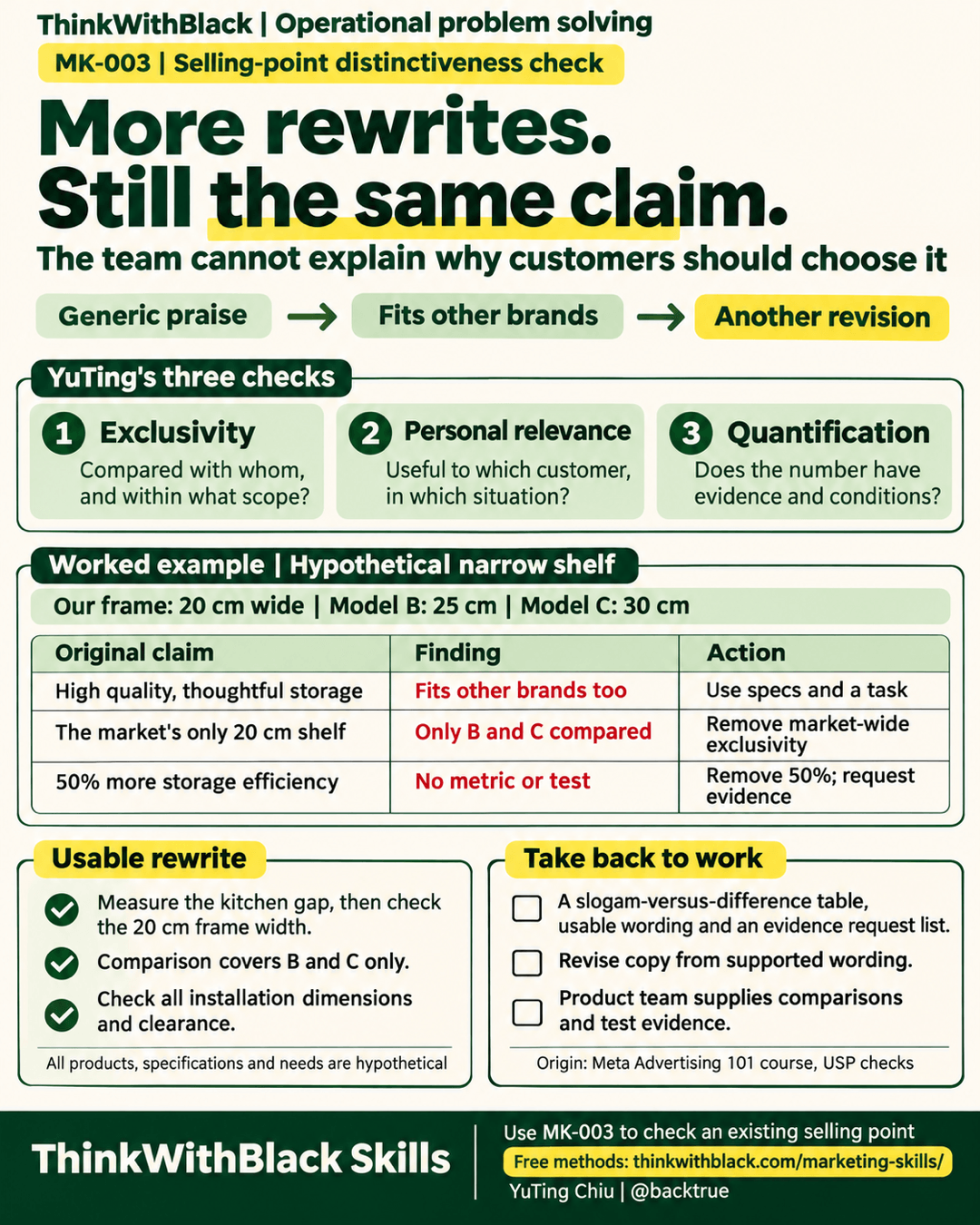
Why a good-sounding line still fails as a differentiator
"High quality, thoughtful storage" expresses the impression a brand wants to leave, but the exact same phrase fits another shelf, storage box, or cabinet. Readers learn nothing specific about the product, and the copy and design teams have no idea what detail to show on screen.
Product specifications give you a verifiable starting point. When a spec sheet states that a shelf frame is 20 cm wide, a shopper trying to fit a rack into a narrow kitchen gap can grab a tape measure and check. Going from "this frame is 20 cm wide" to "the market's only 20 cm shelf," however, jumps across the entire market. If you have only checked two competitor product pages, your evidence supports a comparison against those selected models, not the whole market.
MK-003 pulls mixed claims apart. It puts generic phrases, concrete specs, customer situations, and comparison scopes into separate columns, and traces every number back to its source document. Once the underlying material is sorted out, the next draft can fix the substance of the claim instead of cycling through synonyms.
The ad proposal comes back rejected again with the same comment: "I can't see how this differs from other brands." To get it approved, the team swaps "high quality" for "carefully selected quality," and "thoughtful design" for "professional design." They rework the product photos, layouts, and color schemes too. Yet the lead claim they finally deliver would still work with a competitor's logo on it.
When the deadline hits, someone suggests adding "the only" or a percentage to make the selling point sound stronger. Then the team opens their files: nobody has defined the comparison scope, and there is no test record for the number. The product team reviews the draft and sends it back again. Every rejection triggers another round of layout and color changes. Work stalls because the team hasn't separated generic slogans, supported differences, and unsupported claims. They keep trading adjectives and tweaking visuals without giving customers a concrete reason to buy this specific product.
MK-003 | Selling-point distinctiveness check (English method pack) works on selling-point drafts you have already written. It checks each claim against your product facts, intended customers, and competitor files across three angles: exclusivity, personal relevance, and quantification. By separating generic wording, verifiable specifications, customer tasks, comparison scope, and numerical evidence, the check produces a slogan-versus-difference table, usable rewrites, and an evidence request list. Copywriters and designers get exact specifications and customer situations to work from, and the product team gets a clear list of missing evidence to supply.
What you can claim depends on the files you have on hand:
- The product team has a complete market definition and coverage survey: You have a basis to discuss an "only" claim and can bring it back for review.
- The product team has metric definitions, a comparison baseline, test methods, and results: Percentage improvement claims have backing and can return to the draft for evaluation.
- No competitor files are available yet: Leave exclusivity open for verification. Focus right now on stripping out generic wording and matching product specs to customer tasks.
- You need to build market positioning from scratch or design a full competitive strategy: That belongs to front-end market research and should be handled as a separate project outside MK-003.
Any team in any product category can use these four conditions to see how far their current evidence lets a selling point go.
Where this check comes from
The MK-003 method pack draws from the Unique Selling Proposition (USP) section of YuTing Chiu's course deck, Meta Advertising Course 101: Let AI Help You Run Your Ads (《Meta 廣告學程 101|讓 AI 幫你投出廣告》). Slides 9 and 10 connect three USPs to customer willingness to pay (WTP), the value proposition process, product page layout, and the Feature step in FABE (Feature, Advantage, Benefit, Evidence). Slide 13 lays out four foundations for a working USP:
- Build trust with a specific role by speaking to a defined audience.
- Give a reason for the product to survive after customers compare the market.
- Establish an identifier that holds up across scenarios, channels, and time.
- Offer uniqueness that can be verified repeatedly, starting from what the customer compares it against right now—including what they currently use, the workaround they rely on, or other options they have already considered.
That requirement to let customers compare against their current options—and to hold up under repeated verification—is why MK-003 requires every comparison to name its scope. A claim only stands within the boundaries of the evidence behind it. Slide 14 then defines three checks:
- Exclusivity: Test whether the USP still works if you place it on another product. If it fits competitors too, narrow it down to a specific difference.
- Personal relevance: Check whether the subject of the copy includes the user and the usage situation, linking product features to actual customer needs.
- Quantification: Back the claim with concrete numbers so readers and reviewers can trace it to evidence.
MK-003 turns those three principles into a step-by-step review order:
Step 1: Check exclusivity to see who the difference is relative to. List the compared competitors, model names, source locations, and comparable conditions right next to the claim. Make sure the wording stays within the files you have actually read. If you have no competitor files on hand, flag the generic phrases that could apply to any brand and mark exclusivity as open.
Step 2: Check personal relevance to confirm who needs this difference and in what situation. Tie the product specification to a known customer task. A shopper trying to fit storage into a narrow kitchen gap needs to know the frame width; if the copy only says "thoughtful design," that practical reason to buy disappears. Base every usage situation strictly on the records you already have.
Step 3: Check quantification to verify where each number comes from and when it holds true. Check dimensions directly against the product spec sheet. If a draft claims a percentage improvement, verify the metric definition, comparison baseline, test method, and test results together. Every number keeps its source and conditions attached so precise wording reflects real evidence.
After running all three steps, test the selling point by placing it on a competitor's product. Flag any wording that still sounds normal on another brand as needing sharper differentiation, and move unsupported performance claims onto the evidence request list. These three angles test the evidence boundary of your existing claims so the team keeps what holds up.
For teams checking the method's verification status: the full text of the original Meta Advertising Course 101 handout has been reviewed (covering Slides 9–10 and 13–16, along with background sections on FABE in Slides 73–74 and click-through rate [CTR] in Slides 106–110), keeping the method strictly within what the course material supports. The six acceptance test cases (C01–C06) in the method pack are written, though they have not yet been tested against live AI models or ad accounts. In short, MK-003 provides a structured review framework for copy and evidence; actual ad performance depends on each team's own account tests.
Worked example: three draft claims for a narrow shelf
The products, specs, documents, and customer needs below are hypothetical materials created for a copy-checking exercise; they do not refer to any real brand, competitor, or client. Let's run the full check on three draft selling points for a narrow storage rack, Model A:
- "High quality, thoughtful storage"(「高品質、貼心收納」)
- "The market's only 20 cm narrow shelf"(「全市場唯一二十公分窄架」)
- "50% more storage efficiency"(「收納效率提升 50%」)
Here is the inventory of hypothetical files on hand:
- A1 spec sheet: Lists Model A's frame width as 20 cm.
- B1 and C1 competitor pages: Product pages for selected comparable shelves, Model B and Model C, listing frame widths of 25 cm and 30 cm.
- D1 scenario brief: Defines the target buyer as someone looking to store items in a narrow kitchen gap.
These files support comparing the frame widths of Models A, B, and C for a narrow kitchen gap. They do not include a full market survey or any test records on storage efficiency. Running the three draft claims through the three-angle check produces this breakdown:
| Original claim | Exclusivity check | Personal relevance check | Quantification check | Action for this draft |
|---|---|---|---|---|
| High quality, thoughtful storage | Still fits Models B, C, or other products | States no target user or usage situation | Lists no quality metric or test | Flag generic wording; rewrite around verifiable specs and use |
| The market's only 20 cm narrow shelf | Only B and C files are on hand; market-wide exclusivity remains open | Connects to the kitchen-gap need in D1 | A1 supports 20 cm; "market's only" lacks market-wide evidence | Cut "the market's only"; keep 20 cm and the actual comparison scope |
| 50% more storage efficiency | Does not define what solution it is compared against | States no specific storage task | Lacks efficiency metric, baseline, and test records | Remove the 50% claim; add missing items to the evidence request list |
From this table, the team can decide what stays and what goes:
- Claim 1 (handle generic wording): Flag adjectives that any brand could use and replace them with verifiable specifications and the intended task.
- Claim 2 (narrow the comparison scope): The A1 spec sheet backs "20 cm," and the D1 brief links it to kitchen-gap storage. Because the comparison comes only from B1 (25 cm) and C1 (30 cm), the accurate statement is that Model A's frame is narrower than the selected B and C models. Cut "the market's only" from this draft.
- Claim 3 (move to the evidence request list): "50% more" has no baseline solution, no defined storage task, and no test data. Pull it from the current usable copy and hand the data request to the product team.
Organizing the check into a deliverable table
On the official site, the Chinese MK-003 method pack uses a fixed seven-column table so teams can link their review directly to product facts, customer tasks, and creative angles. Using the same hypothetical narrow-shelf files, the completed seven-column table looks like this:
| Factual feature | Customer task | Perceived benefit | Comparison basis | Creative angle | Lead / support / open | Reason |
|---|---|---|---|---|---|---|
| Model A frame width is 20 cm, A1 | Check whether a shelf fits the kitchen side gap, D1 | Clear width to measure and check against | B1 is 25 cm and C1 is 30 cm; comparison covers only these two models | Measure the kitchen gap first, then check the frame width | Lead candidate | Spec and customer need connect; still need to check other installation dimensions and clearance |
| "High quality, thoughtful storage" (original draft wording) | Not yet tied to a specific task | Generic benefit with no verifiable difference | The exact same line fits Models B and C | Replace with concrete specs and usage when rewriting | Needs rewrite | Keep original line for comparison so the team stops revising by swapping adjectives |
| "Market's only" / "50% more efficiency" lack sufficient evidence | Need to verify the reason to choose and the claimed effect | Exclusivity and efficiency gains remain unverified | Missing market scope, efficiency definition, baseline, and test | Hold back from this draft's lead claims | Open | Partial competitor data or assumed effects cannot be stretched into a final claim |
The "Lead candidate" status in row one rests on the conditions of this example. While "20 cm" answers the frame-width question, a buyer still needs to check height, depth, and clearance against the product manual before purchasing and installing the shelf. Keeping both the specification and the installation conditions in the worksheet lets the copy highlight the practical benefit—measuring the kitchen gap—without overstating where the shelf fits.
If your team works in English or delivers across languages, the English method pack uses an eight-field table. Its columns are structured independently from the seven-column Chinese table; use whichever table matches your team's working language and keep its structure intact:
| Original claim | Exclusivity check | Personal relevance check | Quantification check | Generic slogan portion | Supported difference and source | Rewritten claim | Open conditions |
|---|---|---|---|---|---|---|---|
| High quality, thoughtful storage | Also fits Models B, C and other products | No particular customer task stated | No quality metric or test supplied | Both phrases remain generic | A1 supplies a 20 cm frame width; D1 supplies the kitchen-gap task | Measure the kitchen gap, then check the 20 cm frame width | Check all installation dimensions and clearance; quality evidence not supplied |
| The market's only 20 cm narrow shelf | Only B and C have been supplied; market-wide exclusivity remains open | Width is relevant to D1 | A1 supports 20 cm; no market-wide evidence supports only | The exclusivity wording exceeds the comparison | A1: 20 cm; B1: 25 cm; C1: 30 cm, for these selected models only | State the 20 cm width; identify B and C if using the comparison | Define market scope and provide comparison coverage before making an exclusivity claim |
| 50% more storage efficiency | The alternative is not defined | No specific storage task or result is defined | No metric, baseline, method or test | Efficiency is undefined; 50% is unsupported | No efficiency difference can be established from the supplied material | Remove the efficiency sentence from this draft | Supply the metric, baseline, method, applicable conditions and results |
Revising the copy and assigning next steps
With the table complete, the team can lock in the usable copy and divide the remaining work in one meeting:
- Usable copy ready to ship: Use "Measure the kitchen gap, then check the 20 cm frame width." (Chinese version: 「先量廚房側縫,對照 20 公分架身寬度」). If the ad or landing page includes a competitor comparison, state explicitly that in this example, the selected Models B and C have frame widths of 25 cm and 30 cm, keep the source tags
A1,B1, andC1on the worksheet, and note the installation checks for height, depth, and clearance. - Clear visual direction for copywriters and designers: Nobody has to guess how to illustrate "carefully selected" or "thoughtful." Both visuals and text can show a shopper measuring a kitchen gap with a tape measure and checking the 20 cm frame width.
- Evidence request list for the product team: Pull "the market's only" and "50% more storage efficiency" from the current draft and hand the product team two concrete data requests:
- To claim "only": Provide the market definition, the list of compared competitors, and the survey coverage.
- To claim an efficiency percentage: Provide the efficiency metric definition, the baseline solution compared, the test method, the applicable conditions, and the test results.
That package is the final deliverable: a slogan-versus-difference table, usable wording, and an evidence request list (Chinese deliverable: 「通用口號與差異對照表、可用改寫及待補證據清單」).
How this changes business decisions and review workflows
Running claims through MK-003 changes how a team handles ad reviews and revisions:
- Before using the table: Proposals get rejected because they "don't feel strong enough" or "look just like competitors." The team responds by trading adjectives or tacking on "the only" or unverified percentages—triggering another round of copy, layout, and color rework every time a draft bounces back.
- After adopting the table: Review discussions shift from "does this sound punchy?" to "which spec sheet supports this line, and which test or competitor file is still missing?" Copy and design can immediately ship claims backed by existing specs and customer tasks. Claims that need cross-team proof become structured evidence requests for the product team. Rewriting and evidence gathering happen in parallel, and the brand avoids the trust and compliance risks of publishing unverified "only" or percentage claims.
- When to update your decision:
- When the product team supplies a market definition and coverage survey: Log the new files in the table and re-evaluate the exclusivity claim.
- When the product team supplies the efficiency metric, baseline, method, and test report: Enter the numbers and conditions into the table and bring the performance claim back as a lead candidate.
- When full competitor data is impossible to gather in your category: Set a clear long-term rule—anchor your lead claims on verifiable specifications plus specific customer tasks, and stop burning hours debating "only" wording.
- Check the impact against your own team's records: Take the last lead claim your reviewers rejected and fill out the seven-column (or eight-field) table once. See whether your next review meeting shifts from debating adjectives to checking whether missing data can arrive before launch, and track how many rounds of copy and design rework the next campaign takes. Judge the time saved and conversion results directly from your own team's revision logs and ad account data.
Ready-to-use AI prompts
Gather your draft selling points, product spec sheet, target-customer brief, and any readable competitor pages. Upload them to your AI tool along with the MK-003 method pack, and copy either prompt below to run the check:
Chinese prompt
請先讀完 MK-003。檢查我已寫好的賣點,依獨家化、個人化、數據化三個角度對照商品規格、銷售對象與可讀競品資料,指出換到其他產品仍通用的部分。數字保留來源、比較範圍與條件,不補造數據。交付方法要求的七欄表、可用改寫與待補證據;沒有競品資料的獨家性保留待查。
假設層架與文件|比較僅限本例 B、C 款及所列條件
English prompt (A request to use with your existing copy)
Read the complete MK-003 method. Check my existing selling points from the angles of exclusivity, personal relevance and quantification against the supplied product facts, intended customers and readable competitor material. Identify wording that still fits other products. Retain source locations, comparison scope and conditions for numbers; do not invent data. Complete the method's eight fields, give usable rewritten claims and list missing evidence. Leave exclusivity open when competitor coverage is insufficient.
Hypothetical shelves and documents · comparisons limited to selected B and C models
Download ThinkWithBlack Skills and check your lead claims
Visit ThinkWithBlack Skills, download the complete MK-003 method pack, and upload your draft copy, product facts, audience brief, and competitor files to your AI tool. Start from the claims you already have to separate the differences that hold up from the evidence you still need to gather—and if you find the project useful, follow the link on the site to GitHub and give it a Star.
Bring your material into MK-003
- Chinese method pack and index: 下載 MK-003 方法包 · 下載 INDEX.md 索引 · 查看完整操作說明
- English method pack and index (English version): Download the English MK-003 method pack · Download the English INDEX.md · Getting-started instructions (Chinese) (English page image path:
/assets/skill-articles/mk-003-en.png; Chinese version switch link: 閱讀中文版 →)
First time using the toolkit: download INDEX.md first so the AI can select the right method, then upload the full method pack along with your project files.
Social posts for this Skill
Select a platform to view the infographic and post for this Skill:
References
- Meta 廣告學程 101|讓 AI 幫你投出廣告 (Meta Advertising Course 101: Let AI Help You Run Your Ads): Slide 9 (three USPs, WTP, and the value proposition process), Slide 10 (applying the three USPs to product pages and the Feature step in FABE), Slide 13 (USP foundations: role-specific trust logic, reason to survive after market comparison, cross-scenario / cross-channel / cross-time identifier, repeatable verification of uniqueness, and letting customers compare against their current options first), Slide 14 (original definitions of exclusivity, personal relevance, and quantification), Slides 15–16 (group voting and reporting optimization), Slides 73–74 (FABE and the cola example background), Slides 106–110 (CTR background).
邱煜庭(小黑老師) / YuTing Chiu · @backtrue · ThinkWithBlack
Skill guide compiled by: Author background and courses
Browse other Skill articles by business problem →
Published 2026-11-03 · Updated 2026-11-03