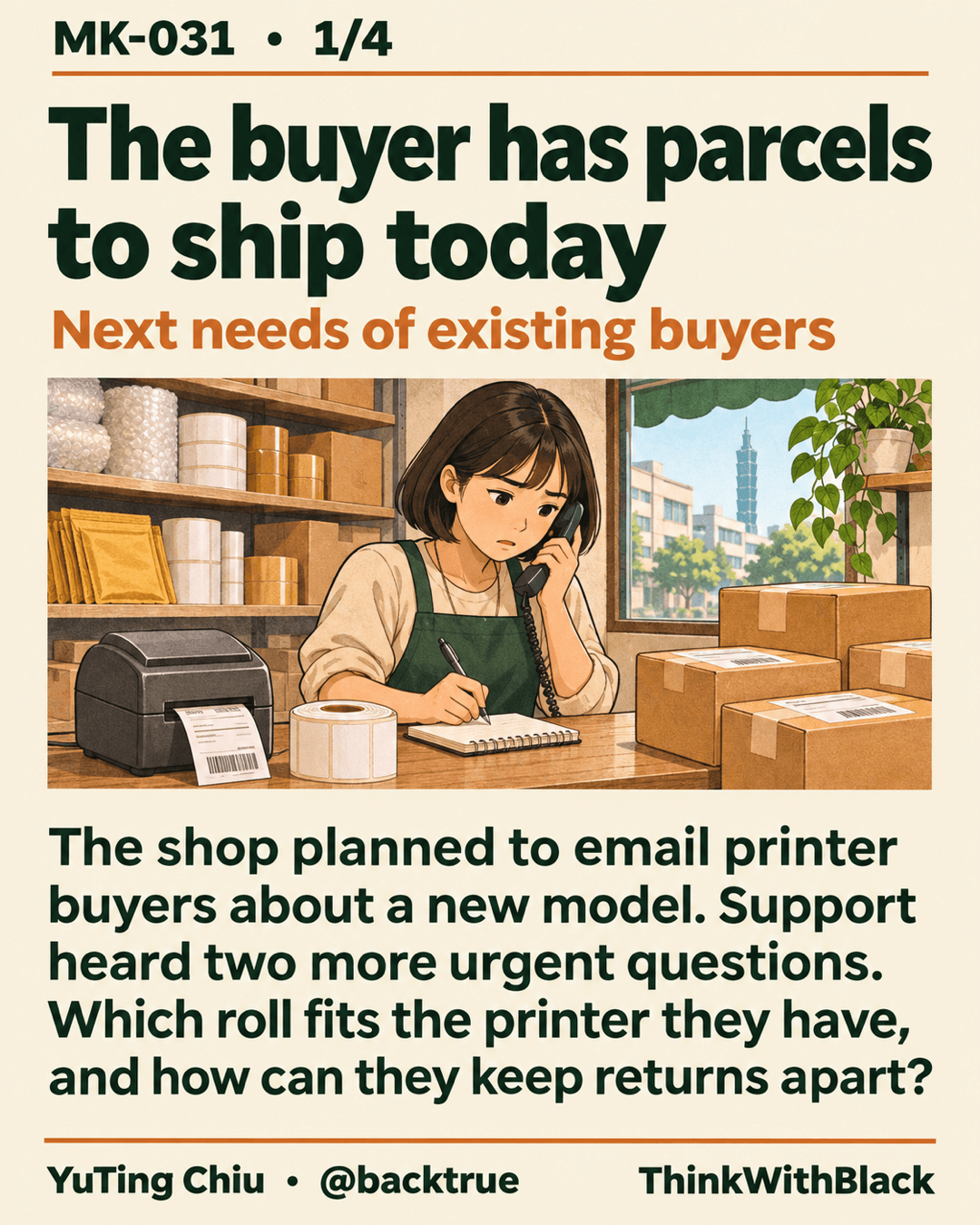
Picture a shipping supplies shop putting together its next customer email. Lin pulls a list of people who bought a thermal label printer and adds the new desktop model to the email. That afternoon, the support team forwards a message from a buyer who needs to print shipping labels before the day's parcels go out. They want to know which roll fits the printer they bought last month. They also have returns piling up by the packing table and want a way to separate the items awaiting inspection.
The purchase list told Lin what the customers had bought. She used this month's featured product to decide what to offer them next. The support message gives her two leads. A compatible roll can keep the current printer in use. A divided bin might help the person at that same packing table sort returns. Each lead needs its own evidence before she can decide what goes in the email and what to ask about first.
Find out what the buyer uses the first product for
I use MK-031, Next needs of existing buyers, to start with an item people already bought and the work they say they use it for. I adapted the method from the customer roles section of my Meta Ads course materials. That section starts with past purchases, then looks at actual shopping carts, customer questions and common accessories to explore what people may need next.
Put the order and the buyer's words side by side. The support message gives Lin a reason to believe this buyer is dealing with parcel shipments. Other orders for the same printer give her a group to investigate. Some people buy equipment for coworkers. Others may use the same model for a different kind of label. Record who buys, who operates the equipment and what they need it for when you have evidence for each.
Follow the buyer's work and the product's function
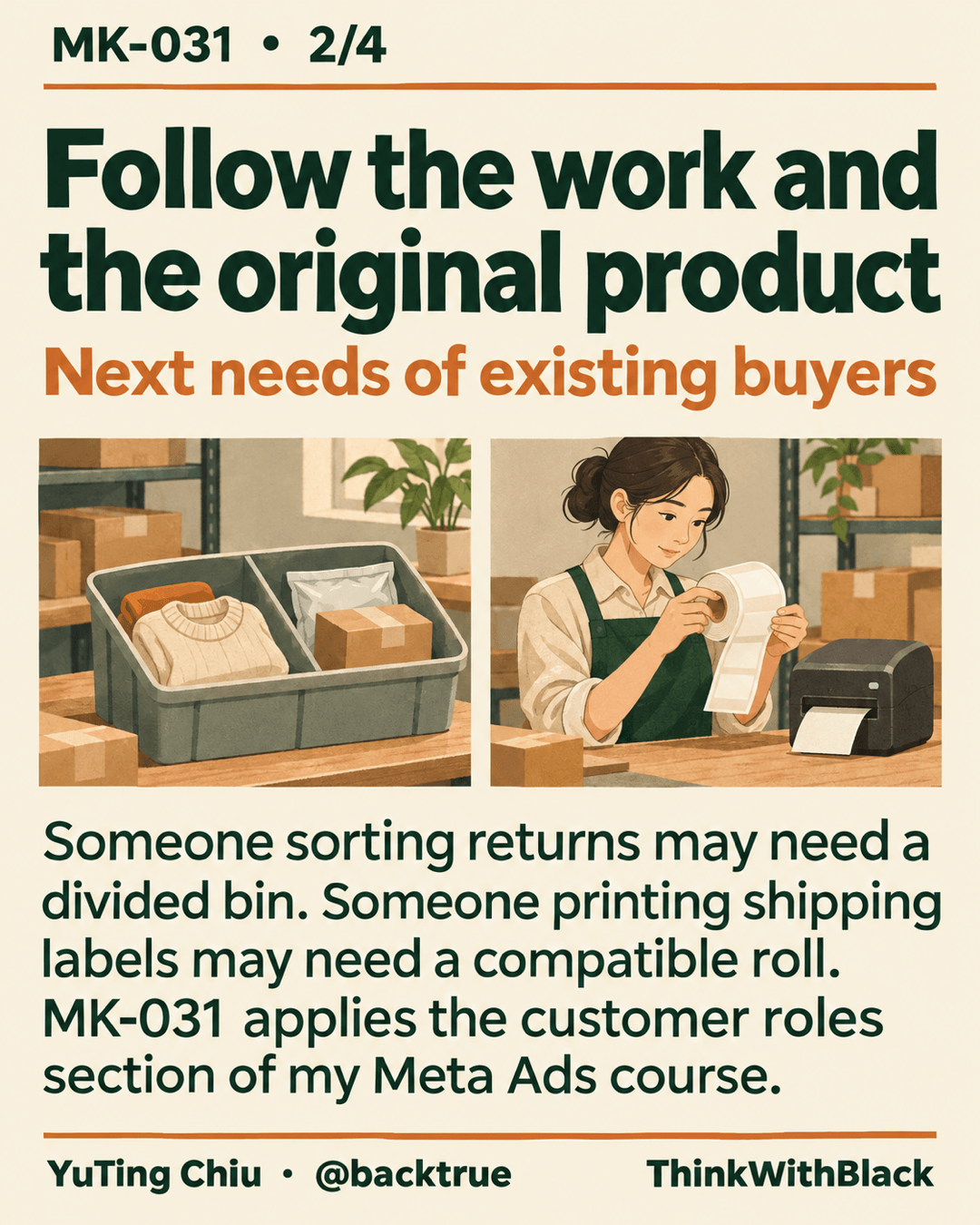
First, follow the work. People who handle both shipments and returns may need a way to keep incoming items separate while they inspect them. A divided bin is one possibility. The support message gives Lin a reason to ask where the returns pile up, how the team separates checked items and how much room they have.
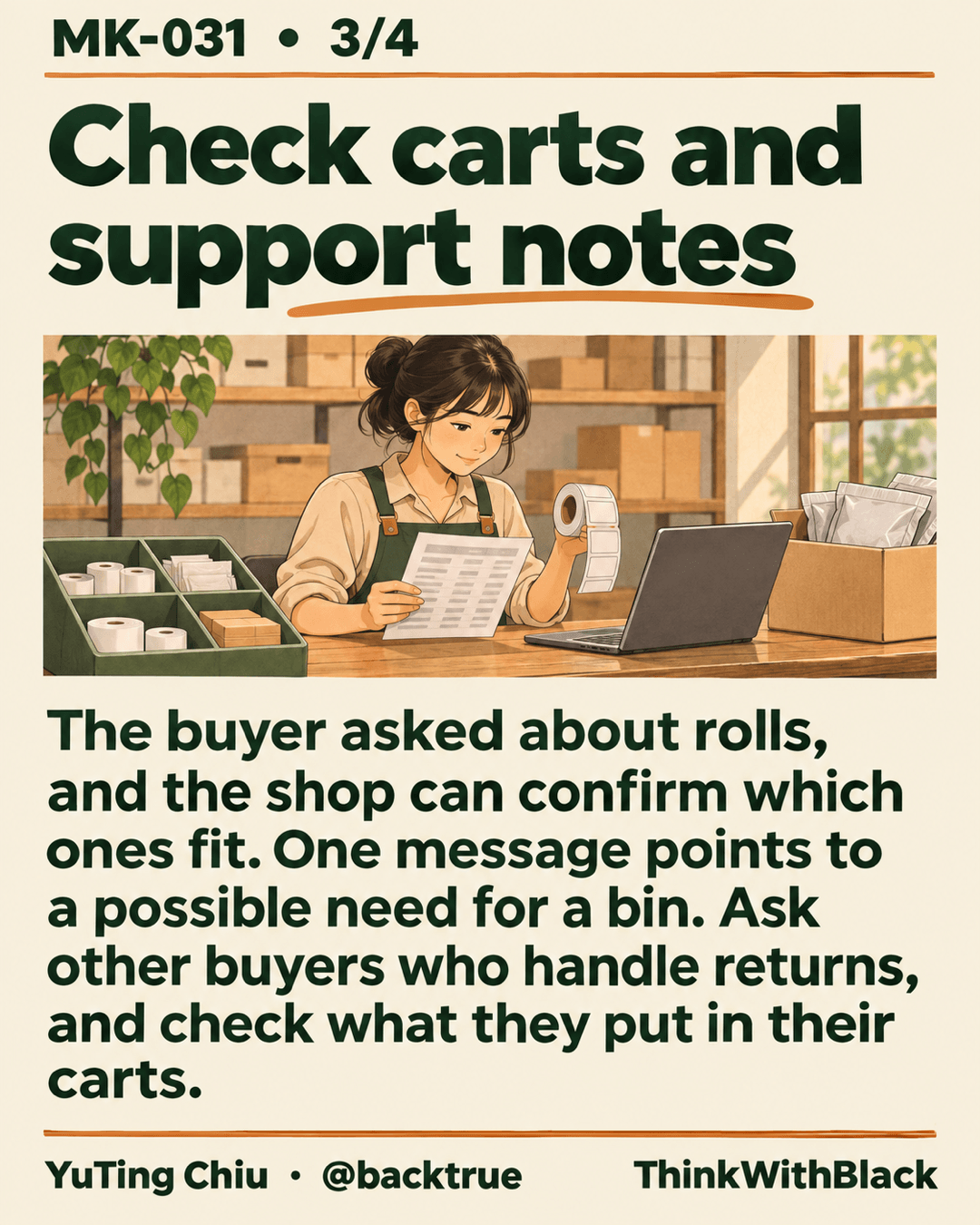
Second, follow the product. Look up the model from the original order, check the shop's compatibility information and identify the rolls that fit and can print the shipping label the buyer needs. Lin can also check whether buyers of that model put the same roll in their carts or bought it again, and ask what they planned to print.
Give each option its own evidence and next step
In this example, Lin has a printer model, a shipping deadline and a compatibility record. That gives her enough to answer the immediate question about the roll. The divided bin is a candidate based on one buyer's account of the returns pile. Lin can ask other buyers who handle returns how they store them. Common packing accessories can give her items to look for in carts and support messages.
| MK-031 field | A roll for the existing printer | A divided bin for returns |
|---|---|---|
| Candidate group | Buyers who have the same printer and use it for parcel labels | Buyers who also handle and sort returns |
| Buying and using roles | The buyer confirmed the purpose. The person who operates the printer still needs to be confirmed | This buyer described the returns at their table. Check who handles that work on other teams |
| Situation | The buyer needs to print shipping labels before parcels go out that afternoon | Incoming returns wait near the packing table |
| Task and concern | Find a roll that fits and prints the right label | Separate unchecked and checked items in the space available |
| Evidence | The order identifies the model. Support records the question. The shop has compatibility information | The buyer told support they want a way to keep returns apart |
| Counterexample | Another buyer may use the same printer for a different label that takes a different roll | A team with a separate returns station may already have enough space |
| What to verify | Confirm compatibility and look for the roll in carts or later orders | Ask where returns go, how inspection is tracked and where the work gets held up |
| Suitable message | Give the compatible roll with the model and dimensions | Ask how returns are handled, then use the answer to decide whether to show the bin |
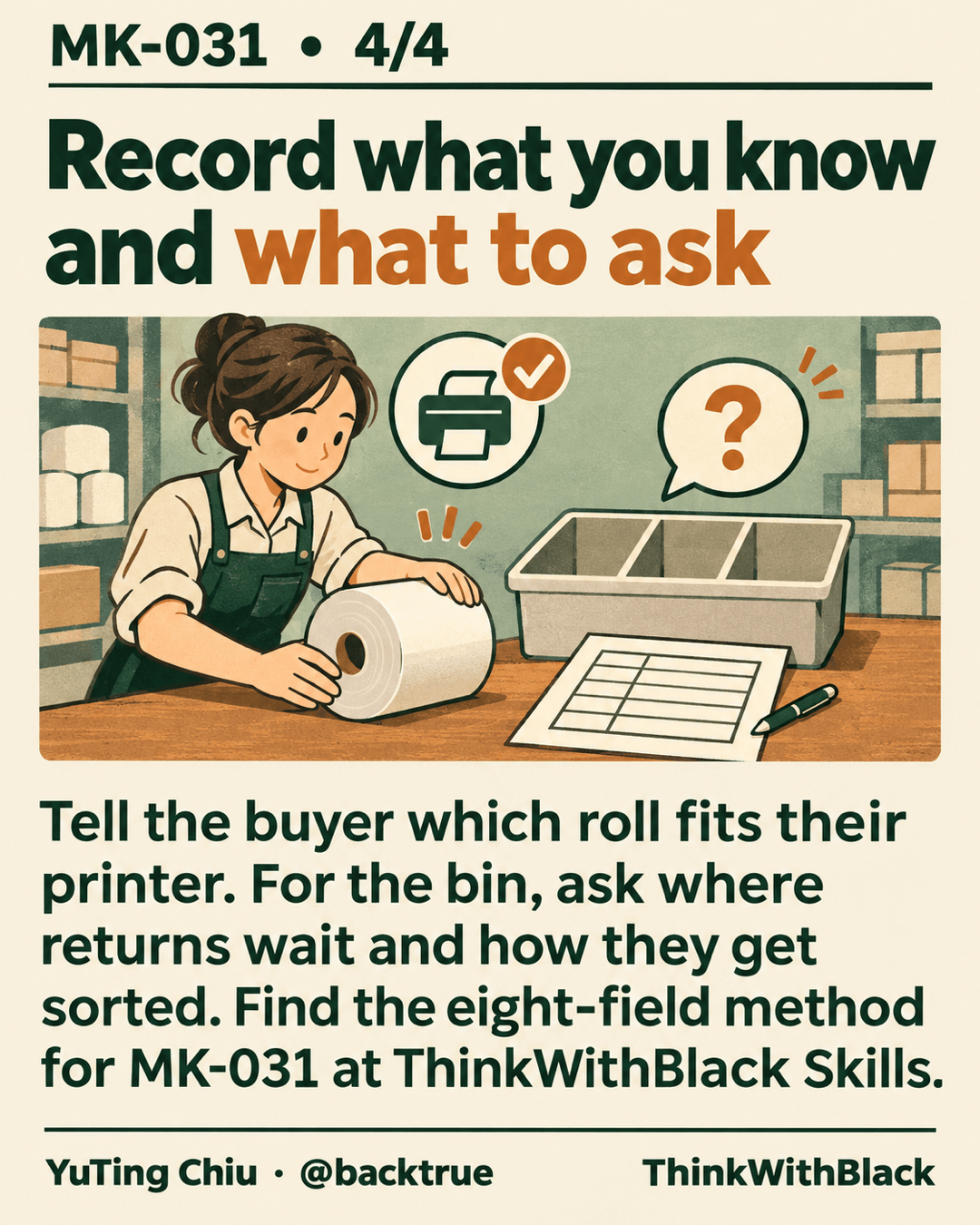
Lin can answer the paper question with the compatible option and keep the model and dimensions on record for her team. She can follow up about the bin by asking how the buyer handles returns now. An answer that the work already happens at a separate station is a reason to move the bin down the list. For the next email, her team can use the work each buyer has actually confirmed to decide what to include.
Download the MK-031 method pack from ThinkWithBlack Skills. Bring one product specification, a few orders with identifying details removed and a support note. Ask AI to propose one next item based on the buyer's work and one based on the original product. For each option, keep the evidence, a counterexample, the next question and the message you could send once you have the answer.
See the method in four cards
This Skill on social media
Choose a platform to view the infographic and post