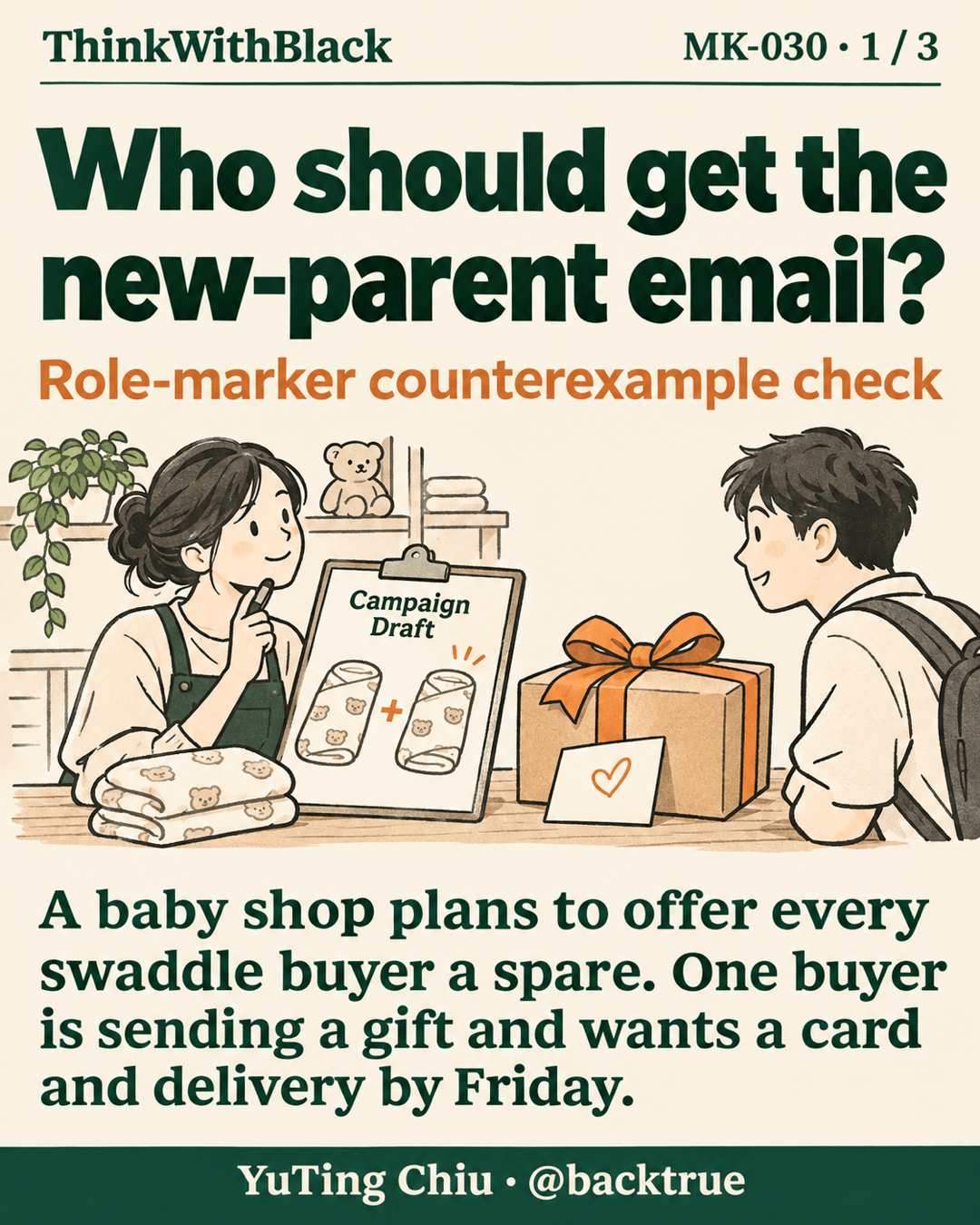
For example, a baby goods shop is preparing an email for its members. The team pulls everyone who bought a newborn swaddle into a “new parents” list and plans to suggest buying a second one. The product is for a baby, so the list looks plausible at first.
Then a message comes through to customer support. A buyer wants to send the swaddle to a friend. Can the shop include a card, and can the parcel arrive by Friday? This person needs help getting a gift delivered. An email suggesting a spare swaddle for home would leave the card and delivery questions unanswered. The support message also gives the team a chance to review the list before sending it. A single confirmed gift order is enough to show that the product alone leaves room for other reasons to buy.
Look for an order that challenges the label
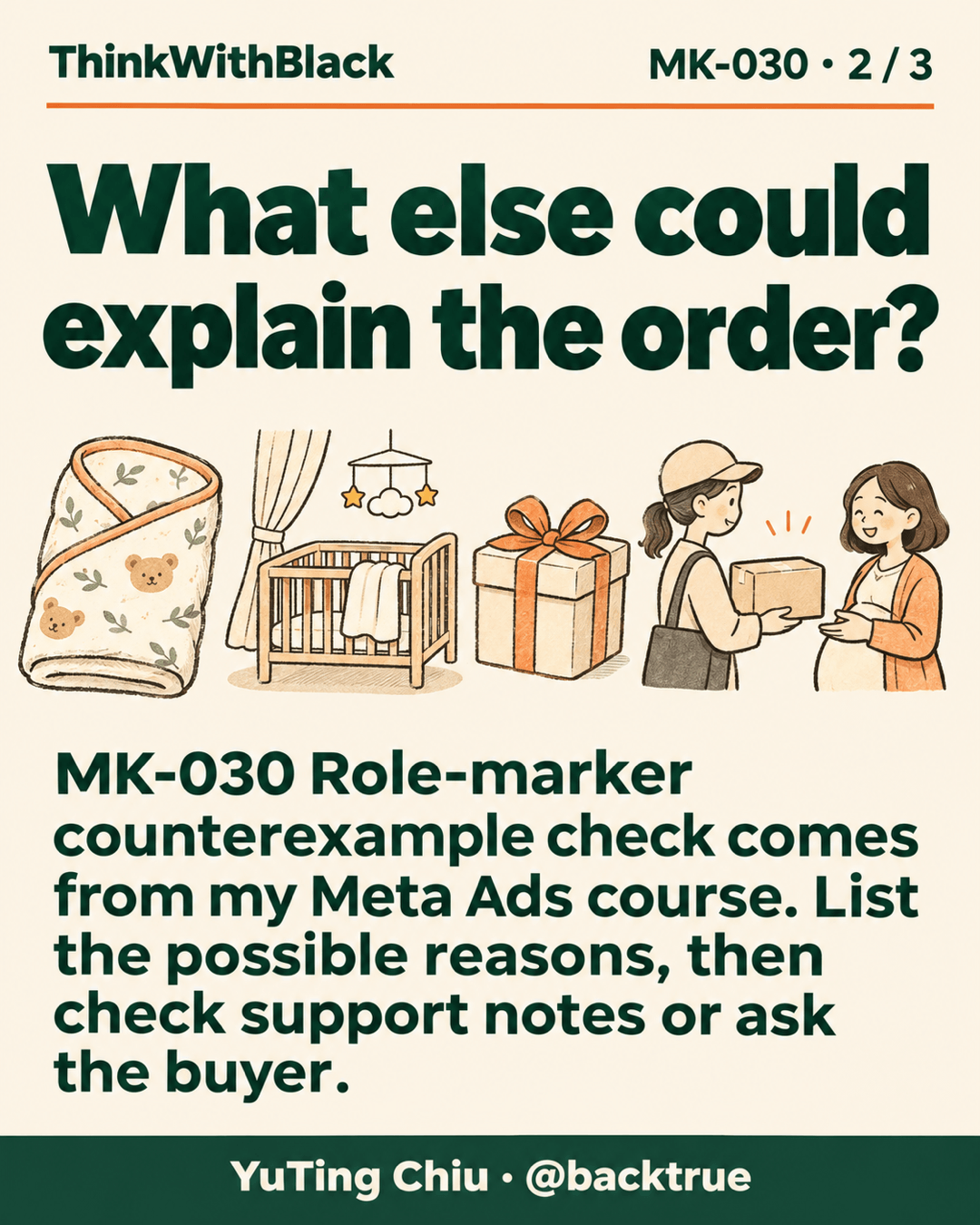
I use MK-030, the Role-marker counterexample check, to compare what the shop sells with what buyers say about their orders. The swaddle shows what the product is used for. The buyer's own words about sending it to a friend confirm the purpose of that order. The note about the card and Friday delivery tells the team what the buyer is trying to get done. For orders with only a product record, keep household use, gifting and buying on someone else's behalf open until you have evidence that can separate them.
I drew the method from the section on customer roles in my Meta Ads course materials, which looks at what purchases can tell you about a customer's role. MK-030 adds a practical check. What other reasons could explain the same purchase? A product with a very specific function can give you a more direct clue about its use. With a swaddle, people can buy for their household, choose a gift, or shop for a relative. Support conversations, survey answers or a purpose customers select themselves can help you tell those situations apart.
Record who bought it, who will use it and what they need this time
Compare the order from the support conversation with another order that only lists the swaddle. You can confirm the gift in the first order. Household use is one possibility for the second, alongside gifting and buying for someone else. Put the clue, the competing explanation and the question to ask in the same table so the person sending the email can see what the team actually knows.
| MK-030 field | Household use candidate | Confirmed gift order |
|---|---|---|
| Hypothesized group | Possibly shopping for their household | Choosing a gift for a friend |
| Buying and using roles | Someone placed the order, and their relationship to the user is unknown | The buyer is giving the gift, and the friend's household will use it |
| Trigger situation | Ordered a swaddle, with the reason still open | Needs a gift to arrive by Friday |
| Tasks and concerns | If household use is confirmed, ask whether they need use or care information | Include a card and find out when the parcel can arrive |
| Supporting clues | The item fits the use, while its purchase purpose is still open | The support note explicitly mentions a friend, a card and a delivery date |
| Counterexamples | The same item is also bought as a gift or on someone's behalf | A delivery deadline alone could be for personal use. This buyer stated the purpose |
| Items to validate | Ask whether the order is for their household, a gift or someone else's purchase | Check dispatch timing and delivery conditions before making a promise |
| Suitable message | Offer care or use information after confirming household use | Reply with card options and the delivery information you can verify |
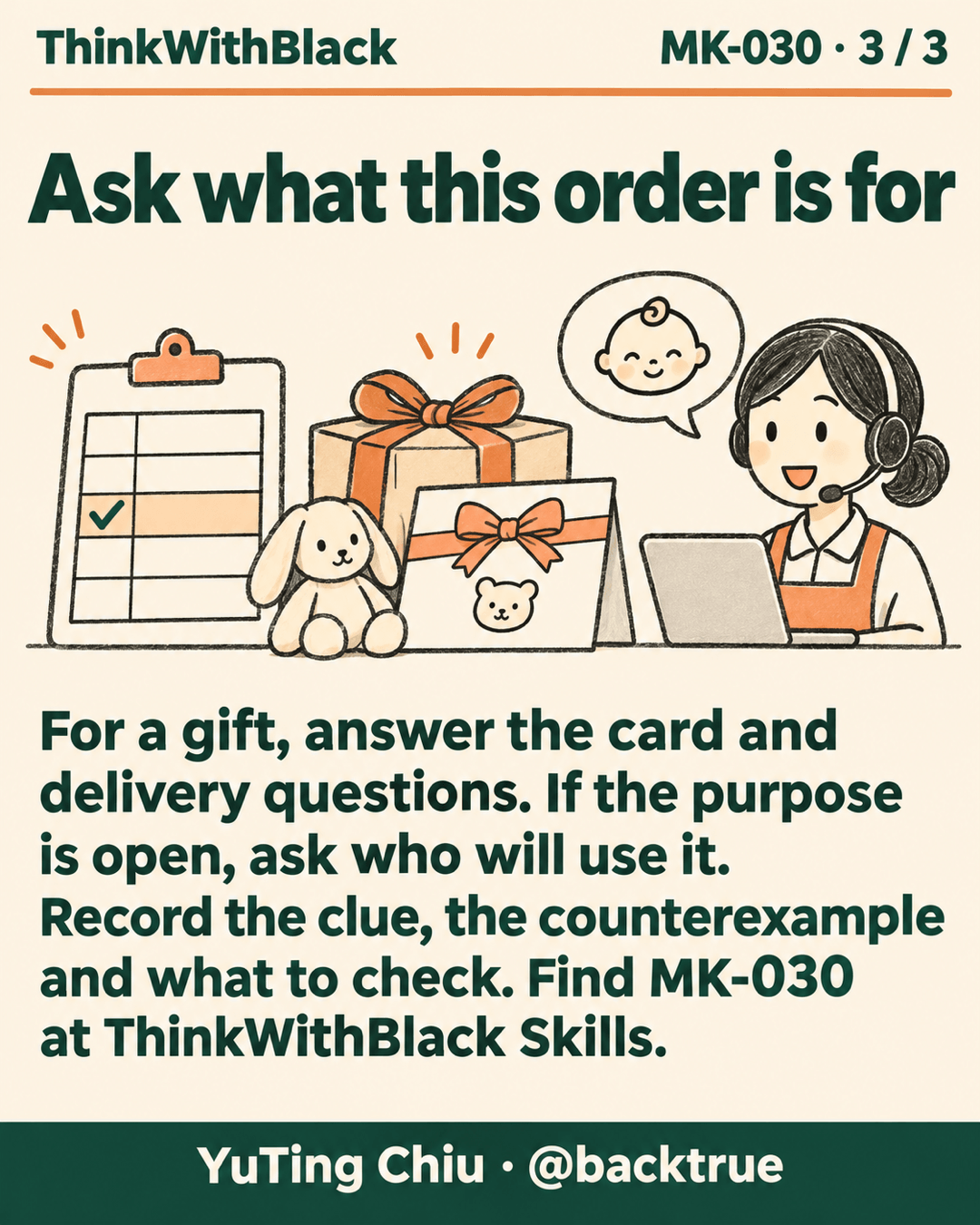
Before sending the campaign, take the confirmed gift order out of the household add-on list and have support answer the card and delivery questions. For someone whose order shows only the item, ask one short question about the purpose and let them choose. Store the answer with that order. If the same person buys again, the new order can have a different purpose.
Download the full MK-030 method from ThinkWithBlack Skills. Take a product you already use to group buyers, a few orders and a support note with personal details removed. Ask the AI to list the plausible reasons, the record supporting each one and a question that would distinguish them. Use the resulting table to decide who should get your next email and what they need to see.
Walk through the example in three cards
This Skill on social media
Choose a platform to view the infographic and post