A team selling dehumidifiers asks AI to describe the people who are likely to buy one. The draft says everyone enquiring about this model is a new parent and plans to put it in a nursery. The designer starts looking for nursery photos, and the marketing team plans to rework the product page around that room. Then someone asks support whether the unit can shut off on a timer while they dry laundry in their rental.
The team has to decide which claims to spend money on. If the page leads with several paragraphs about nurseries, someone drying laundry may still have to dig through the manual or contact support to find out how the timer works. That one persona can shape the ad, the product page and the answers the support team gives.
Check each sentence against a source
I put together MK-028, Persona evidence review, from the dehumidifier example in my Google Ads course materials. The example follows what happens from the moment someone notices a problem through what they search for, the answer they find and what they decide to do. I use that sequence to ask what the team actually knows: Where does the problem come up? What did the person search for? Do we have the page or instructions they would need next?
I would check “they’re new parents,” “everyone plans to use it in a nursery” and “someone needs a shutoff timer” separately. A support note tells me what one person asked. Search terms show what people typed. The product manual tells me what the machine can do. If I want to make a claim about a buyer’s family role, I need evidence about that role.
One support note can lead to three different decisions
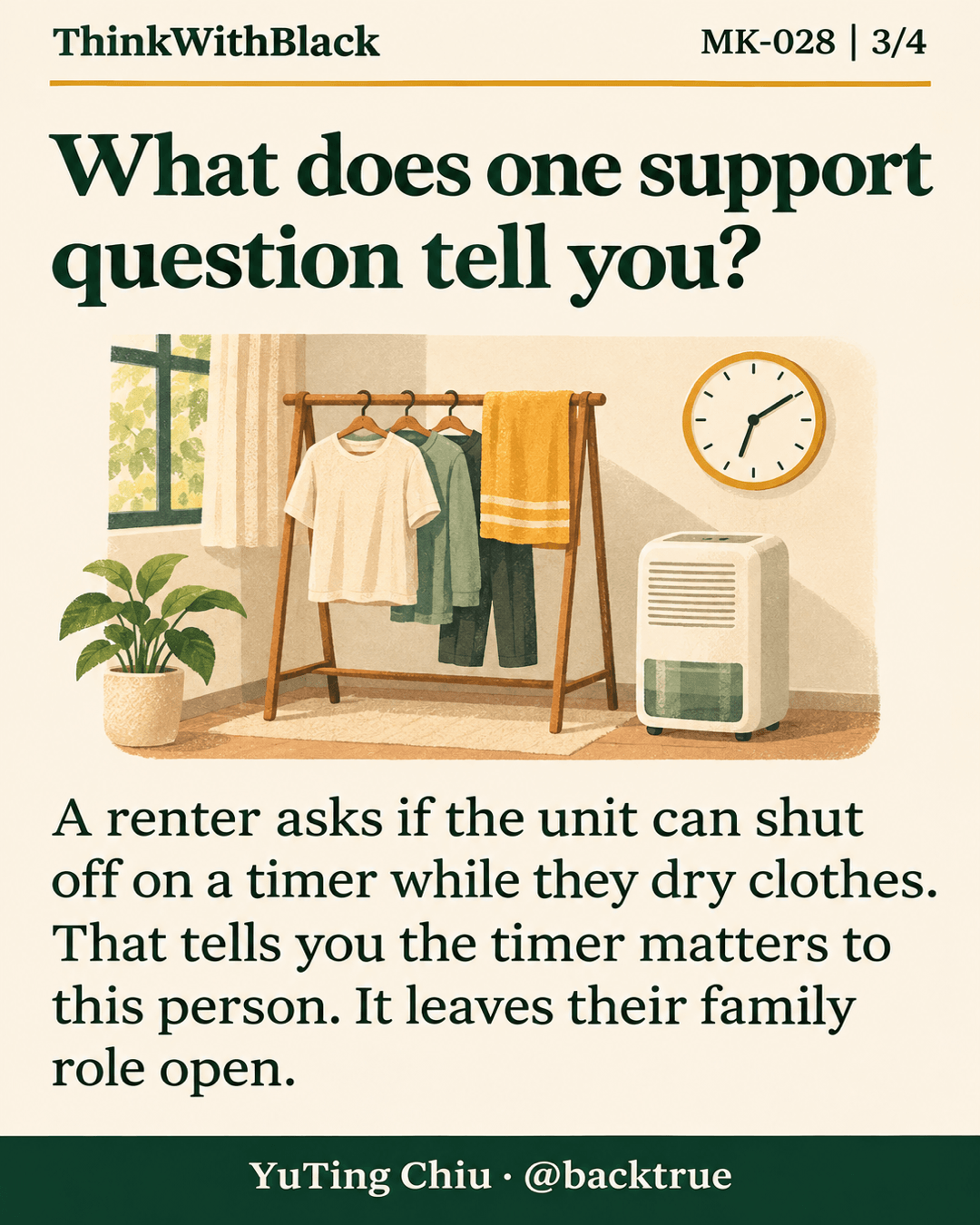
For example, suppose support note A reads: “It’ll go in the laundry area of my rental, outside the bedrooms. Can I set it to switch off on a timer?” The timer section of manual B says this model can switch itself off after a set time. Here is how I would record the evidence.
| MK-028 field | The person cares about the timer | Every enquiry is about nursery use | The person is a new parent |
|---|---|---|---|
| Original persona or need hypothesis | They want the unit to turn itself off on a timer while they dry clothes | Everyone plans to put the unit in a nursery | This person is a new parent |
| Source and location | The timer question in support note A; the timer section of manual B | Support note A says the unit will go in the laundry area, outside the bedrooms | Support note A gives no family role |
| Supported, contradicted or unknown | Supported for this person | Contradicted as a claim about everyone | Unknown |
| What the product can address | This model can switch off on a timer | The team can explain confirmed features for the use described | The product can address the timer question |
| What it cannot address | The manual gives no evidence of how long clothes take to dry | The sources do not establish suitability for a nursery | A product feature does not tell us a buyer’s family role |
| Keep, revise or remove | Keep the timer question and explain how the feature works | Remove “everyone.” Keep nursery use as a question to check | Take the family role out of the live copy and keep it open in the working notes |
| Next evidence needed | Check other anonymised enquiries for the same question | Ask where and how buyers plan to use the unit | If the role matters, look for buyers who volunteer whom they are buying for |
One person who plans to put the unit outside the bedrooms is enough to drop “everyone.” If later notes include people specifically asking about nurseries, keep both situations in the table. Find out what each group asks and which questions you can already answer from product evidence.
Use the table to decide what to write this week
The team can add a short answer about the shutoff timer to the product page now. Name the model, explain how to set it and link to the manual. Support can reuse that answer. Before building a nursery campaign, look for enquiries and search terms that describe that use. If the AI suggests sending people to a laundry guide, check that the page exists. Record the missing step and decide whether to write the guide or point people to a section of the existing manual that answers their question.
Get the English MK-028 method from ThinkWithBlack Skills. Take one sentence you plan to use in an ad or on a product page. Put an anonymised customer question and the relevant product specification next to it. Fill in one row so the team can see what it can publish now and what evidence it needs next.
The method in four cards
This Skill on social media
Choose a platform to view the infographic and post