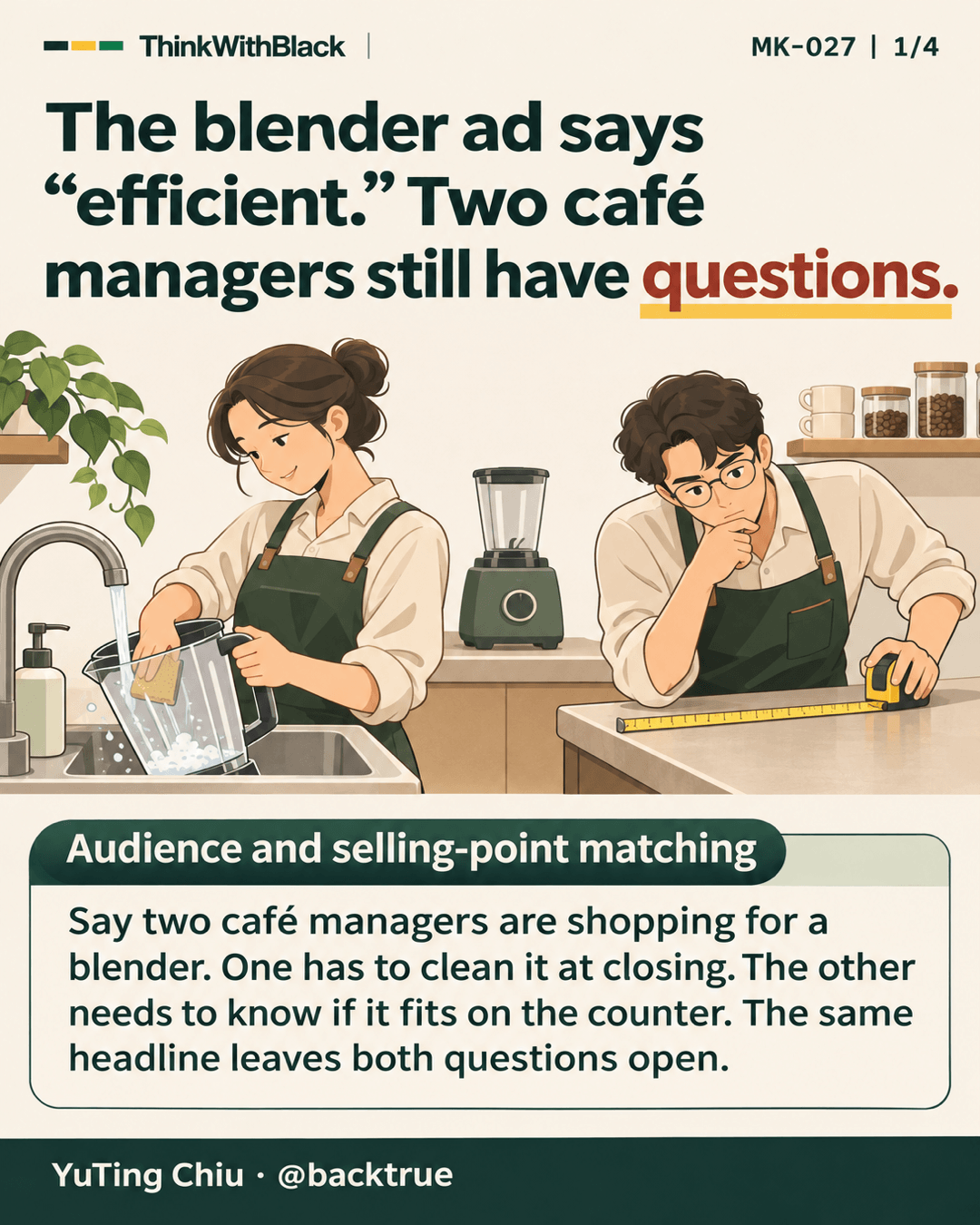
Say an equipment supplier is making two ads for the same blender. The support team has heard from two café managers. One cleans the blender at closing and wants to see how the pitcher comes off. The other has a narrow counter and needs to check whether the machine fits. The design brief gives them the same headline about efficiency.
Customers still have to contact support before they can make a choice. One needs to see the washing steps. The other needs a drawing and a tape measure. The supplier already has a cleaning video and a dimension drawing. What matters is which one each customer sees first.
Start with the decision the customer is trying to make
This is the job of MK-027, Audience and selling-point matching. I developed it from the Persona section of my marketing strategy course materials. Start with what customers actually asked, what helped them choose, why they walked away, and how they use the product. Then look for a verified product claim that addresses the concern holding up the choice.
For example, the drawing shows that the base is 19 cm wide, while a support note shows that one manager is checking counter space. Together, those records give you a reason to show that person the drawing first. They still need to measure the depth, height and working clearance. In the same way, a video can show how the pitcher comes off for washing. A claim about minutes saved would need a timed test.
Make a matching table for the two enquiries
| MK-027 field | Cleaning at closing | A narrow counter |
|---|---|---|
| Context and task evidence | The manager asked how to remove the pitcher for washing after closing | The manager asked whether the machine would fit in the work area |
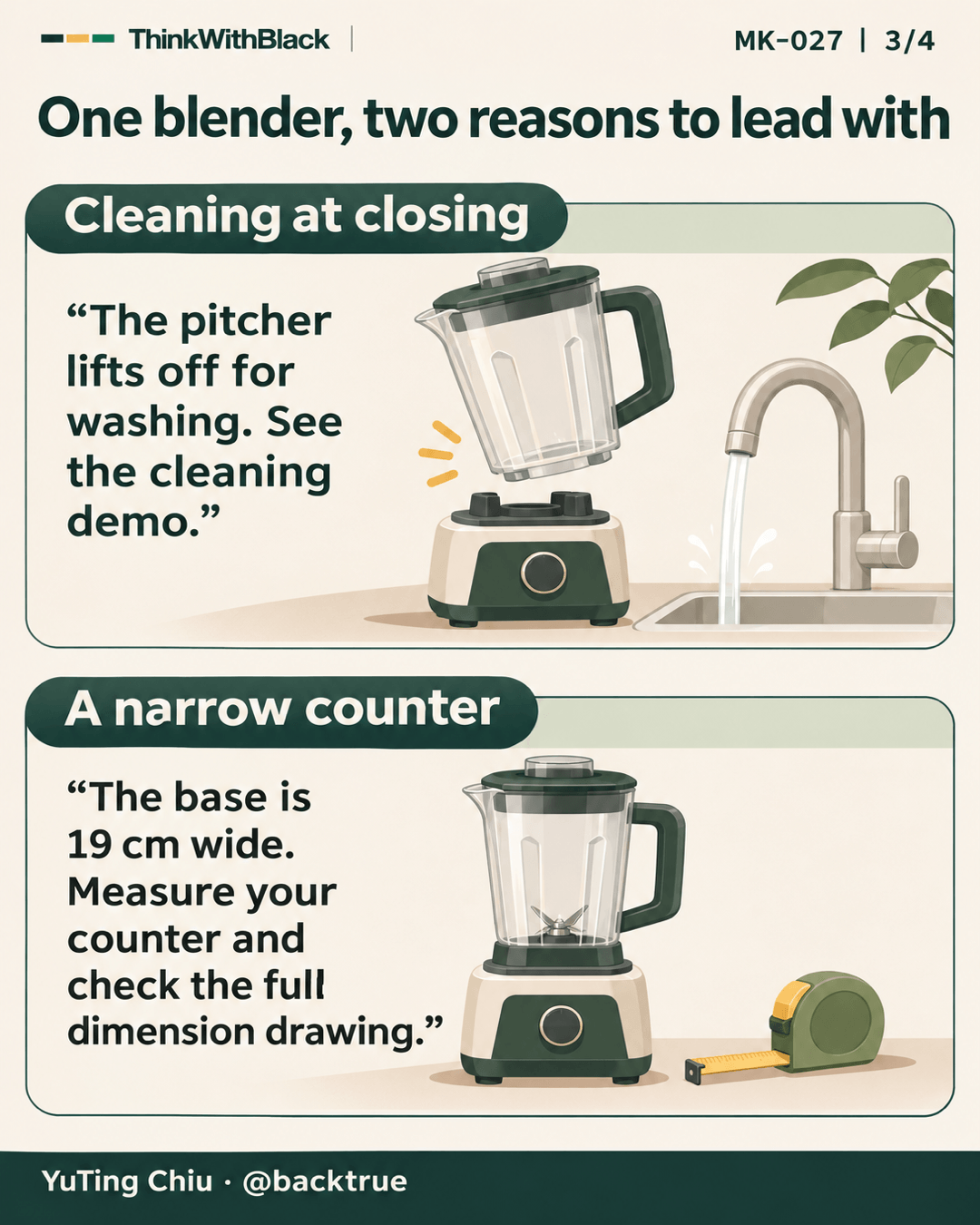
| Possible selling point | The pitcher lifts off for washing | The base is 19 cm wide, with a full dimension drawing |
| Use in this situation | The manager can see the steps and decide whether they fit the closing routine | The manager can measure the work area against the full dimensions |
| Proof source | Cleaning video for this model | Dimension drawing and installation instructions for this model |
| Priority and reason | Lead with the demo because cleaning is holding up the decision. Keep dimensions in the specifications | Lead with dimensions because the manager needs to check fit. Keep cleaning details farther down |
| Actual message | The pitcher lifts off for washing. See the cleaning demo. | The base is 19 cm wide. Measure your counter and check the full dimension drawing. |
| When to change it and what is unknown | If the buyer turns out to be comparing prep volume, check capacity evidence before replacing the cleaning message | Once the buyer confirms the fit, lead with the cleaning demo if washing is their next concern |
The table gives design, sales and support a reason to put one claim first. Use the washing demonstration when the customer is working out the closing routine. Show the drawing first when they are checking the counter. The same manager may need both messages at different points. A bakery and a café may also use the same drawing if they are trying to fit the blender into a narrow work area.
If the measurements show the equipment will not fit, offer a different model or discuss a different placement. Keep necessary features in the specifications when competing models have them too. If the team cannot tell which concern is holding things up, bring back one customer question or one recorded reason for a lost sale and update the relevant row.
Try one row with your own records
Get the English MK-027 method from ThinkWithBlack Skills. Give your AI assistant one enquiry or lost-sale note with personal details removed, plus the specifications, demo or test record for that product model. Ask it to fill the seven fields, write a message supported by the evidence, and tell you what would make the team change it.
This Skill on social media
Choose a platform to view the infographic and post