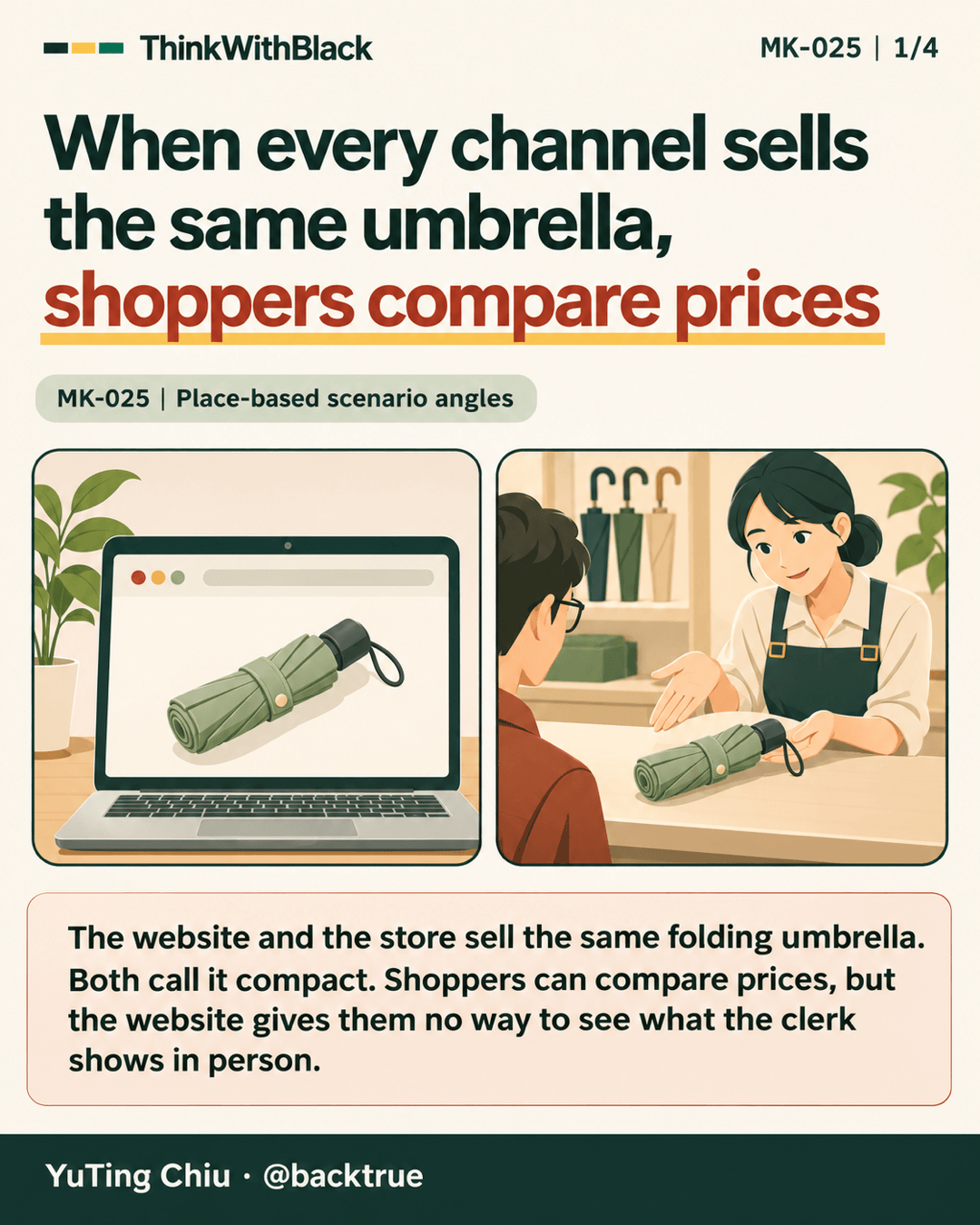
Say you sell a folding umbrella. Your website calls it compact. So does the sign at your store counter. A shopper tries the umbrella in their bag at the counter, then pulls out their phone and sees the same item at two prices. The product page gives them no way to see what the clerk just showed them. If your team jumps straight to cutting prices, it may miss a better question: What did the shopper come to each channel to find out?
I use MK-025, Place-based scenario angles, to sort clues by where the customer encounters the product. The method comes from the section on Place in my course materials on product-line planning, which uses T.P.O.: Time, Place, and Occasion. Think of your website, a marketplace, and a store counter as different places. They may draw shoppers with different questions and give them different ways to try the product. The cost of selling through each channel can differ too.
Start with what people actually asked or did
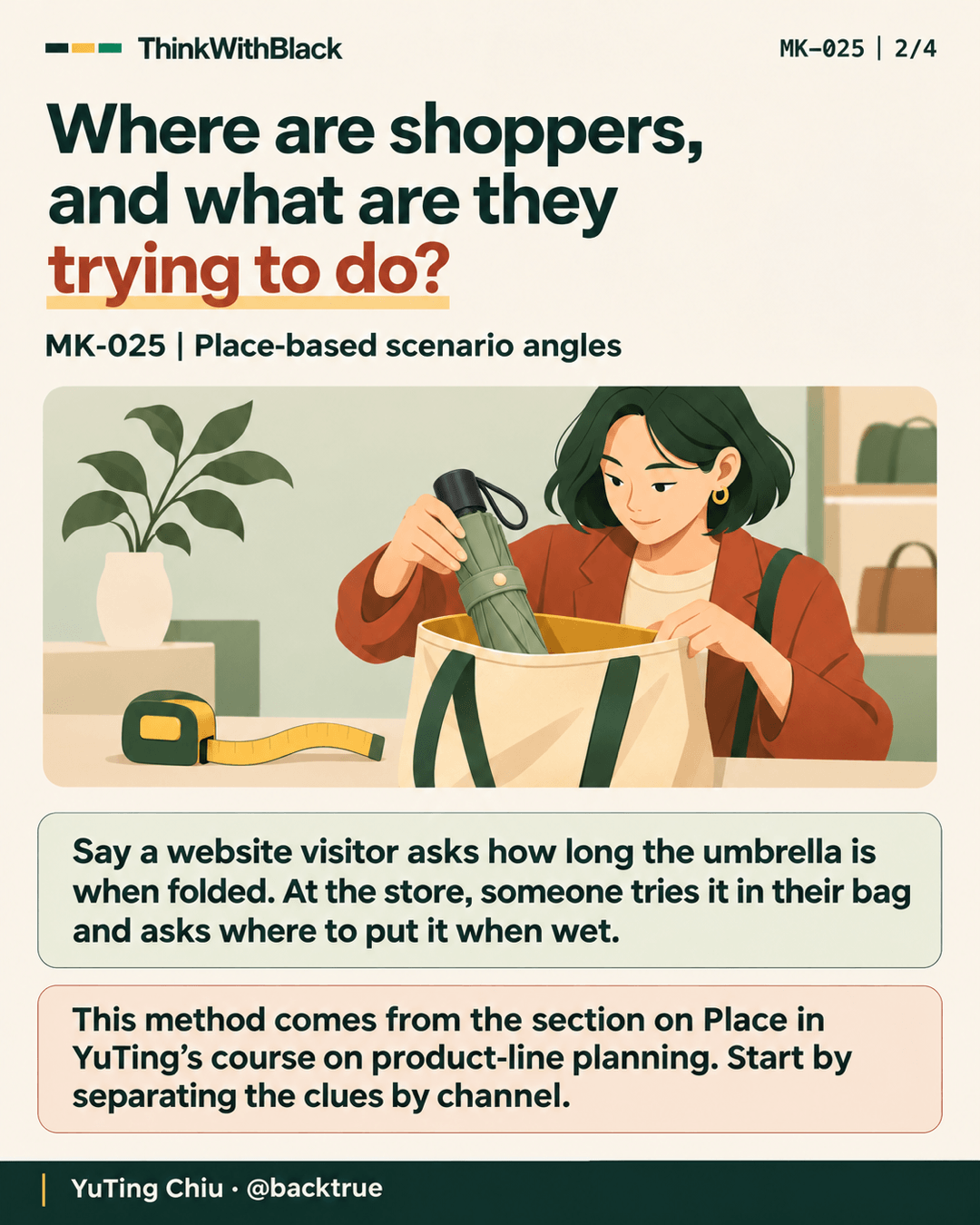
Pull the product facts and customer records for each channel. Suppose website visitors ask how long the umbrella is when folded. Write down the question. At the counter, someone brings their own bag, tries the umbrella in it, and asks where to put it after walking in the rain. Record both the action and the question. One possibility is that shoppers want to check fit. Another is that they want to try putting a wet umbrella away.
The same person could check dimensions online and then try the umbrella in store. They could also be buying it for someone else. Keep the buyer and the person who will use it separate. If the record doesn't say, leave the role open. If someone online asks about a sleeve, keep that clue too. You can ask whether shoppers buy for themselves and whether they need help checking size or carrying a wet umbrella.
Put the two possibilities in a record your team can use
The eight fields below give the team two starting points for the same product. If new evidence changes one of the ideas, update the relevant row. If the two groups turn out to have the same needs, you can combine them.
| Field | Website: checking fit | Store counter: trying wet storage |
|---|---|---|
| Hypothesized group | People looking for folded dimensions on the page | People who want to try fit and storage in person |
| Buying/using role | We know a visitor asked; who will use it is unknown | We know someone tried it; who will buy is unknown |
| Trigger situation | Couldn't find the folded length on the page | Brought their own bag to the counter and tried it |
| Tasks and concerns | Check whether the folded umbrella will fit | Check fit and find a place for the wet umbrella |
| Supporting clues | A folded-length question in website support | The clerk noted a fit check and a question about storing it wet |
| Counterexamples | Some website shoppers also ask about a sleeve | Some shoppers at the counter only ask about length |
| Items to validate | After seeing the dimensions, do they still need a sleeve? | After trying it, do they pick the bundle or just the umbrella? |
| Suitable message | Show the measured folded length and how you measured it | Try it in your own bag and see how the sleeve works |
Try an offer in one place and watch what people choose
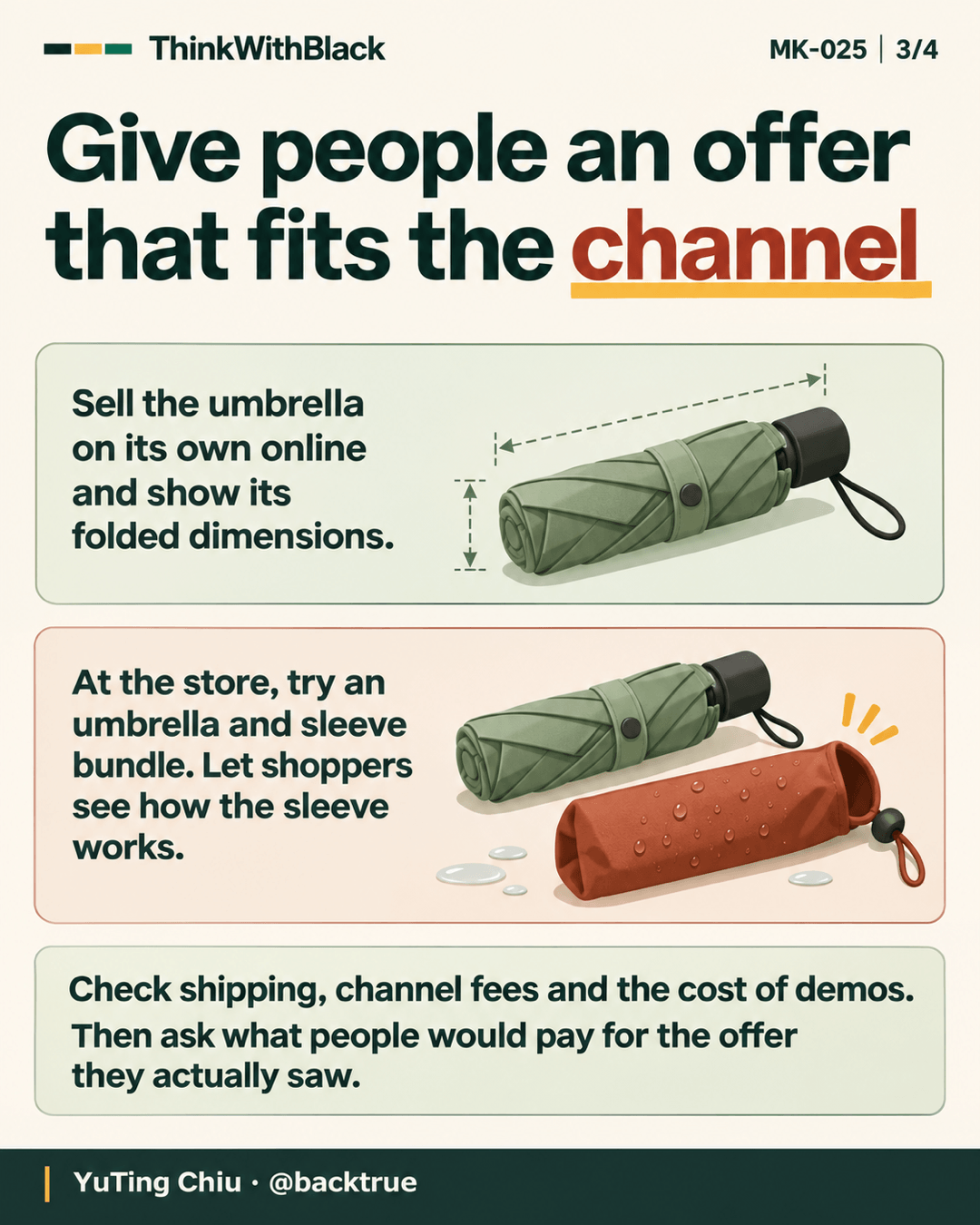
Start with the umbrella on its own online. Show the folded length so shoppers can compare it with their own bags. At the counter, try offering the same umbrella with a sleeve alongside the standalone item. Let people see and try the sleeve before they choose. If website shoppers keep asking about the sleeve too, you can test the bundle online.
Check costs and willingness to pay by channel. Look at shipping and fees online. At the counter, account for the sleeve, any commission, and staff time for demonstrations. When asking what shoppers would pay, record whether they saw the umbrella on its own or in a bundle, along with the delivery and trial conditions. The two proposals give the team something specific to test. The answers and choices they collect will tell them more about the price and which offer these shoppers prefer.
Try it with one of your products
Download MK-025 from ThinkWithBlack Skills. Give your AI assistant one product's specifications and customer-service or survey notes from two channels, with personal details removed. Ask it to fill the eight fields, keep clues that appear in both places, and help you pick one offer to test. Bring the actual choices back to the record when you revise the product page or the store demo.
This Skill on social media
Choose a platform to view the infographic and post