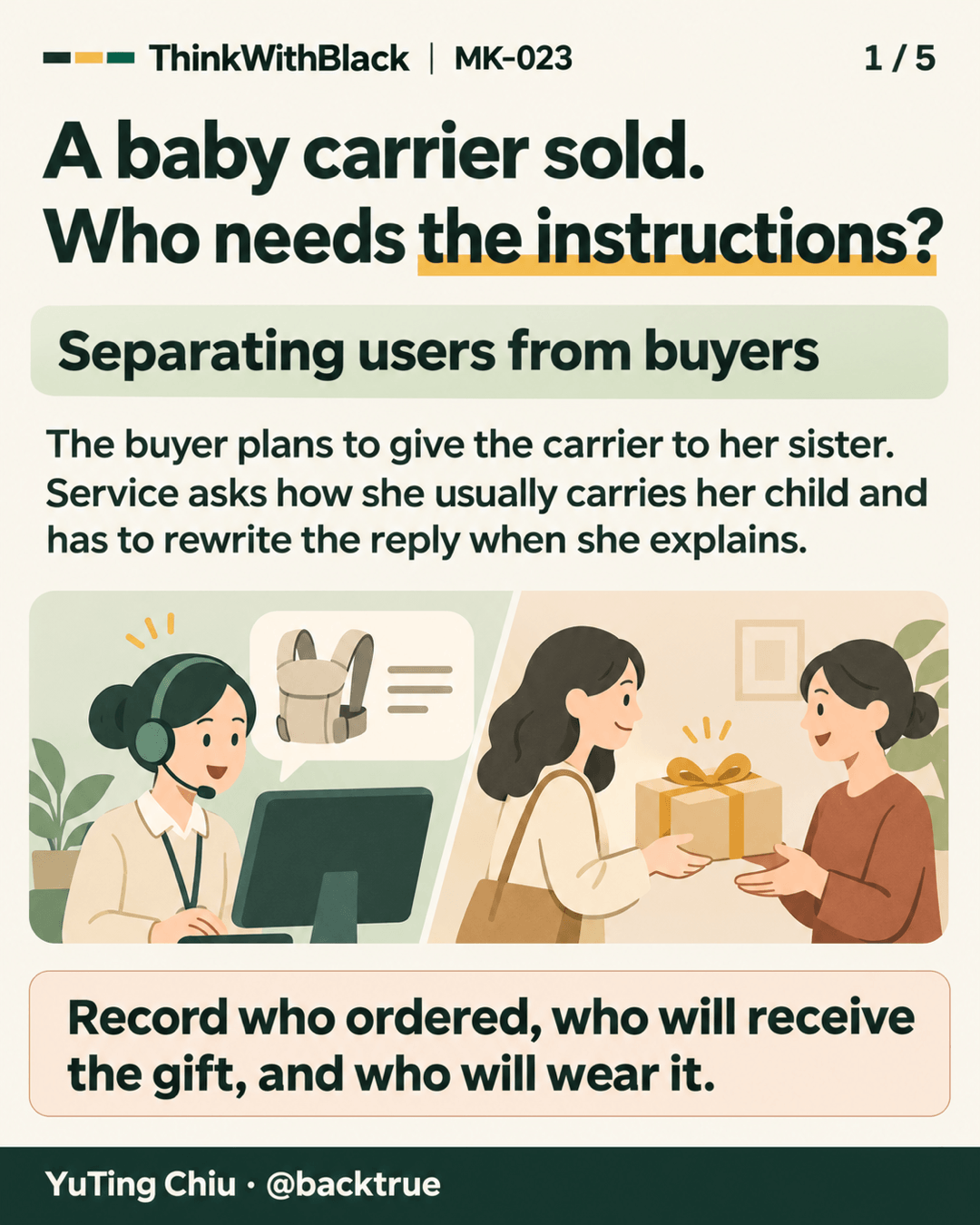
Suppose a customer orders a baby carrier. The service rep addresses her as “Mom” and asks how she usually carries her child. The customer explains that it is a birthday gift for her sister. She wants to know whether the instructions come in the box and where her sister can find the guide for that model
The rep has the order and product details, but has to start the reply over. The buyer's question is about passing the gift along with the instructions. The person who will wear the carrier may only become clear later. If the team tags this order as “mother buying for herself,” the next email can pick up the same mistaken assumption
Record what happened in the order, then find out who will use it
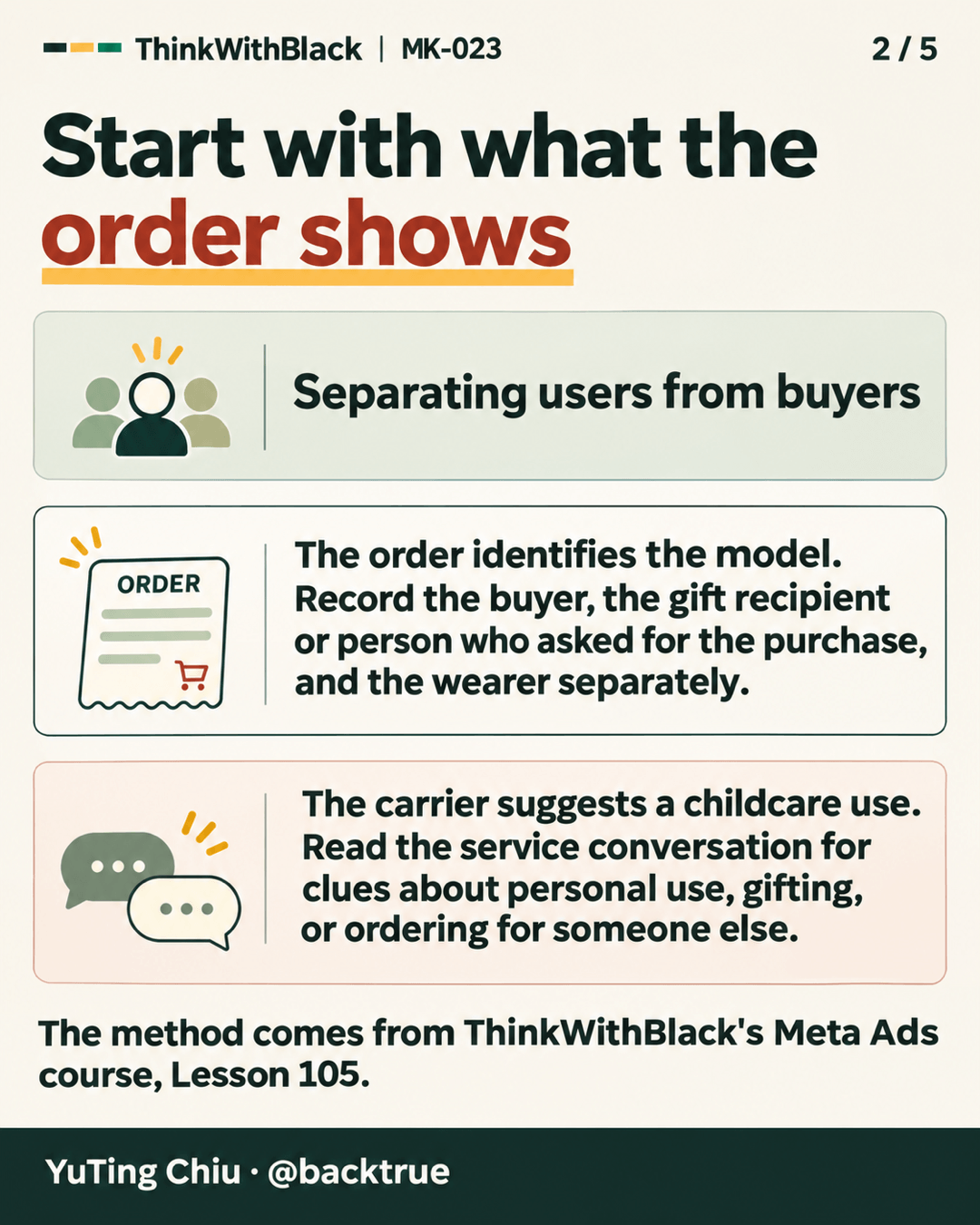
MK-023, “Separating users from buyers,” draws on the section about purchase behaviour and roles in the ThinkWithBlack Meta Ads course, Lesson 105. The product tells you what this purchase might be for. To get the right information to the right person, separate who paid, who will pass the product along, and who will use it. Original course material
Start with what you can see. The order shows the model the buyer purchased. The product details tell you what the carrier is for. The service conversation may tell you who plans to wear it, whether it is a gift, or whether someone is checking out on another person's behalf. Keep each piece of evidence with the question it answers
A baby carrier has a clear function, so it gives you a strong clue that the purchase relates to caring for a child. The buyer could plan to wear it, give it to a caregiver, or order the model a relative requested. If the item is all you have, keep those roles as possibilities. Update the order record when a reply gives you a way to tell them apart
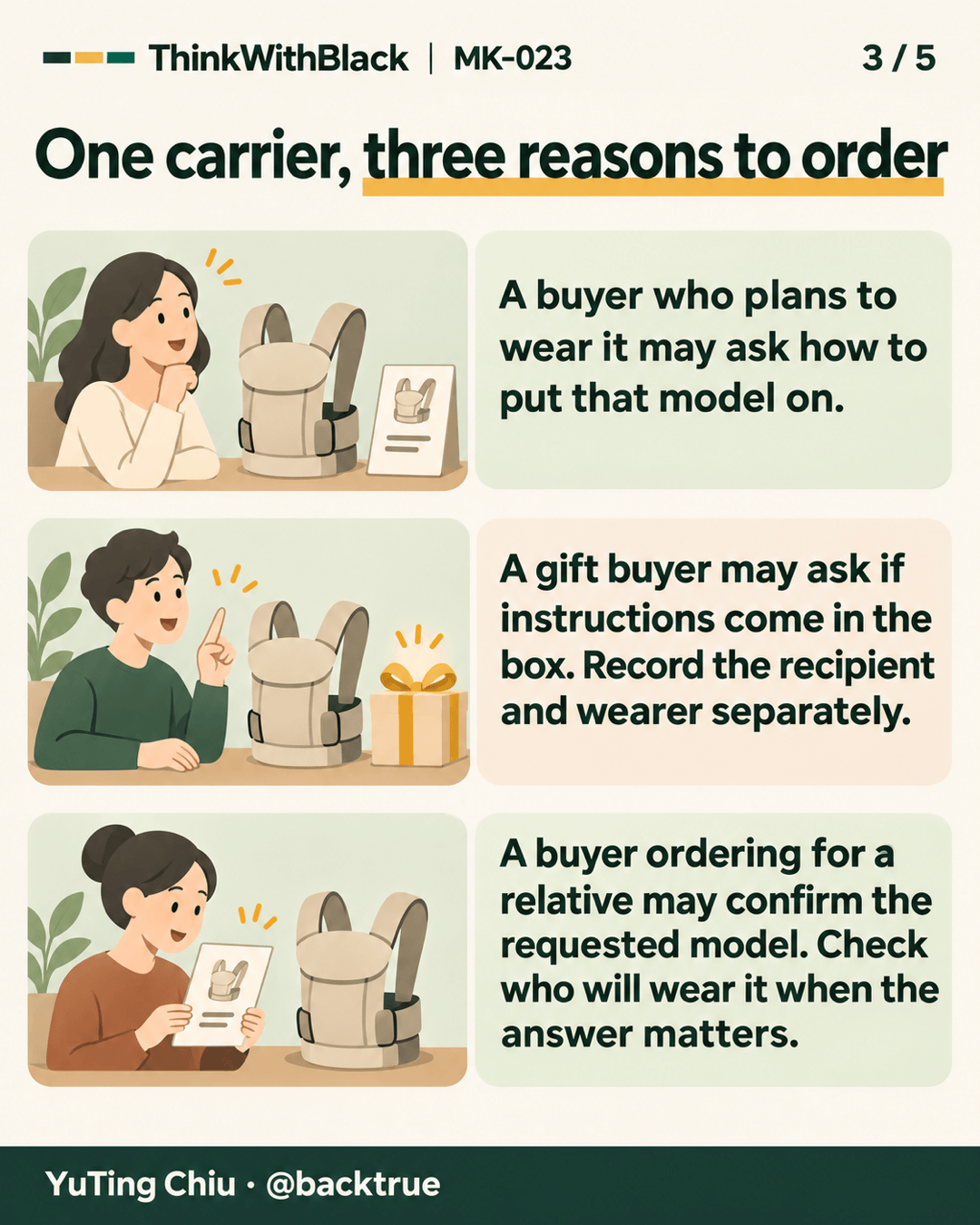
The same carrier can be bought for three reasons
Suppose one buyer says, “I'd like to see how to put this model on.” That supports personal use, and the rep can start with the instructions for that model. Another asks, “It's a gift for my sister. Does the box come with instructions?” That supports gifting and identifies the intended recipient. It leaves open who will actually wear the carrier
A third buyer says that a relative chose the model and asked them to place the order. Record that the buyer is ordering on someone else's behalf. The first reply can confirm the model and delivery details. If the buyer then asks how to use it, find out who should get the guide
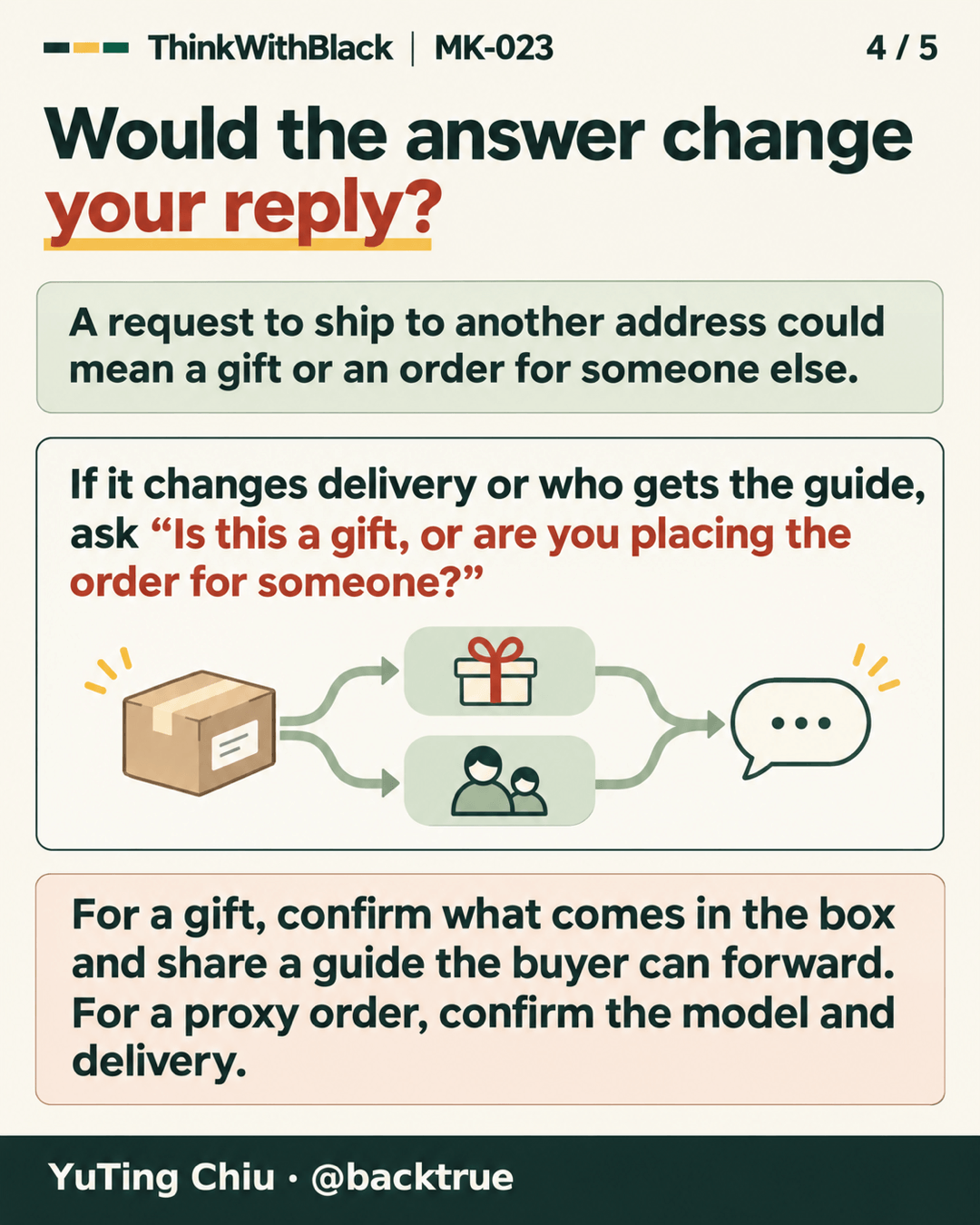
A request to ship to another address could fit either gifting or buying on someone else's behalf. Keep both possibilities. If the distinction changes the delivery, the instructions to include, or the reply, ask one question. “Is this a gift, or are you placing the order for someone?” The answer gives the rep a place to start
Put the evidence and the next reply in one record
The eight fields in MK-023 keep the roles, the evidence, and the next reply together. Here is how the gift and proxy purchases for the same carrier would look
| Field | Buying a gift | Ordering for a relative |
|---|---|---|
| Hypothesised group | Gift purchase, supported by the buyer's message | Proxy purchase, supported by the buyer's message |
| Buying and using roles | The buyer gives the gift. The sister is the intended recipient. The wearer is still unknown | The buyer places the order. A relative chose the model. The wearer is still unknown |
| Trigger situation | The buyer wants a birthday gift for her sister | A relative chose a model and asked the buyer to order it |
| Tasks and concerns | The buyer wants the recipient to be able to find the instructions | The buyer needs to order the requested model and get it to the relative |
| Supporting clues | The service conversation mentions a gift for the sister and asks about the instructions in the box | The service conversation mentions a model chosen by a relative and a request to place the order |
| Counterexamples | The recipient could give the carrier to another caregiver to wear | The buyer could also take turns wearing it |
| Items to verify | If the instructions need to be sent, confirm the delivery arrangement and who needs the guide | If it affects delivery or use instructions, confirm the arrangement and who will wear the carrier |
| Suitable message | Confirm what comes with the model and provide instructions the buyer can forward | Confirm the requested model and delivery details, then share the guide if needed |
Use the record in a service handover. A gift buyer needs an answer about the contents and what they can pass along. Someone ordering for a relative needs the model and delivery details checked. Once a buyer says they plan to wear it, the rep can answer that person's question about the product. If all you have is the item on the order, start with the model guide anyone can use and ask a follow-up when it affects the response
Keep the role attached to this purchase. Someone who buys a gift today may buy for themselves next time. A service message is enough to update the role and evidence for the relevant order. To estimate how many buyers fit each role, the team would need data that distinguishes the roles and a defined set of orders to count
Try it with one product and one service conversation
Choose a product whose function you know and a service record with personal details removed. Download MK-023 from ThinkWithBlack Skills and give the AI both items. Ask it to separate the buyer, the recipient or the person who requested the purchase, and the actual user. Keep the supporting clues and counterexamples with the eight fields. ThinkWithBlack Skills · Download MK-023
Then choose a decision you need to make, such as writing a reply, arranging delivery, or sending the instructions. See which answer would change what you do. The next person to pick up the order should be able to see where the role came from and what to say next
This Skill on social media
Choose a platform to view the infographic and post