Service notes often reduce an enquiry to “too expensive” or “only buys the cheaper version.” The next colleague reads the note, prepares another discount and sends it back
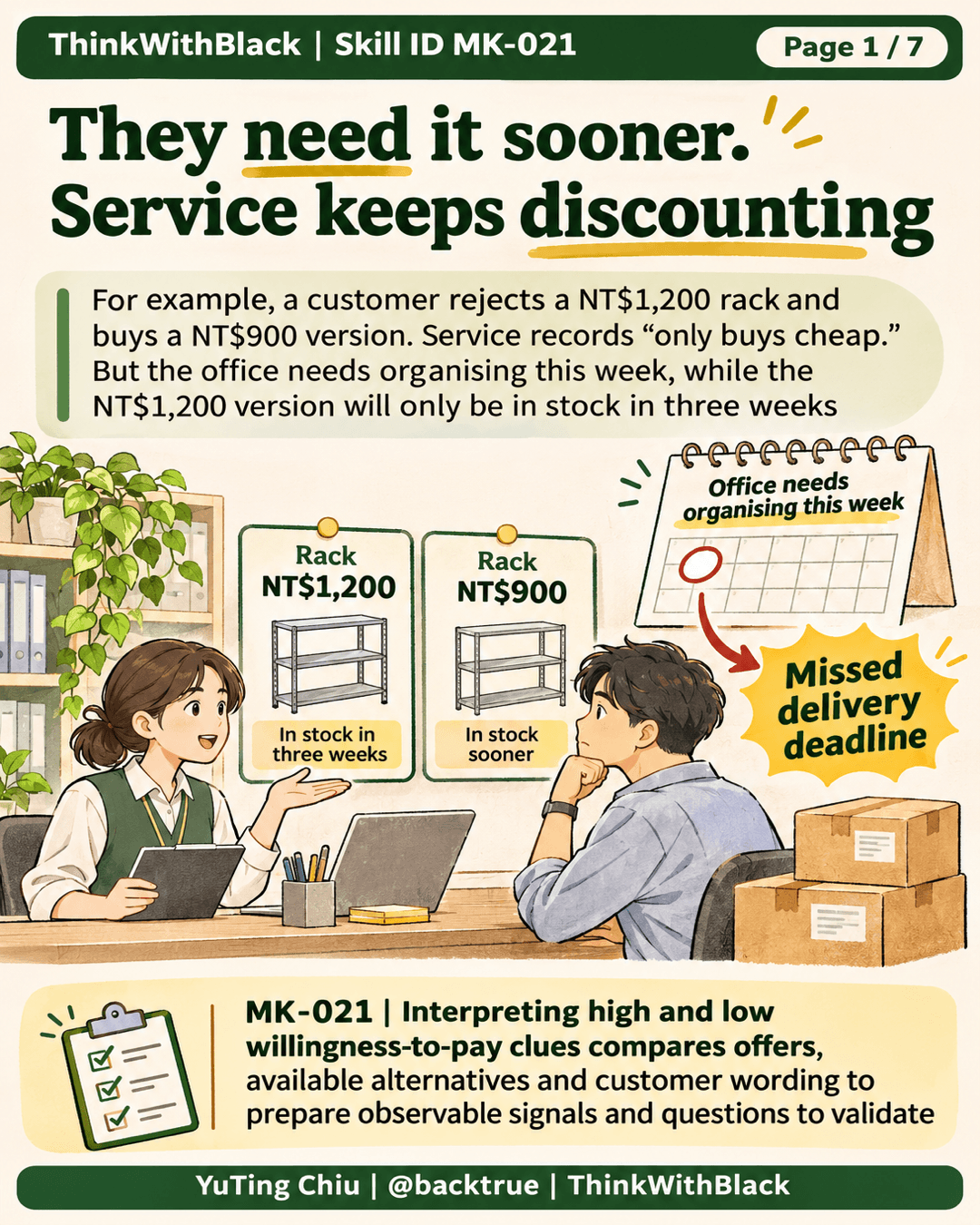
The customer may have rejected the offer for a different reason. They need it this week, while that version will only be in stock in three weeks. Or it will not fit the space they have. The conversation includes a price, but the record loses the condition that stopped the purchase
That mistake carries into the next reply and the next pricing discussion. The business gives away margin while the delivery or specification problem remains. The customer still cannot use the offer
I would put the actual offers and choices side by side before interpreting willingness to pay. What could the person buy at the time? What did they give up? MK-021, Interpreting high and low willingness-to-pay clues, turns those observations into signals and questions the next colleague can follow up
Complete the offer before interpreting the choice
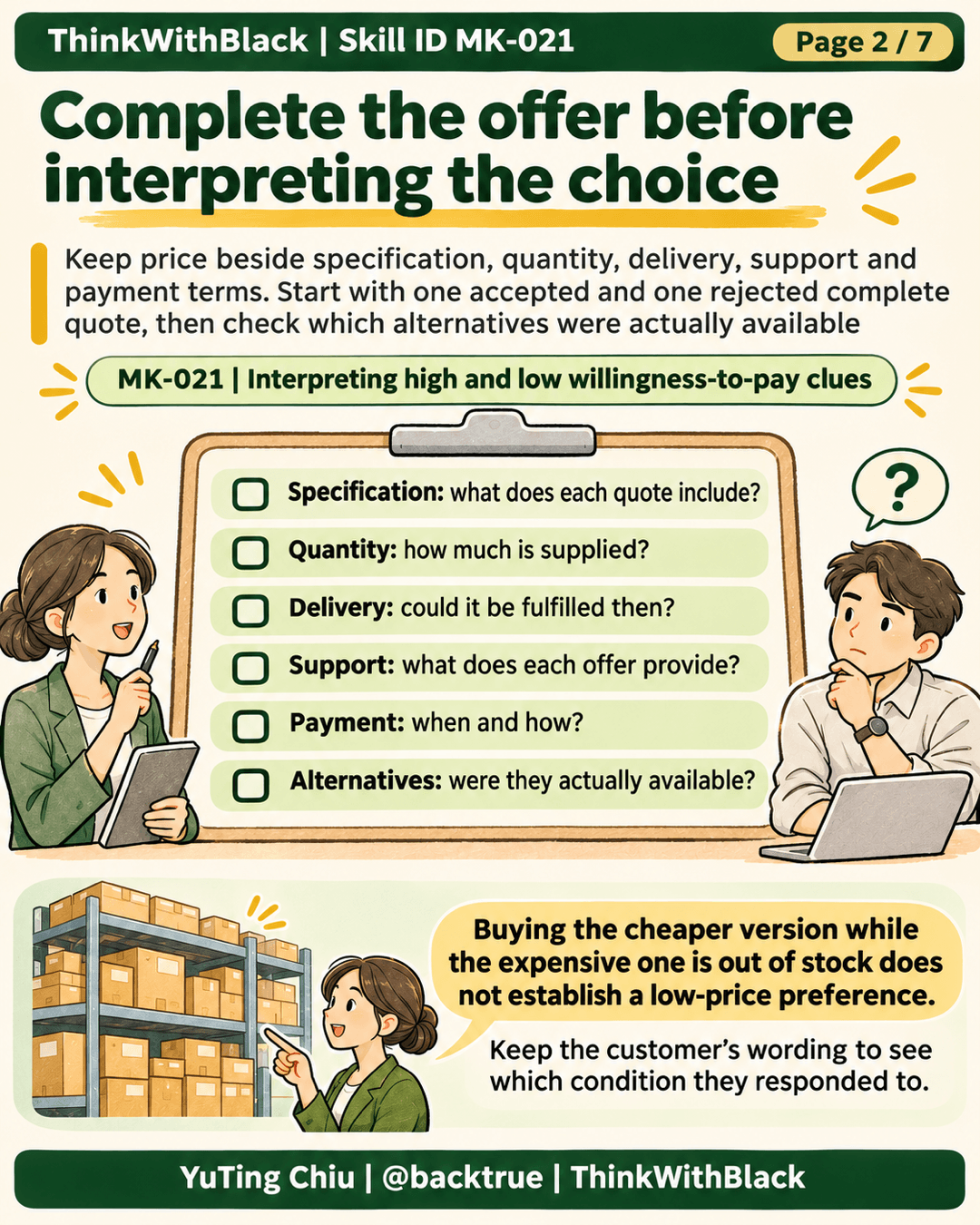
Willingness to pay concerns the value someone would pay for a benefit in a particular situation. The product, quantity, delivery date, support and payment terms belong beside the price
For example, two people may be shopping for storage racks. One needs to organise an office this week; the other will move next month. A three-week wait can mean different things in those situations. Calling each person a permanent high-price or low-price customer loses the purpose of this purchase
Start with one accepted and one rejected offer. Record the product and specification, quantity, delivery, support, payment terms and alternatives that were actually available. Keep the customer’s own wording so the team can see which condition they were responding to
Availability matters. If someone buys a cheaper version while the more expensive option is out of stock, that transaction alone does not establish a preference for the lower price
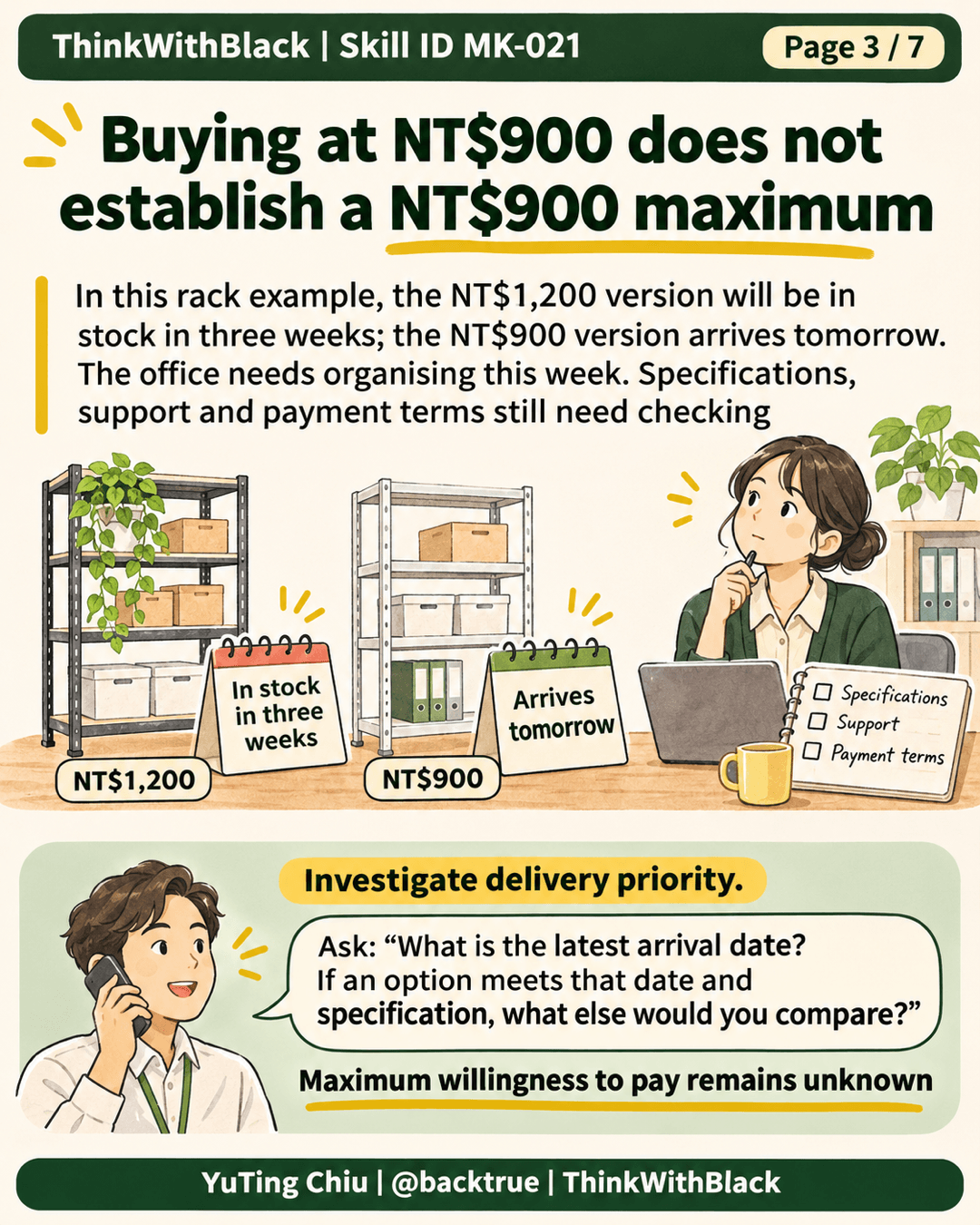
Rejecting NT$1,200 and buying NT$900 does not establish a maximum
Consider a storage-rack enquiry. The first record says the person rejected a NT$1,200 version and bought a NT$900 version. A service note could easily become “maximum budget: NT$900”
Further checking shows that the NT$1,200 version will only be in stock in three weeks, while the NT$900 version arrives tomorrow. The customer needs to organise the office this week. Delivery is now part of the observed trade-off. The two versions’ specifications, support and payment terms still need checking; the NT$300 difference cannot all be attributed to price
| Record | Conditions visible so far | Interpretation to retain |
|---|---|---|
| Rejected the NT$1,200 version | In stock in three weeks; other specifications and terms need checking | Retain the rejection and delivery condition without classifying it as low willingness to pay |
| Bought the NT$900 version | Arrives tomorrow; office needs organising this week | Investigate delivery priority for this purchase; maximum willingness to pay remains unknown |
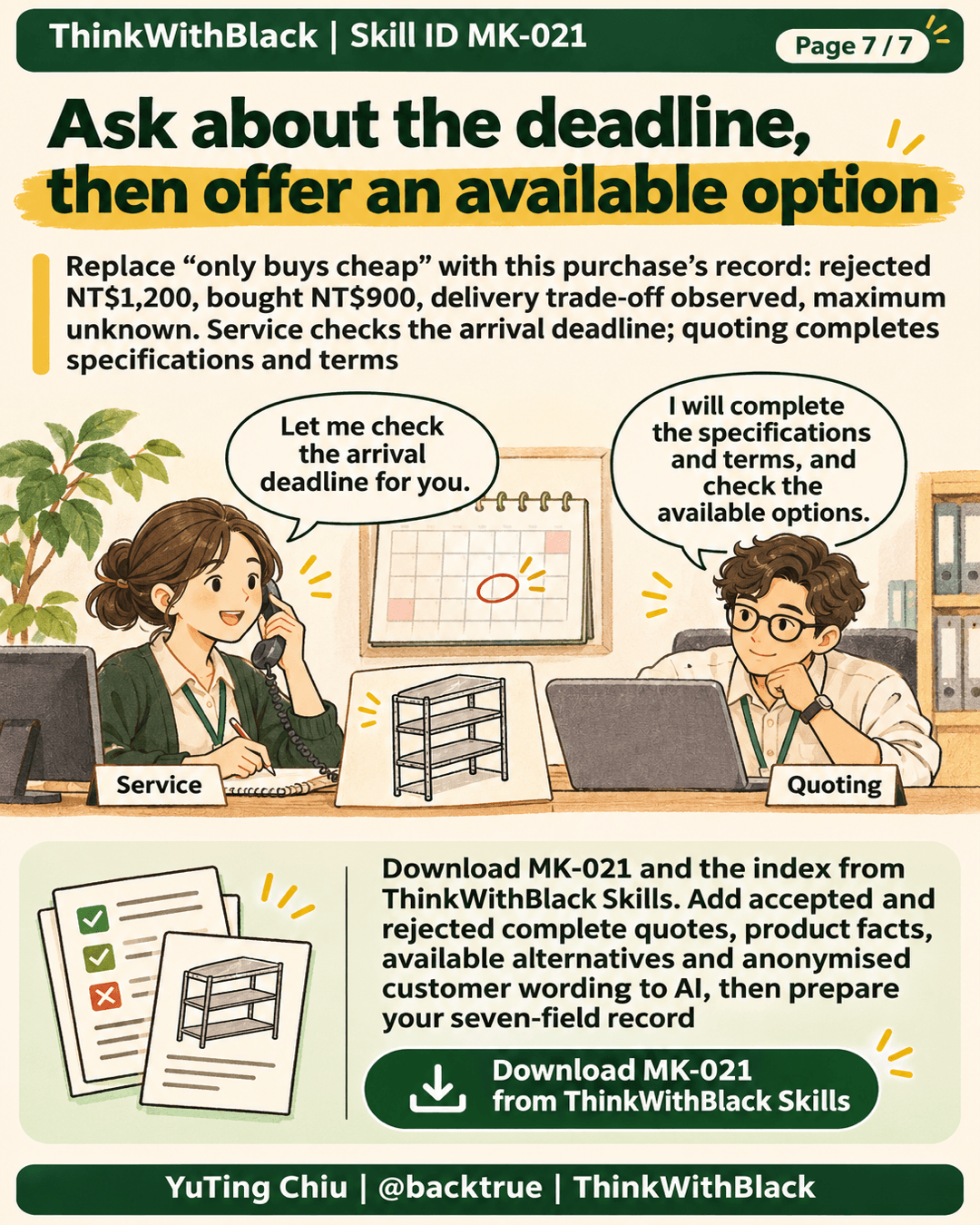
Service can ask: “What is the latest date you need it to arrive? If an option meets that date and the required specification, what else would you compare?” Establish what the person can use, then discuss offers the business can fulfil
The current clue is that delivery matters for this purchase. A later record showing that the same person rejected a higher price under the same specification and delivery terms would add evidence about price. Keep the reason for revising the judgment with the new record
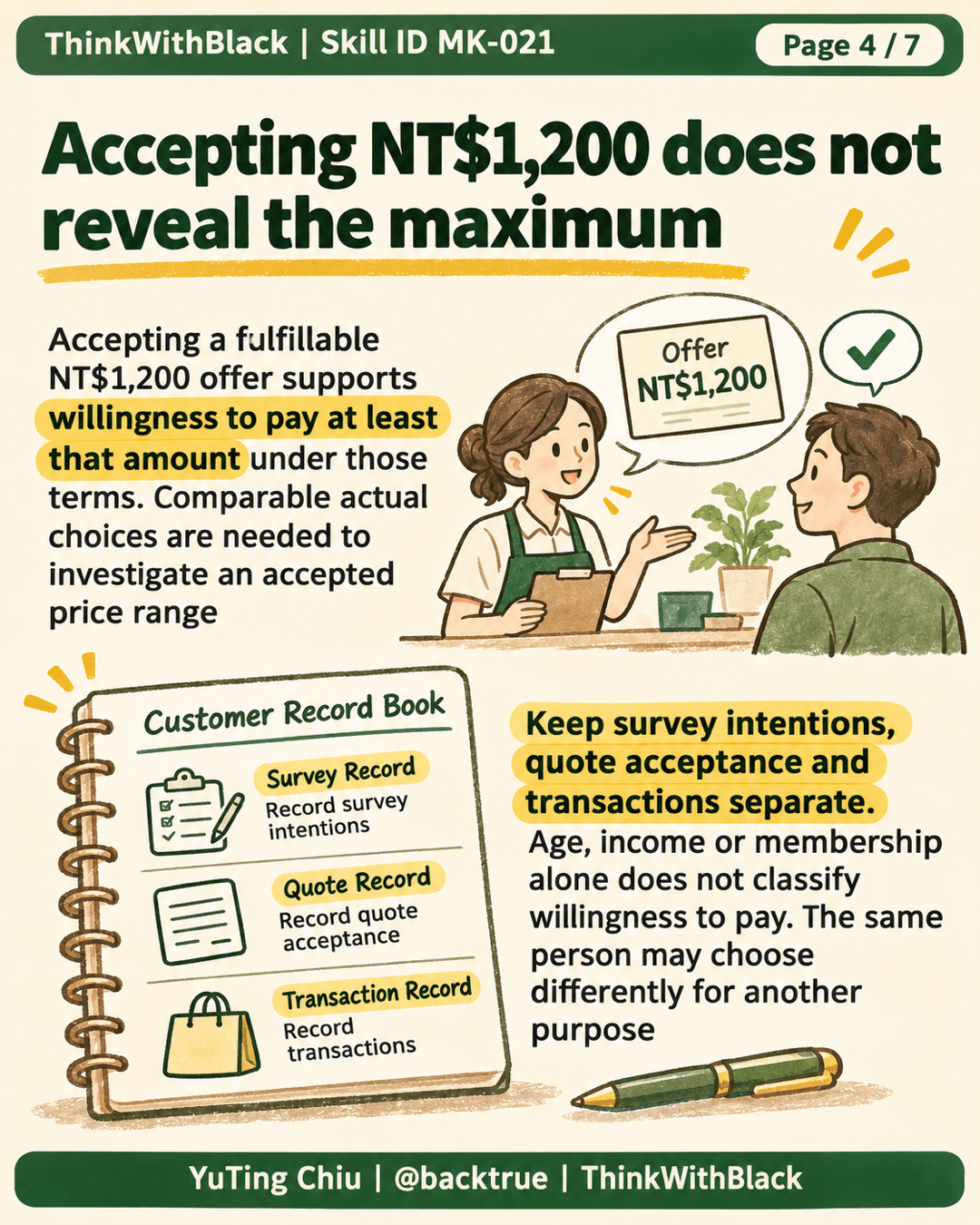
An accepted price is not the highest price the customer would pay
A customer accepting a fulfillable NT$1,200 quote supports a narrower conclusion: in that situation, under those terms, they were willing to pay at least NT$1,200. It does not establish their exact maximum
Comparable choices can provide clues about an accepted price range. A survey response, acceptance of a quote and a completed transaction are different records. Label them separately so later discussions can trace the conclusion to the evidence
Age, income and membership can suggest a value hypothesis worth checking. None of them alone classifies a person as having high or low willingness to pay. Return to the current purchase, its purpose and the available alternatives to find the next useful question
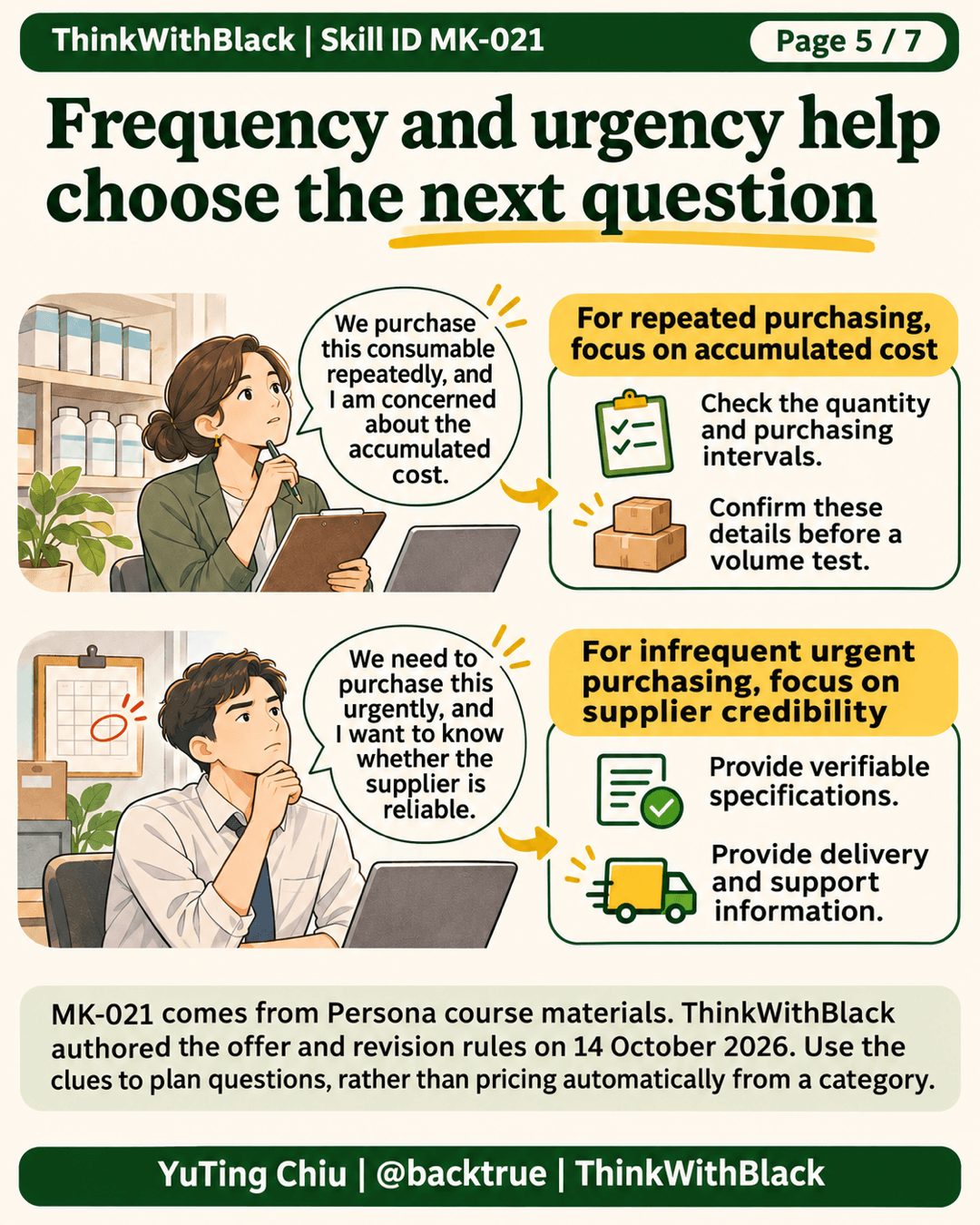
Use frequency and urgency to choose the next question
After clarifying the purpose, consider purchase frequency and strength of need. They help the team prepare questions and possible actions
A frequent buyer of consumables might explicitly raise monthly spending. Check quantities, purchasing intervals and accumulated cost before preparing a quantity or recurring-volume test. Keep price, delivery and use conditions together when interpreting the trade-off
An infrequent buyer may urgently need a product and repeatedly ask whether the supplier and delivery promise are reliable. Answer those questions with specifications, fulfilment conditions and support information the team can verify. Raising the price because the buyer falls into a high-need, low-frequency category leaves the credibility question unanswered
The method comes from the Persona section of the course “Niches form the mass market × precise Personas × digital assets.” ThinkWithBlack authored the offer-comparison and judgment-revision rules on 14 October 2026. Bringing willingness to pay back to the situation makes the clues useful in service and quotation work
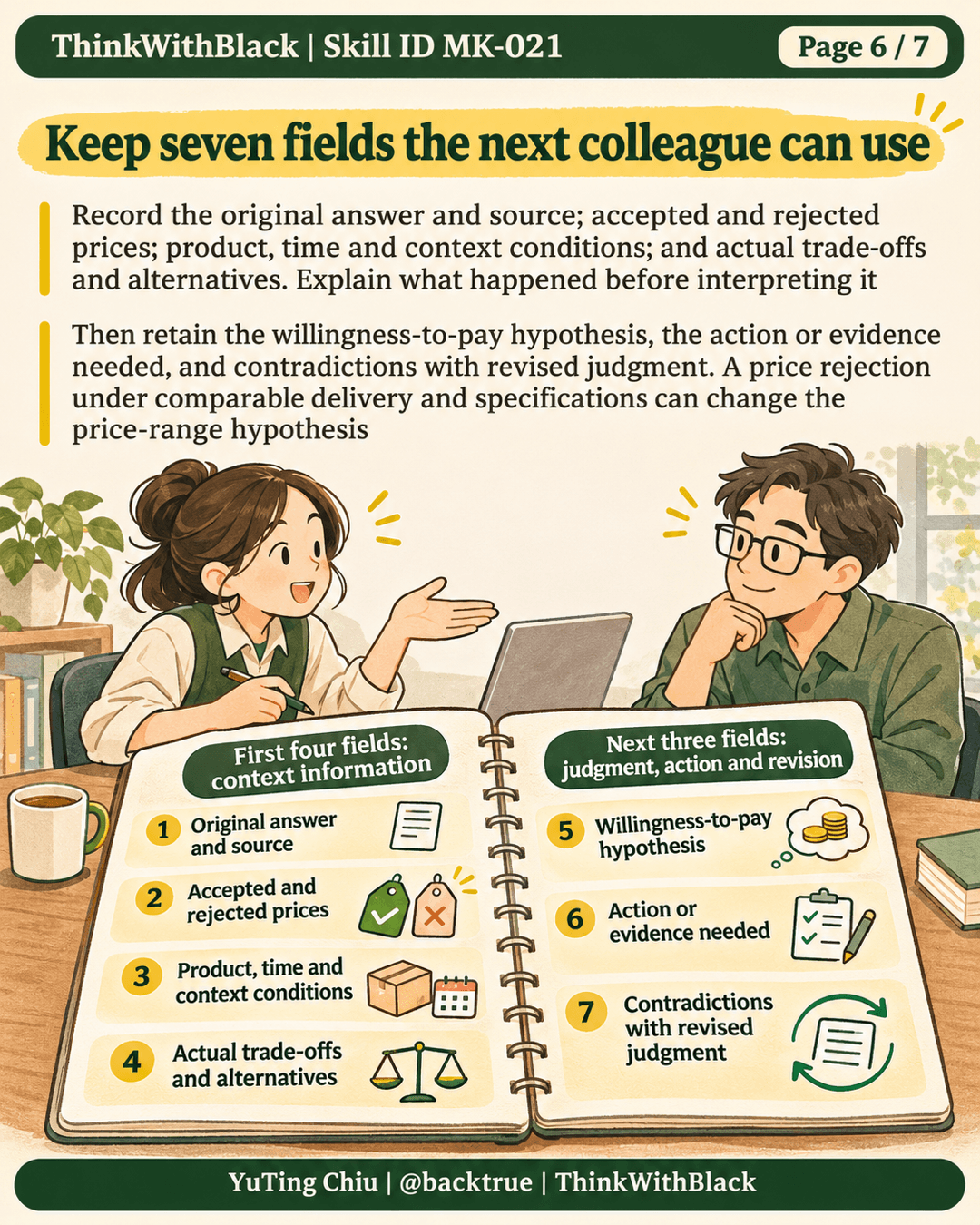
Keep seven fields the next colleague can use
MK-021 records its output in seven fields. The storage-rack example can be carried forward like this:
| Field | What to retain in this example |
|---|---|
| Original answer and source | Customer wording, both quotes and the order record, with their source locations |
| Accepted and rejected prices | Rejected NT$1,200; bought NT$900; maximum willingness to pay remains unknown |
| Product, time and context conditions | Office needed this week; NT$1,200 version in stock in three weeks; NT$900 arrives tomorrow; specifications, support and payment terms still need checking |
| Actual trade-offs and alternatives | Chose the version arriving sooner; check the other options that could actually be fulfilled |
| Willingness-to-pay hypothesis | Investigate delivery priority; this purchase does not establish a permanent preference for low prices |
| Action or evidence needed | Confirm the latest arrival date, complete the specifications and terms, then provide available options meeting the deadline |
| Contradictions and revised judgment | Revise the price-range hypothesis if a comparable offer is explicitly rejected because of price |
Service now has a delivery question to ask. The quoting colleague knows which terms to include. The product-page editor can answer the delivery and specification questions customers actually raise. A discount discussion can use the full trade-off instead of the isolated fact that someone bought a NT$900 item
Seven-page guide
Bring your offers to ThinkWithBlack Skills
Get the index from the ThinkWithBlack Skills directory and download the English MK-021 method pack and use its seven-field record
Add one accepted and one rejected complete quote, product information, the alternatives available at the time and anonymised customer wording to an AI conversation. Ask it to align the conditions, describe the observed trade-off, identify the open questions and state which new records would change its judgment
Use that record in the next reply: clarify the condition blocking the purchase, then provide an option the business can fulfil
This Skill on social media
Choose a platform to view the infographic and post