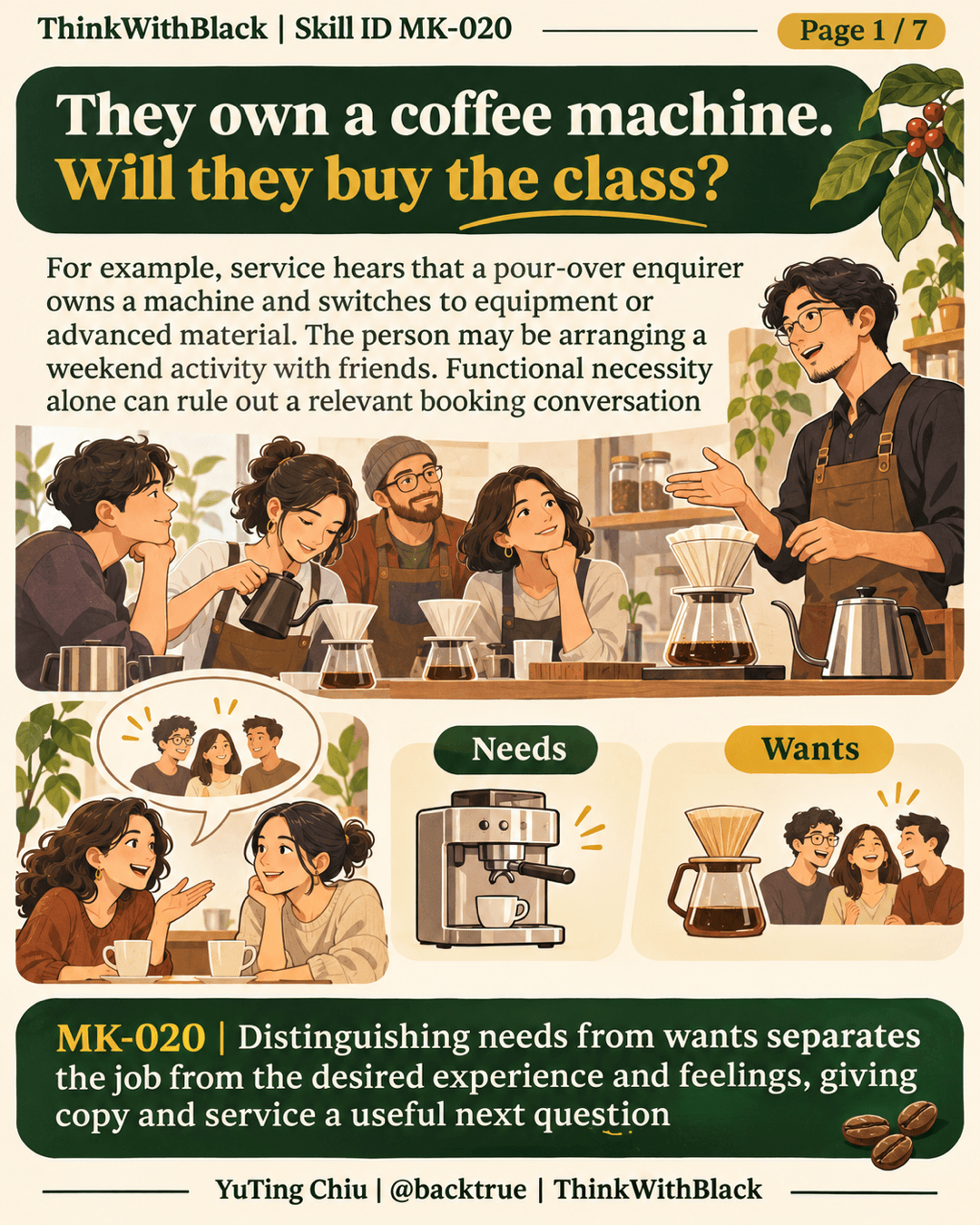
A team selling an introductory pour-over class can easily treat “learning coffee” as one job. The page keeps adding water temperature, grind settings and brewing technique. When someone says they already own a coffee machine, service assumes the class has little to offer and switches to equipment or more advanced material
That person may be looking for a weekend activity with friends. Their daily coffee already has a solution, but the shared experience they want to arrange still needs one. Looking only at functional necessity can make the team rule out a relevant booking conversation
Meanwhile, a complete beginner wants to know whether they can practise during the class and what equipment they will need at home. A page promising a lovely coffee moment leaves those questions open. The same class can miss both enquiries for different reasons
I would separate the job the person needs to complete from the experience, feelings or identity they want, then put both back into the actual situation. That is what MK-020, Distinguishing needs from wants, produces: a comparison of necessary solutions and desired feelings that copy and service can use
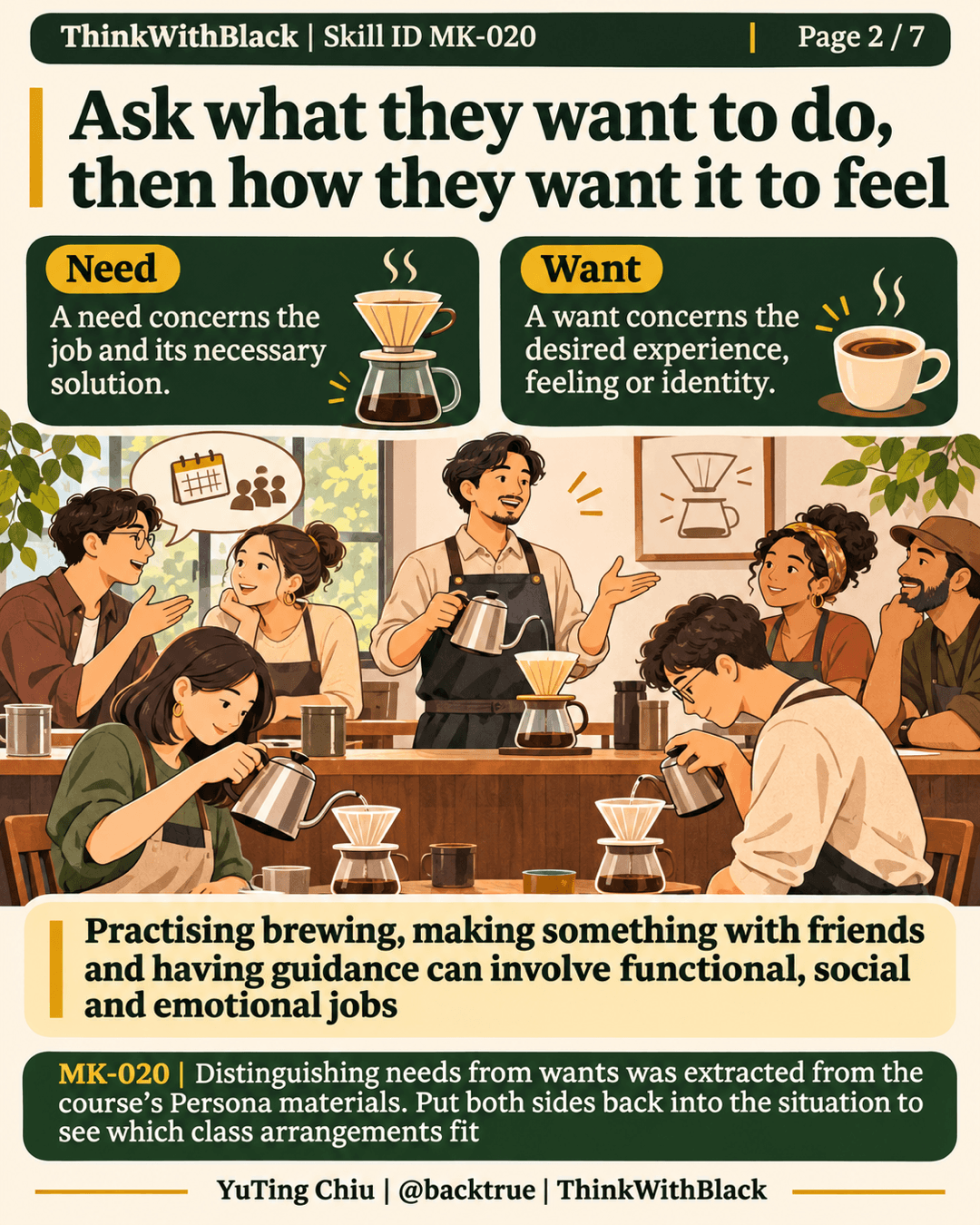
Ask what they want to do, then how they want the experience to feel
“I want to learn pour-over” can contain several jobs. Someone wants a sequence they can practise at home. Someone else wants time doing something unfamiliar with friends. Another person wants to make and serve a cup when people visit
Here, a need concerns the job and the solution required to complete it. A want concerns the desired experience, feeling or identity. Separating them shows which information explains the operation and which explains the experience the person hopes to arrange
MK-020 uses Jobs to Be Done, including functional, social and emotional jobs. A functional job could be practising the brewing sequence. A social job could be spending time making something with friends. An emotional job could involve having someone guide the first attempt. Tie each interpretation to what the person has actually said; a class booking alone does not establish their identity
The method was extracted from the Persona section of “行銷策略實戰學程 Day1-小眾就是大眾 × 精準 Persona × 數位資產.” It treats high and low need as descriptions of intensity. Low functional urgency can coexist with a reason to buy in a particular situation
Establish what the class provides before matching the enquiry
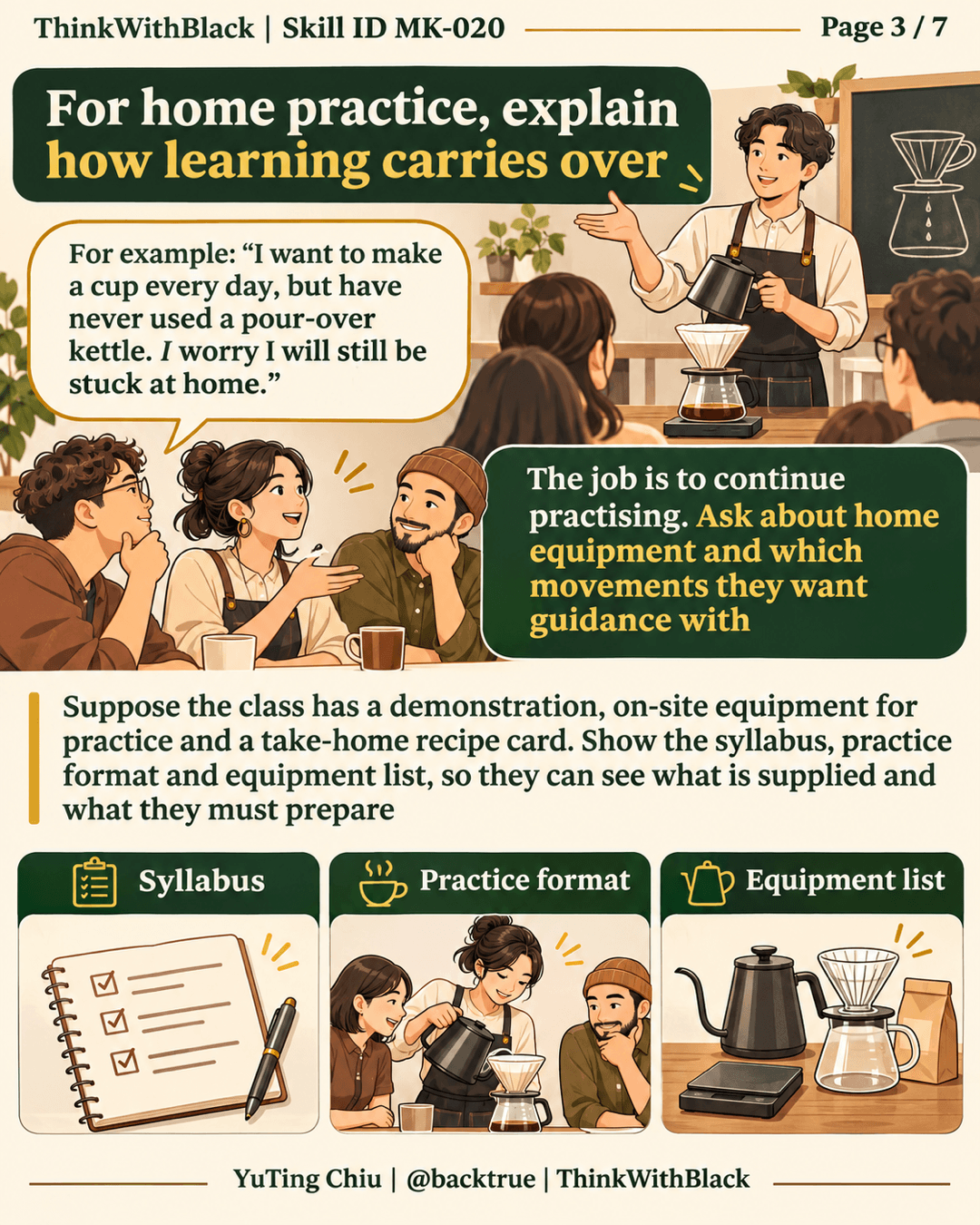
For example, suppose the class includes an instructor demonstration, participant practice with equipment supplied on site, and a recipe card to take home. These facts explain how the class works. Available sessions, places for companions and the equipment needed at home still need to be checked
For someone hoping to brew every day, practice and a recipe card have a concrete purpose. On-site equipment does not mean they need no equipment at home. Service can use the syllabus and equipment list to explain what is supplied and what the participant must prepare
For a group activity, the same class prompts different questions. Can the friends attend the same session? How much opportunity does each participant have to try the process? Those depend on actual arrangements. A description of professional equipment does not answer them
Situation one: they want to brew at home but do not know how to start
For example, an enquirer says: “I want to make a cup every day, but I have never used a pour-over kettle. I worry that I will still be stuck when I get home”
Record the job: continue practising at home using a sequence they understand. Compare that with participant practice, the steps demonstrated and the contents of the recipe card. Ask what equipment they already have and when they plan to brew
The desired feeling also deserves a follow-up. They may want someone present while they try, so they can ask which movement needs adjusting. Describe the actual practice arrangements so they can judge whether the learning format fits
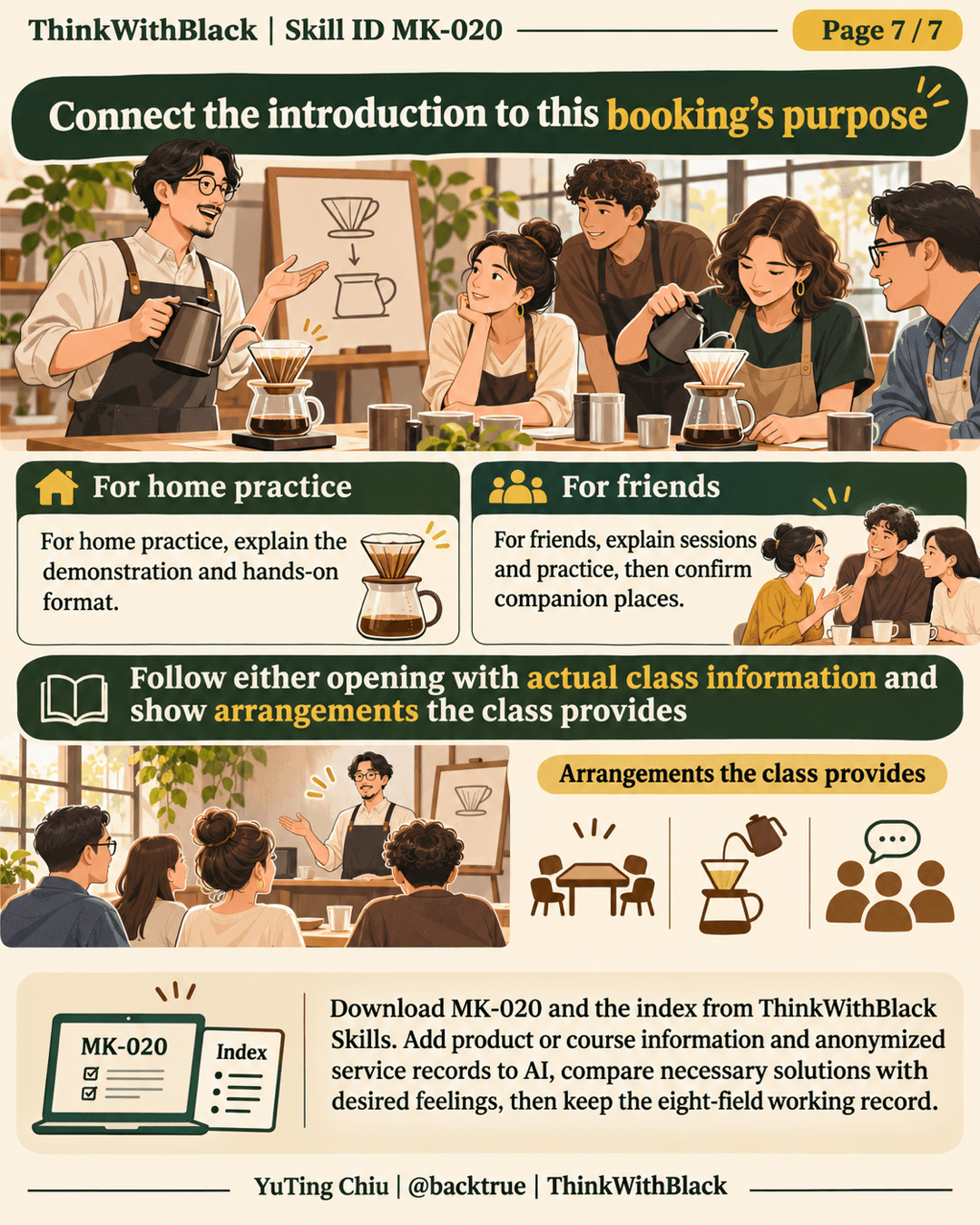
An opening could say: “Want to practise pour-over at home? See what the instructor demonstrates, how participant practice works and which materials you can take away.” Follow it with the syllabus, equipment information and recipe-card contents
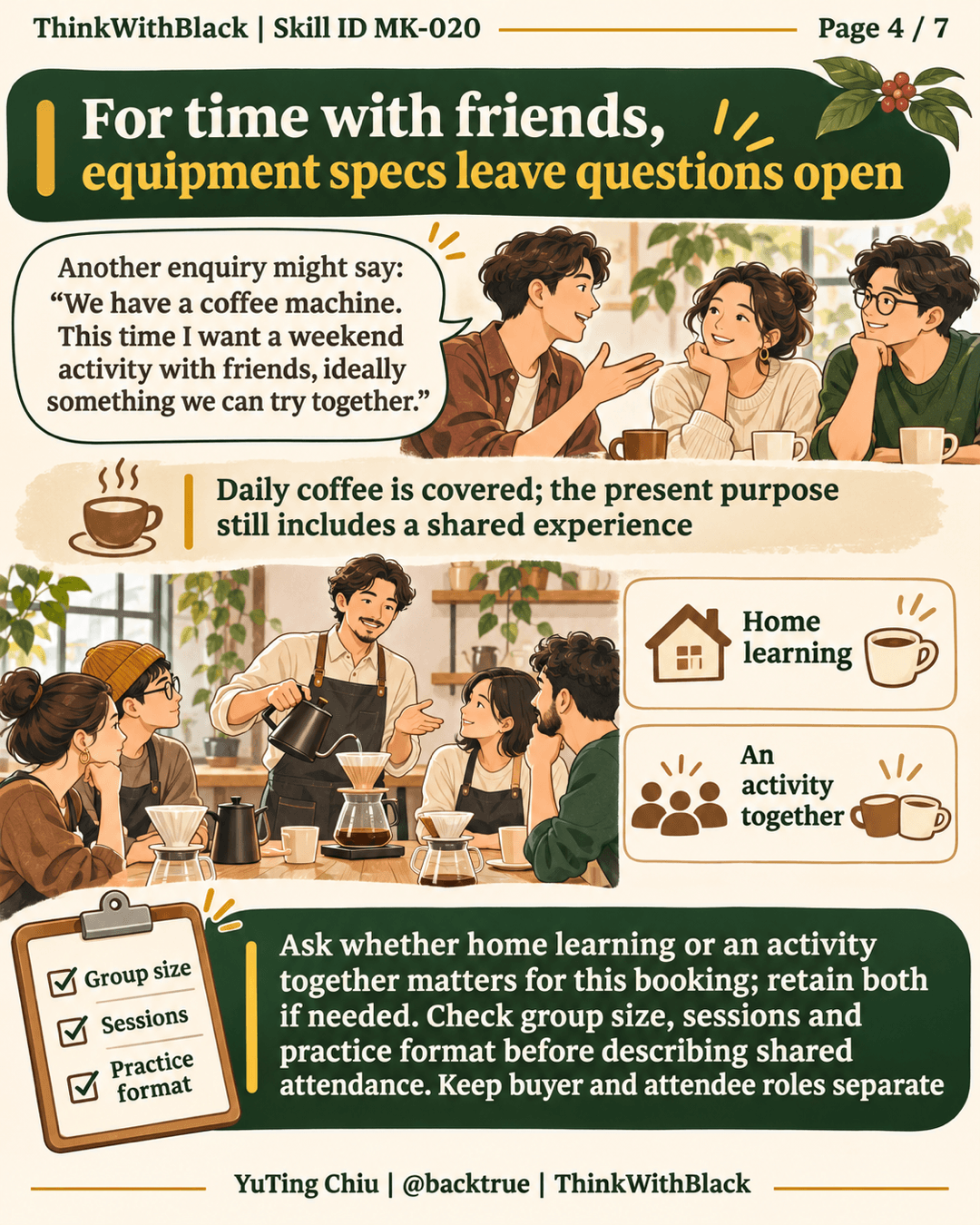
Situation two: they have daily coffee covered and want time making something together
Consider another enquiry: “We have a coffee machine at home. This time I am looking for a weekend activity with friends, ideally something we can try together”
Their daily drink already has a solution, so the functional need may be less urgent. The present job includes arranging time with friends, and the desired experience involves making something together. Saying they do not need an introductory class because they own a machine misses the purpose they stated
Ask: “Are you mainly hoping to learn for home practice, or arrange an activity together? If both matter, we can look at the class arrangements with that in mind.” Then check group size, available sessions and the way practice is organised
A suitable message could be: “Planning a pour-over activity with friends? Check the session times and practice format, then confirm places for everyone.” Only describe a shared-session arrangement once it has been confirmed. The buyer may also be booking for someone else, so keep buying and attending roles separate
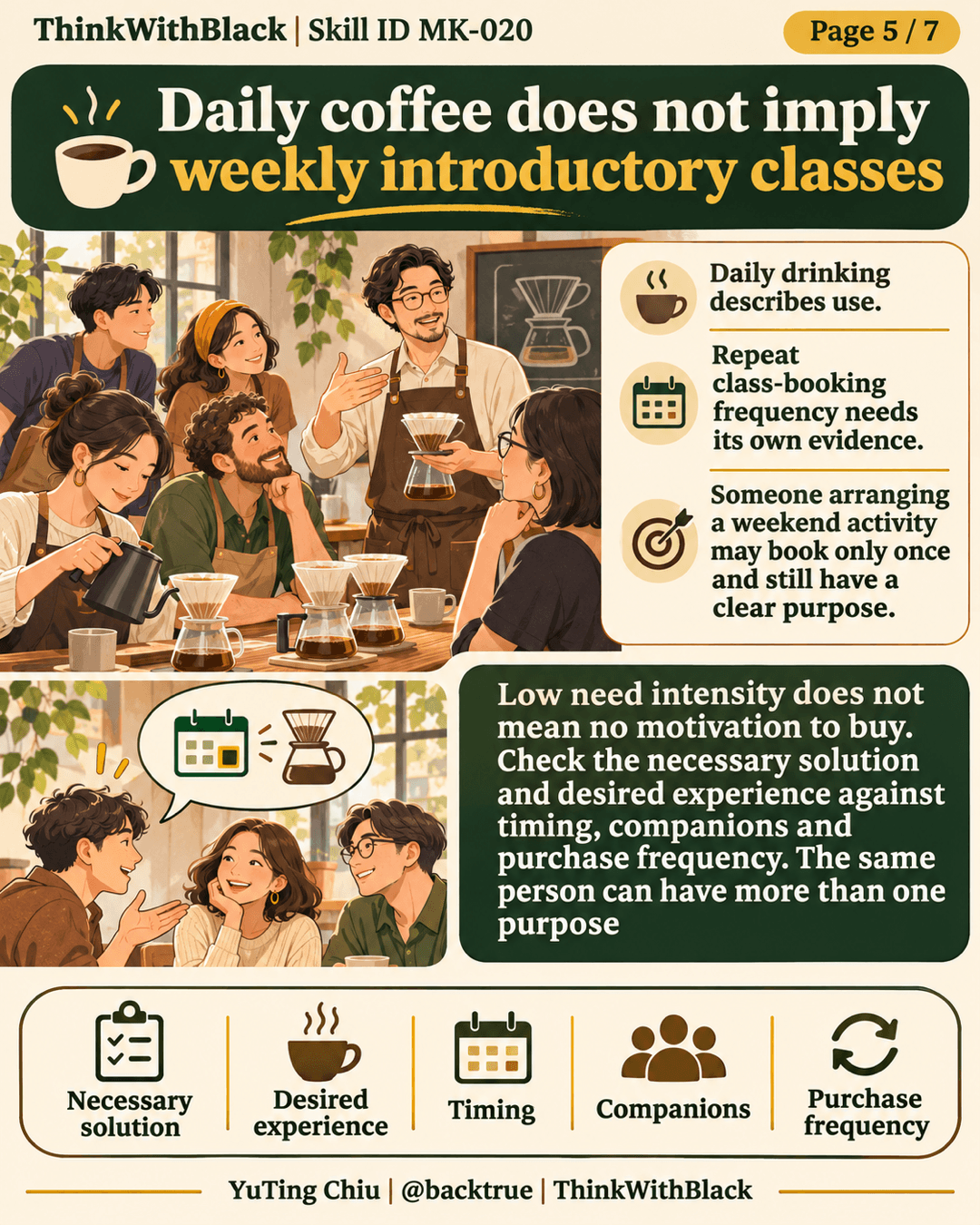
Daily drinking and class-booking frequency describe different things
Bring frequency back into the comparison. Drinking coffee every day describes use. Whether someone wants to buy another introductory class is a separate question. Daily consumption does not establish a reason to promote the same class to them every week
A weekend activity may be a single booking. It can still involve a clear purpose, timing and expectations. Answer that enquiry, then retain any evidence of a further learning or activity requirement
| Situation | Job and necessary solution | Desired experience and frequency check |
|---|---|---|
| Practising at home | Check the demonstration, hands-on practice, recipe card and home equipment | Ask about guidance for getting started; daily drinking does not imply repeat introductory classes |
| An activity with friends | Check sessions, places for companions and the practice format | Confirm the shared activity; a one-off booking can still have a clear motivation |
Both situations can apply to one person. Keep both, then clarify which job matters for this particular booking
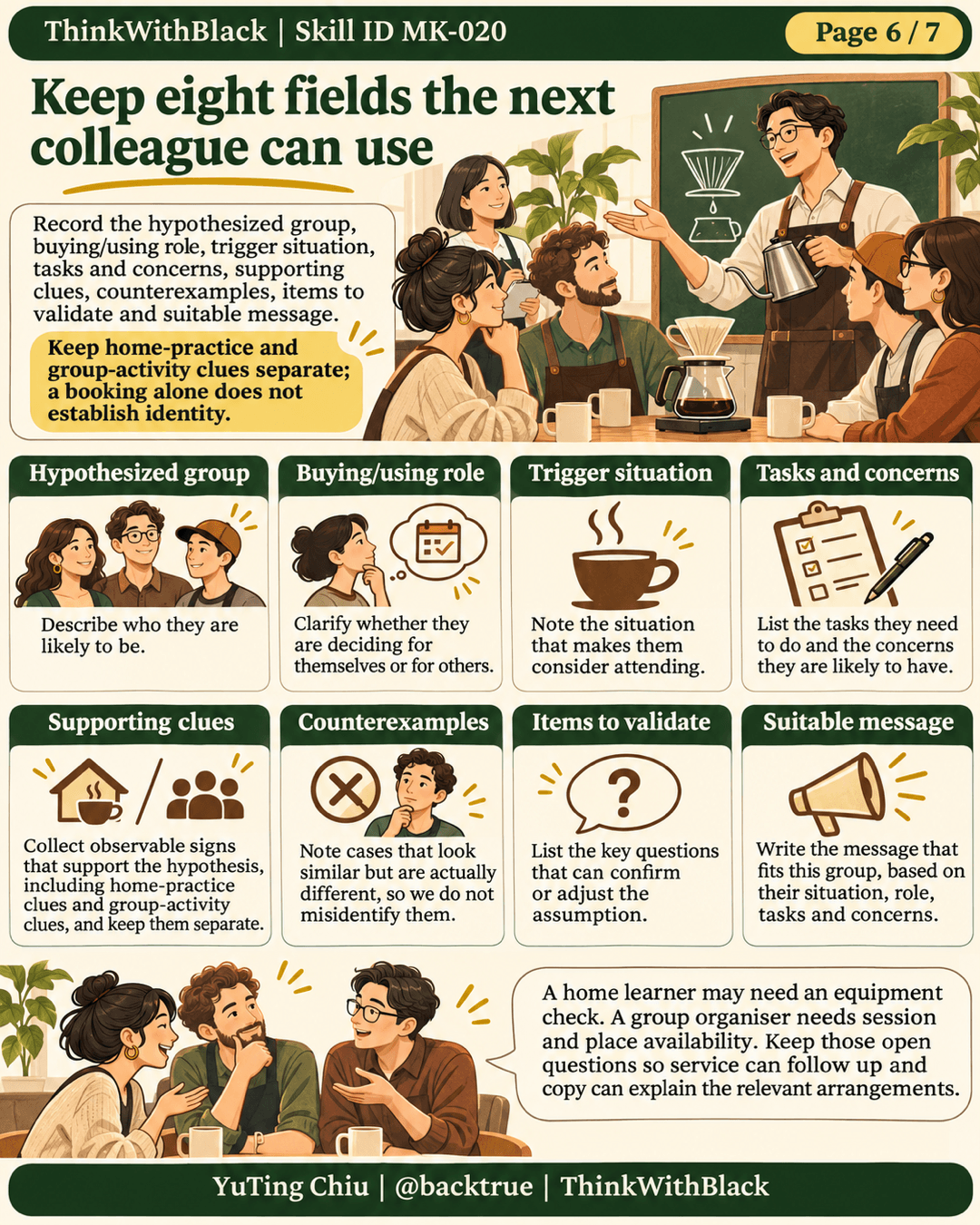
Leave eight fields the next colleague can use
After comparing necessary solutions and desired feelings, MK-020 keeps the result in eight fields. The two situations could be recorded as follows:
| Field | Home-practice situation | Friends attending together |
|---|---|---|
| Hypothesized group | Wants to start making pour-over | Arranging a shared hands-on activity |
| Buying / using role | May attend personally; confirm | May attend or book for friends |
| Trigger situation | Wants daily home brewing but does not know the process | Owns a machine and is looking for a weekend activity |
| Tasks and concerns | Wants to practise at home; equipment and steps matter; confirm desired guidance | Wants compatible times and shared practice; places and format matter |
| Supporting clues | The example enquiry, syllabus, practice format and recipe card | The example group purpose, actual sessions and practice arrangements |
| Counterexamples | May only want one experience, with no plan to buy equipment | May chiefly want practical learning rather than a social activity |
| Items to validate | Home equipment, practice time and where guidance is wanted | Group size, session, buyer versus attendee, and shared-session availability |
| Suitable message | Explain demonstration and practice, then what to prepare at home | Explain sessions and practice format, then confirm companion places |
Copy can use a different opening for each purpose and follow it with relevant class information. Service can ask the open questions. Design can show the actual demonstration and participant practice; any group scene should match the arrangements available
The next discussion about whether someone “needs” the class can use specific evidence: the job for this booking, the experience they want, the part the class provides and the questions still open
Seven-page guide
Use ThinkWithBlack Skills with your own enquiries
Visit the ThinkWithBlack Skills catalog and download the index and MK-020, Distinguishing needs from wants. Add your course or product information and anonymized service records to an AI conversation
Ask for the job, necessary solution and desired experience, checked against the situation and purchase frequency, then keep the result in the eight-field record. Use that comparison to revise the page, explain the class and prepare the next service question
This Skill on social media
Choose a platform to view the infographic and post