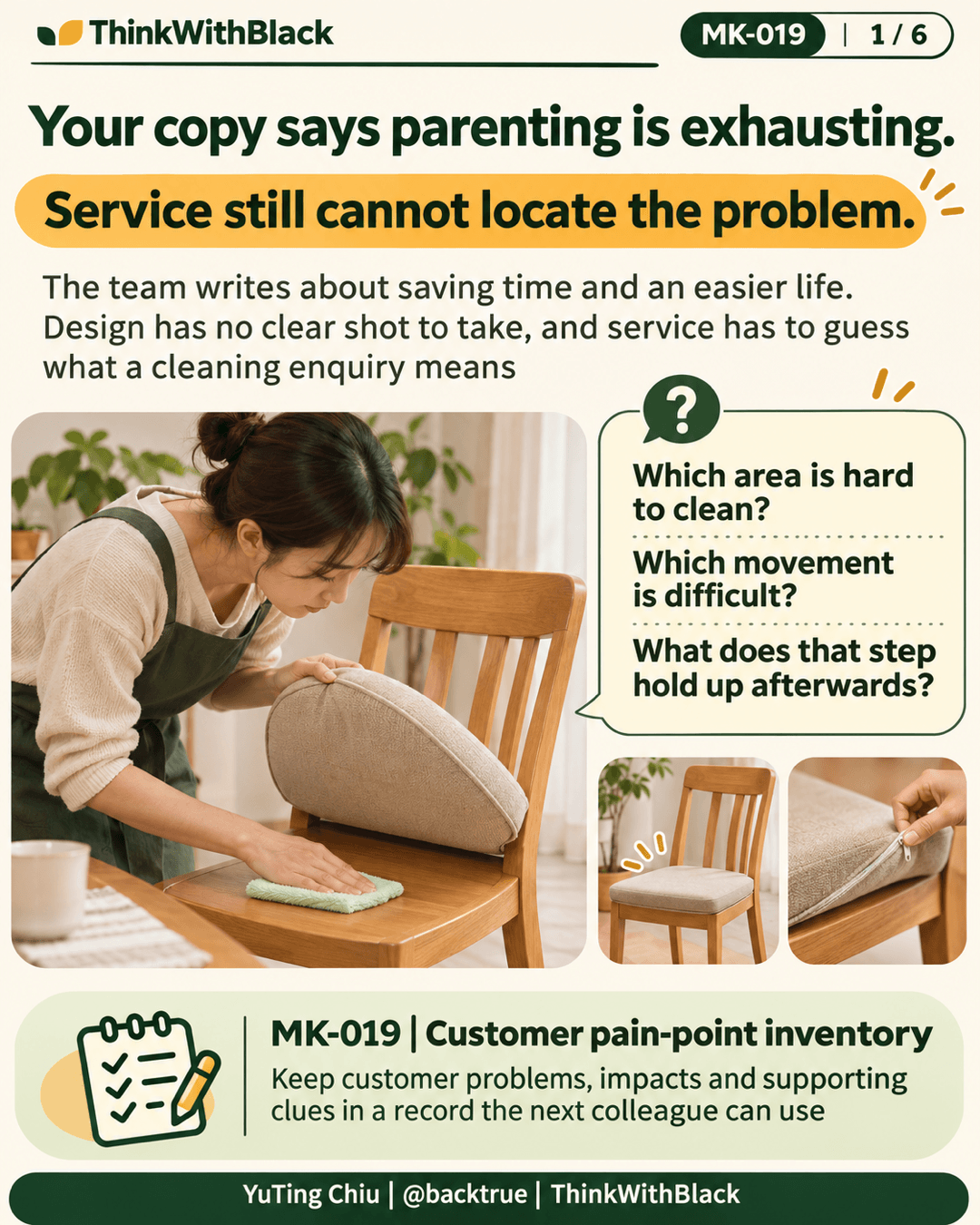
A team writing dining-chair copy lists familiar pain points: parenting is exhausting, people want to save time, and home life should feel easier. The words sound sympathetic. The designer still has no clear shot to take, while service keeps repeating that the seat cushion is removable
Then a customer asks: “Can I wash the whole cushion? How long before someone can sit on it again?” The cleaning task they have in mind differs from the one the team imagined. A page of sympathetic copy has left a buying decision unanswered
I would work down from “exhausting” to the task, the difficult step and what it holds up. That is the purpose of MK-019, Customer pain-point inventory: a list of customer problems, their impacts and the evidence behind them, ready for the next person to use
Make the pain point specific enough to suggest the next question
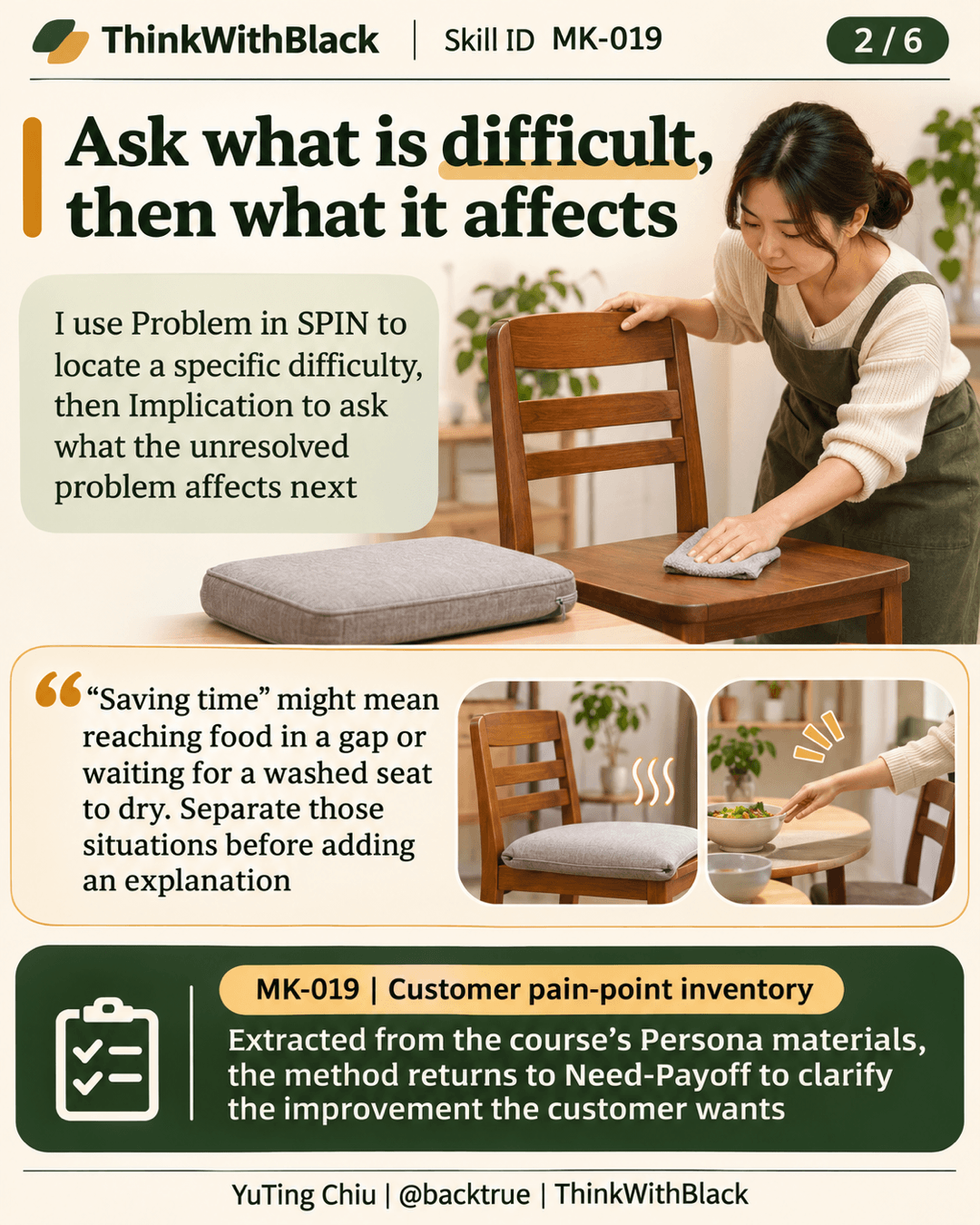
“Saving time” could mean reaching rice trapped in a seam. It could also mean waiting for a washed cushion to dry when there is no spare chair. Those situations need different explanations. “Easy to clean” can leave both sides thinking they have understood each other
For the team, the unfinished work accumulates. Copy stays vague through several revisions. Design adds photos that miss the concern. Service has to guess the intended cleaning method in every conversation, then explain again when the product conditions differ from expectations
A useful record would say: “After dinner, rice gets into the gap between cushion and seat. The person cleaning has to pick it out and wipe each area, holding up the rest of the table clearing.” The next colleague now knows to inspect the gap, removal steps and cleaning movements
Connect the difficult step to what happens afterwards
MK-019 was extracted from the Persona section of “行銷策略實戰學程 Day1-小眾就是大眾 × 精準 Persona × 數位資產.” It uses Problem and Implication from SPIN
Problem identifies the specific difficulty affecting a comparison or decision. Implication asks what that unresolved difficulty affects next. Start with a situation and comparison point, then examine the consequence to understand why it matters to that person
For example, someone comparing fixed and removable cushions may want to know whether they can reach rice trapped in the gap. Ask how they currently deal with it and which later chores it holds up. Only then does a removable cushion connect to a particular job
The method also returns to Need-Payoff: what would the person want to do more easily if the problem improved? Connect that answer to a real product benefit. The downloadable method pack includes the full steps and course-source link
Follow a cleaning enquiry far enough to make it useful
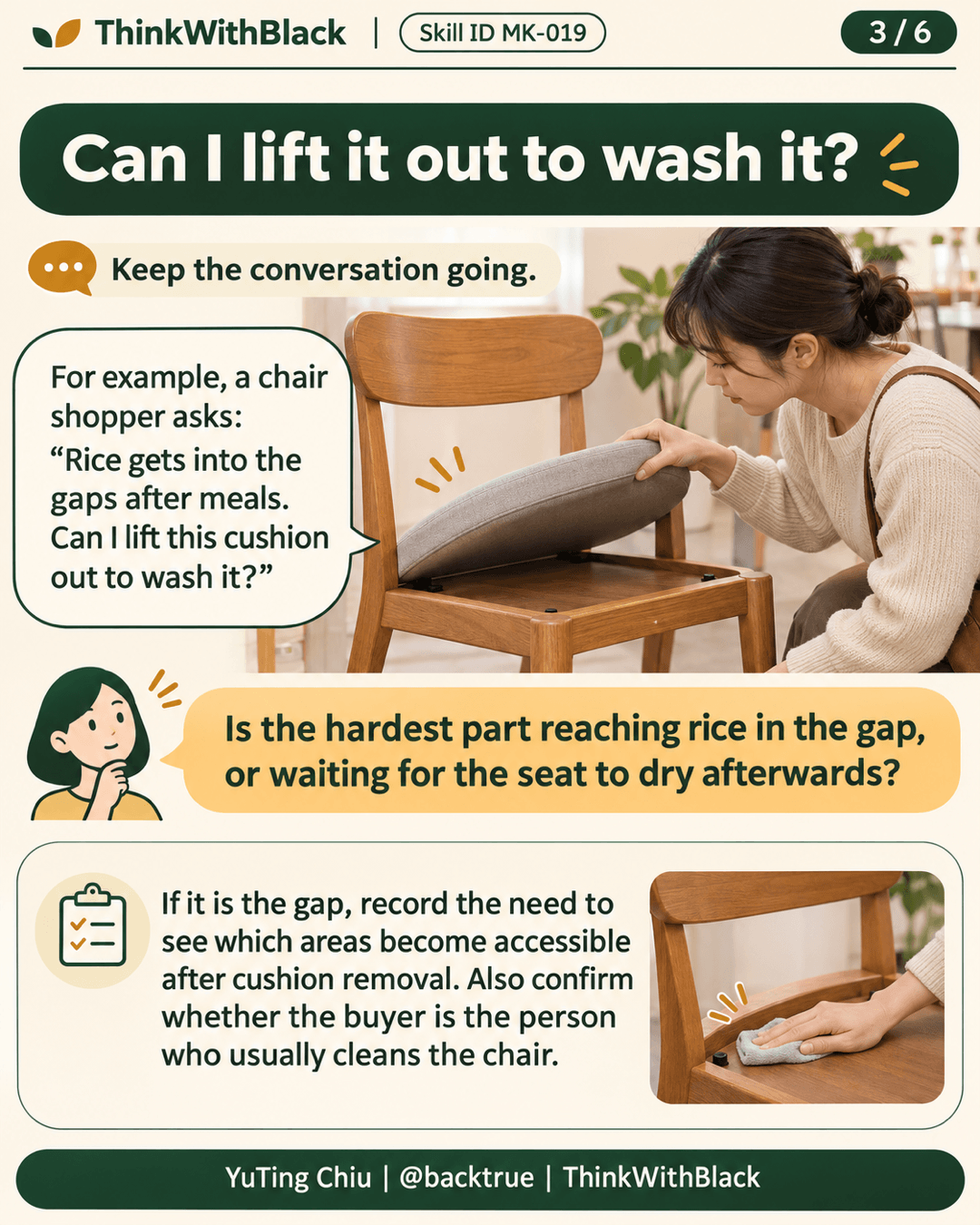
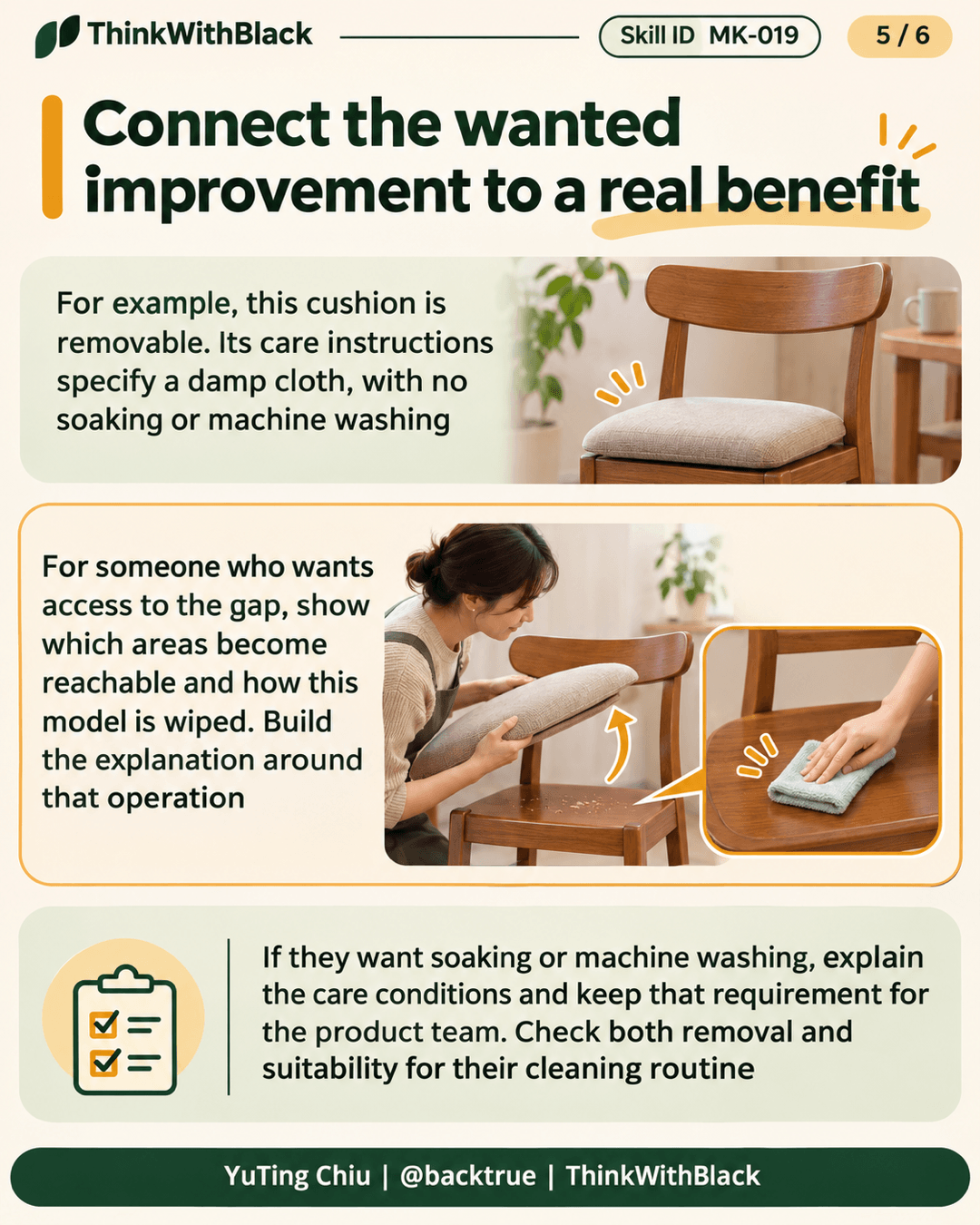
For example, suppose you sell a dining chair with a removable cushion. Its care instructions specify wiping with a damp cloth, with no soaking or machine washing. A shopper asks: “Rice gets into the gaps after meals. Can I lift this cushion out to wash it?”
Keep the original words. You know that cleaning matters and that they ask about removing the cushion. You still need to clarify whether “wash” means wiping, rinsing or machine washing. It also helps to ask whether the purchaser is the person who usually cleans it
Service could ask: “Is the hardest part reaching rice in the gap, or waiting for the seat to dry afterwards?”
If the answer concerns trapped rice, record the Problem as: “After meals, rice is difficult to reach in the gap. The shopper wants to see whether removing the cushion exposes the areas they need to clean”
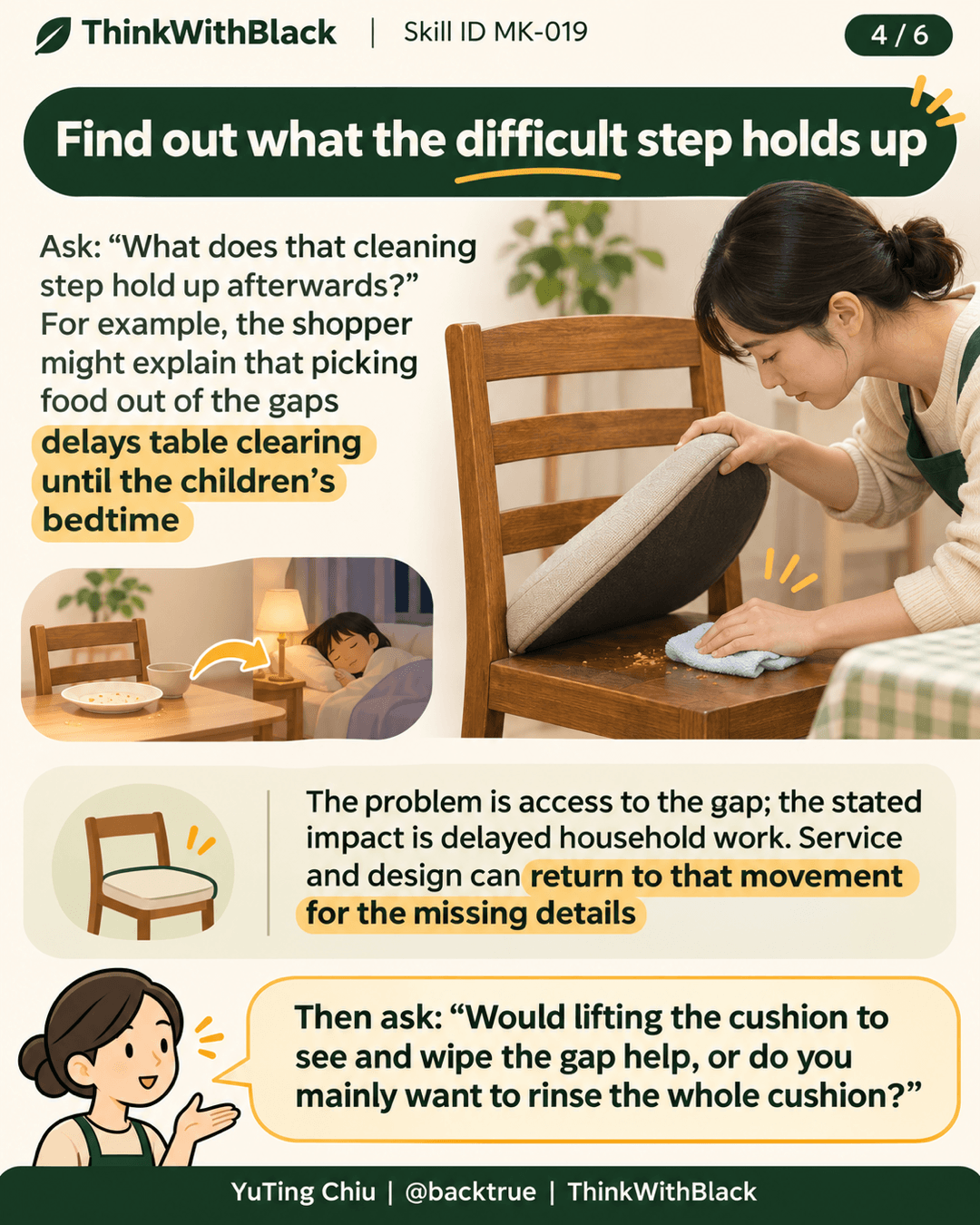
Then ask about the Implication: “What does that cleaning step hold up afterwards?” For example, the shopper might explain: “I still have to clear the table after dinner. Picking food out of the gaps often keeps me busy until the children’s bedtime.” Keep that stated consequence with the original situation
Service can now hand the concern to the writer: answer the gap-cleaning question. The designer can show how the cushion lifts out, which areas become accessible and how the care instructions say to wipe them
Find out which improvement the customer actually wants
The next question could be: “Would lifting the cushion to see and wipe the gap help with your task, or do you mainly want to rinse the whole cushion?”
This checks Need-Payoff. If the person wants visible access for wiping, return to an actual demonstration of this chair. Check whether the troublesome areas are accessible before preparing the explanation
A suitable opening could be: “If cleaning gets stuck at the seat-cushion gap, see which areas you can reach when the cushion is removed and how to wipe them. This cushion is removable; follow its damp-cloth care instructions.” Add a same-model demonstration so readers can compare it with their cleaning routine
If the person specifically wants soaking or machine washing, retain that requirement in the record. It differs from this product’s care conditions, so service should explain those conditions clearly. The product team also learns which enquiries are looking for a different cleaning method
The result is a usable pain-point record, supporting material and a next question. A removable cushion’s benefit should connect to an observable operation, giving the customer something concrete to assess
Keep the problem, consequence and evidence in the same handoff
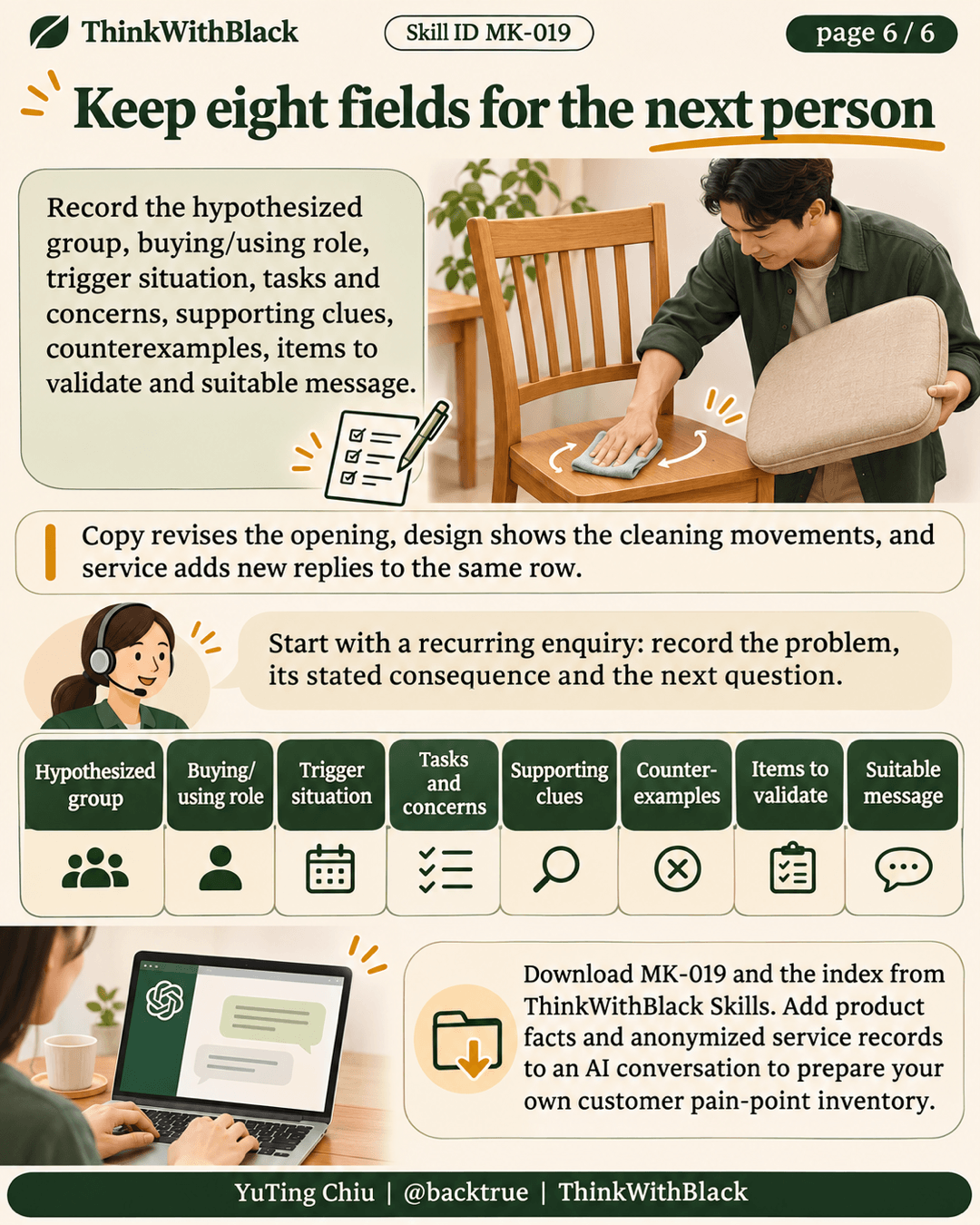
MK-019 uses eight fields. Here is how the dining-chair situation fits them:
| Field | What to record |
|---|---|
| Hypothesized group | Comparing chair-cleaning methods and concerned about the seat-cushion gap |
| Buying / using role | Enquirer may buy, use or clean the chair; confirm each role |
| Trigger situation | Food gets into the gap after meals, prompting a fixed-versus-removable comparison |
| Tasks and concerns | Reach the gap; cleaning holds up table clearing and bedtime arrangements; clarify “wash” |
| Supporting clues | The example enquiry and follow-up, same-model removal demonstration and care instructions |
| Counterexamples | Main concern may be drying time or machine washing rather than access for wiping |
| Items to validate | Who cleans, troublesome area, acceptance of wiping, and response to the demonstration |
| Suitable message | Show accessible areas after cushion removal, then explain the applicable care method |
One enquiry may support more than one concern. Retain both candidates and ask a question that distinguishes them. A chair purchase also does not establish whether someone is a mother, father or caregiver. Buying, using and cleaning roles can belong to different people
Give each colleague a concrete next job
Copy can revise the product-page opening around the task and the information needed to assess it. Design can photograph the actual removal and cleaning movements. Service can follow the open questions and add replies to the same record
The product team can see which concerns existing evidence answers and which enquiries ask for something different from the current care conditions. The next copy discussion can use original remarks to decide whether to add removal photos, clarify the care instructions or investigate the use further
Start with a recurring enquiry. Record what the person is doing, which movement is difficult and which consequence they have actually described. Write one question that separates competing explanations, then connect the evidence to a benefit the product can provide
Six-page guide
Use ThinkWithBlack Skills with your own enquiries
Visit the ThinkWithBlack Skills catalog and download the index and MK-019, Customer pain-point inventory. Add product information and anonymized service records, survey responses or customer notes to an AI conversation
Ask for the eight-field record of problems, impacts, supporting clues and open questions. Check that each suitable message connects to what the product actually does. The team can then keep asking, photographing and explaining from the same evidence
This Skill on social media
Choose a platform to view the infographic and post