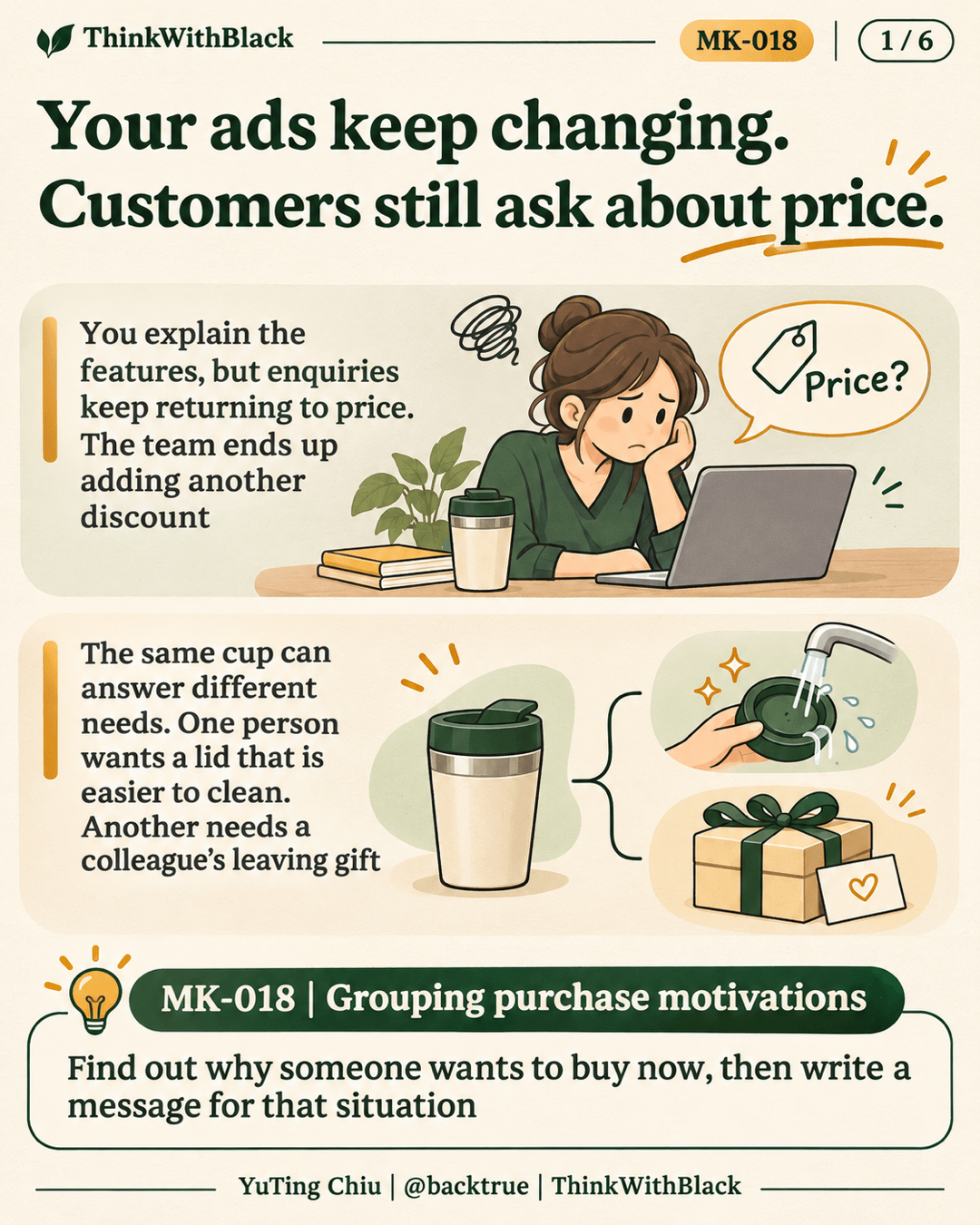
You sell an insulated cup. The product page explains the material, design and cleaning instructions. Your team has rewritten the ads several times, yet enquiries keep coming back to price. Eventually, another discount feels like the only thing left to say
People can need the same cup for very different reasons. One person wants to replace a lid that is difficult to clean. Another needs a leaving gift for a colleague next week. Put both into “great for yourself or as a gift,” and the urgent part of each person's decision disappears
I would start by separating the reasons people want to buy now. MK-018, “Grouping purchase motivations,” uses product facts, customer data, surveys or service records to organize different motivations for buying the same product. That gives the next message someone to address and a particular situation to answer
A lasting value and a reason to buy today do different jobs
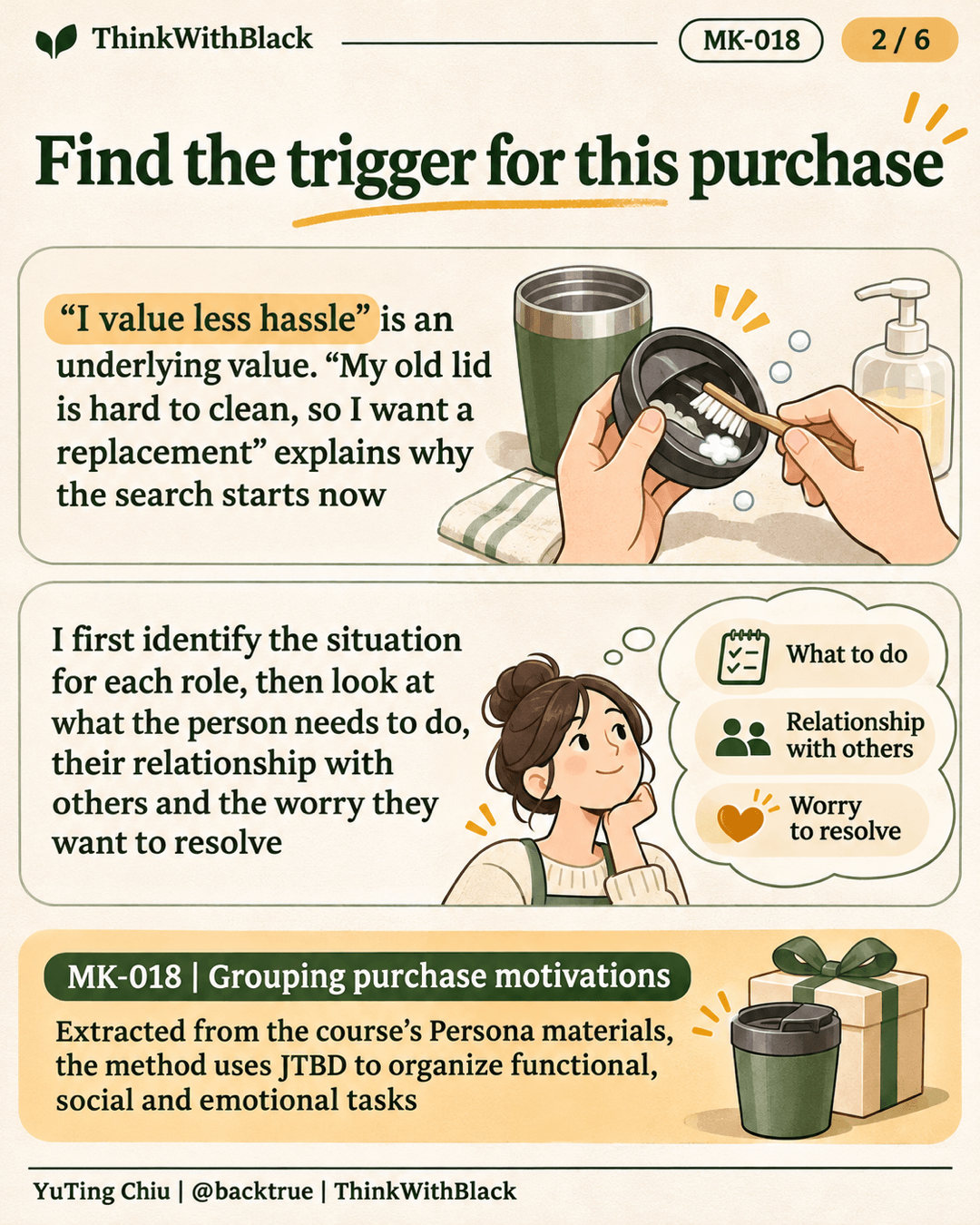
Someone who values an easy life will not necessarily buy a cup today. A particular problem may start the search: their old lid is difficult to clean, and they have decided to replace it
The wish for less hassle is an underlying value. The troublesome old lid is this purchase's trigger. Connect the two, and you know what the message needs to answer first: whether the lid comes apart, how to clean it, and which parts need attention
“People who value quality of life” leaves the writer guessing. A specific buying situation gives the writer and service team something concrete to work on together
Start with who is buying and what this purchase needs to accomplish
MK-018 was extracted from the Persona section of the course materials “行銷策略實戰學程 Day1-小眾就是大眾 × 精準 Persona × 數位資產.” It first lists specific reasons to buy now for each role, then uses Jobs to Be Done, or JTBD, to describe functional, social and emotional tasks
A functional task concerns what someone needs to do, such as cleaning the lid. A social task concerns the choice's relationship with other people, such as choosing an appropriate leaving gift. An emotional task concerns how someone wants to feel, such as avoiding the worry that the gift looks careless
One buying situation can contain several of these tasks. Keep their connections, then combine the underlying value and purchase motivation into suitable creative language
The method pack links to its course source. It also asks you to separate buying and using roles. A maternity-product order, for example, does not establish that the buyer is a mother. Gifts, purchases for family members and team orders can all separate the payer from the user
Work through two situations for the same cup
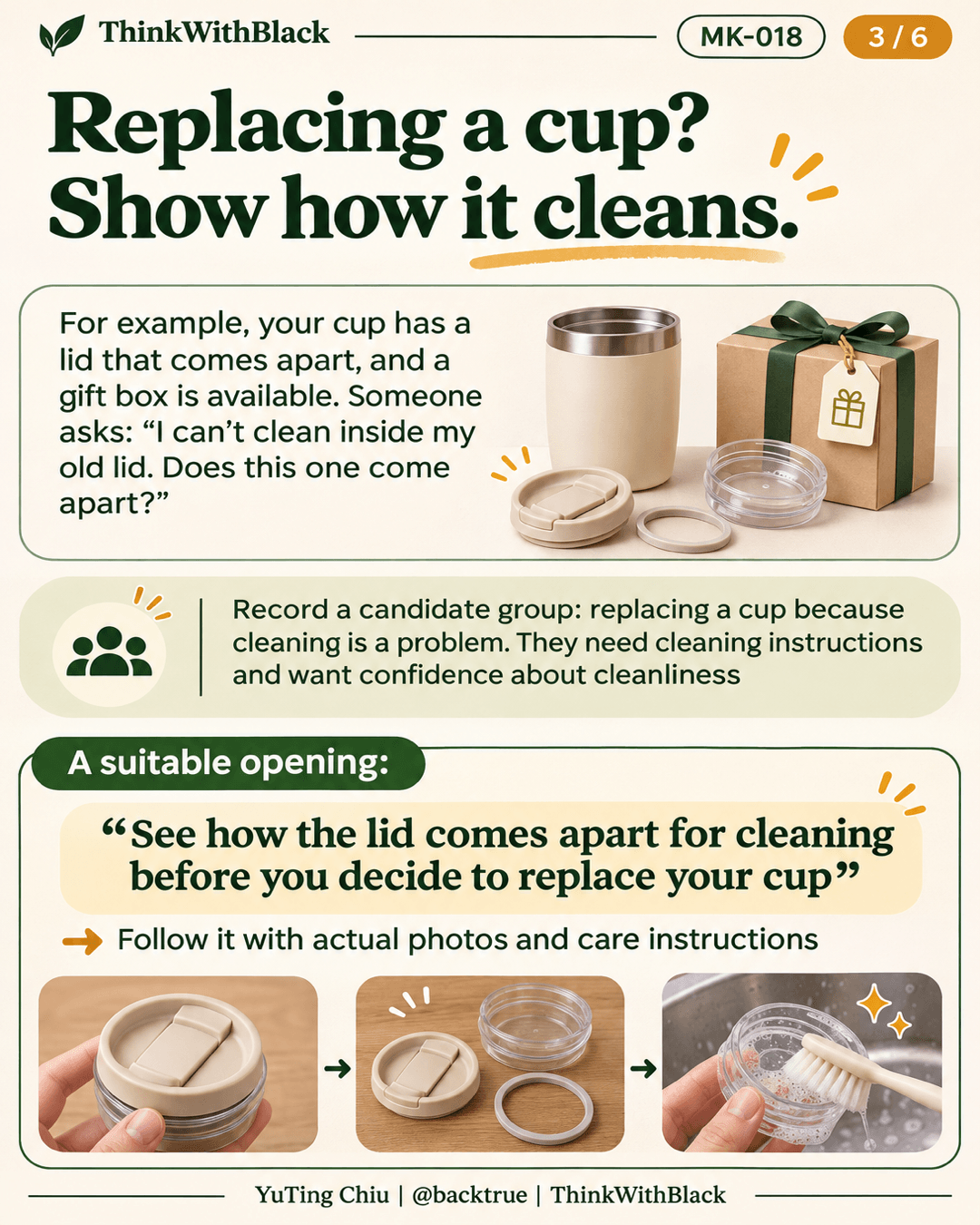
For example, suppose your cup has a lid that comes apart for cleaning, and a gift box is available as an add-on. Use those product conditions to prepare a message for each enquiry
The first enquiry might be: “Does the lid come apart? I can't reach inside my old one to clean it, so I want to replace it”
Record a candidate group: people replacing a cup because cleaning has become a problem. The buyer and user may be the same person; confirm the intended use. The trigger is the old lid. The functional task is to understand how to take the new lid apart and clean it; the emotional concern is the uncertainty about whether it is clean
An appropriate opening is: “See how the lid comes apart for cleaning before you decide to replace your cup.” Follow it with actual disassembly photos, cleaning steps and care instructions. The customer can inspect the part that matters, and the service team knows which information to send
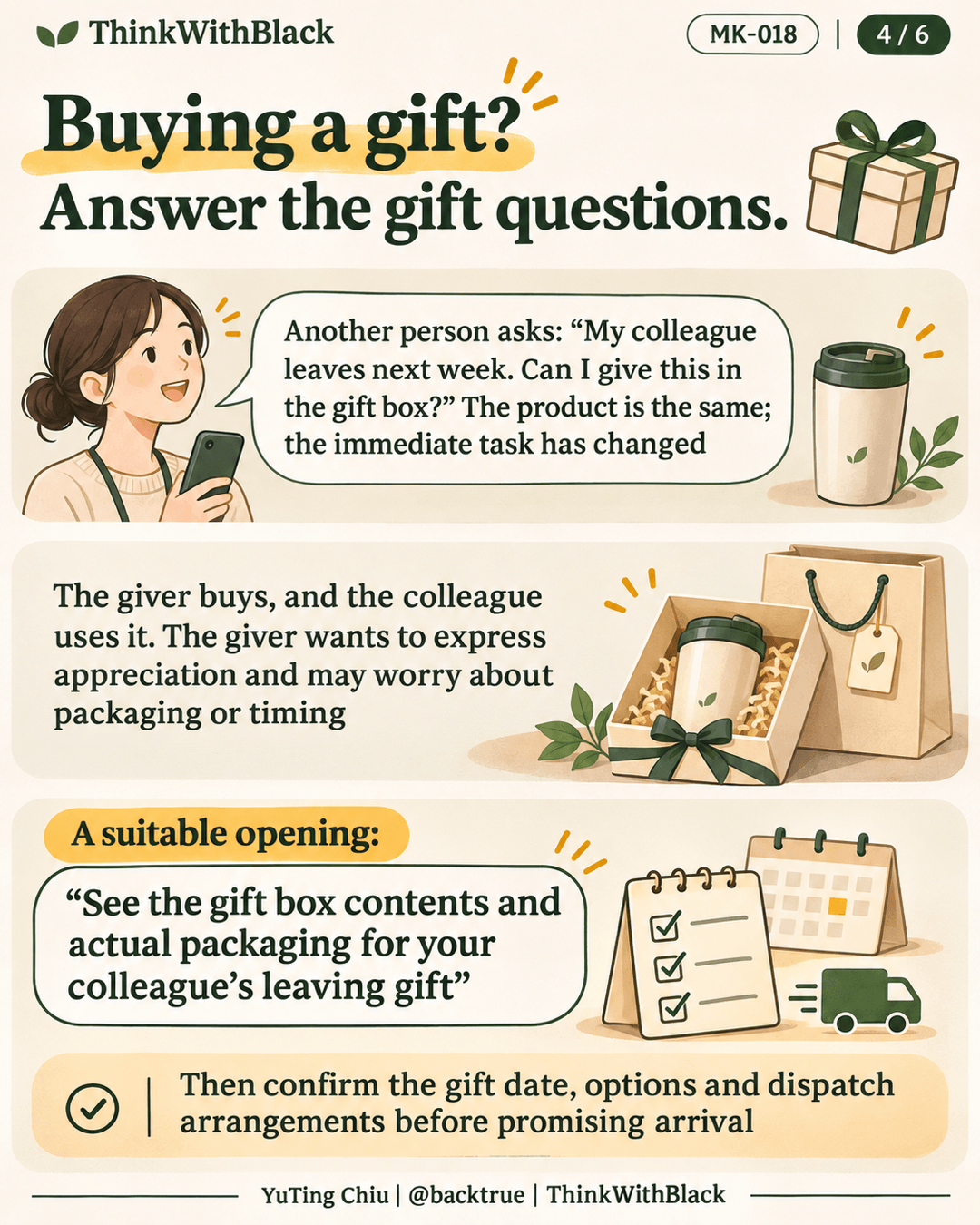
The second enquiry might be: “My colleague leaves next week. Can I give this in the gift box?”
Record another candidate: people preparing a colleague's leaving gift. The purchaser is the giver, while the colleague will use the cup; confirm those roles. The approaching date triggers the search. The social task is to express appreciation appropriately. The emotional concern may be careless-looking packaging or missing the occasion
A suitable opening is: “Choosing a colleague's leaving gift? See the gift box contents and actual packaging.” The service team can then confirm the gift date, available options and current dispatch arrangements before answering whether it can arrive in time. An available gift box and an achievable arrival date each need checking
The product is the same, but the first information differs. One group needs cleaning details. The other needs packaging and gift arrangements. Each piece of creative can address the reason that brought that person to the product
Keep the evidence that could change the grouping
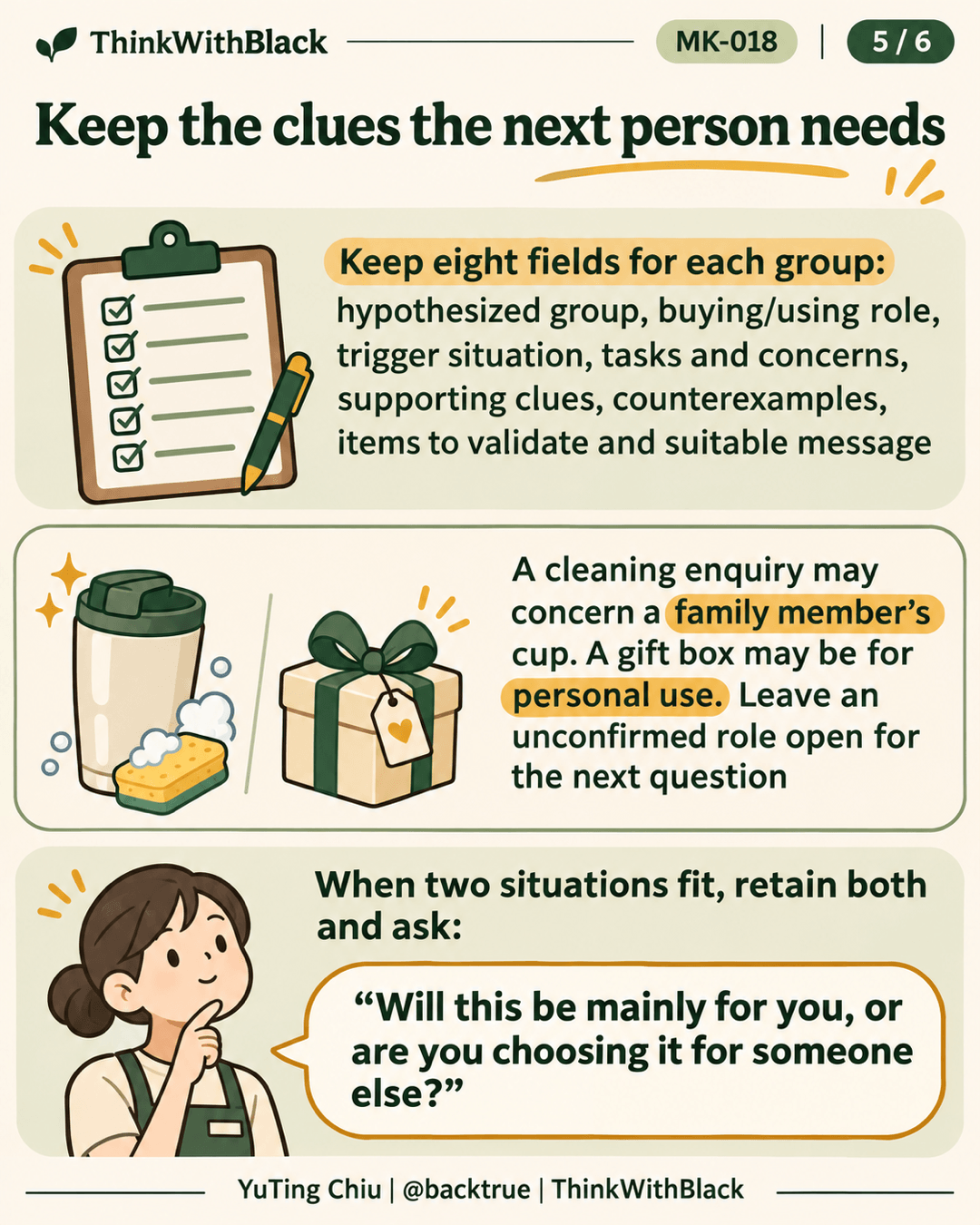
These enquiries help organize candidate motivations. New information may change them. Someone asking about cleaning might be shopping for a family member. Someone asking about a gift box might want it for personal storage. Leave an unconfirmed role open so the service team can ask
If the same record supports both replacing a personal cup and replacing one for a family member, retain both candidates. Ask a question that distinguishes them: “Will this be mainly for you, or are you choosing it for someone else?” The working sheet should make that next question easy to find
MK-018 uses eight fields. Here is how the two situations fit them:
| Field | Replacing a hard-to-clean cup | Preparing a colleague's leaving gift |
|---|---|---|
| Hypothesized group | Wants a replacement because the old lid is difficult to clean | Wants a leaving gift for a colleague |
| Buying / using role | May buy and use it personally; confirm the intended use | Giver buys, colleague uses; confirm both roles |
| Trigger situation | Trouble cleaning the old lid starts a replacement search | Colleague leaves next week |
| Tasks and concerns | Understand disassembly and cleaning; feel confident about cleanliness | Express appreciation; check packaging and timing |
| Supporting clues | The example enquiry mentions the old lid and asks whether the new one comes apart | The example enquiry mentions the colleague, date and gift box |
| Counterexamples | May be choosing a cup for a family member | A gift-box enquiry could concern personal use |
| Items to validate | User, troublesome parts, information needed about cleaning | Gift date, recipient, options and available dispatch arrangements |
| Suitable message | Inspect the lid's cleaning steps before choosing a replacement | Inspect actual box contents and packaging, then confirm arrangements |
Give the sheet to the people doing the next job
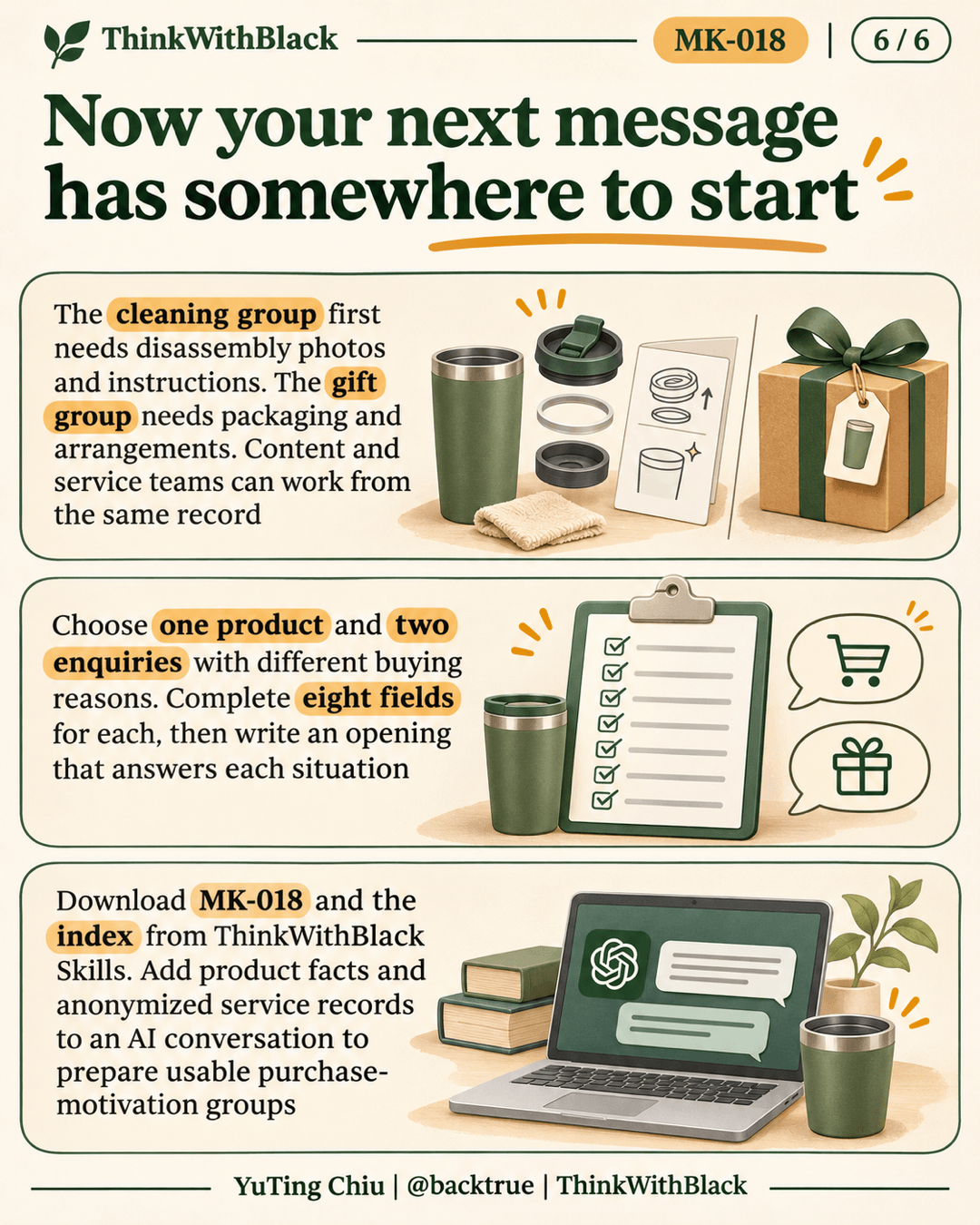
The content team can prepare a separate opening for each group. Cleaning photos and instructions answer the first group's concern. Gift box contents, packaging and arrangements answer the second. Keep the record behind each motivation so the next writer can trace the wording back to its reason
The service team can ask about intended use before sending relevant information. New replies can update the roles, counterexamples and open questions, helping the team decide whether the original grouping still fits
For an advertising test, save each message, its intended motivation and the observation period before reviewing clicks, enquiries and sales. The sheet helps the team prepare specific messages. Actual follow-up data must answer questions about group size, market share and performance
Start today with one product and two enquiries that give different buying reasons. Complete the eight fields for each, then write an opening that addresses that situation. Read it back against the customer's urgent concern: does the information actually answer it?
Six-page guide
Use ThinkWithBlack Skills to prepare your next message
Visit the ThinkWithBlack Skills catalog and download the index and MK-018 method pack. Add them to an AI conversation with your product information and anonymized service records or survey responses. Ask for purchase-motivation groups using all eight fields
The result is a working sheet the content and service teams can use: who is buying, why now, what concerns them, what to say first, and what still needs checking
This Skill on social media
Choose a platform to view the infographic and post