Before planning a repeat-purchase campaign, a membership team needs a useful starting point: how long do customers take to place their second order? A report labelled “average repurchase time” looks like an answer, and the number can quickly become the basis for a discussion about reminder timing
But that label can hide different calculations. If the report averages every gap between successive orders, frequent buyers contribute many more observations than customers who have only bought twice. If the export contains one row per product line, a single order can even appear to be several purchases. The team wants to understand why first-time buyers have not returned, while its report mixes in the later buying habits of established customers
INF-05-07 | Repeat-purchase interval provides a way to repair that starting point. It measures the gap between each eligible customer's first and second valid orders, then reports the mean, median, sample size and customers who could not enter the calculation
Why a large order count can still leave the team stuck
Suppose customer A has placed three orders and customer B has placed two. An average of all successive-order gaps gives A two observations and B one. Customers with more purchases keep adding weight. That calculation describes the recorded order gaps, but it does not give each customer's first-to-second purchase interval equal weight
Historical coverage matters too. The first order in a six-month export could be a long-standing customer's first purchase during those six months. Treating it as their lifetime first order changes the question without making that change visible
This skill checks customer identifiers, unique order IDs, valid payment dates, cancellation/refund/test statuses and historical coverage before calculating. Those choices determine who belongs in the sample and what the result can describe
YuTing's method starts by defining which interval counts
The complete INF-05-07 method identifies its source as the infrastructure skill catalogue, where the task was to calculate mean and median days to repeat purchase. The method turns that task into four checks and calculations, keeping the population, denominator and history visible
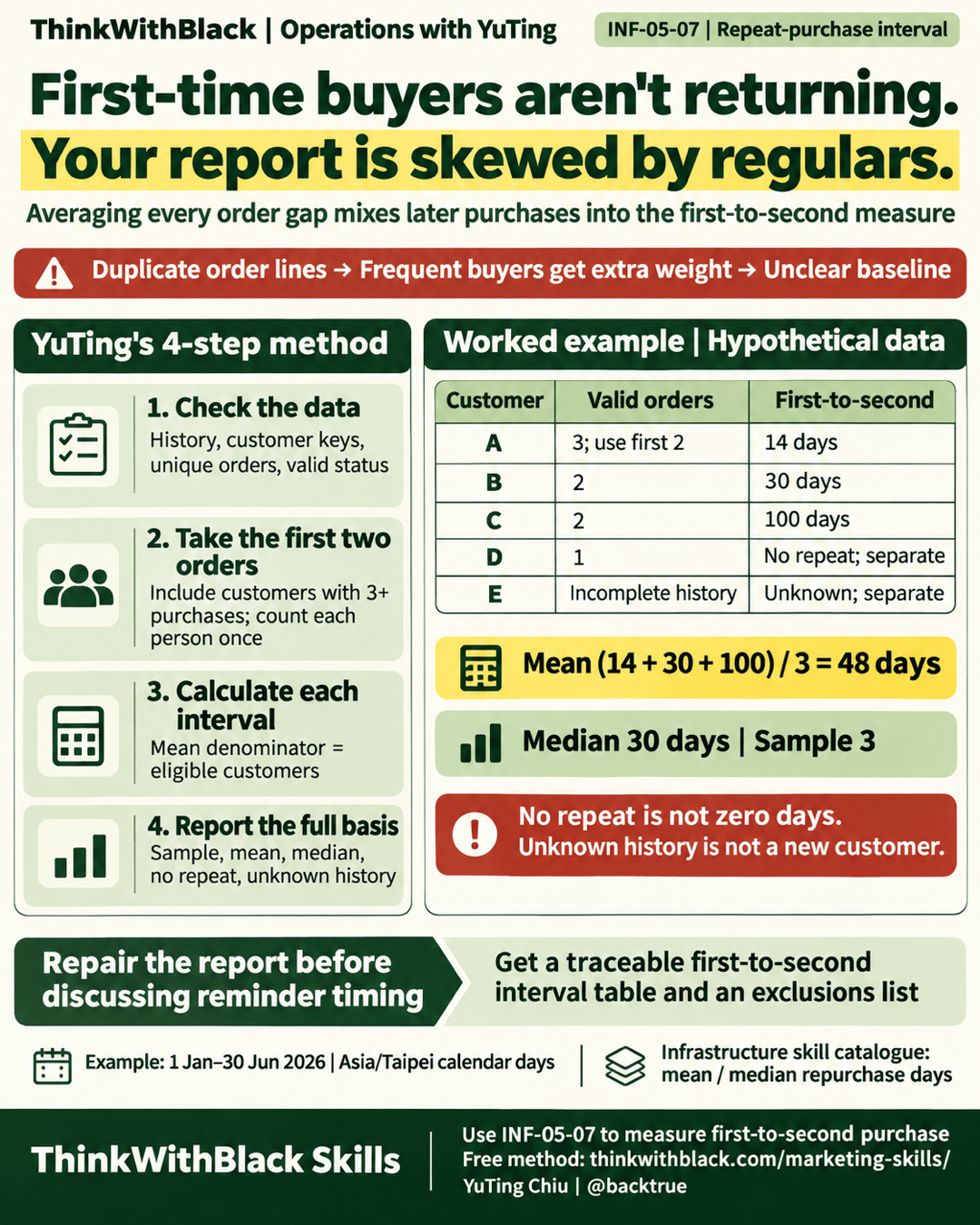
First, check the data. Keep the original export and clean a separate worksheet. Confirm that the customer key consistently identifies the same person, and deduplicate product lines using the unique order ID. Record the time zone and valid-order rules, including how this calculation handles cancellations, refunds and test orders
Second, group valid orders by customer and sort them by payment time. Take only each customer's first and second valid orders. Customers with three or more purchases remain eligible, but each contributes that first-to-second interval only once. Report customers with unverifiable histories separately
Third, calculate each interval and divide the sum by the number of eligible customers. Two distinct valid orders on the same calendar date can have a genuine zero-day interval. A customer with only one order has no second-purchase interval; leave it blank and count that customer separately as having no repeat purchase by the observation cutoff
Fourth, deliver the valid sample size, mean, median, counts without a repeat purchase and with unknown history, and the observation period. Another person should be able to reopen the report and trace the result back to its orders
Worked example: five customers, three eligible intervals
The following customers and orders are hypothetical teaching data, with no associated store or measured business result. The observation period is 1 January to 30 June 2026, using calendar dates in Asia/Taipei. Complete purchasing histories have been confirmed for A through D; E's records from the previous system are incomplete. All orders shown have been deduplicated and satisfy the example's valid-order rules
| Customer | Valid order dates in 2026 | Treatment | First-to-second interval |
|---|---|---|---|
| A | 1 Jan, 15 Jan, 1 Feb | Include the customer; use the first two orders only | 14 days |
| B | 1 Jan, 31 Jan | Use the first two orders | 30 days |
| C | 1 Jan, 11 Apr | Use the first two orders | 100 days |
| D | 1 May | No second order by the cutoff; report separately | No interval |
| E | Two orders visible; older history incomplete | Lifetime first and second orders cannot be verified | Unknown history |
The three eligible intervals are 14, 30 and 100 days. The mean is (14 + 30 + 100) / 3 = 48 days. The median is 30 days. A's third order adds no further interval; D is not assigned zero days, and E's two visible orders are not presented as lifetime first and second purchases
| Required field | Example result |
|---|---|
| Cohort | A, B and C, with complete histories and verified first two orders |
| Interval definition | Calendar-day difference between each customer's first and second valid orders |
| Valid sample | 3 customers, one interval each |
| Mean / median | Mean 48 days; median 30 days |
| Customers without a repeat purchase | 1, customer D, as of 30 June |
| Observation period | 1 January–30 June 2026, Asia/Taipei |
| Unknown history | 1, customer E, in a separate missing-data record |
The mean and median differ because one of the three intervals is 100 days. This result gives the team specific points to check in its old report: did third and later purchases add observations? Were one-order customers assigned zero? Were customers with incomplete histories treated as new buyers?
Replace the unclear report before choosing reminder timing
The practical output is a customer-level first-to-second interval table, together with the calculation rules and separate lists for no repeat purchase and unknown history. A membership team can use it to audit its existing report and distinguish first-to-second buying behaviour from later purchases by regular customers. The next discussion then starts with a defined population and period
The example's 48-day mean and 30-day median describe this sample. Choosing an actual contact date requires product context, the length of observation and subsequent testing; neither number automatically becomes the day to email everyone. D's status also remains tied to 30 June, rather than a claim that the customer will never return
In a spreadsheet, first keep only customers with verified complete histories and stable customer keys, then prepare one row per valid order: column A for customer key, B for a numeric date in the same time zone, and C for unique order ID. Sort the entire table by A, B and C in ascending order. Enter `=1` in D2, then `=IF(A3=A2,D2+1,1)` in D3 and fill down. Leave E2 blank; enter `=IF(D3=2,B3-B2,"")` in E3 and fill down. Column E retains only the first-to-second interval for each customer, including genuine zeros
If the final row is 1000, use `=COUNT(E2:E1000)` for sample size, `=IF(COUNT(E2:E1000)=0,"No valid second-purchase sample",AVERAGE(E2:E1000))` for the mean, and `=IF(COUNT(E2:E1000)=0,"No valid second-purchase sample",MEDIAN(E2:E1000))` for the median. Replace 1000 with the actual final row and re-sort and refill whenever data changes. Count customers with one valid order separately; blank cells in E also include other rows and are not a count of customers without a repeat purchase
Microsoft documents the relevant behaviour in its IF reference, AVERAGE reference and MEDIAN reference
A request to use with your own data
Read the complete INF-05-07 method, then calculate each customer's first-to-second valid-order interval from my uploaded order table. First check historical coverage, customer keys, unique orders, payment dates, time zone, and cancellation/refund/test rules. Deduplicate product lines by order. Include customers with three or more purchases, but count each customer's first-to-second interval only once. Deliver the cohort, interval definition, valid sample size, mean, median, counts without a repeat purchase and with unknown history, and observation period, plus a traceable customer-level interval table. List missing inputs; do not turn unknowns or missing second purchases into zeros
Get the free ThinkWithBlack Skills
Visit ThinkWithBlack Skills and get the complete English INF-05-07 method. Give the method and your actual order data to your AI assistant, and build a repeat-purchase report the team can check together. If the materials are useful, you can also star the GitHub project linked from the website
This Skill on social media
Choose a platform to view the infographic and post